South Korea Kosher Food Market Size, Share & Growth Rate
The South Korea Kosher Food Market was estimated at USD 955 Million in 2025 and is projected to reach USD 1357 Million by 2032, growing at a CAGR of 5.1% from 2026 to 2032. This growth trajectory is fueled by a burgeoning consumer base that increasingly seeks kosher-certified products for various reasons, including religious observance and health consciousness. The globalization of kosher food options, coupled with a rising awareness of dietary practices, is further driving demand within this sector.
South Korea Kosher Food Market Year-wise Growth Rate and Key Drivers
This graph highlights how the South Korea Kosher Food Market has steadily grown over the years, supported by major growth factors.
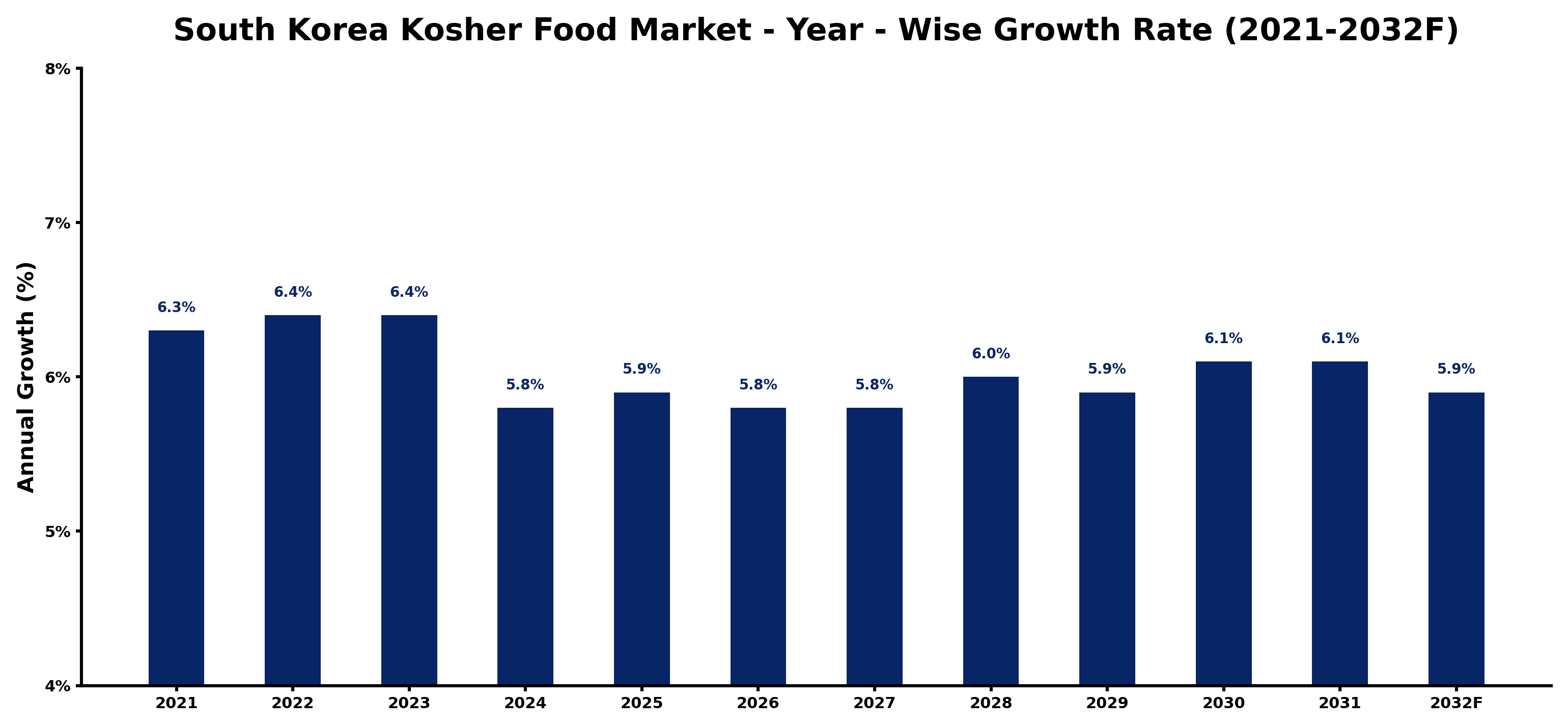
The table below presents the year‑wise growth rates along with the key drivers influencing the market
| Year | Growth Rate | Major Drivers |
| 2021 | 6.3% | Modern processing equipment upgrades enhanced efficiency in kosher food production |
| 2022 | 6.4% | Kosher food processing investments boosted local production capacity efficiency |
| 2023 | 6.4% | Export driven automation in kosher food processing enhances production capacity |
| 2024 | 5.8% | Production expansion in soy products boosts local kosher food exports |
| 2025 | 5.9% | Retail demand for kosher certified products boosts local food processing investment |
| 2026 | 5.8% | Local kosher food manufacturers invest in advanced production technologies |
| 2027 | 5.8% | New processing plants boost kosher food manufacturing capacity significantly |
| 2028 | 6.0% | Export driven certification compliance increased kosher food processing automation |
| 2029 | 5.9% | Automation in kosher food processing enhances production line efficiency |
| 2030 | 6.1% | Increased plant investments bolstered kosher food processing capabilities |
| 2031 | 6.1% | Optimized supply chains enhanced kosher food manufacturing efficiency in South Korea |
| 2032 | 5.9% | Domestic kosher food production investments boost supply chain resilience |
Note - Market size estimations and growth projections presented in this report are based on 6Wresearch's advanced forecasting approach, validated with industry datasets as of June 2026.
South Korea Kosher Food Market Synopsis
The strongest force shaping the South Korea Kosher Food Market is the heightened consumer awareness surrounding dietary choices that align with ethical and religious beliefs. This shift is not only evident among the Jewish community but has also gained traction among health-conscious consumers who perceive kosher foods as adhering to higher quality and safety standards.
Furthermore, the market is witnessing a rapid increase in the availability of certified kosher products, facilitating access for a broader audience. Enhanced distribution networks and collaborations among certification bodies and food manufacturers are pivotal in meeting the diverse needs of consumers who demand quality kosher options across various food categories.
South Korea Kosher Food Market Key Takeaways
- The South Korea Kosher Food Market is projected to grow significantly, driven by increasing consumer demand for certified kosher products.
- Growing awareness of ethical and health-related dietary practices is influencing purchasing decisions among a wider range of consumers.
- Food manufacturers are adapting to market demands by enhancing the availability and diversity of kosher-certified products.
- Government regulations play a crucial role in maintaining high standards for kosher certification and food safety compliance.
- Continuous innovation in production and processing technologies is essential for meeting the rising consumer expectations in this market.
Evaluation of Restraints in South Korea Kosher Food Market
Despite its growth potential, the South Korea Kosher Food Market faces significant challenges. One of the primary restraints is the complexity involved in kosher certification processes, which can deter new entrants and slow market expansion. Compliance with stringent food safety and quality standards adds another layer of difficulty, necessitating robust systems and protocols. Additionally, consumers are increasingly demanding a variety of high-quality kosher food options, putting pressure on producers to continually innovate while managing production costs. These factors collectively impact the market's ability to scale effectively while maintaining consumer trust.
South Korea Kosher Food Market Trends
Current trends in the South Korea Kosher Food Market include a marked increase in plant-based kosher options as health and sustainability become key consumer priorities. Additionally, the rise of e-commerce platforms is transforming the way kosher products reach consumers, making them more accessible than ever. Technology adoption in food processing and certification is also on the rise, ensuring more efficient production and compliance with kosher standards.
South Korea Kosher Food Market Opportunities
The South Korea Kosher Food Market presents several lucrative opportunities for investment and growth. The expanding vegetarian and vegan population offers potential for innovative kosher food products tailored to these consumer segments. Moreover, with the global kosher market gaining traction, South Korean producers can explore export opportunities to international markets, particularly in regions with significant Jewish populations. Investing in R&D for advanced processing technologies can further enhance product offerings and operational efficiencies.
Government Initiatives in the South Korea Kosher Food Market
The South Korean government actively supports the kosher food market through policies aimed at ensuring food safety and compliance with dietary regulations. Financial incentives are available for food manufacturers that achieve kosher certification, promoting adherence to quality assurance protocols. Additionally, there are initiatives focused on enhancing partnerships between certification bodies and the food industry to improve production capacities, thereby bolstering the nation's ability to export kosher-certified products.
Future Insights of the South Korea Kosher Food Market
Looking ahead to 2026-2032, the South Korea Kosher Food Market is expected to continue its upward trajectory. This growth will be driven by increasing consumer education regarding the benefits of kosher dietary practices and the influx of diverse product offerings. Strategic partnerships between producers and certification organizations will enhance market efficiency and consumer trust. The anticipated rise in health awareness and ethical consumption will further solidify kosher food's place in mainstream dietary trends.
South Korea Kosher Food Market Latest Developments (May 2025 - June 2026)
Recent developments in the South Korea Kosher Food Market indicate a growing collaboration between local food manufacturers and international certification agencies to streamline the kosher certification process. Innovations in food processing technologies are also gaining momentum, allowing for more sustainable and efficient production methods. The expansion of online retail platforms has made it easier for consumers to access kosher products, reflecting changing shopping behaviors post-pandemic.
South Korea Kosher Food Market - Key Attractiveness of the Report
- 10 Years of Market Numbers
- Historical Data Starting from 2022 to 2025
- Base Year: 2025
- Forecast Data until 2032
- Key Performance Indicators Impacting the Market
- Major Upcoming Developments and Projects
Key Highlights of the Report:
- South Korea Kosher Food Market Outlook
- Market Size of South Korea Kosher Food Market, 2025
- Forecast of South Korea Kosher Food Market, 2032
- Historical Data and Forecast of South Korea Kosher Food Revenues & Volume for the Period 2022-2032F
- South Korea Kosher Food Market Trend Evolution
- South Korea Kosher Food Market Drivers and Challenges
- South Korea Kosher Food Price Trends
- South Korea Kosher Food Porter's Five Forces
- South Korea Kosher Food Industry Life Cycle
- Historical Data and Forecast of South Korea Kosher Food Market Revenues & Volume By Type for the Period 2022-2032F
- Historical Data and Forecast of South Korea Kosher Food Market Revenues & Volume By Meat for the Period 2022-2032F
- Historical Data and Forecast of South Korea Kosher Food Market Revenues & Volume By Dairy for the Period 2022-2032F
- Historical Data and Forecast of South Korea Kosher Food Market Revenues & Volume By Pareve for the Period 2022-2032F
- Historical Data and Forecast of South Korea Kosher Food Market Revenues & Volume By Application for the Period 2022-2032F
- Historical Data and Forecast of South Korea Kosher Food Market Revenues & Volume By Seafood for the Period 2022-2032F
- Historical Data and Forecast of South Korea Kosher Food Market Revenues & Volume By Processed Meat and Poultry for the Period 2022-2032F
- Historical Data and Forecast of South Korea Kosher Food Market Revenues & Volume By Beverages for the Period 2022-2032F
- Historical Data and Forecast of South Korea Kosher Food Market Revenues & Volume By Staples for the Period 2022-2032F
- Historical Data and Forecast of South Korea Kosher Food Market Revenues & Volume By Snacks & Savoury for the Period 2022-2032F
- Historical Data and Forecast of South Korea Kosher Food Market Revenues & Volume By Bakery and Confectionery for the Period 2022-2032F
- Historical Data and Forecast of South Korea Kosher Food Market Revenues & Volume By Others for the Period 2022-2032F
- Historical Data and Forecast of South Korea Kosher Food Market Revenues & Volume By Distribution Channel for the Period 2022-2032F
- Historical Data and Forecast of South Korea Kosher Food Market Revenues & Volume By Supermarkets and Hypermarkets for the Period 2022-2032F
- Historical Data and Forecast of South Korea Kosher Food Market Revenues & Volume By Grocery Stores for the Period 2022-2032F
- Historical Data and Forecast of South Korea Kosher Food Market Revenues & Volume By Online Stores for the Period 2022-2032F
- South Korea Kosher Food Import Export Trade Statistics
- Market Opportunity Assessment By Type
- Market Opportunity Assessment By Application
- Market Opportunity Assessment By Distribution Channel
- South Korea Kosher Food Top Companies Market Share
- South Korea Kosher Food Competitive Benchmarking By Technical and Operational Parameters
- South Korea Kosher Food Company Profiles
- South Korea Kosher Food Key Strategic Recommendations






































