South Korea lawn & garden equipment Market Size, Share & Growth Rate
The South Korea lawn & garden equipment Market was estimated at USD 387 Million in 2025 and is projected to reach USD 509 Million by 2032, growing at a CAGR of 4.0% from 2026 to 2032. This growth is propelled by a surge in urban gardening, as more residents seek to cultivate their own green spaces amidst the concrete urban landscape. Furthermore, the increasing popularity of eco-friendly practices encourages consumers to invest in sustainable gardening solutions, particularly in urban areas where space is limited.
South Korea lawn & garden equipment Market Year-wise Growth Rate and Key Drivers
This graph highlights how the South Korea lawn & garden equipment Market has steadily grown over the years, supported by major growth factors.
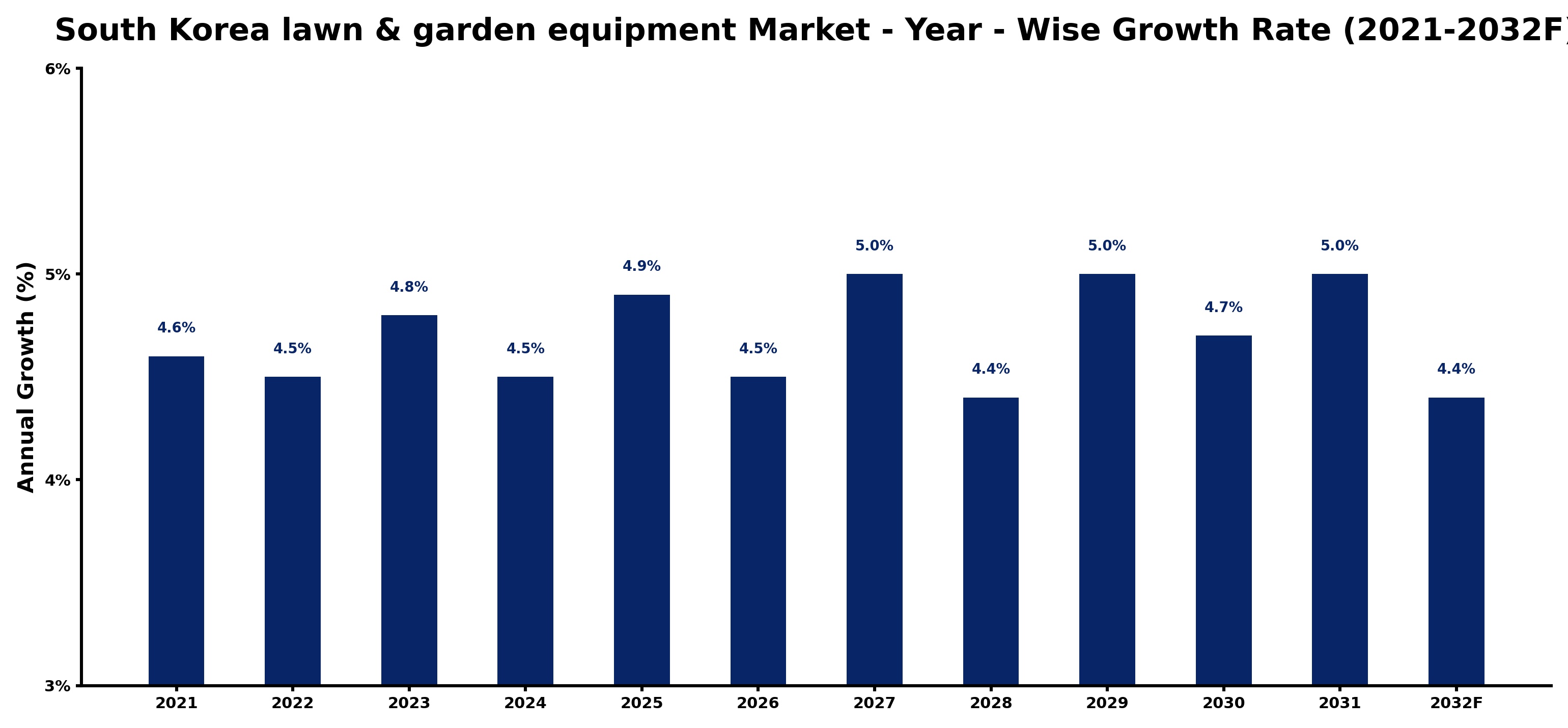
The table below presents the year‑wise growth rates along with the key drivers influencing the market
| Year | Growth Rate | Major Drivers |
| 2021 | 4.6% | Increased home gardening popularity |
| 2022 | 4.5% | Sustainable gardening practices gained traction |
| 2023 | 4.8% | Smart gardening technology adoption rose |
| 2024 | 4.5% | Urban gardening initiatives expanded rapidly |
| 2025 | 4.9% | Eco-friendly products attracted consumers |
| 2026 | 4.5% | DIY gardening projects surged significantly |
| 2027 | 5.0% | Lawn care services demand increased |
| 2028 | 4.4% | Seasonal gardening trends influenced purchases |
| 2029 | 5.0% | Online sales channels expanded rapidly |
| 2030 | 4.7% | Home improvement projects boosted sales |
| 2031 | 5.0% | Community gardening programs flourished |
| 2032 | 4.4% | Gardening workshops enhanced consumer engagement |
Note - Market size estimations and growth projections presented in this report are based on 6Wresearch’s advanced forecasting approach, validated with industry datasets as of June 2026.
South Korea lawn & garden equipment Market Synopsis
Recent momentum in the South Korea lawn & garden equipment market is marked by a growing appreciation for gardening as a leisure activity, driven by rising disposable incomes and a shift toward outdoor living. Consumers are not only investing in gardening for aesthetics but are also focusing on sustainable practices and smart technology to optimize their efforts.
Looking ahead, the market is expected to evolve further as technological advancements and eco-friendly options continue to reshape consumer preferences. The trend toward compact and multifunctional tools is anticipated to rise, catering to the urban dweller's need for efficiency in smaller spaces while aligning with sustainability goals.
South Korea lawn & garden equipment Market Key Takeaways
- The market is witnessing a paradigm shift towards electric and battery-powered equipment, catering to eco-conscious consumers.
- Smart gardening tools, including app-controlled systems, are gaining traction among tech-savvy homeowners.
- Urban gardening trends are leading to increased demand for compact and versatile gardening equipment.
- Investment opportunities are abundant in robotic mowers and sustainable gardening solutions.
- Government policies are promoting eco-friendly practices, positively impacting market growth.
Evaluation of Restraints in South Korea lawn & garden equipment Market
Despite the optimistic growth trajectory, the South Korea lawn & garden equipment market faces significant restraints. Urban areas have limited gardening space, which impacts consumer willingness to invest in larger equipment. This constraint favors compact, multifunctional tools but may hinder overall market expansion. Furthermore, the seasonal nature of gardening creates challenges for inventory management and demand forecasting, complicating planning for manufacturers and retailers alike. The trend toward apartment living further amplifies these issues, necessitating innovative solutions tailored for smaller living environments.
South Korea lawn & garden equipment Market Trends
A notable trend shaping the South Korea lawn & garden equipment market is the increasing consumer preference for sustainable products. Electric lawn mowers and battery-powered tools are preferred over traditional gas-powered alternatives, reflecting growing environmental awareness. Additionally, smart technology integration, such as robotic mowers and automated irrigation systems, is becoming more common, enhancing convenience and efficiency for consumers.
Moreover, the rise of urban gardening and the trend of creating outdoor living spaces are influencing equipment design and functionality. There is a growing need for products that are versatile and adaptable to smaller gardens, balconies, or even indoor environments, aligning with changing lifestyle dynamics.
South Korea lawn & garden equipment Market Opportunities
The South Korea lawn & garden equipment market offers promising investment opportunities, particularly in segments focused on sustainability and technology. Key areas for growth include the development of robotic lawn mowers that can efficiently manage smaller spaces and smart irrigation systems that optimize water usage. Additionally, there is significant potential for eco-friendly tools that resonate with environmentally conscious consumers. Collaborations with local distributors and retailers can also enhance outreach and effectiveness in targeting the growing interest in gardening.
Government Initiatives in the South Korea lawn & garden equipment Market
Government policies in South Korea play a pivotal role in shaping the lawn & garden equipment market. Initiatives aimed at promoting environmental sustainability have led to increased support for electric and battery-powered gardening tools. The government has also introduced regulations designed to reduce emissions from traditional outdoor power equipment. Furthermore, public spending and incentives encourage individuals and businesses to adopt eco-friendly gardening practices, contributing to a favorable market environment.
Future Insights of the South Korea lawn & garden equipment Market
Looking toward 2026-2032, the South Korea lawn & garden equipment market is projected to maintain its positive growth trajectory. Factors such as rising urbanization and an increasing interest in gardening activities will continue to drive demand. The increasing popularity of smart gardening solutions, along with a societal shift towards sustainable practices, will further bolster market expansion. With consumers increasingly prioritizing outdoor living and home improvement, a diverse range of innovative products will likely find a receptive audience.
South Korea lawn & garden equipment Market Latest Developments (May 2025 - June 2026)
In recent months, the South Korea lawn & garden equipment market has seen a flurry of developments aimed at enhancing product offerings and customer engagement. Companies are increasingly focusing on eco-friendly product lines, responding to consumer demand for sustainable gardening solutions. Additionally, advancements in smart technology integration are becoming a focal point, with new features being introduced to enhance user experience. Collaborative ventures between manufacturers and retailers are also on the rise, aiming to improve distribution strategies and reach a broader customer base.
South Korea lawn & garden equipment Market - Key Attractiveness of the Report
- 10 Years of Market Numbers
- Historical Data Starting from 2022 to 2025
- Base Year: 2025
- Forecast Data until 2032
- Key Performance Indicators Impacting the Market
- Major Upcoming Developments and Projects
Key Highlights of the Report:
- South Korea lawn & garden equipment Market Outlook
- Market Size of South Korea lawn & garden equipment Market, 2025
- Forecast of South Korea lawn & garden equipment Market, 2032
- Historical Data and Forecast of South Korea lawn & garden equipment Revenues & Volume for the Period 2022-2032F
- South Korea lawn & garden equipment Market Trend Evolution
- South Korea lawn & garden equipment Market Drivers and Challenges
- South Korea lawn & garden equipment Price Trends
- South Korea lawn & garden equipment Porter's Five Forces
- South Korea lawn & garden equipment Industry Life Cycle
- Historical Data and Forecast of South Korea lawn & garden equipment Market Revenues & Volume By Power for the Period 2022-2032F
- Historical Data and Forecast of South Korea lawn & garden equipment Market Revenues & Volume By Manual for the Period 2022-2032F
- Historical Data and Forecast of South Korea lawn & garden equipment Market Revenues & Volume By Electric-powered for the Period 2022-2032F
- Historical Data and Forecast of South Korea lawn & garden equipment Market Revenues & Volume By Gas-powered for the Period 2022-2032F
- Historical Data and Forecast of South Korea lawn & garden equipment Market Revenues & Volume By Others for the Period 2022-2032F
- Historical Data and Forecast of South Korea lawn & garden equipment Market Revenues & Volume By End-use for the Period 2022-2032F
- Historical Data and Forecast of South Korea lawn & garden equipment Market Revenues & Volume By Residential for the Period 2022-2032F
- Historical Data and Forecast of South Korea lawn & garden equipment Market Revenues & Volume By Golf Courses for the Period 2022-2032F
- Historical Data and Forecast of South Korea lawn & garden equipment Market Revenues & Volume By Playgrounds for the Period 2022-2032F
- Historical Data and Forecast of South Korea lawn & garden equipment Market Revenues & Volume By Operation for the Period 2022-2032F
- Historical Data and Forecast of South Korea lawn & garden equipment Market Revenues & Volume By Walk-behind for the Period 2022-2032F
- Historical Data and Forecast of South Korea lawn & garden equipment Market Revenues & Volume By Riders for the Period 2022-2032F
- Historical Data and Forecast of South Korea lawn & garden equipment Market Revenues & Volume By Others for the Period 2022-2032F
- Historical Data and Forecast of South Korea lawn & garden equipment Market Revenues & Volume By Product for the Period 2022-2032F
- Historical Data and Forecast of South Korea lawn & garden equipment Market Revenues & Volume By Blowers for the Period 2022-2032F
- Historical Data and Forecast of South Korea lawn & garden equipment Market Revenues & Volume By Chain Saws for the Period 2022-2032F
- Historical Data and Forecast of South Korea lawn & garden equipment Market Revenues & Volume By Cutters & Shredders for the Period 2022-2032F
- Historical Data and Forecast of South Korea lawn & garden equipment Market Revenues & Volume By Tractors for the Period 2022-2032F
- Historical Data and Forecast of South Korea lawn & garden equipment Market Revenues & Volume By Lawn Mowers for the Period 2022-2032F
- Historical Data and Forecast of South Korea lawn & garden equipment Market Revenues & Volume By Sprinkler & Hoses for the Period 2022-2032F
- Historical Data and Forecast of South Korea lawn & garden equipment Market Revenues & Volume By Others for the Period 2022-2032F
- South Korea lawn & garden equipment Import Export Trade Statistics
- Market Opportunity Assessment By Power
- Market Opportunity Assessment By End-use
- Market Opportunity Assessment By Operation
- Market Opportunity Assessment By Product
- South Korea lawn & garden equipment Top Companies Market Share
- South Korea lawn & garden equipment Competitive Benchmarking By Technical and Operational Parameters
- South Korea lawn & garden equipment Company Profiles
- South Korea lawn & garden equipment Key Strategic Recommendations






































