South Korea LED Traffic Signs and Signals Market Size, Share & Growth Rate
The South Korea LED Traffic Signs and Signals Market was estimated at USD 630 Million in 2025 and is projected to reach USD 906 Million by 2032, growing at a CAGR of 5.3% from 2026 to 2032. This growth trajectory is significantly fueled by government-backed infrastructure projects aimed at modernizing traffic management systems. Additionally, the increasing vehicle population and urbanization necessitate the implementation of more effective traffic control solutions, further driving demand for advanced LED technologies.
South Korea LED Traffic Signs and Signals Market Year-wise Growth Rate and Key Drivers
This graph highlights how the South Korea LED Traffic Signs and Signals Market has steadily grown over the years, supported by major growth factors.
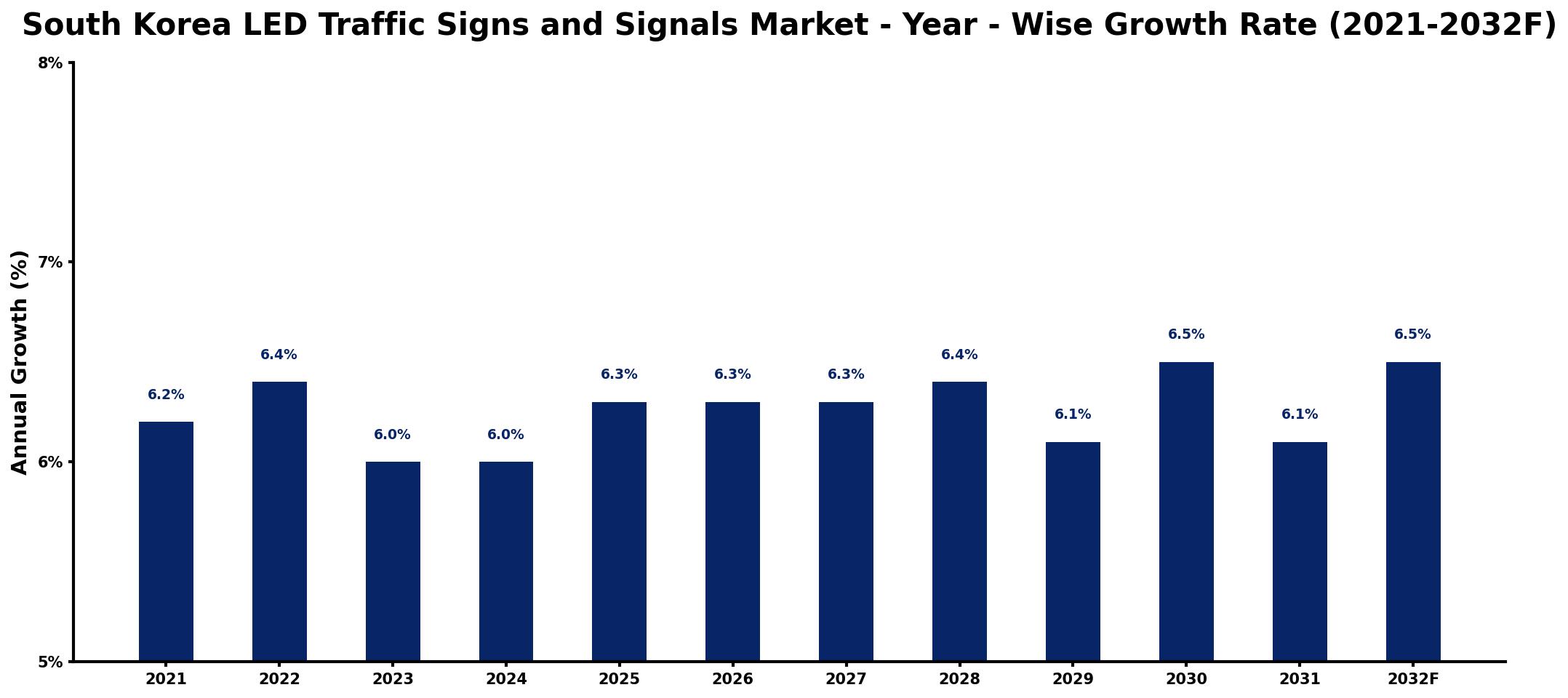
The table below presents the year‑wise growth rates along with the key drivers influencing the market
| Year | Growth Rate | Major Drivers |
| 2021 | 6.2% | Rising urbanization and infrastructure investments |
| 2022 | 6.4% | Government initiatives for smart cities |
| 2023 | 6.0% | Increased focus on road safety |
| 2024 | 6.0% | Growing demand for energy efficiency |
| 2025 | 6.3% | Technological advancements in illumination |
| 2026 | 6.3% | Expansion of public transportation networks |
| 2027 | 6.3% | Heightened awareness of environmental sustainability |
| 2028 | 6.4% | Urban development projects gaining momentum |
| 2029 | 6.1% | Investment in modernized public utilities |
| 2030 | 6.5% | growing downstream application demand |
| 2031 | 6.1% | Commitment to sustainable urban mobility |
| 2032 | 6.5% | Strengthening of regulatory frameworks |
Note: Market size estimations and growth projections presented in this report are based on 6Wresearch's proprietary forecasting methodology, utilizing the latest available industry data, government publications, and primary research inputs.
South Korea LED Traffic Signs and Signals Market Synopsis
A marked shift towards energy-efficient lighting solutions is reshaping the South Korea LED Traffic Signs and Signals Market. The superior longevity and minimal maintenance of LED systems compared to traditional signals make them increasingly attractive to municipalities and private entities alike.
Furthermore, ongoing investments in smart city initiatives are paving the way for advanced applications of LED technology in traffic management. These innovations are not only enhancing visibility and safety but also integrating real-time data analytics, which is revolutionizing the way traffic flow is monitored and managed across urban landscapes.
South Korea LED Traffic Signs and Signals Market Key Takeaways
- The shift toward energy-efficient LED technology is enhancing road safety and operational efficiency.
- Increased urbanization and government initiatives are key drivers of market growth.
- Integration of smart technologies is poised to transform traffic management systems.
- Innovative features such as real-time monitoring are gaining traction in traffic management solutions.
- Partnerships and collaboration are intensifying to bolster competitive advantage in the market.
Evaluation of Restraints in South Korea LED Traffic Signs and Signals Market
While the market is on an upward trajectory, it faces notable restraints, particularly concerning initial capital outlay for adopting LED technology. Transitioning from conventional systems entails substantial costs, which can deter potential investors or municipalities. Additionally, the reliability of LED products under varying weather conditions presents another challenge, as South Korea experiences diverse climatic conditions throughout the year. Manufacturers are under constant pressure to innovate and meet the stringent standards set forth by government regulations, complicating the competitive landscape further.
South Korea LED Traffic Signs and Signals Market Trends
A significant trend is the increasing focus on sustainable and smart traffic solutions, with municipalities investing in intelligent traffic management systems. Such systems leverage advanced algorithms to optimize traffic flow and minimize congestion. Another notable trend is the growing preference for dynamic message signs that can convey real-time information to drivers, thereby improving safety and operational efficiency.
In addition, urban planners and local governments are embracing multifunctional traffic systems that support environmental sustainability objectives. The push for eco-friendly infrastructure is further driving demand for energy-efficient LED traffic solutions.
South Korea LED Traffic Signs and Signals Market Opportunities
The South Korea LED Traffic Signs and Signals market offers substantial investment opportunities, particularly in the realm of smart traffic solutions. Companies focusing on the development of dynamic message signs, adaptive traffic signals, and integrated pedestrian signals are well-positioned to benefit from the evolving market landscape. Moreover, as urbanization accelerates, there will be increased demand for enhanced traffic management solutions. Collaborating with established manufacturers or tech firms to develop innovative LED systems can yield lucrative returns, as the government continues to support modernization efforts across transportation infrastructure.
Government Initiatives in the South Korea LED Traffic Signs and Signals Market
The South Korean government is actively promoting the adoption of LED traffic solutions through various initiatives aimed at modernizing urban infrastructure. Policies favoring smart traffic systems focus on improving road safety, enhancing efficiency, and reducing carbon emissions. Furthermore, subsidies and financial incentives are available to encourage municipalities to transition towards energy-efficient lighting systems. These initiatives not only support the growth of the LED traffic signs and signals market but also emphasize environmental sustainability as a core objective.
Future Insights of the South Korea LED Traffic Signs and Signals Market
Looking forward to 2026-2032, the South Korea LED Traffic Signs and Signals market is set to expand significantly. The confluence of rapid urbanization, increasing government support for smart city initiatives, and heightened awareness of road safety will catalyze further growth. The integration of advanced technologies such as artificial intelligence and the Internet of Things into traffic management systems is expected to be transformative, paving the way for innovative solutions that enhance traffic efficiency. The ongoing evolution of infrastructure projects will only add momentum to this positive outlook.
South Korea LED Traffic Signs and Signals Market Latest Developments (2025 - 2026)
Recent developments indicate a strong push towards integrating smart technologies into LED traffic solutions. Industry players are exploring advanced features that include remote monitoring capabilities and real-time traffic data analytics. The focus is also shifting toward collaborative partnerships that facilitate innovation in product offerings, ensuring companies can keep pace with rapidly evolving market demands and regulatory standards.
South Korea LED Traffic Signs and Signals Market - Key Attractiveness of the Report
- 10 Years of Market Numbers
- Historical Data Starting from 2022 to 2025
- Base Year: 2025
- Forecast Data until 2032
- Key Performance Indicators Impacting the Market
- Major Upcoming Developments and Projects
Key Highlights of the Report:
- South Korea LED Traffic Signs and Signals Market Outlook
- Market Size of South Korea LED Traffic Signs and Signals Market, 2025
- Forecast of South Korea LED Traffic Signs and Signals Market, 2032
- Historical Data and Forecast of South Korea LED Traffic Signs and Signals Revenues & Volume for the Period 2022-2032F
- South Korea LED Traffic Signs and Signals Market Trend Evolution
- South Korea LED Traffic Signs and Signals Market Drivers and Challenges
- South Korea LED Traffic Signs and Signals Price Trends
- South Korea LED Traffic Signs and Signals Porter's Five Forces
- South Korea LED Traffic Signs and Signals Industry Life Cycle
- Historical Data and Forecast of South Korea LED Traffic Signs and Signals Market Revenues & Volume By Product for the Period 2022-2032F
- Historical Data and Forecast of South Korea LED Traffic Signs and Signals Market Revenues & Volume By LED Traffic Signals for the Period 2022-2032F
- Historical Data and Forecast of South Korea LED Traffic Signs and Signals Market Revenues & Volume By LED Traffic Signs for the Period 2022-2032F
- South Korea LED Traffic Signs and Signals Import Export Trade Statistics
- Market Opportunity Assessment By Product
- South Korea LED Traffic Signs and Signals Top Companies Market Share
- South Korea LED Traffic Signs and Signals Competitive Benchmarking By Technical and Operational Parameters
- South Korea LED Traffic Signs and Signals Company Profiles
- South Korea LED Traffic Signs and Signals Key Strategic Recommendations






































