South Korea Letterpress Printing Machinery Market Size, Share & Growth Rate
The South Korea Letterpress Printing Machinery Market was estimated at USD 1347 Million in 2025 and is projected to reach USD 1975 Million by 2032, growing at a CAGR of 5.6% from 2026 to 2032. This growth is largely fueled by the increasing demand for high-quality printing solutions in sectors such as packaging, publishing, and advertising. In addition, the rising trend of customization and personalization in printed materials is encouraging manufacturers to innovate and upgrade their letterpress printing machinery, further propelling market expansion.
South Korea Letterpress Printing Machinery Market Year-wise Growth Rate and Key Drivers
This graph highlights how the South Korea Letterpress Printing Machinery Market has steadily grown over the years, supported by major growth factors.
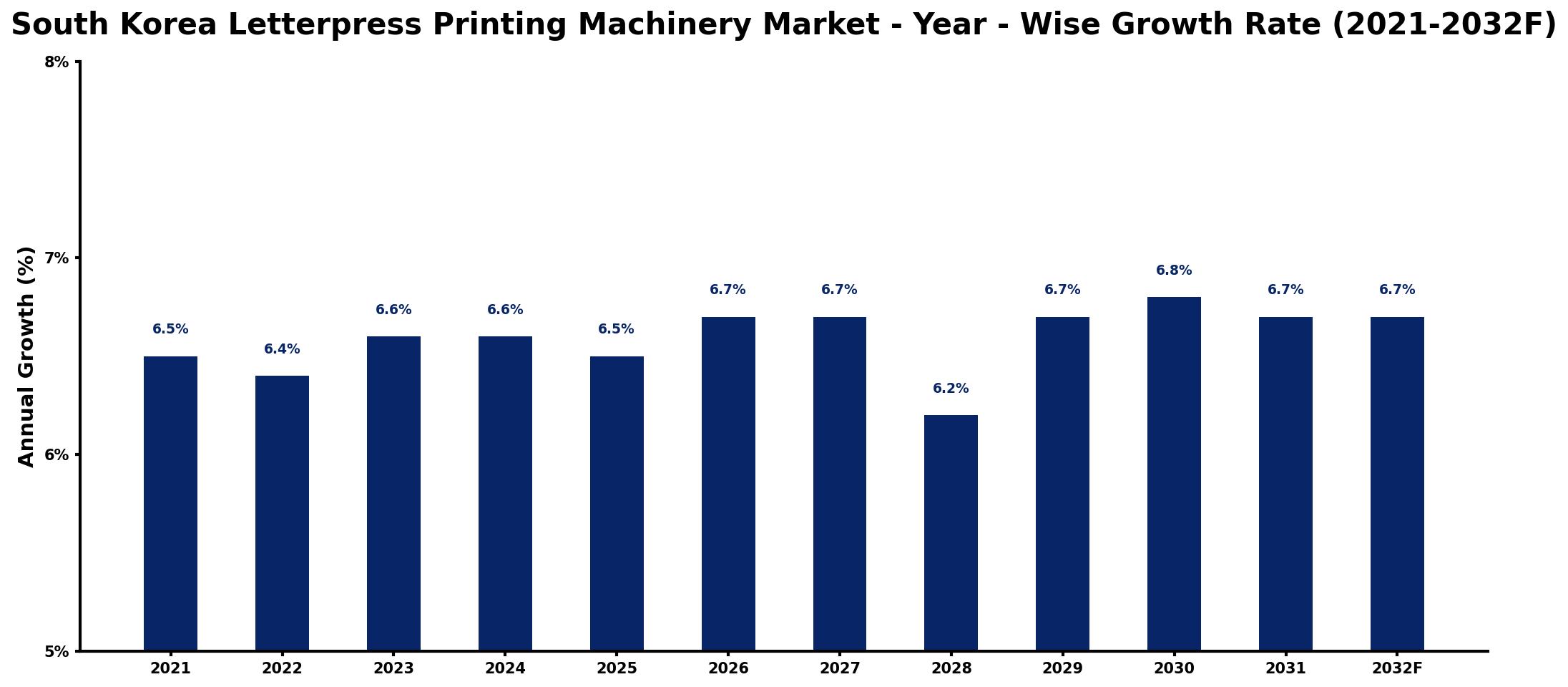
The table below presents the year‑wise growth rates along with the key drivers influencing the market
| Year | Growth Rate | Major Drivers |
| 2021 | 6.5% | Increased consumer goods demand |
| 2022 | 6.4% | Emerging packaging industry growth |
| 2023 | 6.6% | Rise in artisanal products popularity |
| 2024 | 6.6% | Expansion of niche markets |
| 2025 | 6.5% | Investment in sustainable production |
| 2026 | 6.7% | Growing e-commerce sector requirements |
| 2027 | 6.7% | Surge in custom design services |
| 2028 | 6.2% | Shift towards eco-friendly materials |
| 2029 | 6.7% | Increased automation in production |
| 2030 | 6.8% | Strengthened local supply chains |
| 2031 | 6.7% | Higher demand for personalization |
| 2032 | 6.7% | Growing educational sector initiatives |
Note: Market size estimations and growth projections presented in this report are based on 6Wresearch's proprietary forecasting methodology, utilizing the latest available industry data, government publications, and primary research inputs.
South Korea Letterpress Printing Machinery Market Synopsis
In recent years, the South Korea Letterpress Printing Machinery Market has gained momentum due to advancements in printing technology and a surge in demand for superior print quality. However, as the market evolves, it faces pressures from the increasing adoption of digital printing methods, which could redefine competitive dynamics. Nevertheless, the focus on customization offers fresh opportunities for letterpress machinery, enabling it to coexist alongside digital solutions.
Looking ahead, the market is poised for steady growth, driven by technological innovations and a continued emphasis on sustainability. Businesses are increasingly recognizing the value of integrating eco-friendly practices within their operations, thus creating a niche for letterpress printing solutions that align with these values. This evolution underscores a significant shift in market focus and consumer preferences.
South Korea Letterpress Printing Machinery Market Key Takeaways
- The market is growing steadily, driven by demand in packaging, publishing, and advertising sectors.
- Technological advancements are enhancing print quality and efficiency.
- Customization and personalization trends are becoming pivotal market drivers.
- Environmental sustainability is influencing product development and consumer choices.
- Strategic partnerships and innovation remain crucial for competitive advantage.
Evaluation of Restraints in South Korea Letterpress Printing Machinery Market
Despite its growth trajectory, the South Korea Letterpress Printing Machinery Market faces notable restraints. One significant challenge is the competitive pressure from digital printing technologies, which have become more prevalent and efficient, leading to reduced demand for traditional letterpress machinery. Additionally, rising production costs and the continuous need for technological upgrades complicate the landscape for manufacturers. There is also a growing concern regarding the availability of skilled technicians proficient in letterpress operations, creating a talent gap that can hinder market growth.
South Korea Letterpress Printing Machinery Market Trends
A prominent trend in the South Korea Letterpress Printing Machinery Market is the increasing shift towards eco-friendly printing solutions. As both businesses and consumers heighten their awareness of environmental impacts, there is a significant preference for letterpress machinery that emphasizes sustainable materials and practices. Moreover, the integration of automation and digital capabilities into traditional letterpress processes is emerging, enhancing operational efficiency and print quality.
The trend of customization is also shaping the market, as consumers seek personalized products that stand out in a crowded marketplace. This growing demand for bespoke printing solutions drives manufacturers to innovate, creating more versatile and efficient machinery that meets specific customer requirements. As these trends continue to evolve, they are expected to play a pivotal role in the future development of the market.
South Korea Letterpress Printing Machinery Market Opportunities
Investment opportunities within the South Korea Letterpress Printing Machinery Market are abundant, particularly as industries increasingly demand high-quality printed products. Companies that focus on developing innovative and eco-friendly letterpress machinery stand to benefit from the market's growth. Additionally, the potential for foreign investors to establish partnerships or joint ventures with local manufacturers offers a strategic advantage in catering to the surging demand for letterpress solutions. Overall, the combination of technological advancements and an increasing focus on customization presents a fertile ground for investment.
Government Initiatives in the South Korea Letterpress Printing Machinery Market
The South Korean government has introduced various initiatives to bolster the Letterpress Printing Machinery Market, aiming to create a more conducive business environment. These initiatives include financial incentives and tax benefits that encourage investments in the industry. Furthermore, the government actively promotes research and development to enhance technological capabilities, driving innovation. Regulatory measures to ensure quality standards and environmental sustainability are also in place, reflecting the governments commitment to supporting the market while fostering competitiveness on a global scale.
Future Insights of the South Korea Letterpress Printing Machinery Market
Looking towards 2026-2032, the South Korea Letterpress Printing Machinery Market is projected to exhibit positive growth driven by continuous technological innovations and heightened consumer preferences for high-quality, customized printing solutions. While digital printing technologies present challenges, the enduring demand for personalization ensures that letterpress printing will retain its relevance. The focus on sustainability and efficiency is expected to further refine market offerings, setting the stage for moderate growth in the years ahead.
South Korea Letterpress Printing Machinery Market Latest Developments (2025 - 2026)
Recent developments in the South Korea Letterpress Printing Machinery Market indicate a significant push towards integrating digital technologies with traditional letterpress processes. Manufacturers are increasingly exploring automation to enhance production capabilities and reduce operational costs. Additionally, new partnerships among technology providers and printing companies are emerging, aimed at developing innovative solutions that cater to the growing demands for customization and eco-friendliness. This period is characterized by a proactive approach to adapting to market trends and addressing consumer needs.
South Korea Letterpress Printing Machinery Market - Key Attractiveness of the Report
- 10 Years of Market Numbers
- Historical Data Starting from 2022 to 2025
- Base Year: 2025
- Forecast Data until 2032
- Key Performance Indicators Impacting the Market
- Major Upcoming Developments and Projects
Key Highlights of the Report:
- South Korea Letterpress Printing Machinery Market Outlook
- Market Size of South Korea Letterpress Printing Machinery Market, 2025
- Forecast of South Korea Letterpress Printing Machinery Market, 2032
- Historical Data and Forecast of South Korea Letterpress Printing Machinery Revenues & Volume for the Period 2022-2032F
- South Korea Letterpress Printing Machinery Market Trend Evolution
- South Korea Letterpress Printing Machinery Market Drivers and Challenges
- South Korea Letterpress Printing Machinery Price Trends
- South Korea Letterpress Printing Machinery Porter's Five Forces
- South Korea Letterpress Printing Machinery Industry Life Cycle
- Historical Data and Forecast of South Korea Letterpress Printing Machinery Market Revenues & Volume By Type for the Period 2022-2032F
- Historical Data and Forecast of South Korea Letterpress Printing Machinery Market Revenues & Volume By Rotary Letterpress Machine for the Period 2022-2032F
- Historical Data and Forecast of South Korea Letterpress Printing Machinery Market Revenues & Volume By Other for the Period 2022-2032F
- Historical Data and Forecast of South Korea Letterpress Printing Machinery Market Revenues & Volume By Application for the Period 2022-2032F
- Historical Data and Forecast of South Korea Letterpress Printing Machinery Market Revenues & Volume By Securities for the Period 2022-2032F
- Historical Data and Forecast of South Korea Letterpress Printing Machinery Market Revenues & Volume By Invitation Card for the Period 2022-2032F
- Historical Data and Forecast of South Korea Letterpress Printing Machinery Market Revenues & Volume By Other for the Period 2022-2032F
- South Korea Letterpress Printing Machinery Import Export Trade Statistics
- Market Opportunity Assessment By Type
- Market Opportunity Assessment By Application
- South Korea Letterpress Printing Machinery Top Companies Market Share
- South Korea Letterpress Printing Machinery Competitive Benchmarking By Technical and Operational Parameters
- South Korea Letterpress Printing Machinery Company Profiles
- South Korea Letterpress Printing Machinery Key Strategic Recommendations






































