South Korea Manufacturing Analytics Market Size & Growth Rate (2026-2032)
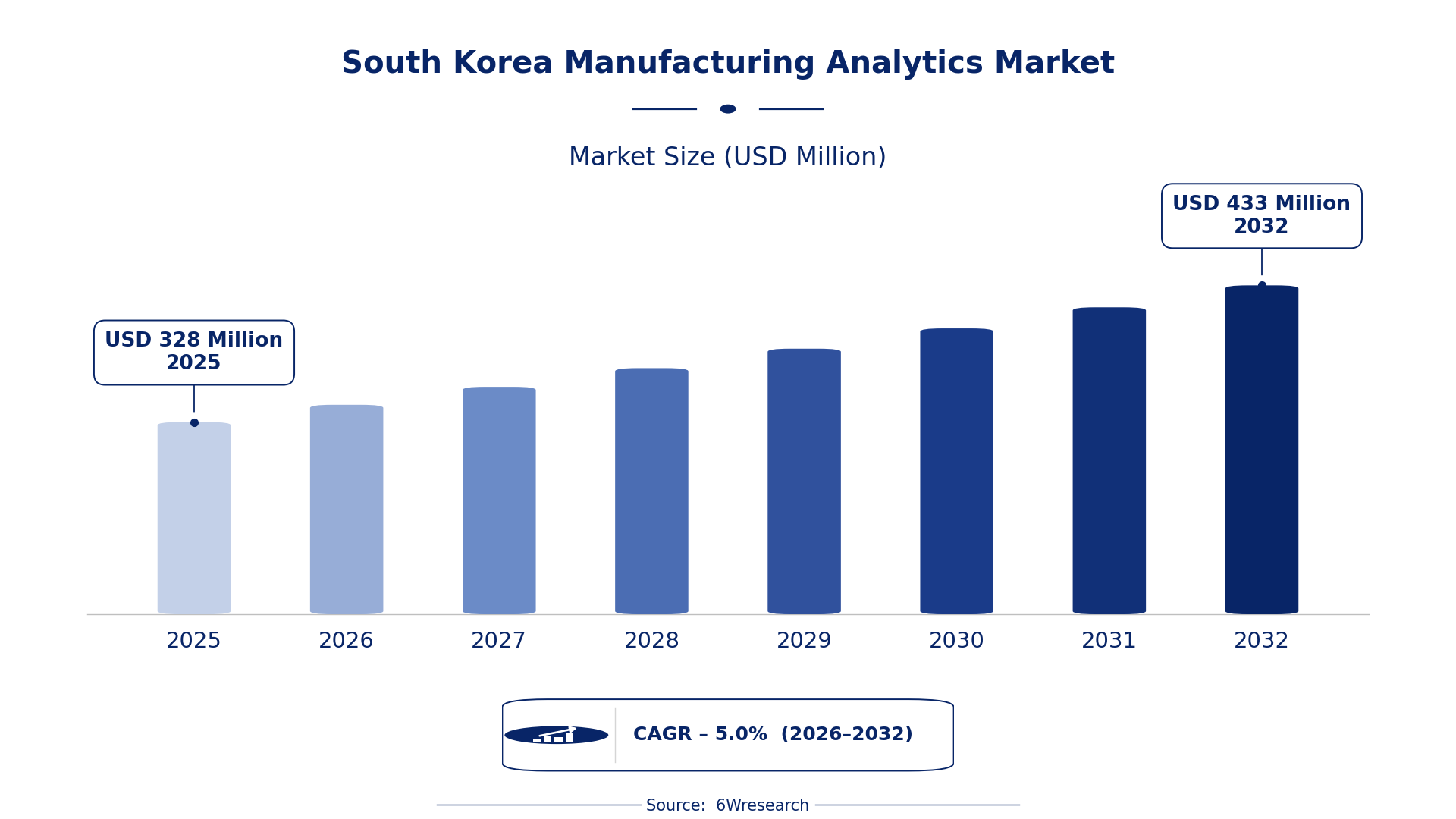
The South Korea Manufacturing Analytics Market was estimated at USD 328 Million in 2025 and is projected to reach USD 433 Million by 2032, growing at a CAGR of 5.0% from 2026 to 2032.
South Korea Manufacturing Analytics Market Synopsis
The South Korean manufacturing analytics market is on a growth trajectory, fueled by a strong commitment to Industry 4.0 initiatives. Companies are increasingly adopting analytics tools to streamline operations, enhance product quality, and drive cost efficiencies. This trend reflects a broader move toward smart manufacturing practices, positioning South Korea as a leader in manufacturing innovation.
As organizations harness big data analytics and AI-driven solutions, the focus has shifted towards predictive maintenance and operational optimization. These advancements not only improve overall productivity but also minimize unexpected downtimes. However, challenges remain, particularly in integrating diverse data sources and legacy systems.
South Korea Manufacturing Analytics Market Year-wise Growth Rate and Key Drivers
This graph illustrates the annual growth rates of the South Korea Manufacturing Analytics Market from 2021 to 2032, highlighting a steady upward trajectory and projected expansion over the forecast period.
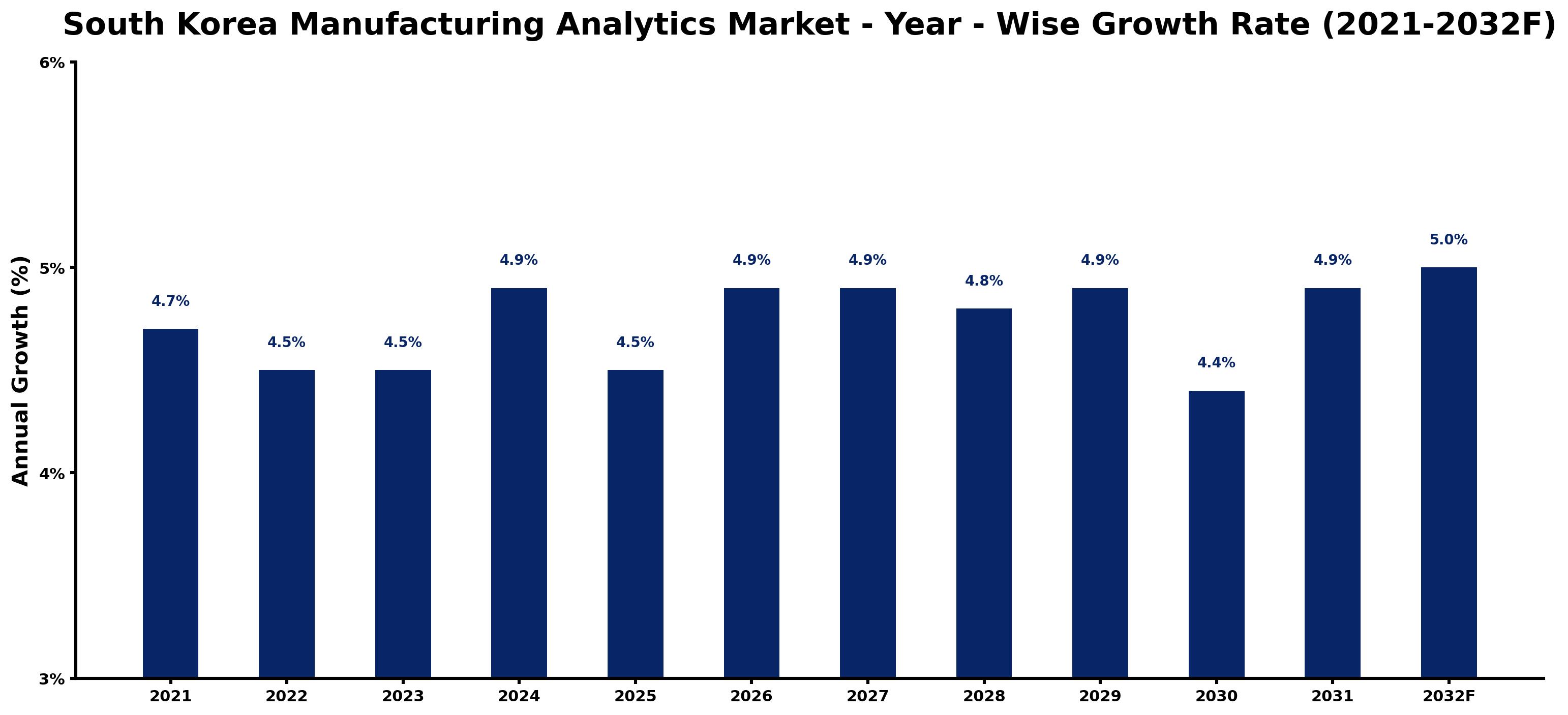
The table below presents the year‑wise growth rates along with the key drivers influencing the market
| Year | Growth Rate | Major Drivers |
| 2021 | 4.7% | Government's 'Smart Factory' initiative boosting analytics adoption. |
| 2022 | 4.5% | Increased demand for real-time production optimization tools. |
| 2023 | 4.5% | Rise in 5G technology supporting advanced manufacturing analytics. |
| 2024 | 4.9% | Corporate investments in AI-driven manufacturing processes expand. |
| 2025 | 4.5% | Focus on Industry 4.0 enhances data-driven decision-making. |
| 2026 | 4.9% | Emerging demand for predictive maintenance in manufacturing sector. |
| 2027 | 4.9% | Sustainable manufacturing practices necessitate advanced analytics solutions. |
| 2028 | 4.8% | Growing emphasis on supply chain resilience and analytics. |
| 2029 | 4.9% | Digital transformation strategies accelerating data integration efforts. |
| 2030 | 4.4% | Government incentives promoting analytics for small manufacturers. |
| 2031 | 4.9% | Increased competition driving demand for operational efficiencies. |
| 2032 | 5.0% | Innovation in IoT technologies enhancing analytics capabilities. |
Note: Market size estimations and growth projections presented in this report are based on 6Wresearch's proprietary forecasting methodology, utilizing the latest available industry data, government publications, and primary research inputs.
South Korea Manufacturing Analytics Market Key Takeaways
Below are some of the specific key takeaways from the market, including:
- The market is driven by strong government support for smart manufacturing technologies.
- Investment in big data and AI analytics is essential for achieving competitive advantages.
- Companies face challenges integrating legacy systems with new analytics solutions.
- Cybersecurity remains a pressing concern, necessitating robust data protection measures.
- Ongoing education on analytics benefits is vital for broader market adoption.
Evaluation of Restraints in South Korea Manufacturing Analytics Market
Despite the promising outlook, the South Korea manufacturing analytics market grapples with significant restraints. One of the most pressing issues is the challenge of integrating disparate data sources, often complicated by the presence of outdated legacy systems. Without seamless data interoperability, the full potential of analytics cannot be realized. Additionally, a shortage of skilled data professionals hampers the ability to leverage advanced analytics effectively. Companies are also increasingly aware of cybersecurity threats that could compromise sensitive operational data, which necessitates comprehensive security frameworks to mitigate risks. Educating manufacturers about the strategic advantages of analytics is another hurdle that must be overcome for widespread adoption.
South Korea Manufacturing Analytics Market Trends
Several trends are currently shaping the South Korea manufacturing analytics market. The integration of IoT devices with analytics software is becoming commonplace, providing real-time insights into production processes. AI and machine learning applications are gaining traction, particularly in predictive maintenance, allowing manufacturers to proactively address equipment failures before they occur. The emphasis on sustainability is also driving the adoption of analytics solutions aimed at optimizing resource use and minimizing waste. Lastly, the growing importance of data privacy is prompting organizations to invest in compliance measures, ensuring they meet stringent regulatory standards.
South Korea Manufacturing Analytics Market Opportunities
The future holds numerous opportunities for growth in the South Korea manufacturing analytics market. As companies increasingly recognize the value of data-driven insights, there is a substantial demand for advanced analytics platforms tailored to specific manufacturing needs. Investment in training programs for data scientists and analysts can help bridge the skill gap, enabling firms to fully utilize analytics tools. on top of that, collaboration between technology providers and manufacturers can lead to innovative solutions that address sector-specific challenges. Exploring partnerships for research and development can also enhance the technological capabilities of local firms, paving the way for the next generation of manufacturing excellence.
Government Initiatives in the South Korea Manufacturing Analytics Market
Government initiatives play a crucial role in shaping the South Korea manufacturing analytics market. With a focus on enhancing productivity and global competitiveness, policies are increasingly directed at fostering innovation and the adoption of analytics technologies. The government's proactive stance in supporting research and development will be instrumental in driving future growth.
- A national program launched in 2025 aims to fund R&D initiatives specifically focused on smart manufacturing technologies.
- Current initiatives are underway to upgrade digital infrastructure, facilitating better data exchange among manufacturers.
- The government has introduced a regulatory framework aimed at enhancing data privacy and security across the manufacturing sector.
- Planned public-private partnerships expected to roll out by 2028 will focus on advancing analytics capabilities in smaller manufacturing firms.
- Incentives for manufacturers adopting analytics solutions are currently being promoted to accelerate the digital transformation process.
Future Insights of the South Korea Manufacturing Analytics Market
Looking ahead, the South Korea manufacturing analytics market is set for a transformative phase between 2026 and 2032. As the adoption of AI-driven analytics becomes more mainstream, manufacturers will increasingly rely on data insights to inform strategic decisions and enhance operational efficiency. The push towards sustainability will necessitate analytics solutions that help track and optimize resource usage, ensuring compliance with environmental regulations. With the ongoing support of government initiatives and the growing emphasis on cybersecurity, the market is likely to witness steady growth, paving the way for innovative applications and enhanced productivity.
South Korea Manufacturing Analytics Market Latest Developments
Recent industry activity in the South Korea manufacturing analytics market indicates a surge in innovation and adoption of new technologies. Companies are increasingly investing in advanced analytics capabilities to stay competitive and improve operational performance. The focus is on integrating modern analytics tools into existing manufacturing processes.
- A major technology vendor launched a new predictive maintenance solution in early 2025, aimed at reducing equipment downtime in manufacturing facilities.
- An initiative that began in mid-2025 focuses on training and developing data analytics professionals, addressing the skill gap in the industry.
- A collaboration between several manufacturers to enhance data sharing protocols is currently ongoing, expected to yield results by the end of 2025.
- Upcoming partnerships are planned for late 2026, aiming to integrate IoT devices with analytics platforms to further streamline production processes.
- A recent investment by a regional operator in an analytics-driven quality control system is currently underway, with deployment expected by early 2026.
South Korea Manufacturing Analytics Market - Key Attractiveness of the Report
- 10 Years of Market Numbers
- Historical Data Starting from 2022 to 2025
- Base Year: 2025
- Forecast Data until 2032
- Key Performance Indicators Impacting the Market
- Major Upcoming Developments and Projects
The government is promoting several initiatives, including funding for R&D, creating a regulatory framework for data privacy, and incentives for manufacturers to adopt analytics technologies.
Key Highlights of the Report:
- South Korea Manufacturing Analytics Market Outlook
- Market Size of South Korea Manufacturing Analytics Market, 2025
- Forecast of South Korea Manufacturing Analytics Market, 2032
- Historical Data and Forecast of South Korea Manufacturing Analytics Revenues & Volume for the Period 2022-2032F
- South Korea Manufacturing Analytics Market Trend Evolution
- South Korea Manufacturing Analytics Market Drivers and Challenges
- South Korea Manufacturing Analytics Price Trends
- South Korea Manufacturing Analytics Porter's Five Forces
- South Korea Manufacturing Analytics Industry Life Cycle
- Historical Data and Forecast of South Korea Manufacturing Analytics Market Revenues & Volume By Type for the Period 2022-2032F
- Historical Data and Forecast of South Korea Manufacturing Analytics Market Revenues & Volume By Software for the Period 2022-2032F
- Historical Data and Forecast of South Korea Manufacturing Analytics Market Revenues & Volume By Service for the Period 2022-2032F
- Historical Data and Forecast of South Korea Manufacturing Analytics Market Revenues & Volume By Deployment Models for the Period 2022-2032F
- Historical Data and Forecast of South Korea Manufacturing Analytics Market Revenues & Volume By On-premises for the Period 2022-2032F
- Historical Data and Forecast of South Korea Manufacturing Analytics Market Revenues & Volume By On-demand for the Period 2022-2032F
- Historical Data and Forecast of South Korea Manufacturing Analytics Market Revenues & Volume By Applications for the Period 2022-2032F
- Historical Data and Forecast of South Korea Manufacturing Analytics Market Revenues & Volume By Predictive maintenance & asset management for the Period 2022-2032F
- Historical Data and Forecast of South Korea Manufacturing Analytics Market Revenues & Volume By Inventory management for the Period 2022-2032F
- Historical Data and Forecast of South Korea Manufacturing Analytics Market Revenues & Volume By Supply chain planning & procurement for the Period 2022-2032F
- Historical Data and Forecast of South Korea Manufacturing Analytics Market Revenues & Volume By Energy management for the Period 2022-2032F
- Historical Data and Forecast of South Korea Manufacturing Analytics Market Revenues & Volume By Emergency management for the Period 2022-2032F
- Historical Data and Forecast of South Korea Manufacturing Analytics Market Revenues & Volume By Sales & customer management for the Period 2022-2032F
- Historical Data and Forecast of South Korea Manufacturing Analytics Market Revenues & Volume By Other applications for the Period 2022-2032F
- Historical Data and Forecast of South Korea Manufacturing Analytics Market Revenues & Volume By Industry Vertical for the Period 2022-2032F
- Historical Data and Forecast of South Korea Manufacturing Analytics Market Revenues & Volume By Automotive & aerospace manufacturing for the Period 2022-2032F
- Historical Data and Forecast of South Korea Manufacturing Analytics Market Revenues & Volume By Electronics equipment manufacturing for the Period 2022-2032F
- Historical Data and Forecast of South Korea Manufacturing Analytics Market Revenues & Volume By Food & beverages manufacturing for the Period 2022-2032F
- Historical Data and Forecast of South Korea Manufacturing Analytics Market Revenues & Volume By Chemicals & materials manufacturing for the Period 2022-2032F
- Historical Data and Forecast of South Korea Manufacturing Analytics Market Revenues & Volume By Machinery & industrial equipment manufacturing for the Period 2022-2032F
- Historical Data and Forecast of South Korea Manufacturing Analytics Market Revenues & Volume By Pharma and life sciences for the Period 2022-2032F
- Historical Data and Forecast of South Korea Manufacturing Analytics Market Revenues & Volume By Paper, pulp, plastic and rubber manufacturing for the Period 2022-2032F
- Historical Data and Forecast of South Korea Manufacturing Analytics Market Revenues & Volume By Others for the Period 2022-2032F
- South Korea Manufacturing Analytics Import Export Trade Statistics
- Market Opportunity Assessment By Type
- Market Opportunity Assessment By Deployment Models
- Market Opportunity Assessment By Applications
- Market Opportunity Assessment By Industry Vertical
- South Korea Manufacturing Analytics Top Companies Market Share
- South Korea Manufacturing Analytics Competitive Benchmarking By Technical and Operational Parameters
- South Korea Manufacturing Analytics Company Profiles
- South Korea Manufacturing Analytics Key Strategic Recommendations






































