South Korea Medical Tubing Market Size, Share & Growth Rate
The South Korea Medical Tubing Market was estimated at USD 293 Million in 2025 and is projected to reach USD 399 Million by 2032, growing at a CAGR of 4.5% from 2026 to 2032. This growth trajectory is primarily driven by the increasing preference for minimally invasive surgical procedures, which necessitate advanced medical tubing solutions. In addition, a rising geriatric population demanding innovative healthcare solutions further propels the market as medical facilities invest in high-quality tubing materials that ensure patient safety and procedural efficacy.
South Korea Medical Tubing Market Year-wise Growth Rate and Key Drivers
This graph highlights how the South Korea Medical Tubing Market has steadily grown over the years, supported by major growth factors.
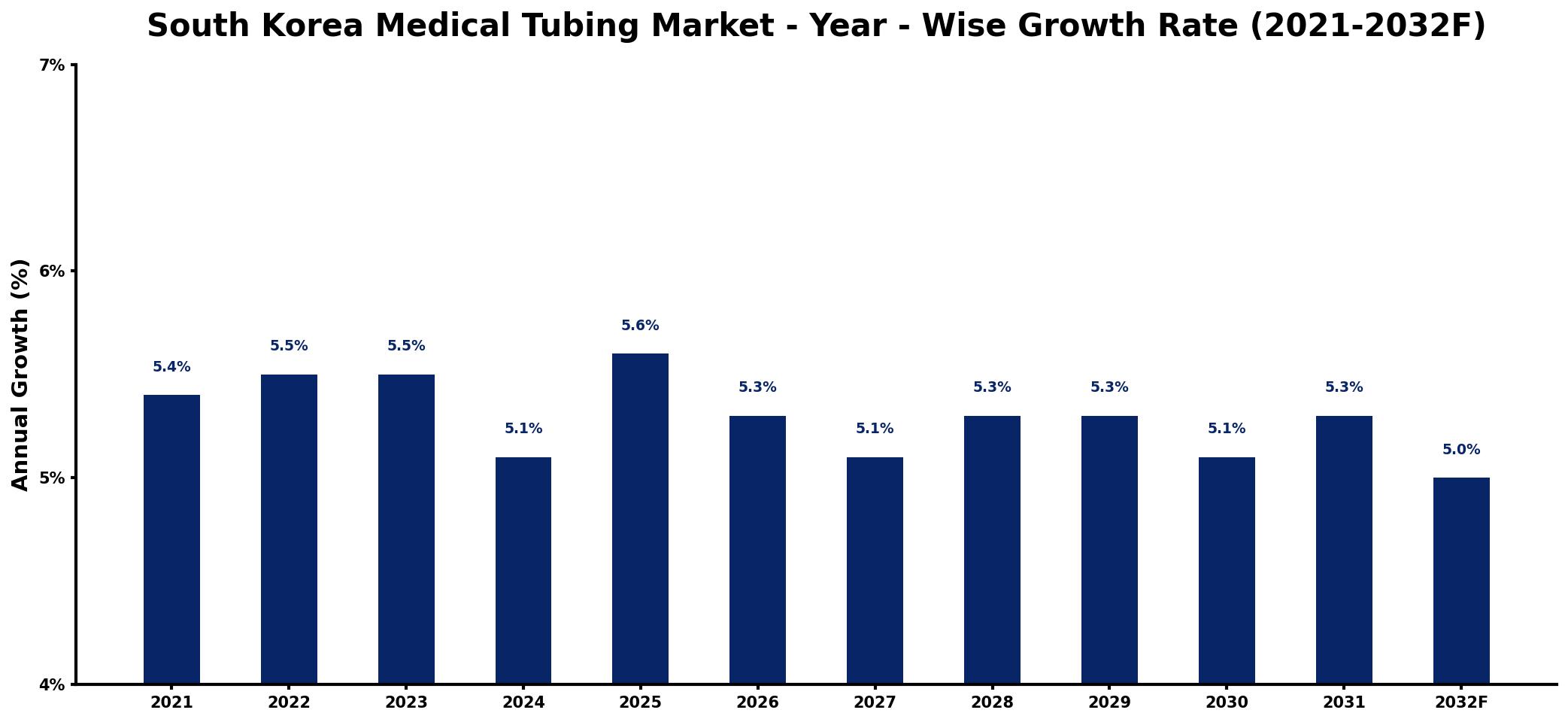
The table below presents the year‑wise growth rates along with the key drivers influencing the market
| Year | Growth Rate | Major Drivers |
| 2021 | 5.4% | Rising healthcare infrastructure investments |
| 2022 | 5.5% | Growing demand for innovative solutions |
| 2023 | 5.5% | Expansion of healthcare facilities network |
| 2024 | 5.1% | Increase in regulatory compliance requirements |
| 2025 | 5.6% | Surge in outpatient procedures demand |
| 2026 | 5.3% | Technological advancements in healthcare |
| 2027 | 5.1% | Rising prevalence of chronic diseases |
| 2028 | 5.3% | Growth in home healthcare services |
| 2029 | 5.3% | Increasing investments in R&D |
| 2030 | 5.1% | rising export shipment volumes |
| 2031 | 5.3% | growing automotive sector requirements |
| 2032 | 5.0% | Rising focus on sustainability practices |
Note: Market size estimations and growth projections presented in this report are based on 6Wresearch's proprietary forecasting methodology, utilizing the latest available industry data, government publications, and primary research inputs.
South Korea Medical Tubing Market Synopsis
The South Korea Medical Tubing Market is currently experiencing notable expansion, attributed to an interplay of technological advancements and heightened healthcare expenditures. As healthcare providers prioritize the adoption of state-of-the-art medical devices, the need for specialized medical tubing, including antimicrobial options, is becoming increasingly critical.
Moreover, South Korea's robust healthcare infrastructure further facilitates the markets growth, as it supports the integration of advanced medical technologies. With a focus on compliance with rigorous regulatory standards, manufacturers are compelled to innovate, ensuring their products meet both safety and performance benchmarks.
South Korea Medical Tubing Market Key Takeaways
- The increasing demand for minimally invasive surgeries significantly boosts the market.
- Key manufacturers are innovating with antimicrobial and specialized medical tubing materials.
- Regulatory compliance remains a focal point, influencing product development and quality assurance.
- There is a trend towards single-use disposable tubing to enhance patient safety and reduce infection risks.
- The aging population in South Korea is driving demand for advanced medical solutions and technologies.
Evaluation of Restraints in South Korea Medical Tubing Market
Despite the promising growth, the South Korea Medical Tubing Market faces several significant restraints. One primary concern is the stringent regulatory landscape that governs medical devices, impacting production timelines and costs. Manufacturers must navigate complex compliance requirements, which can slow down the market's responsiveness to emerging demands. Furthermore, the presence of intense competition drives the need for continual innovation, leading to pricing pressures that can affect overall market profitability. Ensuring quality and safety remains paramount, as any product defects can result in serious ramifications for patient health and provider trust.
South Korea Medical Tubing Market Trends
The South Korea Medical Tubing Market is witnessing a shift toward advanced materials that enhance product performance. Manufacturers are increasingly utilizing innovative polymers and composite materials that offer superior flexibility, strength, and resistance to environmental factors. Precision extrusion capabilities are becoming vital to meet the evolving demands of complex medical procedures. Additionally, there is a notable rise in the adoption of disposable tubing solutions, aimed at preventing cross-contamination and promoting patient safety in clinical settings.
South Korea Medical Tubing Market Opportunities
Investors and manufacturers have numerous opportunities for growth in the South Korea Medical Tubing Market, primarily driven by the increasing demand for high-quality medical devices. The necessity for innovative tubing solutions in applications such as catheters, IV lines, and respiratory tubes presents a fertile ground for investment. Collaborating with local healthcare facilities and medical device manufacturers can provide avenues for expansion, as they increasingly seek reliable partners to enhance their operational efficiency and patient care capabilities.
Government Initiatives in the South Korea Medical Tubing Market
The South Korean government has taken significant steps to promote the medical tubing market through various policies aimed at ensuring product quality and safety. Regulatory frameworks like the Medical Devices Act and Korea Good Manufacturing Practice (KGMP) govern manufacturing and distribution practices. Furthermore, programs such as the Bio-Venture Support Project and Medical Device Industry Development Support Program offer financial incentives and resources to local manufacturers, fostering innovation and enhancing competitiveness within the global market.
Future Insights of the South Korea Medical Tubing Market
Looking forward to 2026-2032, the South Korea Medical Tubing Market is poised for substantial growth, bolstered by the increasing prevalence of minimally invasive surgeries and advancements in medical technology. The ongoing expansion of the healthcare sector, combined with rising healthcare expenditures, will likely accelerate the adoption of innovative medical tubing solutions. With a keen focus on enhancing product quality and safety, stakeholders in this market can expect a landscape rich with opportunities for innovation and collaboration.
South Korea Medical Tubing Market Latest Developments (2025 - 2026)
In recent months, the South Korea Medical Tubing Market has seen a surge in technological advancements, particularly in the development of precision-engineered tubing solutions tailored for specific medical applications. Companies are increasingly emphasizing research and development efforts aimed at enhancing biocompatibility and flexibility in their product offerings. Moreover, the trend toward single-use disposable tubing has gained traction, driven by heightened awareness around infection control and patient safety protocols across healthcare facilities.
South Korea Medical Tubing Market - Key Attractiveness of the Report
- 10 Years of Market Numbers
- Historical Data Starting from 2022 to 2025
- Base Year: 2025
- Forecast Data until 2032
- Key Performance Indicators Impacting the Market
- Major Upcoming Developments and Projects
Key Highlights of the Report:
- South Korea Medical Tubing Market Outlook
- Market Size of South Korea Medical Tubing Market, 2025
- Forecast of South Korea Medical Tubing Market, 2032
- Historical Data and Forecast of South Korea Medical Tubing Revenues & Volume for the Period 2022-2032F
- South Korea Medical Tubing Market Trend Evolution
- South Korea Medical Tubing Market Drivers and Challenges
- South Korea Medical Tubing Price Trends
- South Korea Medical Tubing Porter's Five Forces
- South Korea Medical Tubing Industry Life Cycle
- Historical Data and Forecast of South Korea Medical Tubing Market Revenues & Volume By Material for the Period 2022-2032F
- Historical Data and Forecast of South Korea Medical Tubing Market Revenues & Volume By Plastics for the Period 2022-2032F
- Historical Data and Forecast of South Korea Medical Tubing Market Revenues & Volume By Rubbers for the Period 2022-2032F
- Historical Data and Forecast of South Korea Medical Tubing Market Revenues & Volume By Specialty Polymers for the Period 2022-2032F
- Historical Data and Forecast of South Korea Medical Tubing Market Revenues & Volume By Structure for the Period 2022-2032F
- Historical Data and Forecast of South Korea Medical Tubing Market Revenues & Volume By Single-lumen for the Period 2022-2032F
- Historical Data and Forecast of South Korea Medical Tubing Market Revenues & Volume By Co-extruded for the Period 2022-2032F
- Historical Data and Forecast of South Korea Medical Tubing Market Revenues & Volume By Multi-lumen for the Period 2022-2032F
- Historical Data and Forecast of South Korea Medical Tubing Market Revenues & Volume By Tapered Or Bump Tubing for the Period 2022-2032F
- Historical Data and Forecast of South Korea Medical Tubing Market Revenues & Volume By Braided Tubing for the Period 2022-2032F
- Historical Data and Forecast of South Korea Medical Tubing Market Revenues & Volume By Application for the Period 2022-2032F
- Historical Data and Forecast of South Korea Medical Tubing Market Revenues & Volume By Bulk Disposable Tubing for the Period 2022-2032F
- Historical Data and Forecast of South Korea Medical Tubing Market Revenues & Volume By Catheters & Cannulas for the Period 2022-2032F
- Historical Data and Forecast of South Korea Medical Tubing Market Revenues & Volume By Drug Delivery System for the Period 2022-2032F
- Historical Data and Forecast of South Korea Medical Tubing Market Revenues & Volume By Special Applications for the Period 2022-2032F
- South Korea Medical Tubing Import Export Trade Statistics
- Market Opportunity Assessment By Material
- Market Opportunity Assessment By Structure
- Market Opportunity Assessment By Application
- South Korea Medical Tubing Top Companies Market Share
- South Korea Medical Tubing Competitive Benchmarking By Technical and Operational Parameters
- South Korea Medical Tubing Company Profiles
- South Korea Medical Tubing Key Strategic Recommendations






































