South Korea Melamine Market Size Growth Rate
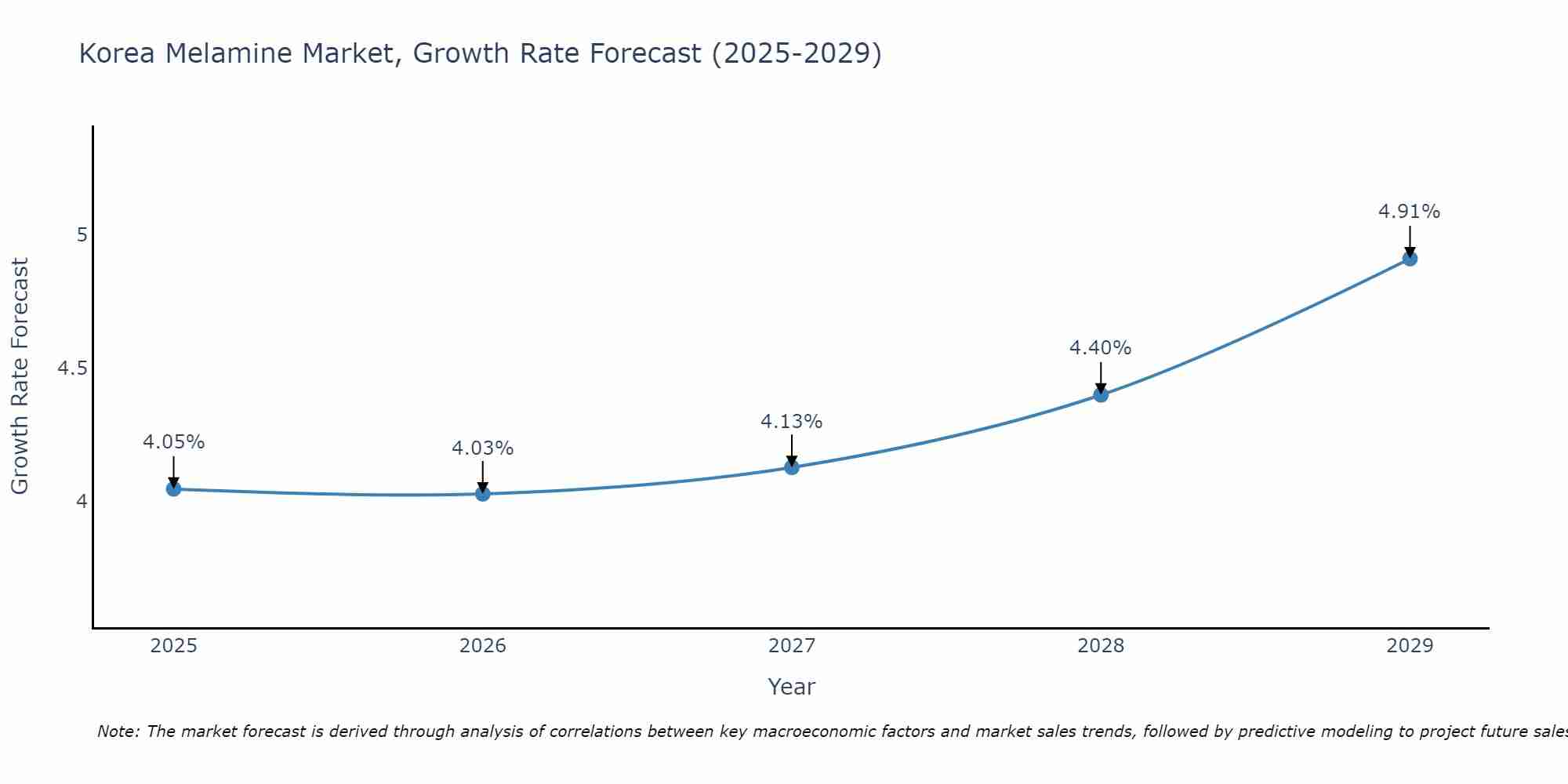
The South Korea Melamine Market is projected to witness mixed growth rate patterns during 2025 to 2029. The growth rate starts at 4.05% in 2025 and reaches 4.91% by 2029.
South Korea Melamine Market Overview
The South Korea melamine market is experiencing steady growth driven by increasing demand from various end-use industries such as construction, automotive, and packaging. Melamine, a versatile compound used in the production of laminates, adhesives, coatings, and resins, is gaining popularity due to its durability, heat resistance, and aesthetic appeal. The market is witnessing innovation in product development to cater to the evolving consumer preferences for sustainable and eco-friendly materials. Key players in the South Korea melamine market are focusing on expanding their product portfolios, enhancing manufacturing capabilities, and strengthening distribution networks to meet the growing demand. Rising disposable income levels and rapid urbanization are further fueling the market growth, with opportunities for market expansion expected in the coming years.
South Korea Melamine Market Trends
The South Korea Melamine market is experiencing steady growth driven by the increasing demand from various end-use industries, such as construction, automotive, and packaging. The market is witnessing a rising trend towards the use of melamine in the production of laminates, furniture, and tableware due to its durability and aesthetic appeal. Manufacturers are focusing on developing innovative melamine-based products to cater to the evolving consumer preferences for sustainable and eco-friendly materials. Additionally, the growing awareness about the benefits of melamine, such as heat resistance and chemical stability, is further fueling the market growth. However, fluctuating raw material prices and stringent regulations regarding the use of melamine in food contact materials are some challenges faced by the industry players.
South Korea Melamine Market Challenges
The South Korea Melamine Market faces challenges in terms of competition from other substitute materials such as porcelain and ceramic due to their perceived higher quality and safety standards. Additionally, fluctuating raw material prices and regulatory constraints on melamine usage in food contact applications pose challenges for market growth. Consumer perception of melamine as a potentially harmful substance, especially in light of past scandals involving melamine contamination in food products, also hinders market demand. Furthermore, the market is susceptible to global economic conditions and trade tensions, impacting both import and export dynamics. To overcome these challenges, companies in the South Korea Melamine Market need to focus on product innovation, quality assurance, and effective marketing strategies to differentiate themselves and regain consumer trust.
South Korea Melamine Market Investment Opportunities
The South Korea melamine market presents promising investment opportunities due to the increasing demand for melamine resin in various end-use industries such as construction, automotive, and packaging. The country`s strong manufacturing base and technological advancements make it an attractive market for investors looking to capitalize on the growth of the melamine market. Additionally, the South Korean government`s focus on infrastructure development and sustainability initiatives further support the growth of the melamine market. Investing in South Korea`s melamine market can provide opportunities for long-term growth and profitability, especially with the rising trend of eco-friendly and durable materials in the market. Conducting thorough market research and understanding the regulatory environment will be crucial for investors to make informed decisions and leverage the potential of the South Korea melamine market.
South Korea Melamine Market Government Policy
The South Korean government has implemented strict regulations and policies regarding the use of melamine in food products to ensure consumer safety. The Ministry of Food and Drug Safety (MFDS) has set maximum allowable limits for melamine in various food items to prevent contamination and protect public health. Additionally, the government conducts regular inspections and testing of food products to enforce compliance with these regulations. Any violation of melamine limits can result in severe penalties, including fines and product recalls. The South Korean authorities are committed to maintaining high standards of food safety and are continuously monitoring the market to safeguard the well-being of consumers.
South Korea Melamine Market Future Outlook
The South Korea melamine market is poised for steady growth in the foreseeable future due to increasing demand from the construction, automotive, and packaging industries. The market is expected to benefit from the country`s strong economic growth, rising urbanization, and expanding manufacturing sector. Additionally, the growing focus on sustainable and eco-friendly materials is likely to drive the demand for melamine as a versatile and durable compound in various applications. With ongoing research and development efforts to enhance product quality and performance, coupled with favorable government initiatives to support industrial growth, the South Korea melamine market is anticipated to witness a positive trajectory in the coming years.
Key Highlights of the Report:
- South Korea Melamine Market Outlook
- Market Size of South Korea Melamine Market, 2021
- Forecast of South Korea Melamine Market, 2027
- Historical Data and Forecast of South Korea Melamine Revenues & Volume for the Period 2018 - 2027
- South Korea Melamine Market Trend Evolution
- South Korea Melamine Market Drivers and Challenges
- South Korea Melamine Price Trends
- South Korea Melamine Porter's Five Forces
- South Korea Melamine Industry Life Cycle
- Historical Data and Forecast of South Korea Melamine Market Revenues & Volume By Forms for the Period 2018 - 2027
- Historical Data and Forecast of South Korea Melamine Market Revenues & Volume By Melamine Resin for the Period 2018 - 2027
- Historical Data and Forecast of South Korea Melamine Market Revenues & Volume By Melamine Foams for the Period 2018 - 2027
- Historical Data and Forecast of South Korea Melamine Market Revenues & Volume By Applications for the Period 2018 - 2027
- Historical Data and Forecast of South Korea Melamine Market Revenues & Volume By Laminates for the Period 2018 - 2027
- Historical Data and Forecast of South Korea Melamine Market Revenues & Volume By Wood Adhesives for the Period 2018 - 2027
- Historical Data and Forecast of South Korea Melamine Market Revenues & Volume By Surface Coatings for the Period 2018 - 2027
- Historical Data and Forecast of South Korea Melamine Market Revenues & Volume By Thermoset Plastics for the Period 2018 - 2027
- Historical Data and Forecast of South Korea Melamine Market Revenues & Volume By End-users for the Period 2018 - 2027
- Historical Data and Forecast of South Korea Melamine Market Revenues & Volume By Construction for the Period 2018 - 2027
- Historical Data and Forecast of South Korea Melamine Market Revenues & Volume By Chemical for the Period 2018 - 2027
- Historical Data and Forecast of South Korea Melamine Market Revenues & Volume By Textile for the Period 2018 - 2027
- Historical Data and Forecast of South Korea Melamine Market Revenues & Volume By Automotive for the Period 2018 - 2027
- South Korea Melamine Import Export Trade Statistics
- Market Opportunity Assessment By Forms
- Market Opportunity Assessment By Applications
- Market Opportunity Assessment By End-users
- South Korea Melamine Top Companies Market Share
- South Korea Melamine Competitive Benchmarking By Technical and Operational Parameters
- South Korea Melamine Company Profiles
- South Korea Melamine Key Strategic Recommendations






































