South Korea Metadata Management Tools Market Size & Growth Rate (2026-2032)
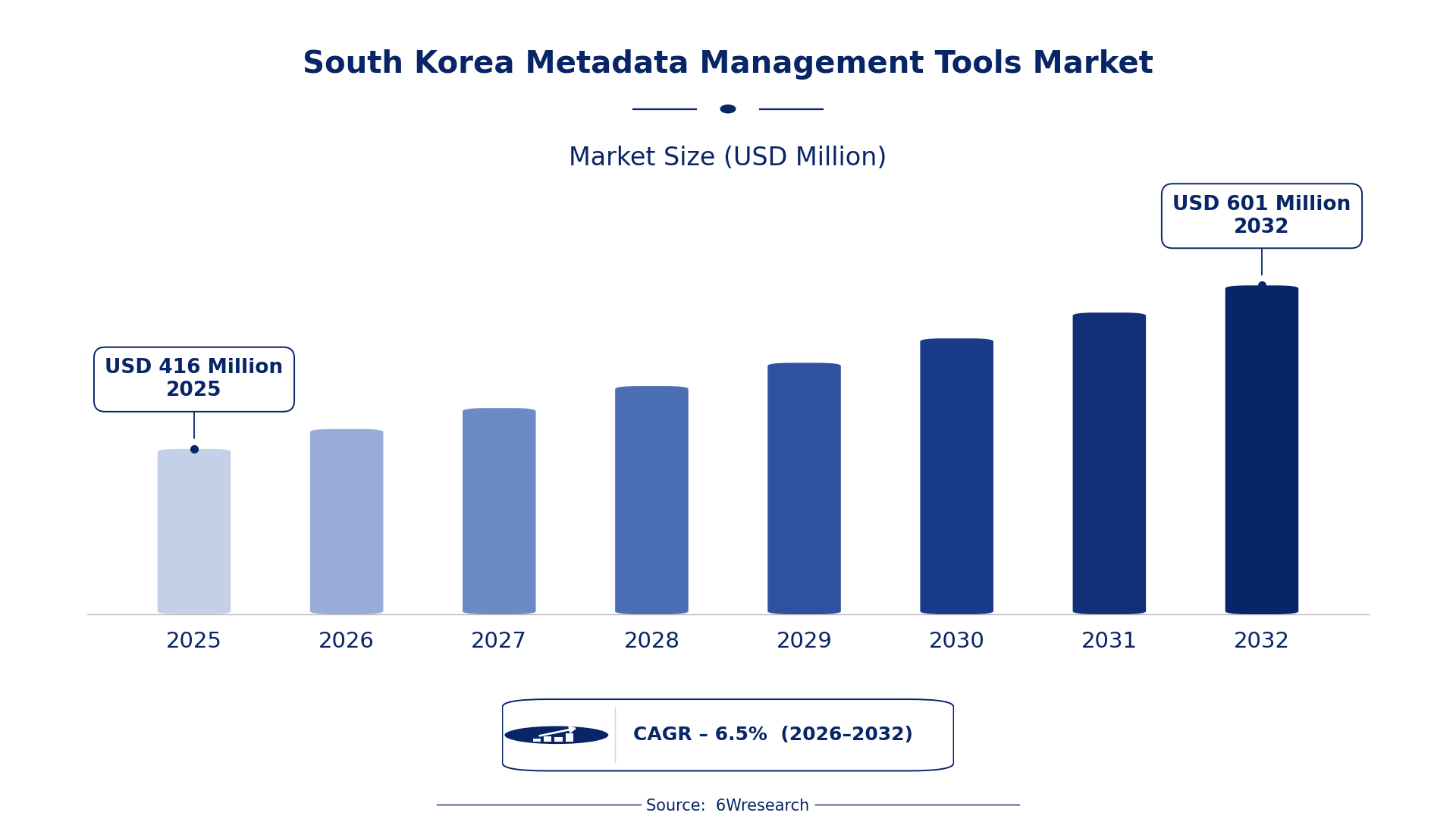
The South Korea Metadata Management Tools Market was estimated at USD 416 Million in 2025 and is projected to reach USD 601 Million by 2032, growing at a CAGR of 6.5% from 2026 to 2032.
South Korea Metadata Management Tools Market Synopsis
The primary driver of the South Korea Metadata Management Tools Market is the accelerating digital transformation initiatives across various industries. Organizations are increasingly recognizing the critical need to manage their data effectively, which is creating robust demand for sophisticated metadata management solutions.
As the volume of data generated continues to surge, so does the need for enhanced data governance and compliance measures. Companies are prioritizing tools that not only ensure accuracy but also improve data analytics capabilities, fundamentally reshaping how they approach data management.
South Korea Metadata Management Tools Market Year-wise Growth Rate and Key Drivers
This graph illustrates the annual growth rates of the South Korea Metadata Management Tools Market from 2021 to 2032, highlighting a steady upward trajectory and projected expansion over the forecast period.
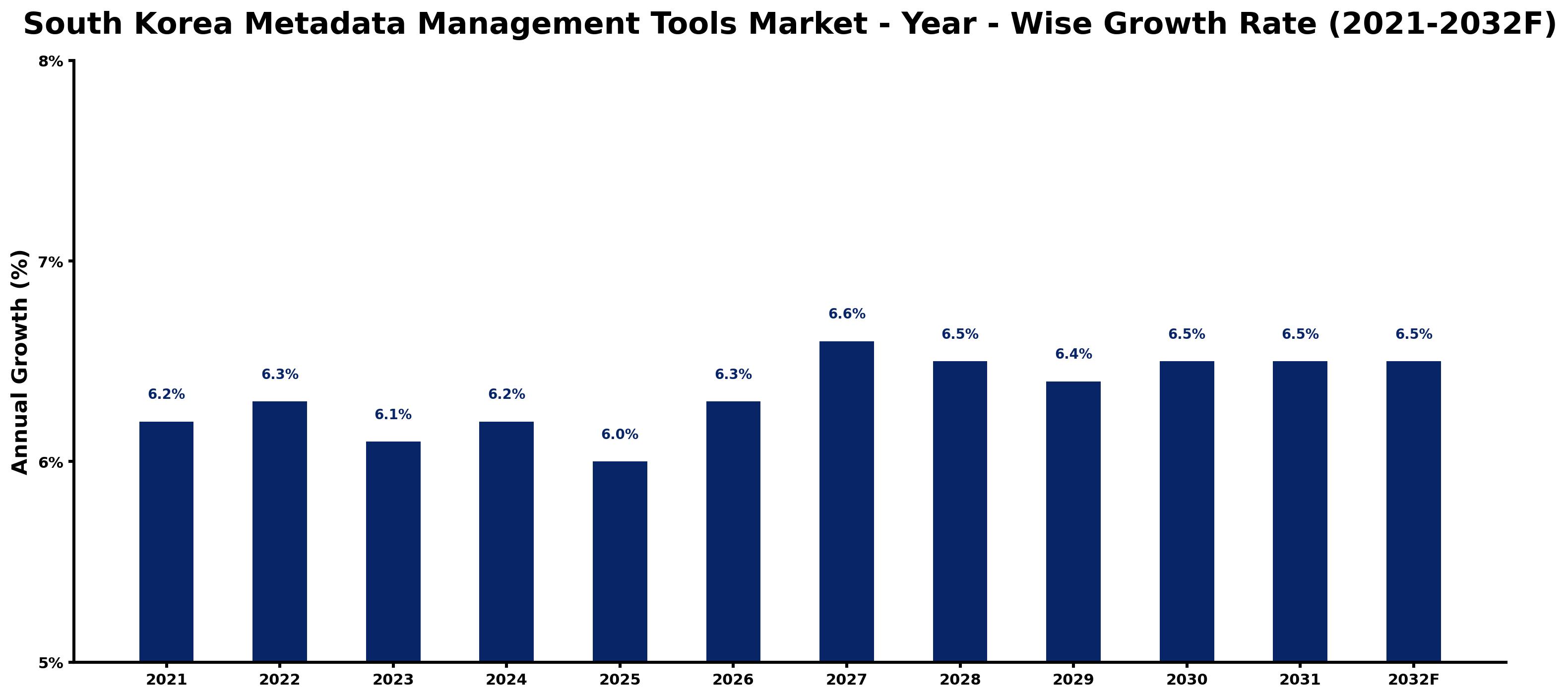
The table below presents the year‑wise growth rates along with the key drivers influencing the market
| Year | Growth Rate | Major Drivers |
| 2021 | 6.2% | Government's Digital New Deal boosts data management adoption. |
| 2022 | 6.3% | Growing e-commerce demand drives need for metadata optimization. |
| 2023 | 6.1% | Launch of the AI Data Strategy enhances metadata tools usage. |
| 2024 | 6.2% | Increased focus on cybersecurity strengthens metadata management importance. |
| 2025 | 6.0% | Emergence of 5G technology fuels data-driven applications growth. |
| 2026 | 6.3% | Rise in cloud computing boosts metadata management solutions. |
| 2027 | 6.6% | Accelerating AI integration requires enhanced data governance frameworks. |
| 2028 | 6.5% | Local enterprises prioritizing data quality for competitive advantage. |
| 2029 | 6.4% | Growing awareness of data privacy elevates metadata management needs. |
| 2030 | 6.5% | Increased reliance on data lakes demands robust metadata tools. |
| 2031 | 6.5% | Corporate strategies emphasize efficient data cataloging solutions. |
| 2032 | 6.5% | Regulatory changes enhance focus on data lifecycle management. |
Note: Market size estimations and growth projections presented in this report are based on 6Wresearch's proprietary forecasting methodology, utilizing the latest available industry data, government publications, and primary research inputs.
South Korea Metadata Management Tools Market Key Takeaways
Below are some of the specific key takeaways from the market, including:
- The market is driven by the need for effective data governance and compliance solutions.
- Cloud-based metadata management tools are gaining traction due to their flexibility and scalability.
- AI-driven automation in metadata processes is becoming increasingly common.
- Organizations are looking for integrated solutions that connect with existing data management platforms.
- The South Korean government is actively promoting metadata management initiatives to enhance data quality.
Evaluation of Restraints in South Korea Metadata Management Tools Market
Despite the promising growth trajectory, the South Korea Metadata Management Tools Market faces notable challenges. A key restraint is the complexity arising from diverse data sources and formats, which complicates the implementation of effective metadata management tools. on top of that, the absence of standardized definitions for metadata can lead to inconsistencies and inefficiencies in data handling.
Organizations often struggle with real-time data governance as data volumes continue to expand at an unprecedented rate. Cultural considerations regarding data privacy and security also introduce additional hurdles, necessitating solutions that not only comply with local regulations but also address these unique challenges.
South Korea Metadata Management Tools Market Trends
The shift towards cloud-based metadata management solutions is becoming increasingly pronounced, driven by the demand for flexible and scalable options. Organizations are looking for tools that can operate effectively across both on-premises and cloud environments, reflecting a broader trend towards hybrid data management strategies.
There is also a significant push for automation within metadata management, with vendors enhancing their offerings to include AI-driven capabilities. These advancements help improve data quality and compliance, making it easier for organizations to manage their metadata assets efficiently.
South Korea Metadata Management Tools Market Opportunities
Investment opportunities in the South Korea Metadata Management Tools Market are robust, particularly as businesses increasingly embrace data-driven decision-making. Companies that offer innovative solutions tailored to the specific needs of the Korean market are well-positioned for growth.
The focus on regulatory compliance also creates avenues for investment, as organizations seek tools that enhance their data governance and security practices. As digital transformation continues to gain momentum, the demand for advanced metadata management tools will likely rise, offering substantial returns for savvy investors.
Government Initiatives in the South Korea Metadata Management Tools Market
Government initiatives are actively shaping the South Korea Metadata Management Tools Market, fostering innovation and standardization. The South Korean government has established guidelines to ensure consistency in metadata management across various sectors, which is crucial for interoperability. These policies not only promote the adoption of metadata management tools but also support advancements in data governance practices.
- A recently completed initiative focused on establishing national metadata management standards to enhance data quality across industries.
- Currently ongoing is a public-private partnership aimed at developing tools that improve data governance and compliance practices.
- A planned regulatory framework, set to launch in the coming years, will mandate enhanced transparency in metadata management across organizations.
- The government is providing funding for R&D activities related to metadata management tools, with an emphasis on data security.
Future Insights of the South Korea Metadata Management Tools Market
Looking ahead to 2026-2032, the South Korea Metadata Management Tools Market is set for sustained growth. The increasing recognition of the value of data governance will drive demand for advanced management tools. Additionally, compliance with evolving data privacy regulations will compel organizations to invest in effective metadata management solutions.
As digital transformation efforts continue to expand, the market will likely see a surge in the adoption of integrated solutions that offer comprehensive data management capabilities. This evolution will enable organizations to harness their data assets more effectively, ensuring a competitive edge in the marketplace.
South Korea Metadata Management Tools Market Latest Developments
Recent developments in the South Korea Metadata Management Tools Market reflect a strong focus on innovation and improved data practices. Over the last year, companies have been actively enhancing their offerings to meet the growing demands of organizations navigating complex data environments.
- A major technology vendor launched an AI-enhanced metadata management platform in early 2025, aimed at improving data governance.
- An initiative that began in late 2024 is currently underway, focused on integrating metadata management tools with existing data ecosystems.
- A collaborative project between several industry players is planned for late 2026, aimed at developing standardized metadata definitions.
- A pilot program designed to showcase the benefits of cloud-based metadata solutions was launched in Q1 2025 and is gathering positive feedback.
South Korea Metadata Management Tools Market - Key Attractiveness of the Report
- 10 Years of Market Numbers
- Historical Data Starting from 2022 to 2025
- Base Year: 2025
- Forecast Data until 2032
- Key Performance Indicators Impacting the Market
- Major Upcoming Developments and Projects
Key Highlights of the Report:
- South Korea Metadata Management Tools Market Outlook
- Market Size of South Korea Metadata Management Tools Market, 2025
- Forecast of South Korea Metadata Management Tools Market, 2032
- Historical Data and Forecast of South Korea Metadata Management Tools Revenues & Volume for the Period 2022-2032F
- South Korea Metadata Management Tools Market Trend Evolution
- South Korea Metadata Management Tools Market Drivers and Challenges
- South Korea Metadata Management Tools Price Trends
- South Korea Metadata Management Tools Porter's Five Forces
- South Korea Metadata Management Tools Industry Life Cycle
- Historical Data and Forecast of South Korea Metadata Management Tools Market Revenues & Volume By Component for the Period 2022-2032F
- Historical Data and Forecast of South Korea Metadata Management Tools Market Revenues & Volume By Tools for the Period 2022-2032F
- Historical Data and Forecast of South Korea Metadata Management Tools Market Revenues & Volume By Services for the Period 2022-2032F
- Historical Data and Forecast of South Korea Metadata Management Tools Market Revenues & Volume By Application for the Period 2022-2032F
- Historical Data and Forecast of South Korea Metadata Management Tools Market Revenues & Volume By Data Governance for the Period 2022-2032F
- Historical Data and Forecast of South Korea Metadata Management Tools Market Revenues & Volume By Risk and Compliance Management for the Period 2022-2032F
- Historical Data and Forecast of South Korea Metadata Management Tools Market Revenues & Volume By Incident Management for the Period 2022-2032F
- Historical Data and Forecast of South Korea Metadata Management Tools Market Revenues & Volume By Product and Process Management for the Period 2022-2032F
- Historical Data and Forecast of South Korea Metadata Management Tools Market Revenues & Volume By Other Applications for the Period 2022-2032F
- Historical Data and Forecast of South Korea Metadata Management Tools Market Revenues & Volume By Business Function for the Period 2022-2032F
- Historical Data and Forecast of South Korea Metadata Management Tools Market Revenues & Volume By HR for the Period 2022-2032F
- Historical Data and Forecast of South Korea Metadata Management Tools Market Revenues & Volume By Finance for the Period 2022-2032F
- Historical Data and Forecast of South Korea Metadata Management Tools Market Revenues & Volume By Marketing and Sales for the Period 2022-2032F
- Historical Data and Forecast of South Korea Metadata Management Tools Market Revenues & Volume By Legal for the Period 2022-2032F
- Historical Data and Forecast of South Korea Metadata Management Tools Market Revenues & Volume By Operations for the Period 2022-2032F
- Historical Data and Forecast of South Korea Metadata Management Tools Market Revenues & Volume By Deployment Mode for the Period 2022-2032F
- Historical Data and Forecast of South Korea Metadata Management Tools Market Revenues & Volume By Cloud for the Period 2022-2032F
- Historical Data and Forecast of South Korea Metadata Management Tools Market Revenues & Volume By On-premises for the Period 2022-2032F
- Historical Data and Forecast of South Korea Metadata Management Tools Market Revenues & Volume By Metadata Type for the Period 2022-2032F
- Historical Data and Forecast of South Korea Metadata Management Tools Market Revenues & Volume By Business Metadata for the Period 2022-2032F
- Historical Data and Forecast of South Korea Metadata Management Tools Market Revenues & Volume By Technical Metadata for the Period 2022-2032F
- Historical Data and Forecast of South Korea Metadata Management Tools Market Revenues & Volume By Operational Metadata for the Period 2022-2032F
- Historical Data and Forecast of South Korea Metadata Management Tools Market Revenues & Volume By Vertical for the Period 2022-2032F
- Historical Data and Forecast of South Korea Metadata Management Tools Market Revenues & Volume By BFSI for the Period 2022-2032F
- Historical Data and Forecast of South Korea Metadata Management Tools Market Revenues & Volume By Retail and Consumer Goods for the Period 2022-2032F
- Historical Data and Forecast of South Korea Metadata Management Tools Market Revenues & Volume By Government for the Period 2022-2032F
- Historical Data and Forecast of South Korea Metadata Management Tools Market Revenues & Volume By Telecom and IT for the Period 2022-2032F
- Historical Data and Forecast of South Korea Metadata Management Tools Market Revenues & Volume By Healthcare and Life Sciences for the Period 2022-2032F
- Historical Data and Forecast of South Korea Metadata Management Tools Market Revenues & Volume By Manufacturing for the Period 2022-2032F
- Historical Data and Forecast of South Korea Metadata Management Tools Market Revenues & Volume By Energy and Utilities for the Period 2022-2032F
- Historical Data and Forecast of South Korea Metadata Management Tools Market Revenues & Volume By Transportation and Logistics for the Period 2022-2032F
- South Korea Metadata Management Tools Import Export Trade Statistics
- Market Opportunity Assessment By Component
- Market Opportunity Assessment By Application
- Market Opportunity Assessment By Business Function
- Market Opportunity Assessment By Deployment Mode
- Market Opportunity Assessment By Metadata Type
- Market Opportunity Assessment By Vertical
- South Korea Metadata Management Tools Top Companies Market Share
- South Korea Metadata Management Tools Competitive Benchmarking By Technical and Operational Parameters
- South Korea Metadata Management Tools Company Profiles
- South Korea Metadata Management Tools Key Strategic Recommendations






































