South Korea Microlearning Market Size & Growth Rate (2026-2032)
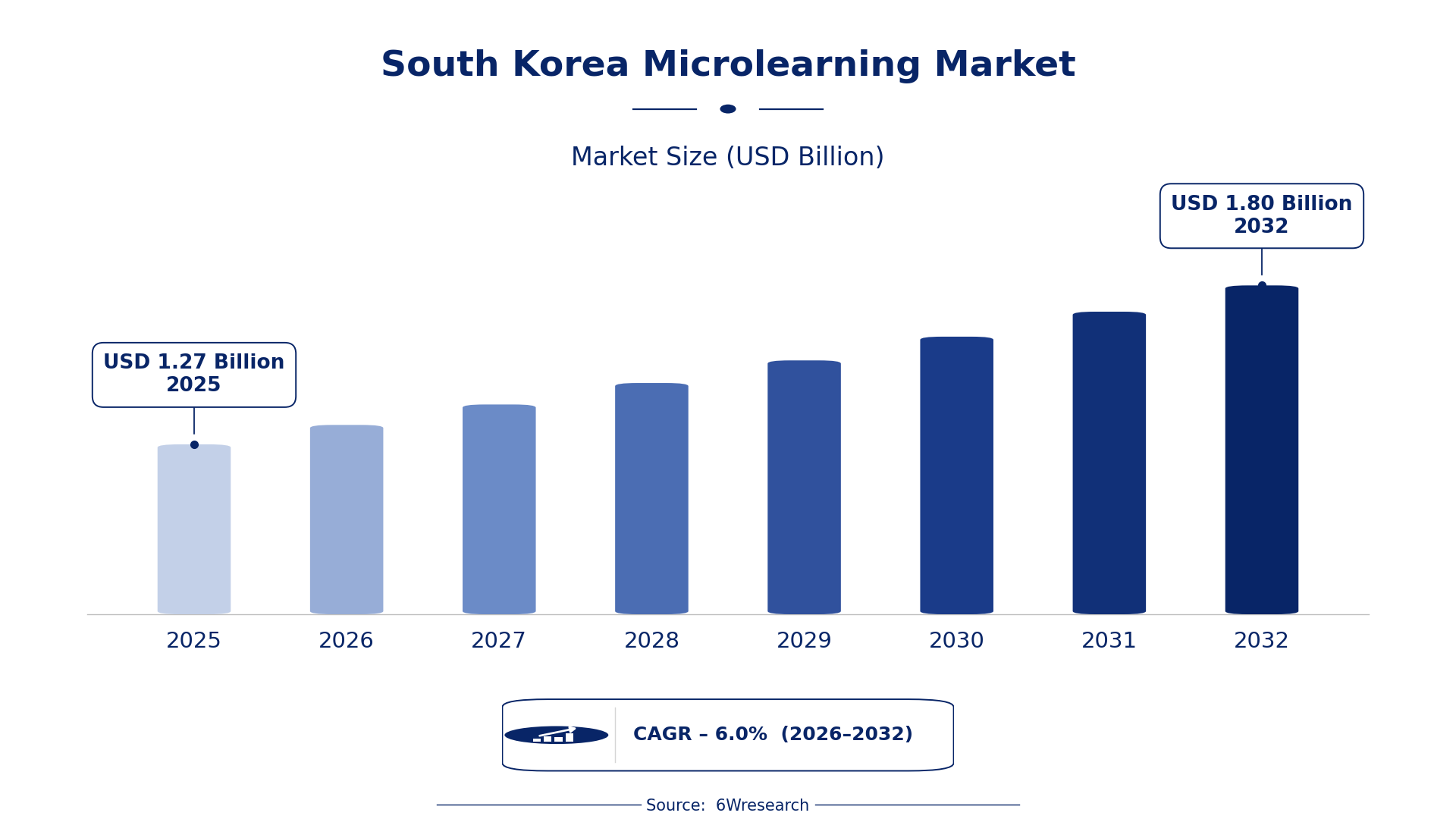
The South Korea Microlearning Market was estimated at USD 1266 Million in 2025 and is projected to reach USD 1799 Million by 2032, growing at a CAGR of 6.0% from 2026 to 2032.
South Korea Microlearning Market Synopsis
In recent years, the microlearning sector in South Korea has seen accelerated growth, driven by the rapid adoption of digital learning tools. As organizations pivot towards more agile and accessible training solutions, the market is set to shift significantly, expanding its reach into various industries and educational sectors.
Looking ahead, the South Korea Microlearning Market is likely to evolve further, influenced by technological advancements and changing workforce needs. The emphasis on personalized learning experiences and ongoing skill development will be crucial in shaping future strategies and investments in this space.
South Korea Microlearning Market Year-wise Growth Rate and Key Drivers
This graph illustrates the annual growth rates of the South Korea Microlearning Market from 2021 to 2032, highlighting a steady upward trajectory and projected expansion over the forecast period.
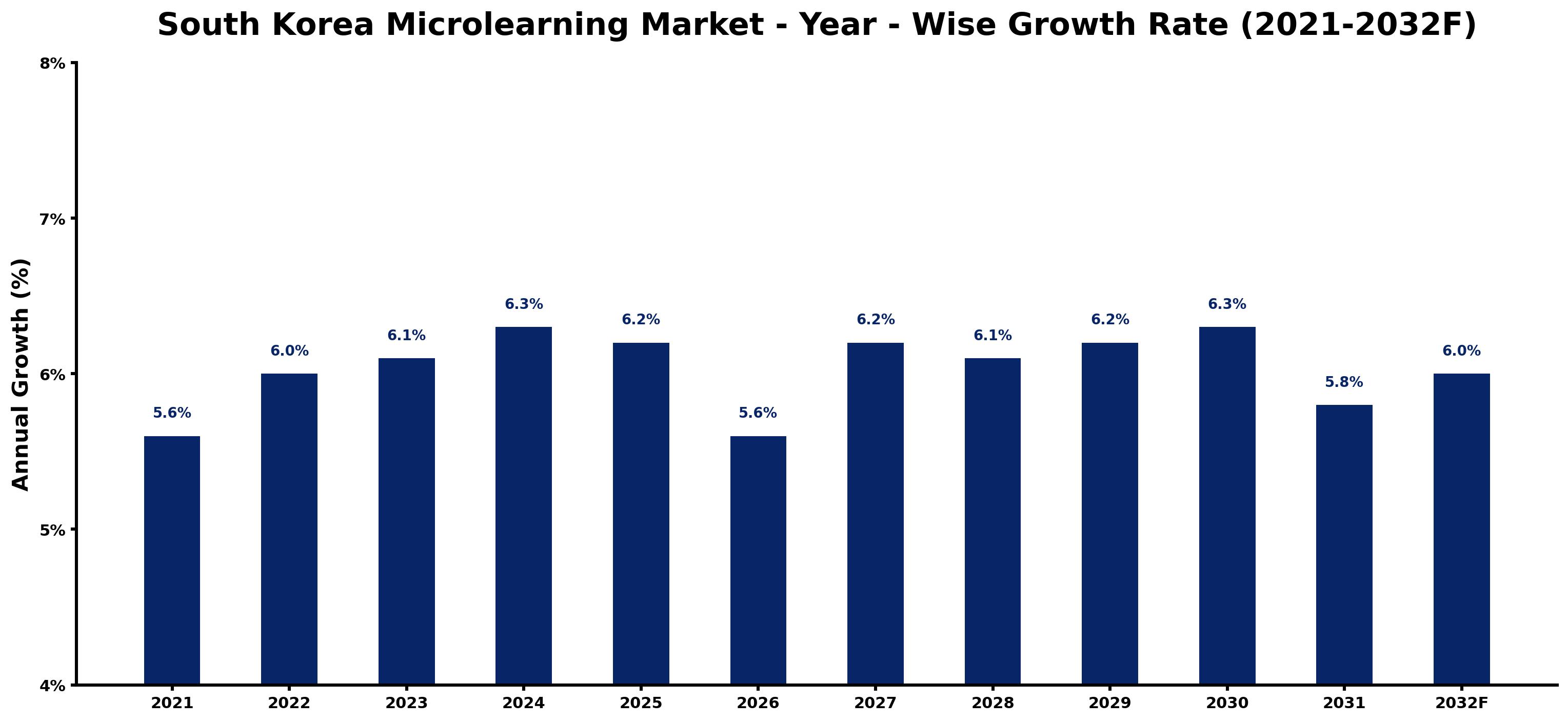
The table below presents the year‑wise growth rates along with the key drivers influencing the market
| Year | Growth Rate | Major Drivers |
| 2021 | 5.6% | Government initiatives promoting digital education programs. |
| 2022 | 6.0% | Increased smartphone penetration driving mobile learning adoption. |
| 2023 | 6.1% | Corporate training budgets shifting towards microlearning solutions. |
| 2024 | 6.3% | Focus on upskilling workforce amid economic digitalization. |
| 2025 | 6.2% | Emergence of local edtech startups offering innovative content. |
| 2026 | 5.6% | Rising popularity of gamified learning among young professionals. |
| 2027 | 6.2% | Enhanced internet infrastructure enabling seamless learning experiences. |
| 2028 | 6.1% | Shift towards lifelong learning driven by demographic changes. |
| 2029 | 6.2% | Partnerships between universities and tech firms for microcredentials. |
| 2030 | 6.3% | Increased emphasis on digital competencies in national curriculum. |
| 2031 | 5.8% | Growing awareness of skills gap in technology industries. |
| 2032 | 6.0% | Demand for rapid training responses in fluctuating job market. |
Note: Market size estimations and growth projections presented in this report are based on 6Wresearch's proprietary forecasting methodology, utilizing the latest available industry data, government publications, and primary research inputs.
South Korea Microlearning Market Key Takeaways
Below are some of the specific key takeaways from the market, including:
- The market is expanding due to increasing demand for flexible learning solutions.
- Advancements in mobile technology are enhancing content accessibility.
- Personalized learning experiences are driving engagement and retention.
- Government policies are fostering innovation in educational technologies.
- Infrastructure improvements are essential for wider adoption of microlearning.
Evaluation of Restraints in South Korea Microlearning Market
Despite promising growth, the South Korea Microlearning Market grapples with several constraints. A primary challenge lies in effective content delivery; organizations must ensure that modules are not only informative but also engaging to sustain learner interest. Infrastructure limitations, particularly in remote areas, hinder access to quality microlearning solutions. on top of that, the scalability of these educational tools remains a concern, as companies seek assurance that investments will yield substantial returns in employee performance and skill enhancement.
South Korea Microlearning Market Trends
The current trends in the South Korea Microlearning Market reflect a shift toward mobile-first learning solutions. With the proliferation of smartphones and tablets, learners prefer on-the-go access to educational content. Another trend is the integration of gamification elements, which enhance user engagement and motivation. Artificial intelligence is also making inroads, enabling personalized learning paths and adaptive content delivery tailored to individual learner needs. As companies embrace these trends, the demand for innovative microlearning strategies is expected to rise.
South Korea Microlearning Market Opportunities
There are promising avenues for growth within the South Korea Microlearning Market. The rising need for continuous professional development creates a fertile ground for organizations to invest in microlearning solutions. Educational institutions can also capitalize on this trend, offering tailored programs that address specific skill gaps. Collaborations between tech companies and educational bodies present another opportunity, as they can leverage resources and expertise to create cutting-edge learning platforms. Additionally, as remote work becomes more prevalent, microlearning can play a vital role in delivering training efficiently.
Government Initiatives in the South Korea Microlearning Market
The South Korean government is actively involved in shaping the microlearning sector through various initiatives aimed at enhancing educational technology. With a focus on improving access to digital learning, public policy is increasingly prioritizing funding and support for microlearning platforms. These initiatives not only foster innovation but also align with the national agenda to boost the overall quality of education across the country.
- A recently completed program provided funding for research and development in microlearning technologies.
- A current initiative focuses on building partnerships between educational institutions and technology firms to promote innovative learning solutions.
- Upcoming regulations are expected to introduce tax incentives for companies investing in digital education platforms.
- A planned public-private initiative aims to improve digital infrastructure in underserved regions by 2027.
- A government-led project is underway to develop a national standard for evaluating microlearning effectiveness in educational settings.
Future Insights of the South Korea Microlearning Market
From 2026 to 2032, the South Korea Microlearning Market is set to flourish, driven by a continued emphasis on flexible and personalized education. The integration of cutting-edge technologies will not only enhance content delivery but also improve learner engagement. With a tech-savvy workforce demanding ongoing development, organizations will increasingly adopt microlearning as a primary training method. As the market matures, we can expect to see more sophisticated platforms emerge, reshaping the educational experience for both employees and students alike.
South Korea Microlearning Market Latest Developments
In the past year, the South Korea Microlearning Market has witnessed notable activity, reflecting a growing interest in digital learning solutions. Companies are increasingly investing in innovative platforms that cater to the evolving needs of learners. This surge in development indicates a strong commitment to enhancing educational accessibility and effectiveness.
- A major technology vendor launched a new microlearning platform in early 2025, designed to integrate with existing corporate training systems.
- An initiative that began in mid-2025 is currently underway, focused on developing localized content for various industries to improve relevance and engagement.
- A recent partnership formed between a leading educational institution and a tech firm aims to create gamified microlearning experiences, enhancing student motivation.
- A rollout expected to begin in the second half of 2026 will introduce a national online repository of microlearning resources for educators.
- A public sector upgrade project is ongoing, enhancing internet infrastructure to support digital learning initiatives in rural areas.
South Korea Microlearning Market - Key Attractiveness of the Report
- 10 Years of Market Numbers
- Historical Data Starting from 2022 to 2025
- Base Year: 2025
- Forecast Data until 2032
- Key Performance Indicators Impacting the Market
- Major Upcoming Developments and Projects
Key Highlights of the Report:
- South Korea Microlearning Market Outlook
- Market Size of South Korea Microlearning Market, 2025
- Forecast of South Korea Microlearning Market, 2032
- Historical Data and Forecast of South Korea Microlearning Revenues & Volume for the Period 2022-2032F
- South Korea Microlearning Market Trend Evolution
- South Korea Microlearning Market Drivers and Challenges
- South Korea Microlearning Price Trends
- South Korea Microlearning Porter's Five Forces
- South Korea Microlearning Industry Life Cycle
- Historical Data and Forecast of South Korea Microlearning Market Revenues & Volume By Component for the Period 2022-2032F
- Historical Data and Forecast of South Korea Microlearning Market Revenues & Volume By Solution for the Period 2022-2032F
- Historical Data and Forecast of South Korea Microlearning Market Revenues & Volume By Services for the Period 2022-2032F
- Historical Data and Forecast of South Korea Microlearning Market Revenues & Volume By Industry for the Period 2022-2032F
- Historical Data and Forecast of South Korea Microlearning Market Revenues & Volume By Retail for the Period 2022-2032F
- Historical Data and Forecast of South Korea Microlearning Market Revenues & Volume By Manufacturing for the Period 2022-2032F
- Historical Data and Forecast of South Korea Microlearning Market Revenues & Volume By Logistics for the Period 2022-2032F
- Historical Data and Forecast of South Korea Microlearning Market Revenues & Volume By BFSI for the Period 2022-2032F
- Historical Data and Forecast of South Korea Microlearning Market Revenues & Volume By Telecom for the Period 2022-2032F
- Historical Data and Forecast of South Korea Microlearning Market Revenues & Volume By IT for the Period 2022-2032F
- Historical Data and Forecast of South Korea Microlearning Market Revenues & Volume By Healthcare for the Period 2022-2032F
- Historical Data and Forecast of South Korea Microlearning Market Revenues & Volume By Life Sciences for the Period 2022-2032F
- Historical Data and Forecast of South Korea Microlearning Market Revenues & Volume By Deployment Type for the Period 2022-2032F
- Historical Data and Forecast of South Korea Microlearning Market Revenues & Volume By On-Premises for the Period 2022-2032F
- Historical Data and Forecast of South Korea Microlearning Market Revenues & Volume By Cloud for the Period 2022-2032F
- Historical Data and Forecast of South Korea Microlearning Market Revenues & Volume By Organization Size for the Period 2022-2032F
- Historical Data and Forecast of South Korea Microlearning Market Revenues & Volume By SMEs for the Period 2022-2032F
- Historical Data and Forecast of South Korea Microlearning Market Revenues & Volume By Large Enterprises for the Period 2022-2032F
- South Korea Microlearning Import Export Trade Statistics
- Market Opportunity Assessment By Component
- Market Opportunity Assessment By Industry
- Market Opportunity Assessment By Deployment Type
- Market Opportunity Assessment By Organization Size
- South Korea Microlearning Top Companies Market Share
- South Korea Microlearning Competitive Benchmarking By Technical and Operational Parameters
- South Korea Microlearning Company Profiles
- South Korea Microlearning Key Strategic Recommendations






































