South Korea Mineral Processing Equipment Market Size, Share & Growth Rate
The South Korea Mineral Processing Equipment Market was estimated at USD 413 Million in 2025 and is projected to reach USD 587 Million by 2032, growing at a CAGR of 5.2% from 2026 to 2032. This growth trajectory is underpinned by the robust performance of the country's mining industry, alongside significant investments in infrastructure that demand enhanced processing capabilities. As industries evolve, the push for more efficient and sustainable technologies is also driving innovation in equipment design and functionality.
South Korea Mineral Processing Equipment Market Year-wise Growth Rate and Key Drivers
This graph highlights how the South Korea Mineral Processing Equipment Market has steadily grown over the years, supported by major growth factors.
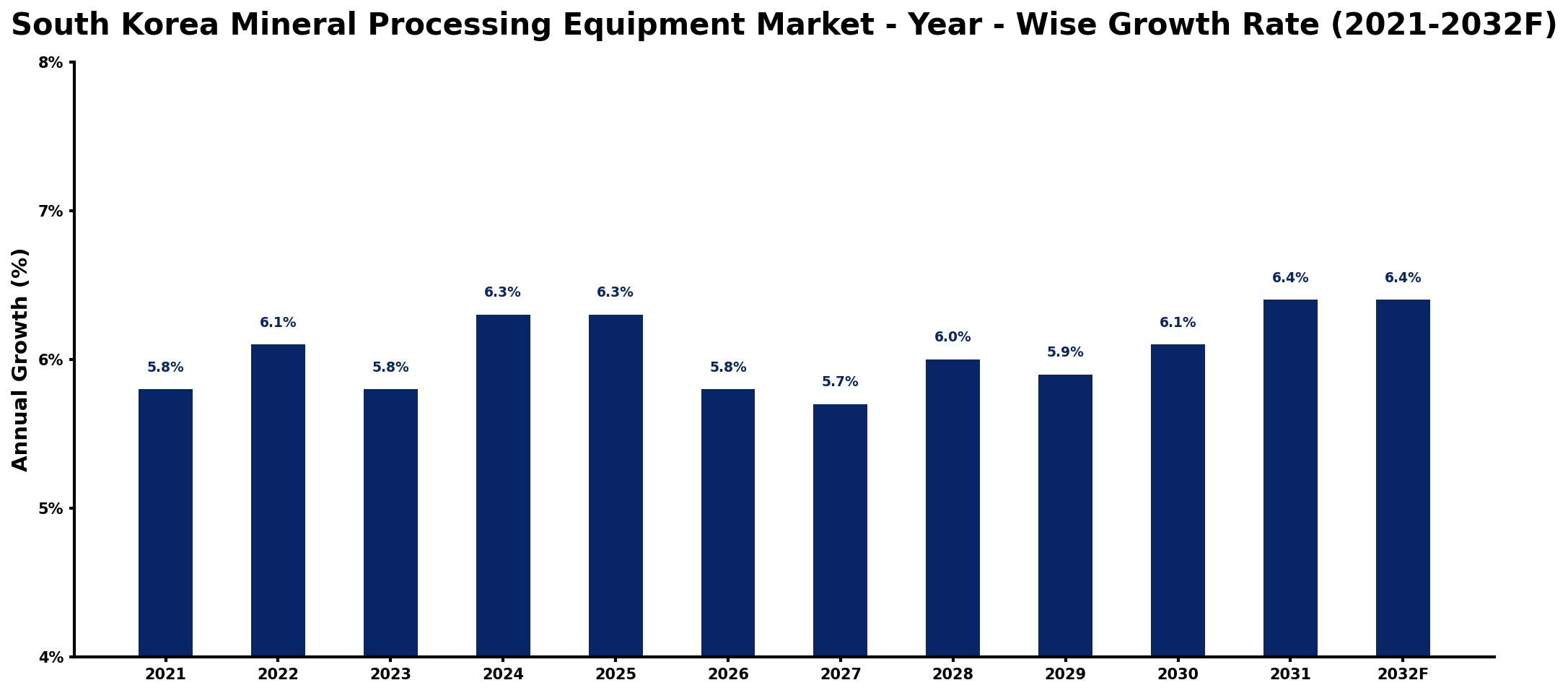
The table below presents the year‑wise growth rates along with the key drivers influencing the market
| Year | Growth Rate | Major Drivers |
| 2021 | 5.8% | Rising demand from construction sector |
| 2022 | 6.1% | Increased investments in infrastructure projects |
| 2023 | 5.8% | Growing focus on sustainable practices |
| 2024 | 6.3% | Expansion of mining operations globally |
| 2025 | 6.3% | Technological advancements in extraction |
| 2026 | 5.8% | Increased exploration activities in Asia |
| 2027 | 5.7% | Higher demand from energy sector |
| 2028 | 6.0% | Growth in recycling initiatives worldwide |
| 2029 | 5.9% | growing regional consumption patterns |
| 2030 | 6.1% | Increased governmental support initiatives |
| 2031 | 6.4% | increased production capacity utilization |
| 2032 | 6.4% | Growing emphasis on automation technologies |
Note: Market size estimations and growth projections presented in this report are based on 6Wresearch's proprietary forecasting methodology, utilizing the latest available industry data, government publications, and primary research inputs.
South Korea Mineral Processing Equipment Market Synopsis
In recent years, the South Korea mineral processing equipment market has gained considerable momentum, fueled by the growing demand for advanced processing technologies. This momentum reflects a shift towards more sustainable practices and an emphasis on automation to optimize operational efficiency. Looking ahead, the market is poised for further expansion, largely driven by increasing investments in high-tech solutions that can meet the diverse needs of the mining sector.
As the market evolves, players are adapting to new trends that prioritize resource recovery and environmental responsibility. These factors are reshaping the competitive landscape, encouraging manufacturers to innovate in areas such as modular design and mobile processing capabilities. The future of the South Korea mineral processing equipment market is thus closely linked to advancements in technology and sustainability.
South Korea Mineral Processing Equipment Market Key Takeaways
- The market is forecasted to grow at a CAGR of 5.2% from 2026 to 2032.
- Technological innovations are driving the demand for automation and digital solutions.
- Investment in energy-efficient equipment is becoming crucial for compliance with environmental regulations.
- Flexibility and scalability are increasingly favored in equipment design to accommodate varying production requirements.
- Strategic partnerships between domestic and international firms are enhancing market competitiveness.
Evaluation of Restraints in South Korea Mineral Processing Equipment Market
Despite the promising growth prospects, the South Korea mineral processing equipment market faces several significant restraints. Intense competition, both locally and globally, compels companies to continually innovate and upgrade their offerings, which can strain resources and extend development timelines. Moreover, the volatility of raw material prices poses a challenge, impacting the overall production costs for manufacturers. Stringent environmental regulations also necessitate ongoing investments in sustainable practices, requiring companies to balance compliance with profitability.
South Korea Mineral Processing Equipment Market Trends
A notable trend in the South Korea mineral processing equipment market is the shift towards automation and digitalization. Companies are increasingly adopting smart technologies that enable real-time monitoring and process optimization, thereby enhancing overall efficiency. Additionally, there is a rising focus on sustainability, leading manufacturers to create equipment that reduces water and energy consumption. The market is also witnessing a preference for modular and mobile processing solutions, which offer adaptable options for various production needs, thus improving operational flexibility.
South Korea Mineral Processing Equipment Market Opportunities
Opportunities for growth in the South Korea mineral processing equipment market are abundant, particularly for those who embrace technological advancements. Suppliers of high-tech machinery, such as crushers, grinding mills, and separators, are well-positioned to capitalize on the increasing demand from the mining sector. Moreover, there is significant potential in investing in green technologies aimed at enhancing energy efficiency and minimizing environmental impact. Collaborating with local mining companies can also yield strategic advantages, opening doors to new ventures and increased market share.
Government Initiatives in the South Korea Mineral Processing Equipment Market
The South Korean government has established a range of initiatives designed to bolster the mineral processing equipment market. These include financial incentives aimed at encouraging research and development within the mining sector. Regulations are also in place to promote environmental sustainability and safety standards in mineral processing operations, ensuring that companies comply while driving innovation. Furthermore, the government actively fosters partnerships between domestic companies and foreign manufacturers to facilitate technology transfer, which enhances the overall competitiveness of the market.
Future Insights of the South Korea Mineral Processing Equipment Market
Looking ahead to 2026-2032, the South Korea mineral processing equipment market is set for steady growth, primarily fueled by rising demand across mining, construction, and manufacturing sectors. Technological advancements will play a pivotal role in enhancing efficiency and productivity, while government support for sustainable practices will drive further investment. While challenges such as fluctuating raw material prices and strict regulations persist, the market is poised for expansion, offering significant opportunities for innovation and development.
South Korea Mineral Processing Equipment Market Latest Developments (2025 - 2026)
In the recent months, the South Korea mineral processing equipment market has seen a notable direction toward the integration of smart technologies, with companies adopting advanced analytics and AI to enhance operational processes. There is also a growing emphasis on the development of eco-friendly equipment solutions, aligning with global sustainability trends. Additionally, partnerships between local and international firms are becoming increasingly common, aimed at leveraging cutting-edge technologies and enhancing market reach.
South Korea Mineral Processing Equipment Market - Key Attractiveness of the Report
- 10 Years of Market Numbers
- Historical Data Starting from 2022 to 2025
- Base Year: 2025
- Forecast Data until 2032
- Key Performance Indicators Impacting the Market
- Major Upcoming Developments and Projects
Key Highlights of the Report:
- South Korea Mineral Processing Equipment Market Outlook
- Market Size of South Korea Mineral Processing Equipment Market, 2025
- Forecast of South Korea Mineral Processing Equipment Market, 2032
- Historical Data and Forecast of South Korea Mineral Processing Equipment Revenues & Volume for the Period 2022-2032F
- South Korea Mineral Processing Equipment Market Trend Evolution
- South Korea Mineral Processing Equipment Market Drivers and Challenges
- South Korea Mineral Processing Equipment Price Trends
- South Korea Mineral Processing Equipment Porter's Five Forces
- South Korea Mineral Processing Equipment Industry Life Cycle
- Historical Data and Forecast of South Korea Mineral Processing Equipment Market Revenues & Volume By Mineral Mining Sector for the Period 2022-2032F
- Historical Data and Forecast of South Korea Mineral Processing Equipment Market Revenues & Volume By Bauxite for the Period 2022-2032F
- Historical Data and Forecast of South Korea Mineral Processing Equipment Market Revenues & Volume By Iron for the Period 2022-2032F
- Historical Data and Forecast of South Korea Mineral Processing Equipment Market Revenues & Volume By Lithium for the Period 2022-2032F
- Historical Data and Forecast of South Korea Mineral Processing Equipment Market Revenues & Volume By Others for the Period 2022-2032F
- Historical Data and Forecast of South Korea Mineral Processing Equipment Market Revenues & Volume By Equipment for the Period 2022-2032F
- Historical Data and Forecast of South Korea Mineral Processing Equipment Market Revenues & Volume By Crushers for the Period 2022-2032F
- Historical Data and Forecast of South Korea Mineral Processing Equipment Market Revenues & Volume By Feeders for the Period 2022-2032F
- Historical Data and Forecast of South Korea Mineral Processing Equipment Market Revenues & Volume By Conveyors for the Period 2022-2032F
- Historical Data and Forecast of South Korea Mineral Processing Equipment Market Revenues & Volume By Drills & Breakers for the Period 2022-2032F
- Historical Data and Forecast of South Korea Mineral Processing Equipment Market Revenues & Volume By Others for the Period 2022-2032F
- Historical Data and Forecast of South Korea Mineral Processing Equipment Market Revenues & Volume By Application for the Period 2022-2032F
- Historical Data and Forecast of South Korea Mineral Processing Equipment Market Revenues & Volume By Construction for the Period 2022-2032F
- Historical Data and Forecast of South Korea Mineral Processing Equipment Market Revenues & Volume By Mining for the Period 2022-2032F
- Historical Data and Forecast of South Korea Mineral Processing Equipment Market Revenues & Volume By Others for the Period 2022-2032F
- South Korea Mineral Processing Equipment Import Export Trade Statistics
- Market Opportunity Assessment By Mineral Mining Sector
- Market Opportunity Assessment By Equipment
- Market Opportunity Assessment By Application
- South Korea Mineral Processing Equipment Top Companies Market Share
- South Korea Mineral Processing Equipment Competitive Benchmarking By Technical and Operational Parameters
- South Korea Mineral Processing Equipment Company Profiles
- South Korea Mineral Processing Equipment Key Strategic Recommendations






































