South Korea Mobile Phone Accessories Market Summary
The south korea mobile phone accessories market was estimated at USD 383 Million in 2025 and is projected to reach USD 558 Million by 2032, growing at a CAGR of 6.8% from 2026 to 2032.
South Korea Mobile Phone Accessories Market Year-wise Growth Rate and Key Drivers
This graph highlights how the South Korea Mobile Phone Accessories Market has steadily grown over the past five years, supported by major growth factors.
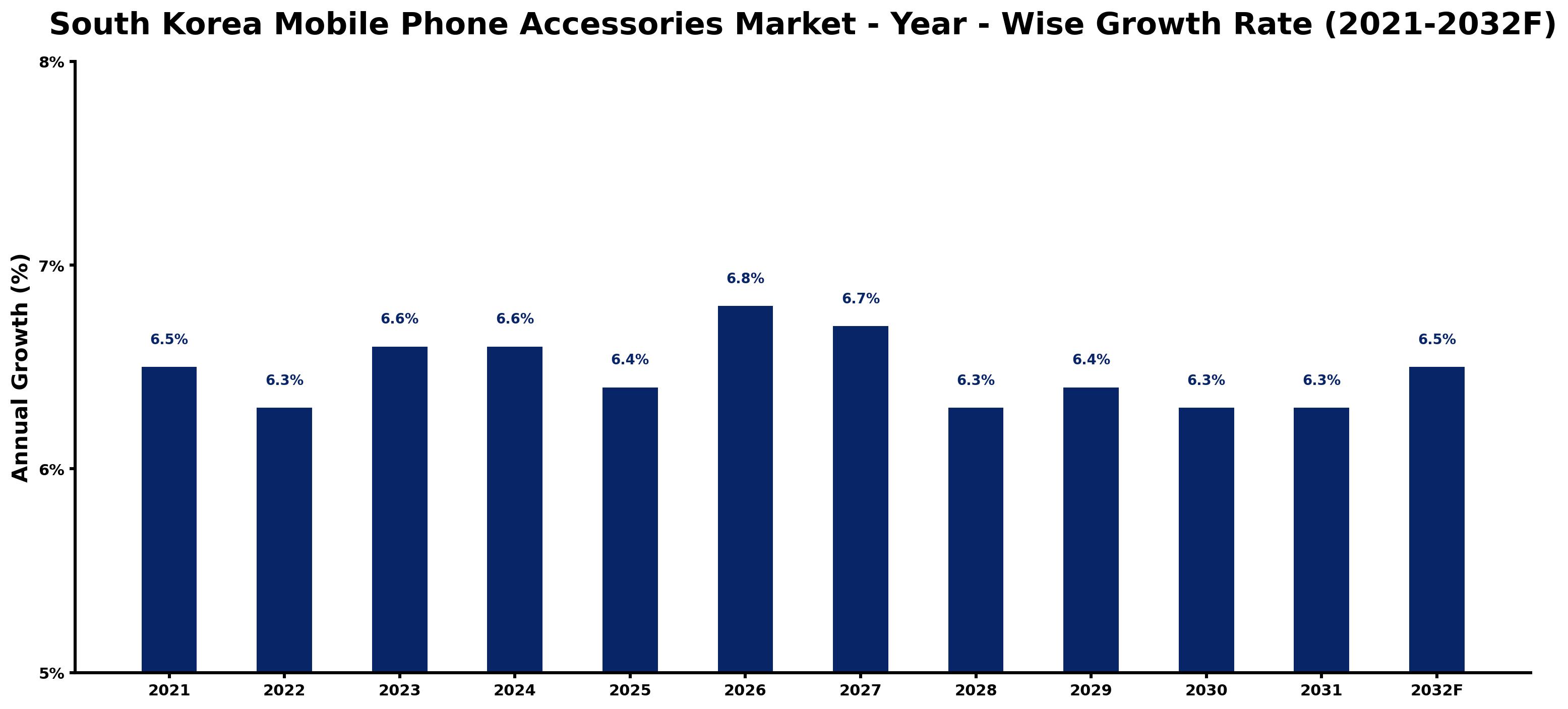
The table below presents the year wise growth rates along with the key drivers influencing the market
| Year | Growth Rate | Major Drivers |
| 2021 | 6.5% | Post-lockdown retail projects intensified online shopping, boosting accessory sales significantly. |
| 2022 | 6.3% | Rising smartphone ownership among younger demographics increased demand for innovative accessories. |
| 2023 | 6.6% | Technological improvements in mobile devices led to greater accessory compatibility and variety. |
| 2024 | 6.6% | Consumer preference for personalization drove sales of customizable mobile phone cases. |
| 2025 | 6.4% | Collaborations with local influencers enhanced brand visibility and market penetration strategies. |
| 2026 | 6.8% | Sustainability concerns prompted interest in eco-friendly materials for mobile phone accessories. |
| 2027 | 6.7% | Expansion of 5G networks encouraged demand for high-performance accessories and peripherals. |
| 2028 | 6.3% | Emerging trends in remote work increased reliance on mobile devices and their accessories. |
| 2029 | 6.4% | Smart home integration led to a rise in accessories that complement connected devices. |
| 2030 | 6.3% | Increased competition among brands fostered innovation in design and functionality of accessories. |
| 2031 | 6.3% | Enhanced e-commerce platforms enabled easier access to a broader range of products. |
| 2032 | 6.5% | Market consolidation among key players streamlined distribution channels and improved pricing strategies. |
Note - Market size estimations and growth projections presented in this report are based on 6Wresearch's advanced forecasting approach, validated with industry datasets as of June 2026.
South Korea Mobile Phone Accessories Market Synopsis
The South Korea Mobile Phone Accessories Market is projected to reach 6.8% and witness significant growth during the forecast period (2026-2032). This vibrant market is primarily driven by the increasing demand for personalized and enhanced smartphone functionalities among consumers. Various accessories, including protective cases, chargers, and headphones, are catering to a wide array of preferences while meeting the specific requirements of diverse devices.
South Korea Mobile Phone Accessories Market Growth Drivers
The growth of the South Korea Mobile Phone Accessories Market is substantiated by several key factors:
- Continuous innovation in smartphone technology fosters consumer interest in related accessories that enhance device performance.
- High consumer demand for personalization drives the popularity of customizable accessories, such as unique protective cases and stylish covers.
- Rapid advancements in technologies such as wireless charging and audio devices enhance the functionality and appeal of mobile accessories.
- An expanding base of smartphone users, including younger demographics who are trend-conscious and tech-savvy, propels market growth.
- Robust distribution networks and e-commerce platforms provide consumers with convenient access to a diverse range of mobile phone accessories.
South Korea Mobile Phone Accessories Market Trends and Opportunities
The South Korea Mobile Phone Accessories Market is experiencing several notable trends that present opportunities for stakeholders:
- Increasing integration of health and fitness features in accessories, such as smartwatches and fitness trackers, is attracting health-conscious consumers.
- Growth in sustainable practices and eco-friendly products, including accessories made from recyclable materials, is becoming a focal point for consumers.
- Emergence of smart accessories equipped with IoT technology, allowing users to manage and monitor devices more effectively.
- Heightened interest in augmented reality (AR) and virtual reality (VR) accessories, catering to gaming and immersive media experiences.
- Expansion of lifestyle branding among accessories, as companies target niche markets with unique product designs and collaborations.
South Korea Mobile Phone Accessories Market Challenges and Restraints
Despite the promising growth trajectory, the South Korea Mobile Phone Accessories Market faces several challenges:
- Intense competition among manufacturers necessitates constant innovation, making differentiation a critical challenge.
- Environmental concerns regarding the recycling and disposal of electronic accessories compel companies to rethink product life cycles.
- Rapid technological advancements may lead to compatibility issues with existing accessories, impacting consumer confidence.
- Fluctuating raw material costs can affect the pricing strategies of manufacturers, leading to potential market instability.
- Regulatory challenges around product safety and compliance require ongoing attention and investment from companies operating in the space.
South Korea Mobile Phone Accessories Market Government Investment and Initiatives
The South Korean government plays a significant role in the development of the mobile phone accessories market, implementing a range of policies and initiatives:
- Strict regulations are set in place to ensure product safety and quality standards for mobile accessories, fostering consumer trust.
- The government encourages recycling programs aimed at reducing electronic waste, which is particularly relevant in the fast-evolving mobile accessories sector.
- Incentives are provided to domestic manufacturers to promote the production of high-quality accessories, bolstering local industry.
- Public investments in technology development support innovation in mobile accessories, driving advancements in design and functionality.
- Initiatives to enhance consumer awareness regarding responsible disposal and environmental impacts of mobile accessories are being actively promoted.
South Korea Mobile Phone Accessories Market Latest Developments (May 2025 - June 2026)
In the period from May 2025 to June 2026, the South Korea Mobile Phone Accessories Market has seen several important developments:
- There has been an uptick in the launch of eco-friendly products, with various manufacturers unveiling lines made from sustainable materials.
- Advancements in wireless technology have led to the proliferation of wireless headphones and chargers, enhancing user convenience.
- Collaborations between accessory manufacturers and technology firms are increasing, focusing on integrating smart functionalities into traditional products.
- Consumer interest in AR and VR accessories has spurred product innovations, positioning companies to target the growing gaming market.
- Enhanced online retail strategies are being adopted, with brands focusing on direct-to-consumer channels to optimize sales and engagement.
South Korea Mobile Phone Accessories Market - Key Attractiveness of the Report
- 10 Years of Market Numbers
- Historical Data Starting from 2022 to 2025
- Base Year: 2025
- Forecast Data until 2032
- Key Performance Indicators Impacting the Market
- Major Upcoming Developments and Projects
Key Highlights of the Report:
- South Korea Mobile Phone Accessories Market Outlook
- Market Size of South Korea Mobile Phone Accessories Market, 2025
- Forecast of South Korea Mobile Phone Accessories Market, 2032
- Historical Data and Forecast of South Korea Mobile Phone Accessories Revenues & Volume for the Period 2022-2032F
- South Korea Mobile Phone Accessories Market Trend Evolution
- South Korea Mobile Phone Accessories Market Drivers and Challenges
- South Korea Mobile Phone Accessories Price Trends
- South Korea Mobile Phone Accessories Porter's Five Forces
- South Korea Mobile Phone Accessories Industry Life Cycle
- Historical Data and Forecast of South Korea Mobile Phone Accessories Market Revenues & Volume By Product Type for the Period 2022-2032F
- Historical Data and Forecast of South Korea Mobile Phone Accessories Market Revenues & Volume By Earphones/Headphone for the Period 2022-2032F
- Historical Data and Forecast of South Korea Mobile Phone Accessories Market Revenues & Volume By Charger for the Period 2022-2032F
- Historical Data and Forecast of South Korea Mobile Phone Accessories Market Revenues & Volume By Power Bank for the Period 2022-2032F
- Historical Data and Forecast of South Korea Mobile Phone Accessories Market Revenues & Volume By Protective Cases for the Period 2022-2032F
- Historical Data and Forecast of South Korea Mobile Phone Accessories Market Revenues & Volume By Others for the Period 2022-2032F
- Historical Data and Forecast of South Korea Mobile Phone Accessories Market Revenues & Volume By Distribution Channel for the Period 2022-2032F
- Historical Data and Forecast of South Korea Mobile Phone Accessories Market Revenues & Volume By Online for the Period 2022-2032F
- Historical Data and Forecast of South Korea Mobile Phone Accessories Market Revenues & Volume By Offline for the Period 2022-2032F
- Historical Data and Forecast of South Korea Mobile Phone Accessories Market Revenues & Volume By Price Range for the Period 2022-2032F
- Historical Data and Forecast of South Korea Mobile Phone Accessories Market Revenues & Volume By Premium for the Period 2022-2032F
- Historical Data and Forecast of South Korea Mobile Phone Accessories Market Revenues & Volume By Mid for the Period 2022-2032F
- Historical Data and Forecast of South Korea Mobile Phone Accessories Market Revenues & Volume By Low for the Period 2022-2032F
- South Korea Mobile Phone Accessories Import Export Trade Statistics
- Market Opportunity Assessment By Product Type
- Market Opportunity Assessment By Distribution Channel
- Market Opportunity Assessment By Price Range
- South Korea Mobile Phone Accessories Top Companies Market Share
- South Korea Mobile Phone Accessories Competitive Benchmarking By Technical and Operational Parameters
- South Korea Mobile Phone Accessories Company Profiles
- South Korea Mobile Phone Accessories Key Strategic Recommendations






































