South Korea Mobile Satellite Services Market Size & Growth Rate (2026-2032)
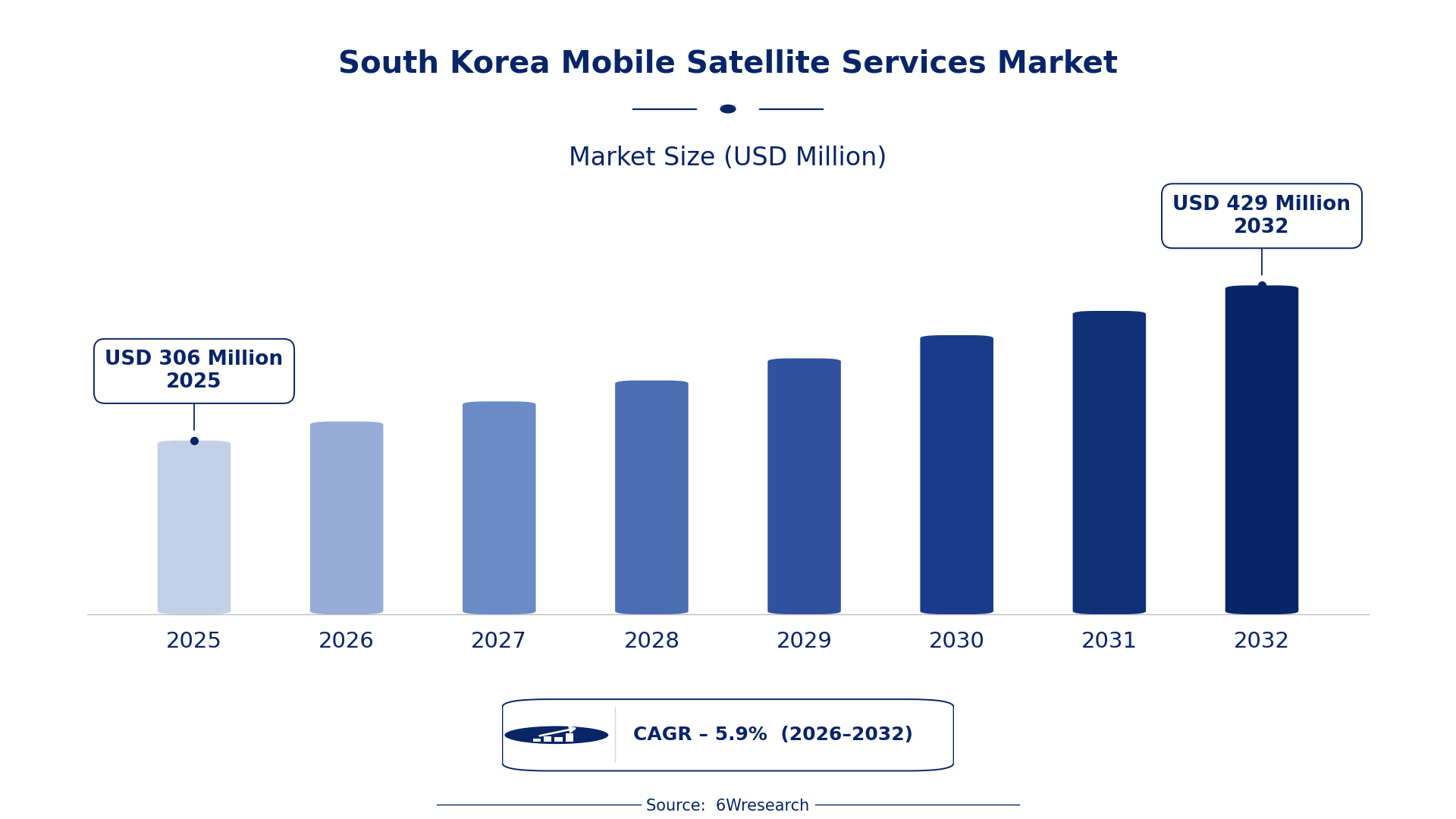
The South Korea Mobile Satellite Services Market was estimated at USD 306 Million in 2025 and is projected to reach USD 429 Million by 2032, growing at a CAGR of 5.9% from 2026 to 2032.
South Korea Mobile Satellite Services Market Synopsis
As South Korea continues to evolve technologically, the mobile satellite services market has emerged as a critical player in enabling communication in remote areas. This sector addresses the urgent need for reliable connectivity, particularly in regions where terrestrial networks are either insufficient or non-existent.
The market caters to various applications, including maritime, aviation, and emergency response communications. With a growing focus on broadband access and Internet of Things (IoT) solutions, mobile satellite services are becoming indispensable to both commercial and public sectors in South Korea.
South Korea Mobile Satellite Services Market Year-wise Growth Rate and Key Drivers
This graph illustrates the annual growth rates of the South Korea Mobile Satellite Services Market from 2021 to 2032, highlighting a steady upward trajectory and projected expansion over the forecast period.

The table below presents the year‑wise growth rates along with the key drivers influencing the market
| Year | Growth Rate | Major Drivers |
| 2021 | 5.9% | Launch of South Korea's domestic satellite program. |
| 2022 | 5.7% | Increased demand for broadband services in remote areas. |
| 2023 | 5.6% | Government support for rural satellite communications expansion. |
| 2024 | 6.0% | Rise in maritime connectivity solutions for fishing industry. |
| 2025 | 5.6% | Technological advancements in satellite communication systems. |
| 2026 | 6.1% | Growing adoption of IoT applications in urban planning. |
| 2027 | 6.0% | Enhanced collaboration between private satellite firms and government. |
| 2028 | 5.8% | Surge in military applications for satellite communication. |
| 2029 | 5.5% | Development of next-generation satellite technology by Korea's KARI. |
| 2030 | 5.6% | Increased investment in defense satellite communications programs. |
| 2031 | 6.1% | The 5G rollout driving demand for integrated satellite systems. |
| 2032 | 5.9% | Growth in telemedicine services utilizing satellite technology. |
Note: Market size estimations and growth projections presented in this report are based on 6Wresearch's proprietary forecasting methodology, utilizing the latest available industry data, government publications, and primary research inputs.
South Korea Mobile Satellite Services Market Key Takeaways
Below are some of the specific key takeaways from the market, including:
- The market's growth is primarily fueled by the increasing demand for connectivity in remote and underserved regions.
- Advancements in satellite technology are enhancing the reliability and capabilities of mobile satellite services.
- IoT integration is becoming a focal point for the deployment of mobile satellite communications.
- Regulatory frameworks are evolving to support the expansion of mobile satellite service networks.
- Investments in disaster response communications are elevating the market's profile across multiple sectors.
Evaluation of Restraints in South Korea Mobile Satellite Services Market
Despite its growth potential, the South Korea mobile satellite services market faces several constraints. Spectrum allocation remains a contentious issue, complicating efforts to expand services. Regulatory challenges further hinder seamless connectivity, especially in remote regions. Latency and bandwidth limitations continue to pose obstacles, particularly for applications requiring real-time data transfer. Finally, competition from terrestrial mobile networks adds another layer of complexity, as these networks become more capable of serving similar markets.
South Korea Mobile Satellite Services Market Trends
Several trends are currently shaping the South Korea mobile satellite services market. The integration of advanced satellite technologies, such as high-throughput satellites (HTS), is significantly improving data speeds and capacity. There's also a marked shift towards hybrid solutions that combine terrestrial and satellite technologies, catering to diverse operational needs. Furthermore, the increase in IoT devices is driving demand for mobile satellite communications, making it easier for businesses to connect and manage assets across varied locations.
South Korea Mobile Satellite Services Market Opportunities
The opportunities for growth in this market are substantial. With the government emphasizing connectivity in underserved areas, new projects are likely to emerge that facilitate mobile satellite service expansion. The growing emphasis on disaster management and response presents another avenue for investment. Additionally, as industries such as logistics and agriculture adopt IoT solutions, the demand for mobile satellite connectivity will continue to rise, providing ample opportunities for service providers.
Government Initiatives in the South Korea Mobile Satellite Services Market
Government policies in South Korea are actively fostering the growth of the mobile satellite services market. With initiatives aimed at improving national telecommunications infrastructure, the regulatory environment is becoming more conducive to investment and innovation. Such policies are essential for addressing connectivity gaps and enhancing emergency response capabilities across the nation.
- A national digital infrastructure upgrade programme was completed recently to enhance mobile satellite service accessibility in rural areas.
- Currently, ongoing research and development initiatives are being supported by the government to improve satellite technology efficiency.
- A regulatory framework that promotes spectrum management for mobile satellite services is in the implementation phase.
- A planned public-private partnership is expected to increase telecommunications infrastructure access by 2028.
Future Insights of the South Korea Mobile Satellite Services Market
Looking ahead to 2026-2032, the South Korea mobile satellite services market is set to experience a paradigm shift driven by technological advancements and regulatory support. The convergence of satellite and terrestrial networks will likely reshape service delivery. As demand for broadband access in remote areas escalates, companies that prioritize innovation will be positioned to capitalize on emerging opportunities.
South Korea Mobile Satellite Services Market Latest Developments
Over the past year, the South Korea mobile satellite services market has seen notable activity, indicating a vibrant sector poised for growth. Companies are increasingly focusing on enhancing service reliability and expanding their networks to meet rising demand.
- A leading regional operator launched a new satellite communication service in early 2025, enhancing coverage for maritime operations.
- In mid-2025, a major technology vendor announced an initiative to upgrade satellite communication equipment, which is currently underway.
- A rollout of IoT-focused satellite services is expected to begin in the second half of 2026, aimed at supporting various industries.
- Recently, a partnership formed between key stakeholders aims to streamline mobile satellite service deployment in remote areas, with phases already launched.
South Korea Mobile Satellite Services Market - Key Attractiveness of the Report
- 10 Years of Market Numbers
- Historical Data Starting from 2022 to 2025
- Base Year: 2025
- Forecast Data until 2032
- Key Performance Indicators Impacting the Market
- Major Upcoming Developments and Projects
Key Highlights of the Report:
- South Korea Mobile Satellite Services Market Outlook
- Market Size of South Korea Mobile Satellite Services Market, 2025
- Forecast of South Korea Mobile Satellite Services Market, 2032
- Historical Data and Forecast of South Korea Mobile Satellite Services Revenues & Volume for the Period 2022-2032F
- South Korea Mobile Satellite Services Market Trend Evolution
- South Korea Mobile Satellite Services Market Drivers and Challenges
- South Korea Mobile Satellite Services Price Trends
- South Korea Mobile Satellite Services Porter's Five Forces
- South Korea Mobile Satellite Services Industry Life Cycle
- Historical Data and Forecast of South Korea Mobile Satellite Services Market Revenues & Volume By Services for the Period 2022-2032F
- Historical Data and Forecast of South Korea Mobile Satellite Services Market Revenues & Volume By Video for the Period 2022-2032F
- Historical Data and Forecast of South Korea Mobile Satellite Services Market Revenues & Volume By Voice for the Period 2022-2032F
- Historical Data and Forecast of South Korea Mobile Satellite Services Market Revenues & Volume By Data for the Period 2022-2032F
- Historical Data and Forecast of South Korea Mobile Satellite Services Market Revenues & Volume By Tracking for the Period 2022-2032F
- Historical Data and Forecast of South Korea Mobile Satellite Services Market Revenues & Volume By Monitoring Services for the Period 2022-2032F
- Historical Data and Forecast of South Korea Mobile Satellite Services Market Revenues & Volume By Access Type for the Period 2022-2032F
- Historical Data and Forecast of South Korea Mobile Satellite Services Market Revenues & Volume By Land Mobile for the Period 2022-2032F
- Historical Data and Forecast of South Korea Mobile Satellite Services Market Revenues & Volume By Maritime for the Period 2022-2032F
- Historical Data and Forecast of South Korea Mobile Satellite Services Market Revenues & Volume By Aeronautical for the Period 2022-2032F
- Historical Data and Forecast of South Korea Mobile Satellite Services Market Revenues & Volume By Industry Vertical for the Period 2022-2032F
- Historical Data and Forecast of South Korea Mobile Satellite Services Market Revenues & Volume By Oil and gas for the Period 2022-2032F
- Historical Data and Forecast of South Korea Mobile Satellite Services Market Revenues & Volume By Media and entertainment for the Period 2022-2032F
- Historical Data and Forecast of South Korea Mobile Satellite Services Market Revenues & Volume By Mining for the Period 2022-2032F
- Historical Data and Forecast of South Korea Mobile Satellite Services Market Revenues & Volume By Military and defense for the Period 2022-2032F
- Historical Data and Forecast of South Korea Mobile Satellite Services Market Revenues & Volume By Aviation for the Period 2022-2032F
- Historical Data and Forecast of South Korea Mobile Satellite Services Market Revenues & Volume By Transportation for the Period 2022-2032F
- Historical Data and Forecast of South Korea Mobile Satellite Services Market Revenues & Volume By Others for the Period 2022-2032F
- South Korea Mobile Satellite Services Import Export Trade Statistics
- Market Opportunity Assessment By Services
- Market Opportunity Assessment By Access Type
- Market Opportunity Assessment By Industry Vertical
- South Korea Mobile Satellite Services Top Companies Market Share
- South Korea Mobile Satellite Services Competitive Benchmarking By Technical and Operational Parameters
- South Korea Mobile Satellite Services Company Profiles
- South Korea Mobile Satellite Services Key Strategic Recommendations






































