South Korea Mobile Security Market Size & Growth Rate (2026-2032)
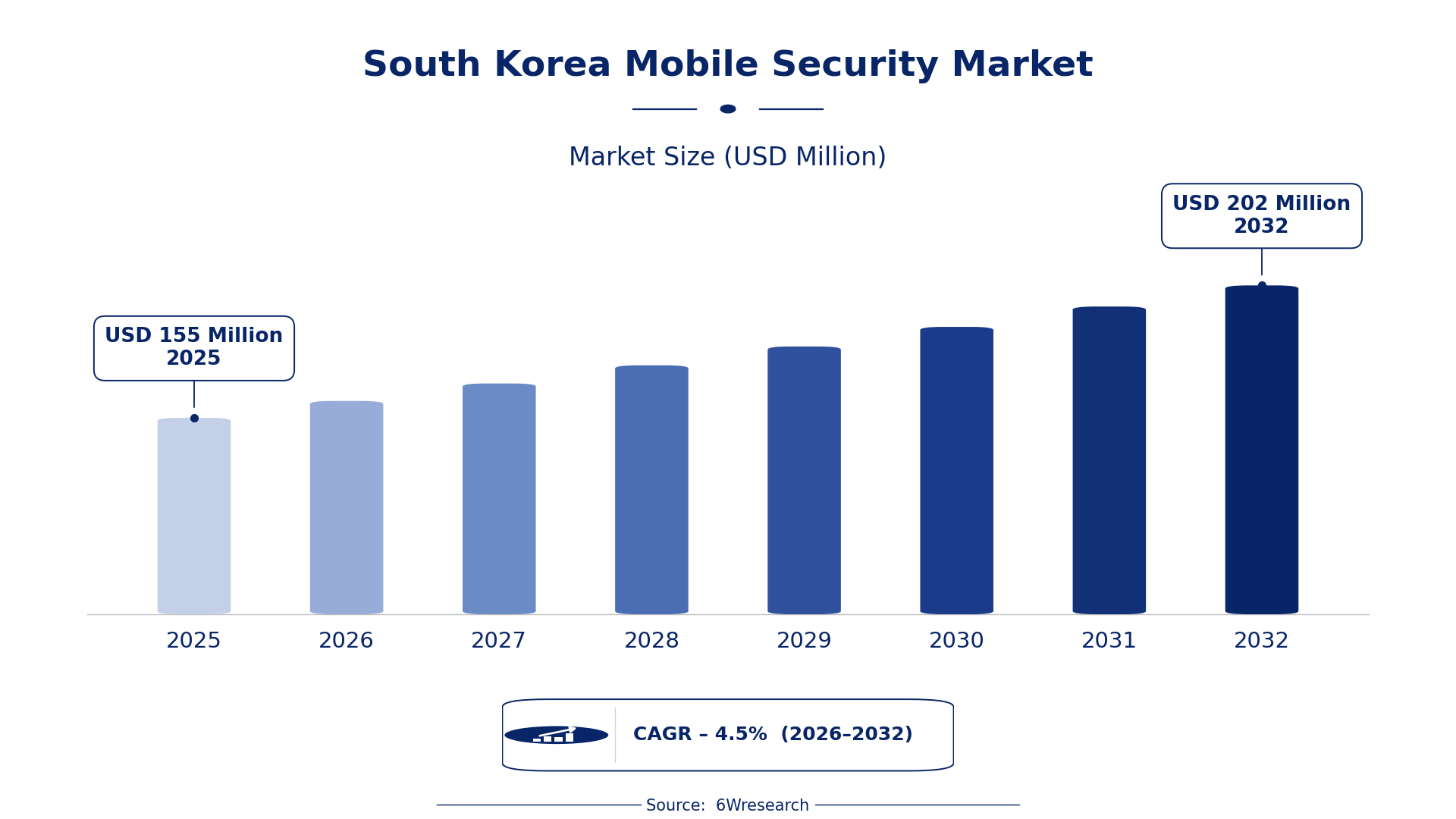
The South Korea Mobile Security Market was estimated at USD 155 Million in 2025 and is projected to reach USD 202 Million by 2032, growing at a CAGR of 4.5% from 2026 to 2032.
South Korea Mobile Security Market Synopsis
The escalating concerns about cyber threats are the most influential force impacting the South Korea Mobile Security Market today. With the rapid adoption of mobile banking and e-commerce, there is an urgent need for advanced security solutions that can protect sensitive user data.
The demand for mobile security solutions is being amplified by the need for compliance with strict data protection regulations. As organizations prioritize user privacy and data integrity, they are compelled to invest in enhanced encryption, biometric authentication, and comprehensive threat detection systems.
South Korea Mobile Security Market Year-wise Growth Rate and Key Drivers
This graph illustrates the annual growth rates of the South Korea Mobile Security Market from 2021 to 2032, highlighting a steady upward trajectory and projected expansion over the forecast period.
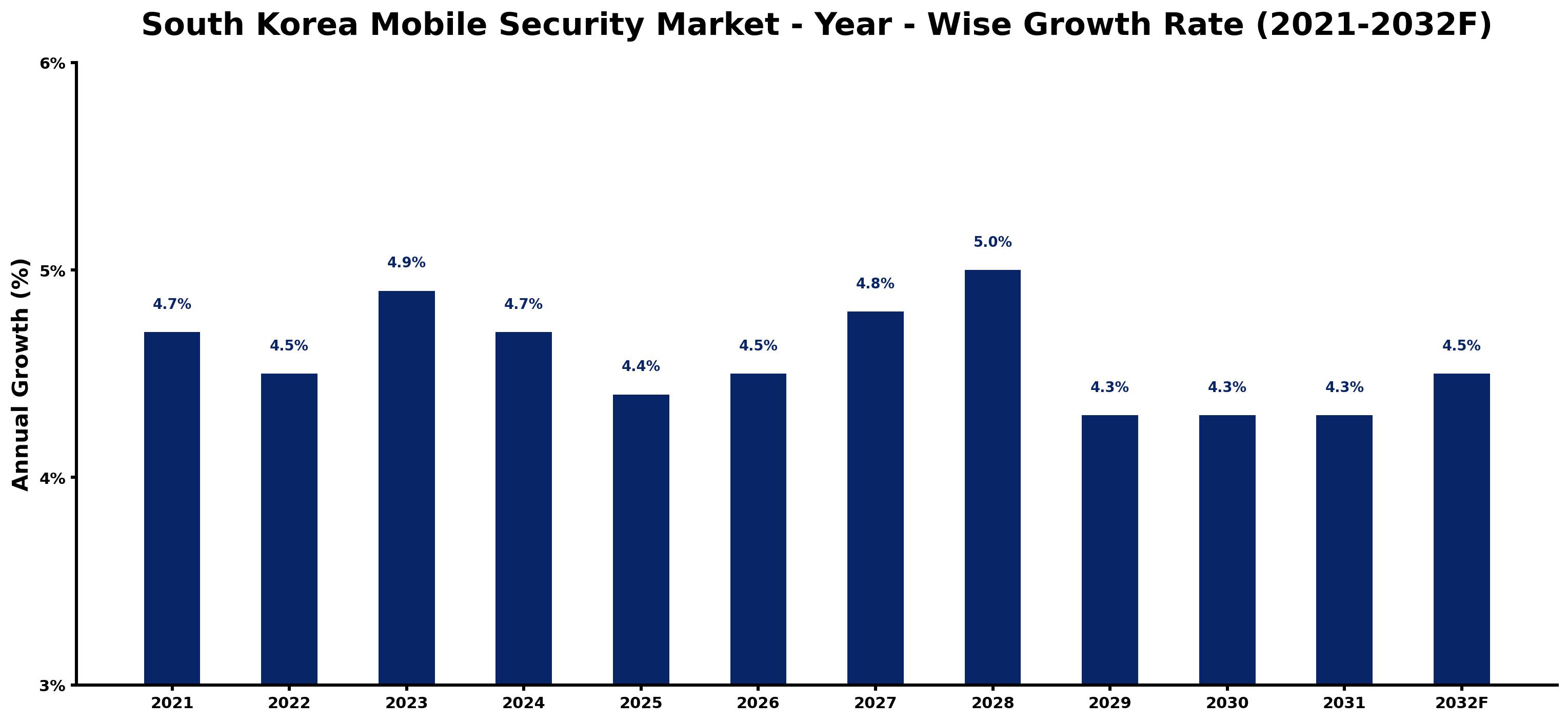
The table below presents the year‑wise growth rates along with the key drivers influencing the market
| Year | Growth Rate | Major Drivers |
| 2021 | 4.7% | Increased investment in 5G technology enhances security needs. |
| 2022 | 4.5% | Rise in mobile payment usage boosts security software demand. |
| 2023 | 4.9% | Cybersecurity breaches prompt heightened mobile security regulations. |
| 2024 | 4.7% | Public sector digitization initiatives drive mobile security advancements. |
| 2025 | 4.4% | Growing smartphone penetration rate increases vulnerability concerns. |
| 2026 | 4.5% | Local fintech startups demand robust mobile security solutions. |
| 2027 | 4.8% | Government support for mobile app innovation strengthens security focus. |
| 2028 | 5.0% | Emergence of smart devices necessitates advanced mobile protection. |
| 2029 | 4.3% | Digital banking growth ignites demand for secure mobile transactions. |
| 2030 | 4.3% | Increased consumer awareness of cyber threats bolsters market growth. |
| 2031 | 4.3% | Regulatory frameworks for data protection enlarge mobile security scope. |
| 2032 | 4.5% | Collaboration between tech firms and government enhances security standards. |
Note: Market size estimations and growth projections presented in this report are based on 6Wresearch's proprietary forecasting methodology, utilizing the latest available industry data, government publications, and primary research inputs.
South Korea Mobile Security Market Key Takeaways
Below are some of the specific key takeaways from the market, including:
- Increasing investments in mobile security due to rising instances of data breaches and cyber threats.
- Biometric authentication and encryption technologies are becoming standard security measures.
- The regulatory environment is driving compliance-related investments in security solutions.
- Growing awareness of security best practices among consumers and enterprises.
- Innovation in mobile threat detection systems is reshaping the security solution offerings.
Evaluation of Restraints in South Korea Mobile Security Market
One of the key restraints in the South Korea Mobile Security Market is the rapidly evolving nature of cyber threats that outpace current security measures. Businesses often struggle to balance the need for robust security with maintaining user convenience, which can hinder adoption rates. on top of that, stringent compliance requirements can create barriers for smaller firms that may lack the resources to meet these standards. Additionally, user education on security practices remains a significant challenge, as many individuals still overlook basic security protocols, making them susceptible to attacks.
South Korea Mobile Security Market Trends
An increasing trend is the integration of artificial intelligence in mobile security solutions. AI-driven technologies are now being utilized for real-time threat detection and automated response systems, enhancing the efficacy of security measures. Another notable trend is the rise of mobile-first strategies among businesses, necessitating more comprehensive security frameworks that can safeguard user data across multiple platforms.
on top of that, the shift towards decentralized applications and blockchain technologies is influencing how security is approached in the mobile space. Companies are exploring the use of these technologies to enhance data security and transaction integrity, which could lead to innovative mobile security solutions.
South Korea Mobile Security Market Opportunities
The South Korea Mobile Security Market presents ample growth opportunities driven by the increasing penetration of mobile devices in both consumer and enterprise sectors. There is a growing need for tailored security solutions for verticals such as finance, healthcare, and e-commerce, where sensitive data is prevalent. on top of that, as 5G technology becomes more widespread, the demand for enhanced mobile security solutions will likely surge, making it a lucrative area for investment.
Investment in user education programs and partnerships with technology vendors can also open new avenues for market players, enhancing their service offerings and fostering trust among consumers.
Government Initiatives in the South Korea Mobile Security Market
The South Korean government is actively shaping the Mobile Security Market through stringent regulations and proactive initiatives aimed at enhancing cybersecurity. Current public policies prioritize user data protection and seek to foster a collaborative environment between the public and private sectors to tackle rising cyber threats. These measures are critical in ensuring that mobile devices and applications remain secure amidst evolving risks.
- A national digital security framework was launched in early 2025 to establish encryption and data protection standards for mobile applications.
- Ongoing initiatives include public-private partnerships focusing on mobile threat detection and response, enhancing the overall security posture of mobile infrastructure.
- Plans are in place for a regulatory update expected to be completed by late 2026, which will mandate compliance checks for mobile security measures in enterprises.
- The government is currently implementing awareness campaigns to educate citizens about mobile security risks and best practices.
- Upcoming funding programs are set to support startups developing innovative mobile security solutions, anticipated to roll out in 2027.
Future Insights of the South Korea Mobile Security Market
Looking ahead to 2026-2032, the South Korea Mobile Security Market is expected to experience a robust growth trajectory. As digital transactions continue to proliferate, the sophistication of cyber threats will escalate, compelling organizations to adopt advanced security protocols. on top of that, the integration of technologies such as AI and blockchain will not only enhance security capabilities but also create entirely new paradigms for data protection. The convergence of mobile and IoT technologies will further drive the demand for innovative security solutions tailored to protect a wide range of connected devices.
South Korea Mobile Security Market Latest Developments
Recent developments in the South Korea Mobile Security Market indicate a growing emphasis on strengthening security frameworks amidst rising threats. In the past year, companies have been focusing on enhancing their mobile security offerings to keep pace with technological advancements and regulatory changes. This trend reflects a collective commitment to safeguarding user data and ensuring compliance with government regulations.
- A major technology vendor launched a new mobile security platform in Q1 2025, aimed at integrating AI-driven threat detection features.
- An initiative that began in mid-2025 is currently underway, focusing on developing standards for secure mobile app development.
- Plans are in place for an industry-wide cybersecurity conference scheduled for early 2026, designed to promote knowledge-sharing among mobile security professionals.
- By late 2025, a collaborative project was established to enhance encryption protocols across major telecommunications networks.
- Ongoing partnerships between universities and industry leaders are expected to yield innovative mobile security research outcomes by 2026.
South Korea Mobile Security Market - Key Attractiveness of the Report
- 10 Years of Market Numbers
- Historical Data Starting from 2022 to 2025
- Base Year: 2025
- Forecast Data until 2032
- Key Performance Indicators Impacting the Market
- Major Upcoming Developments and Projects
Key Highlights of the Report:
- South Korea Mobile Security Market Outlook
- Market Size of South Korea Mobile Security Market, 2025
- Forecast of South Korea Mobile Security Market, 2032
- Historical Data and Forecast of South Korea Mobile Security Revenues & Volume for the Period 2022-2032F
- South Korea Mobile Security Market Trend Evolution
- South Korea Mobile Security Market Drivers and Challenges
- South Korea Mobile Security Price Trends
- South Korea Mobile Security Porter's Five Forces
- South Korea Mobile Security Industry Life Cycle
- Historical Data and Forecast of South Korea Mobile Security Market Revenues & Volume By End User for the Period 2022-2032F
- Historical Data and Forecast of South Korea Mobile Security Market Revenues & Volume By Individual for the Period 2022-2032F
- Historical Data and Forecast of South Korea Mobile Security Market Revenues & Volume By Enterprise (Solution (Authentication, Application Security, & Device Security), Service) for the Period 2022-2032F
- Historical Data and Forecast of South Korea Mobile Security Market Revenues & Volume By Deployment Mode for the Period 2022-2032F
- Historical Data and Forecast of South Korea Mobile Security Market Revenues & Volume By On-premises for the Period 2022-2032F
- Historical Data and Forecast of South Korea Mobile Security Market Revenues & Volume By Cloud for the Period 2022-2032F
- Historical Data and Forecast of South Korea Mobile Security Market Revenues & Volume By Organization Size for the Period 2022-2032F
- Historical Data and Forecast of South Korea Mobile Security Market Revenues & Volume By Small and Medium-Sized Enterprises (SMEs) for the Period 2022-2032F
- Historical Data and Forecast of South Korea Mobile Security Market Revenues & Volume By Large Enterprises for the Period 2022-2032F
- Historical Data and Forecast of South Korea Mobile Security Market Revenues & Volume By Vertical for the Period 2022-2032F
- Historical Data and Forecast of South Korea Mobile Security Market Revenues & Volume By BFSI for the Period 2022-2032F
- Historical Data and Forecast of South Korea Mobile Security Market Revenues & Volume By Telecom & IT for the Period 2022-2032F
- Historical Data and Forecast of South Korea Mobile Security Market Revenues & Volume By Retail for the Period 2022-2032F
- Historical Data and Forecast of South Korea Mobile Security Market Revenues & Volume By Healthcare for the Period 2022-2032F
- Historical Data and Forecast of South Korea Mobile Security Market Revenues & Volume By Government & Defense for the Period 2022-2032F
- Historical Data and Forecast of South Korea Mobile Security Market Revenues & Volume By Manufacturing for the Period 2022-2032F
- Historical Data and Forecast of South Korea Mobile Security Market Revenues & Volume By Others for the Period 2022-2032F
- Historical Data and Forecast of South Korea Mobile Security Market Revenues & Volume By Operating System for the Period 2022-2032F
- Historical Data and Forecast of South Korea Mobile Security Market Revenues & Volume By iOS for the Period 2022-2032F
- Historical Data and Forecast of South Korea Mobile Security Market Revenues & Volume By Android for the Period 2022-2032F
- South Korea Mobile Security Import Export Trade Statistics
- Market Opportunity Assessment By End User
- Market Opportunity Assessment By Deployment Mode
- Market Opportunity Assessment By Organization Size
- Market Opportunity Assessment By Vertical
- Market Opportunity Assessment By Operating System
- South Korea Mobile Security Top Companies Market Share
- South Korea Mobile Security Competitive Benchmarking By Technical and Operational Parameters
- South Korea Mobile Security Company Profiles
- South Korea Mobile Security Key Strategic Recommendations






































