South Korea Molded Pulp Packaging Market Size, Share & Growth Rate
The South Korea Molded Pulp Packaging Market was estimated at USD 218 Million in 2025 and is projected to reach USD 287 Million by 2032, growing at a CAGR of 4.0% from 2026 to 2032. This positive trajectory is largely influenced by a growing emphasis on sustainable practices across sectors such as electronics, healthcare, and food & beverage. As South Korean consumers increasingly gravitate towards environmentally friendly options, manufacturers are adopting innovative biodegradable materials that resonate with these preferences and comply with evolving regulations.
South Korea Molded Pulp Packaging Market Year-wise Growth Rate and Key Drivers
This graph highlights how the South Korea Molded Pulp Packaging Market has steadily grown over the years, supported by major growth factors.
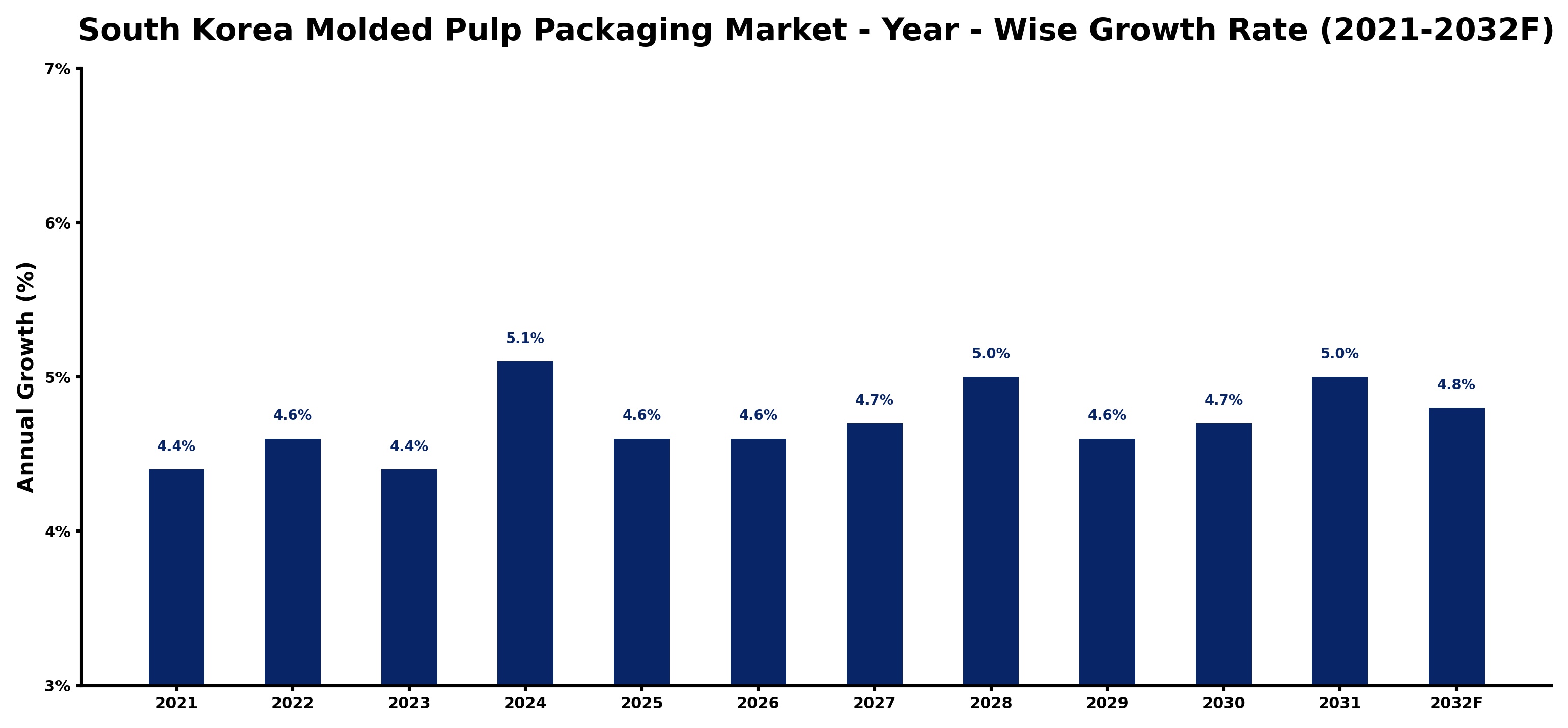
The table below presents the year‑wise growth rates along with the key drivers influencing the market
| Year | Growth Rate | Major Drivers |
| 2021 | 4.4% | Increasing industrial infrastructure investments |
| 2022 | 4.6% | Rising electricity demand across industries |
| 2023 | 4.4% | Growing urbanization and commercial development |
| 2024 | 5.1% | Expansion of transportation and logistics networks |
| 2025 | 4.6% | Growing renewable energy integration projects |
| 2026 | 4.6% | Government infrastructure modernization initiatives |
| 2027 | 4.7% | Rising electricity demand across industries |
| 2028 | 5.0% | Expansion of manufacturing activities |
| 2029 | 4.6% | Increasing industrial infrastructure investments |
| 2030 | 4.7% | Increasing adoption of advanced technologies |
| 2031 | 5.0% | Rapid growth in telecom and data center sectors |
| 2032 | 4.8% | Growing renewable energy integration projects |
Note - Market size estimations and growth projections presented in this report are based on 6Wresearch’s advanced forecasting approach, validated with industry datasets as of June 2026.
South Korea Molded Pulp Packaging Market Synopsis
The molded pulp packaging market in South Korea is currently experiencing notable momentum, primarily driven by heightened environmental awareness and regulatory pressures aimed at minimizing single-use plastics. This rising demand is fostering an environment ripe for innovation in design and production processes, as companies pivot towards more sustainable packaging solutions.
Furthermore, the diverse applications of molded pulp packaging in industries such as electronics and food & beverage are enhancing its appeal. As organizations prioritize eco-friendly initiatives, the market is poised for robust growth, marking a significant shift in traditional packaging paradigms.
South Korea Molded Pulp Packaging Market Key Takeaways
- Growing emphasis on sustainability is driving demand for molded pulp packaging solutions.
- Innovative production techniques and material sourcing are transforming the market landscape.
- Regulatory frameworks are increasingly favoring environmentally friendly packaging options.
- Diverse applications across multiple industries enhance the market's growth potential.
- Continued government support is fostering the transition to biodegradable packaging materials.
Evaluation of Restraints in South Korea Molded Pulp Packaging Market
While the South Korea molded pulp packaging market demonstrates considerable growth potential, it faces notable challenges that may inhibit its full capacity. One of the primary concerns is the consistency of product quality; achieving uniformity in molded pulp products often proves difficult due to variability in raw materials and production methods. Additionally, stringent packaging standards demand that manufacturers not only adhere to environmental regulations but also fulfill industry-specific quality requirements. These factors, combined with scalability issues and logistical complexities, could hinder broader market expansion as companies attempt to meet increasing demand.
South Korea Molded Pulp Packaging Market Trends
Current trends in the molded pulp packaging market reveal a strong focus on sustainable design and material innovation. Companies are increasingly employing advanced technology to enhance production efficiency while reducing waste. Moreover, collaborations between manufacturers and research institutions are leading to the development of new biodegradable materials that are both functional and sustainable.
The rising trend of circular economy practices is also influencing product development, encouraging firms to adopt closed-loop systems that minimize environmental impact. Additionally, consumer preferences are shifting towards eco-friendly alternatives, pushing brands to rethink their packaging strategies.
South Korea Molded Pulp Packaging Market Opportunities
Significant opportunities for growth in the molded pulp packaging market lie within the healthcare and electronics sectors. As these industries face increasing scrutiny regarding their environmental footprints, the demand for sustainable packaging solutions is set to rise. The trend of e-commerce and online food delivery services is also creating a burgeoning market for custom molded pulp packaging that can provide both protection and sustainability. Furthermore, as consumers become more environmentally conscious, brands that invest in innovative molded pulp solutions are likely to gain a competitive edge.
Government Initiatives in the South Korea Molded Pulp Packaging Market
The South Korean government actively promotes the transition to molded pulp packaging as part of its broader environmental strategy. Numerous initiatives, including subsidies and awareness campaigns, are aimed at encouraging companies to replace traditional packaging materials with biodegradable options. These government measures not only facilitate financial assistance for businesses adopting sustainable practices but also foster public awareness regarding the benefits of eco-friendly packaging solutions.
Future Insights of the South Korea Molded Pulp Packaging Market
Looking ahead to the period between 2026 and 2032, the molded pulp packaging market in South Korea is expected to continue its upward trajectory. Factors such as stringent environmental regulations, evolving consumer preferences, and innovative technological advancements will contribute to this growth. As companies increasingly focus on sustainability, the adoption of molded pulp solutions is likely to become a standard practice across multiple industries, paving the way for a significant transformation in packaging paradigms.
South Korea Molded Pulp Packaging Market Latest Developments (May 2025 - June 2026)
Recent developments in the molded pulp packaging market underscore a heightened focus on sustainability and innovation. Industry players are increasingly embracing advanced technologies to improve the efficiency and efficacy of production processes. Additionally, there has been a notable increase in collaborations aimed at developing new materials that enhance the functionality of molded pulp packaging. Such initiatives are expected to lead to more diverse and adaptable product offerings, catering to a wider range of consumer needs.
South Korea Molded Pulp Packaging Market - Key Attractiveness of the Report
- 10 Years of Market Numbers
- Historical Data Starting from 2022 to 2025
- Base Year: 2025
- Forecast Data until 2032
- Key Performance Indicators Impacting the Market
- Major Upcoming Developments and Projects
Key Highlights of the Report:
- South Korea Molded Pulp Packaging Market Outlook
- Market Size of South Korea Molded Pulp Packaging Market, 2025
- Forecast of South Korea Molded Pulp Packaging Market, 2032
- Historical Data and Forecast of South Korea Molded Pulp Packaging Revenues & Volume for the Period 2022-2032F
- South Korea Molded Pulp Packaging Market Trend Evolution
- South Korea Molded Pulp Packaging Market Drivers and Challenges
- South Korea Molded Pulp Packaging Price Trends
- South Korea Molded Pulp Packaging Porter's Five Forces
- South Korea Molded Pulp Packaging Industry Life Cycle
- Historical Data and Forecast of South Korea Molded Pulp Packaging Market Revenues & Volume By Source for the Period 2022-2032F
- Historical Data and Forecast of South Korea Molded Pulp Packaging Market Revenues & Volume By Wood Pulp for the Period 2022-2032F
- Historical Data and Forecast of South Korea Molded Pulp Packaging Market Revenues & Volume By Non-wood Pulp for the Period 2022-2032F
- Historical Data and Forecast of South Korea Molded Pulp Packaging Market Revenues & Volume By Molded Type for the Period 2022-2032F
- Historical Data and Forecast of South Korea Molded Pulp Packaging Market Revenues & Volume By Thick Wall for the Period 2022-2032F
- Historical Data and Forecast of South Korea Molded Pulp Packaging Market Revenues & Volume By Transfer for the Period 2022-2032F
- Historical Data and Forecast of South Korea Molded Pulp Packaging Market Revenues & Volume By Thermoformed for the Period 2022-2032F
- Historical Data and Forecast of South Korea Molded Pulp Packaging Market Revenues & Volume By Processed for the Period 2022-2032F
- Historical Data and Forecast of South Korea Molded Pulp Packaging Market Revenues & Volume By Product for the Period 2022-2032F
- Historical Data and Forecast of South Korea Molded Pulp Packaging Market Revenues & Volume By Trays for the Period 2022-2032F
- Historical Data and Forecast of South Korea Molded Pulp Packaging Market Revenues & Volume By End Caps for the Period 2022-2032F
- Historical Data and Forecast of South Korea Molded Pulp Packaging Market Revenues & Volume By Bowls & Cups for the Period 2022-2032F
- Historical Data and Forecast of South Korea Molded Pulp Packaging Market Revenues & Volume By Clamshells for the Period 2022-2032F
- Historical Data and Forecast of South Korea Molded Pulp Packaging Market Revenues & Volume By Plates for the Period 2022-2032F
- Historical Data and Forecast of South Korea Molded Pulp Packaging Market Revenues & Volume By Others for the Period 2022-2032F
- South Korea Molded Pulp Packaging Import Export Trade Statistics
- Market Opportunity Assessment By Source
- Market Opportunity Assessment By Molded Type
- Market Opportunity Assessment By Product
- South Korea Molded Pulp Packaging Top Companies Market Share
- South Korea Molded Pulp Packaging Competitive Benchmarking By Technical and Operational Parameters
- South Korea Molded Pulp Packaging Company Profiles
- South Korea Molded Pulp Packaging Key Strategic Recommendations






































