South Korea Multifunctional Composite Materials Market Summary
The south korea multifunctional composite materials market was estimated at USD 424 Million in 2025 and is projected to reach USD 592 Million by 2032, growing at a CAGR of 5.4% from 2026 to 2032.
South Korea Multifunctional Composite Materials Market Year-wise Growth Rate and Key Drivers
This graph highlights how the South Korea Multifunctional Composite Materials Market has steadily grown over the past five years, supported by major growth factors.
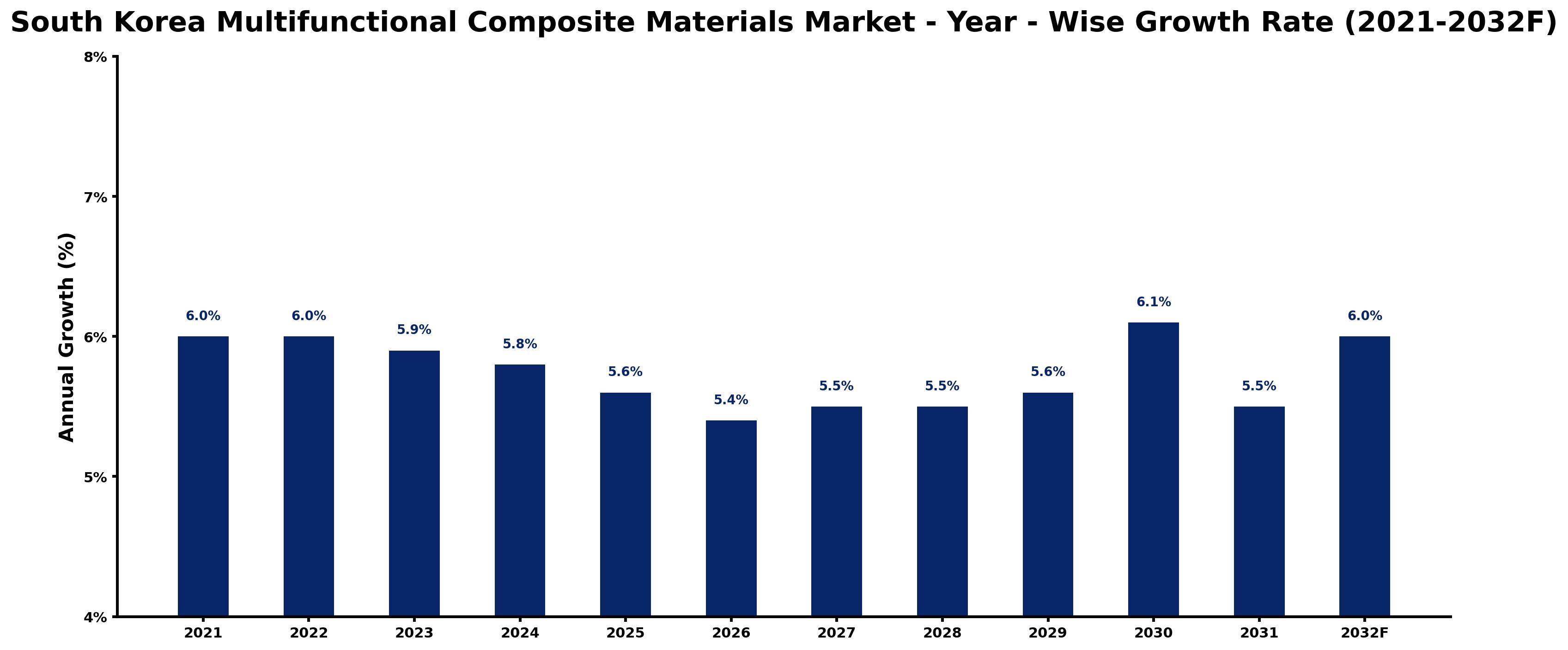
The table below presents the year wise growth rates along with the key drivers influencing the market
| Year | Growth Rate | Major Drivers |
| 2021 | 6.0% | Post-pandemic recovery in construction led to an uptick in material sourcing strategies. |
| 2022 | 6.0% | Emerging trends in lightweight materials began reshaping product development across industries. |
| 2023 | 5.9% | R&D investments focused on enhancing durability and versatility in composite materials surged. |
| 2024 | 5.8% | Challenges from traditional materials prompted companies to explore multifunctional alternatives. |
| 2025 | 5.6% | Local manufacturing capabilities expanded, reducing reliance on imported composite solutions significantly. |
| 2026 | 5.4% | Increased collaboration between academia and industry accelerated innovation in multifunctional composites. |
| 2027 | 5.5% | Sustainability concerns pushed manufacturers to prioritize eco-friendly materials in their offerings. |
| 2028 | 5.5% | Technological breakthroughs in nanocomposites led to enhanced performance in key applications. |
| 2029 | 5.6% | Investment in aerospace and automotive sectors drove demand for advanced composite materials. |
| 2030 | 6.1% | Emerging markets within South Korea began adopting multifunctional composites for localized solutions. |
| 2031 | 5.5% | Shifts in consumer preferences encouraged the use of multifunctional materials in everyday products. |
| 2032 | 6.0% | A comprehensive digital transformation in manufacturing streamlined production of composite materials. |
Note - Market size estimations and growth projections presented in this report are based on 6Wresearch's advanced forecasting approach, validated with industry datasets as of June 2026.
South Korea Multifunctional Composite Materials Market Synopsis
The South Korea Multifunctional Composite Materials Market is projected to reach 5.4% and witness significant growth during the forecast period (2026-2032). This market's expansion is largely attributed to the increasing demand for lightweight and high-strength materials across several industries, prominently including automotive, aerospace, and construction. Multifunctional composite materials provide an array of benefits such as thermal conductivity, electrical insulation, and enhanced impact resistance, effectively making them suitable for a diverse range of applications. Innovations in material science, paired with the ongoing push for sustainability, are pivotal in propelling market growth.
South Korea Multifunctional Composite Materials Market Growth Drivers
The growth trajectory of the South Korea Multifunctional Composite Materials Market is underpinned by several key drivers:
- Increasing demand across industries such as automotive and aerospace for lightweight components that can lead to improved fuel efficiency and reduced emissions.
- Advancements in manufacturing processes that allow for the production of composites with enhanced properties, thereby widening their application spectrum.
- The regulatory push towards sustainability and eco-friendly materials, encouraging industries to adopt multifunctional composites that align with global environmental standards.
- The ongoing trend of digitalization and automation in manufacturing, which further optimizes the production of composite materials, making them more accessible to various sectors.
- Growing investments in infrastructure development, particularly in the construction sector, are driving the demand for high-performance materials that can withstand challenging conditions.
South Korea Multifunctional Composite Materials Market Challenges and Restraints
Despite the positive growth outlook, the South Korea Multifunctional Composite Materials Market faces several challenges:
- The high cost associated with raw materials and production processes can deter potential users, limiting broader market penetration.
- Manufacturing complex composites requires advanced technology and skilled personnel, contributing to elevated operational costs for producers.
- Competition from alternative materials that may provide similar functional benefits at lower costs presents a significant challenge in terms of market positioning.
- Ensuring consistent quality and performance of composite materials is a technical challenge that can impact customer trust and market acceptance.
- Rapidly evolving industry requirements necessitate continuous innovation, placing additional pressure on manufacturers to keep pace with changing demands.
South Korea Multifunctional Composite Materials Market Government Investment and Initiatives
The South Korean government plays an instrumental role in fostering the growth of the multifunctional composite materials market through various initiatives and investments. Government policies are focused on:
- Providing research grants and subsidies specifically targeting key industries such as aerospace and automotive, which are heavily reliant on advanced materials.
- Encouraging collaboration between academic institutions and the private sector, thereby promoting innovation in the development of cutting-edge composite materials.
- Implementing policies that support the transition towards sustainable manufacturing practices, enhancing the competitiveness of domestic producers in the global market.
- Establishing infrastructure for advanced research and development, facilitating the exploration of new composite applications and functionalities.
- Promoting public-private partnerships that stimulate investment in the multifunctional materials sector, ensuring a robust development pipeline.
South Korea Multifunctional Composite Materials Market Latest Developments (May 2025 - June 2026)
Recent developments in the South Korea Multifunctional Composite Materials Market indicate a dynamic shift towards enhanced research activities and collaborative projects. The period from May 2025 to June 2026 has seen an uptick in partnerships between research institutions and industry players aimed at innovating new composite materials that meet emerging sector needs. Additionally, there has been an enhanced emphasis on sustainability, prompting many companies to adopt eco-friendly practices in the production and utilization of composites. The focus on digital manufacturing processes is also gaining traction, with advancements allowing for more precise and efficient production methods. Furthermore, market participants are increasingly exploring international collaborations to leverage technological advancements and expand market reach.
South Korea Multifunctional Composite Materials Market - Key Attractiveness of the Report
- 10 Years of Market Numbers
- Historical Data Starting from 2022 to 2025
- Base Year: 2025
- Forecast Data until 2032
- Key Performance Indicators Impacting the Market
- Major Upcoming Developments and Projects
Key Highlights of the Report:
- South Korea Multifunctional Composite Materials Market Outlook
- Market Size of South Korea Multifunctional Composite Materials Market, 2025
- Forecast of South Korea Multifunctional Composite Materials Market, 2032
- Historical Data and Forecast of South Korea Multifunctional Composite Materials Revenues & Volume for the Period 2022-2032F
- South Korea Multifunctional Composite Materials Market Trend Evolution
- South Korea Multifunctional Composite Materials Market Drivers and Challenges
- South Korea Multifunctional Composite Materials Price Trends
- South Korea Multifunctional Composite Materials Porter's Five Forces
- South Korea Multifunctional Composite Materials Industry Life Cycle
- Historical Data and Forecast of South Korea Multifunctional Composite Materials Market Revenues & Volume By Product Type for the Period 2022-2032F
- Historical Data and Forecast of South Korea Multifunctional Composite Materials Market Revenues & Volume By Carbon Fiber for the Period 2022-2032F
- Historical Data and Forecast of South Korea Multifunctional Composite Materials Market Revenues & Volume By Fabrics/Reinforcements for the Period 2022-2032F
- Historical Data and Forecast of South Korea Multifunctional Composite Materials Market Revenues & Volume By Prepregs/Resins for the Period 2022-2032F
- Historical Data and Forecast of South Korea Multifunctional Composite Materials Market Revenues & Volume By Adhesives for the Period 2022-2032F
- Historical Data and Forecast of South Korea Multifunctional Composite Materials Market Revenues & Volume By Honeycomb for the Period 2022-2032F
- Historical Data and Forecast of South Korea Multifunctional Composite Materials Market Revenues & Volume By Other for the Period 2022-2032F
- Historical Data and Forecast of South Korea Multifunctional Composite Materials Market Revenues & Volume By Applications for the Period 2022-2032F
- Historical Data and Forecast of South Korea Multifunctional Composite Materials Market Revenues & Volume By Aerospace Industry for the Period 2022-2032F
- Historical Data and Forecast of South Korea Multifunctional Composite Materials Market Revenues & Volume By Medical Industry for the Period 2022-2032F
- Historical Data and Forecast of South Korea Multifunctional Composite Materials Market Revenues & Volume By Machinery Industry for the Period 2022-2032F
- Historical Data and Forecast of South Korea Multifunctional Composite Materials Market Revenues & Volume By Achitechture Industry for the Period 2022-2032F
- Historical Data and Forecast of South Korea Multifunctional Composite Materials Market Revenues & Volume By Other for the Period 2022-2032F
- South Korea Multifunctional Composite Materials Import Export Trade Statistics
- Market Opportunity Assessment By Product Type
- Market Opportunity Assessment By Applications
- South Korea Multifunctional Composite Materials Top Companies Market Share
- South Korea Multifunctional Composite Materials Competitive Benchmarking By Technical and Operational Parameters
- South Korea Multifunctional Composite Materials Company Profiles
- South Korea Multifunctional Composite Materials Key Strategic Recommendations






































