South Korea Network Encryption Market Size & Growth Rate (2026-2032)
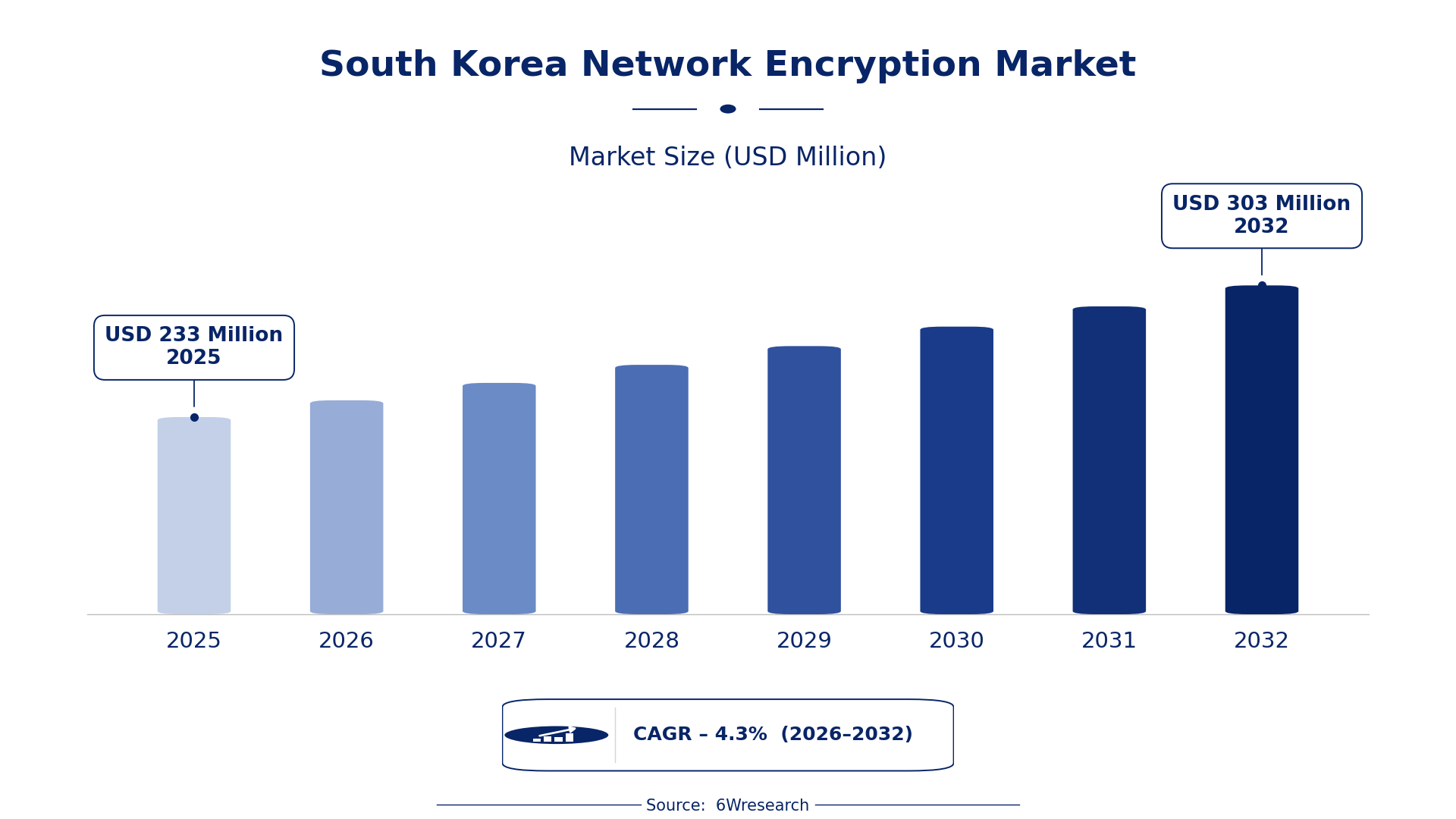
The South Korea Network Encryption Market was estimated at USD 233 Million in 2025 and is projected to reach USD 303 Million by 2032, growing at a CAGR of 4.3% from 2026 to 2032.
South Korea Network Encryption Market Synopsis
The South Korea Network Encryption Market has experienced notable momentum recently, driven by heightened awareness of cybersecurity threats and the growing importance of data privacy. As businesses increasingly seek to safeguard sensitive information, the market is shifting towards innovative encryption solutions that cater to evolving regulatory requirements and consumer expectations.
Looking ahead, the market is expected to continue on this growth trajectory, with organizations prioritizing robust encryption measures to protect data during transmission. This shift not only enhances security but also reinforces customer trust, positioning encryption as a critical component of South Korea's digital infrastructure.
South Korea Network Encryption Market Year-wise Growth Rate and Key Drivers
This graph illustrates the annual growth rates of the South Korea Network Encryption Market from 2021 to 2032, highlighting a steady upward trajectory and projected expansion over the forecast period.
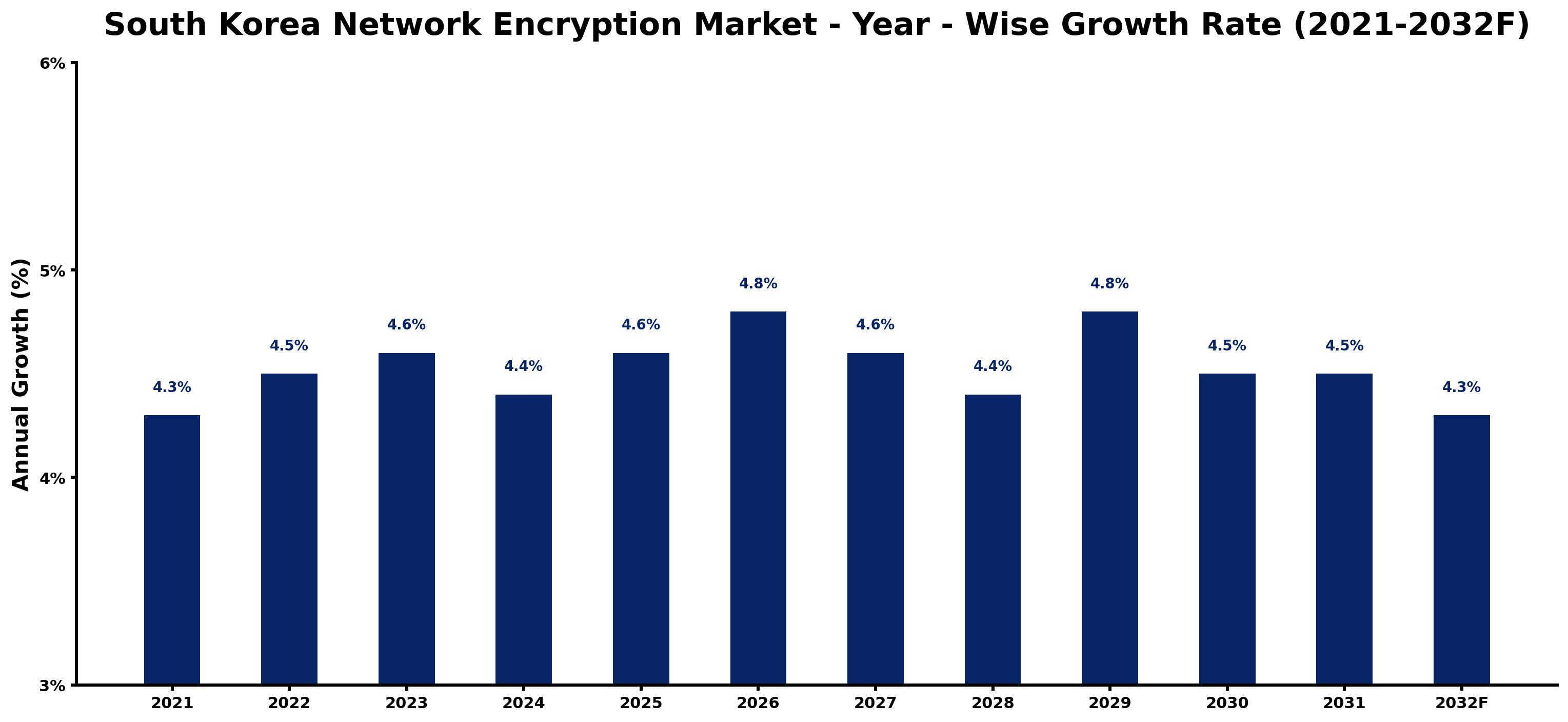
The table below presents the year‑wise growth rates along with the key drivers influencing the market
| Year | Growth Rate | Major Drivers |
| 2021 | 4.3% | Korea's Personal Information Protection Act strengthening data security mandates. |
| 2022 | 4.5% | Increased cyberattack incidents prompting urgent encryption adoption. |
| 2023 | 4.6% | Rising investments in cloud services enhancing encryption implementation needs. |
| 2024 | 4.4% | Growing awareness of phishing threats driving network encryption sales. |
| 2025 | 4.6% | Policy push for blockchain integration increasing encryption demand. |
| 2026 | 4.8% | Government support for fintech boosting secure data solutions. |
| 2027 | 4.6% | Surging online banking usage necessitating robust encryption methods. |
| 2028 | 4.4% | Telehealth expansion creating need for secure patient data protection. |
| 2029 | 4.8% | Increased remote work fueling demand for encrypted communications. |
| 2030 | 4.5% | Rising AI applications requiring secure data transmission solutions. |
| 2031 | 4.5% | Regulatory pressure for data residency accelerating encryption use. |
| 2032 | 4.3% | Local industry focus on IoT security driving encryption growth. |
Note: Market size estimations and growth projections presented in this report are based on 6Wresearch's proprietary forecasting methodology, utilizing the latest available industry data, government publications, and primary research inputs.
South Korea Network Encryption Market Key Takeaways
Below are some of the specific key takeaways from the market, including:
- Rising cyber threats are compelling organizations to adopt encryption solutions for data protection.
- Regulatory compliance is a key driver, pushing businesses to implement robust encryption standards.
- Perceptions of encryption complexity remain a barrier to widespread adoption, especially in high-speed networks.
- Government initiatives are actively shaping the market, promoting the use of encryption technologies across sectors.
- Innovations in encryption technology are emerging to address both security and performance challenges.
Evaluation of Restraints in South Korea Network Encryption Market
Despite the market's growth, several restraints hinder broader adoption of network encryption in South Korea. A prevailing concern is the complexity associated with implementing encryption solutions, particularly within high-speed networks where performance can be affected. Organizations often perceive encryption as resource-intensive, which leads to hesitancy in adoption. Additionally, the evolving nature of compliance standards adds layers of complexity, making it challenging for businesses to keep pace while ensuring their encryption measures remain effective and compliant.
South Korea Network Encryption Market Trends
Several key trends are shaping the South Korea Network Encryption Market. The increasing sophistication of cyber threats is driving a shift towards advanced encryption technologies, including quantum encryption, which promises to enhance data security significantly. on top of that, the adoption of cloud-based encryption solutions is on the rise as organizations migrate to cloud environments, necessitating secure data transmission. There's also a growing focus on user-friendly encryption solutions that minimize complexity while maximizing security, reflecting a demand for accessibility alongside robust protection.
South Korea Network Encryption Market Opportunities
Opportunities for growth within the South Korea Network Encryption Market are substantial. As more businesses recognize the critical need for data security, investment in encryption technologies is expected to surge. There is a particularly strong demand for solutions that integrate with existing infrastructure and provide scalability. on top of that, as regulations tighten, companies that offer compliance-oriented encryption products and services stand to gain a competitive edge. Emerging sectors such as IoT and fintech present unique challenges that require innovative encryption solutions, further expanding the market potential.
Government Initiatives in the South Korea Network Encryption Market
The South Korean government plays a crucial role in shaping the Network Encryption Market through various initiatives aimed at enhancing cybersecurity and data protection. By mandating encryption standards for sensitive data transmission, the government not only fosters trust in digital communications but also encourages the adoption of encryption technologies across both public and private sectors. This regulatory posture is essential in addressing the challenges posed by cyber threats and ensuring compliance with international standards.
- A recently completed initiative established new national encryption standards, aimed at enhancing security protocols for public sector communications.
- Current efforts focus on developing a comprehensive cybersecurity strategy that includes mandatory encryption for critical infrastructure.
- A planned public-private initiative is expected to launch by 2026, aimed at expanding encryption technology access to small and medium-sized enterprises.
- The government is currently investing in cybersecurity awareness programs to educate organizations on best practices for encryption implementation.
- A regulatory framework introduced in 2025 mandates encryption for all sensitive data transmitted across telecommunications networks.
Future Insights of the South Korea Network Encryption Market
Looking toward 2026-2032, the South Korea Network Encryption Market is set to experience sustained growth driven by escalating cybersecurity threats and regulatory requirements. As businesses embrace digital transformation, the demand for advanced encryption solutions will intensify. Organizations will increasingly prioritize not only compliance but also the need for efficient, user-friendly encryption technologies. This shift will foster innovation, encouraging vendors to develop solutions that meet the diverse needs of a rapidly evolving digital landscape.
South Korea Network Encryption Market Latest Developments
In the past year, activity within the South Korea Network Encryption Market has accelerated, reflecting a growing urgency to enhance cybersecurity measures. Organizations are recognizing the critical importance of encryption in safeguarding sensitive data, leading to several noteworthy developments. The push towards integrating advanced technologies has sparked interest in innovative encryption solutions, setting the stage for further advancements in the field.
- A major technology vendor launched a new encryption platform in early 2025, designed to support multi-cloud environments and improve data security.
- An initiative that began in mid-2025 is currently underway to enhance encryption capabilities within government communications infrastructure.
- A rollout expected to begin in Q3 2026 will introduce encryption-as-a-service offerings to cater to small businesses.
- A regional operator completed an upgrade of its encryption protocols in early 2025, enhancing security for customer data transmission.
- Plans for a collaborative cybersecurity research program were announced in late 2025, aiming to explore advanced encryption techniques.
South Korea Network Encryption Market - Key Attractiveness of the Report
- 10 Years of Market Numbers
- Historical Data Starting from 2022 to 2025
- Base Year: 2025
- Forecast Data until 2032
- Key Performance Indicators Impacting the Market
- Major Upcoming Developments and Projects
Key Highlights of the Report:
- South Korea Network Encryption Market Outlook
- Market Size of South Korea Network Encryption Market, 2025
- Forecast of South Korea Network Encryption Market, 2032
- Historical Data and Forecast of South Korea Network Encryption Revenues & Volume for the Period 2022-2032F
- South Korea Network Encryption Market Trend Evolution
- South Korea Network Encryption Market Drivers and Challenges
- South Korea Network Encryption Price Trends
- South Korea Network Encryption Porter's Five Forces
- South Korea Network Encryption Industry Life Cycle
- Historical Data and Forecast of South Korea Network Encryption Market Revenues & Volume By Component for the Period 2022-2032F
- Historical Data and Forecast of South Korea Network Encryption Market Revenues & Volume By Hardware for the Period 2022-2032F
- Historical Data and Forecast of South Korea Network Encryption Market Revenues & Volume By Platform for the Period 2022-2032F
- Historical Data and Forecast of South Korea Network Encryption Market Revenues & Volume By Services for the Period 2022-2032F
- Historical Data and Forecast of South Korea Network Encryption Market Revenues & Volume By Transmission Type for the Period 2022-2032F
- Historical Data and Forecast of South Korea Network Encryption Market Revenues & Volume By Traditional Transmission for the Period 2022-2032F
- Historical Data and Forecast of South Korea Network Encryption Market Revenues & Volume By Optical Transmission for the Period 2022-2032F
- Historical Data and Forecast of South Korea Network Encryption Market Revenues & Volume By Organization Size for the Period 2022-2032F
- Historical Data and Forecast of South Korea Network Encryption Market Revenues & Volume By Small and Medium-sized Enterprises for the Period 2022-2032F
- Historical Data and Forecast of South Korea Network Encryption Market Revenues & Volume By Large-sized Enterprises for the Period 2022-2032F
- Historical Data and Forecast of South Korea Network Encryption Market Revenues & Volume By Vertical for the Period 2022-2032F
- Historical Data and Forecast of South Korea Network Encryption Market Revenues & Volume By Telecom & IT for the Period 2022-2032F
- Historical Data and Forecast of South Korea Network Encryption Market Revenues & Volume By BFSI for the Period 2022-2032F
- Historical Data and Forecast of South Korea Network Encryption Market Revenues & Volume By Government for the Period 2022-2032F
- Historical Data and Forecast of South Korea Network Encryption Market Revenues & Volume By Media & Entertainment for the Period 2022-2032F
- Historical Data and Forecast of South Korea Network Encryption Market Revenues & Volume By Other End-user Industries for the Period 2022-2032F
- South Korea Network Encryption Import Export Trade Statistics
- Market Opportunity Assessment By Component
- Market Opportunity Assessment By Transmission Type
- Market Opportunity Assessment By Organization Size
- Market Opportunity Assessment By Vertical
- South Korea Network Encryption Top Companies Market Share
- South Korea Network Encryption Competitive Benchmarking By Technical and Operational Parameters
- South Korea Network Encryption Company Profiles
- South Korea Network Encryption Key Strategic Recommendations






































