South Korea Network Slicing Market Size, Share & Growth Rate
The South Korea Network Slicing Market was estimated at USD 1331 Million in 2025 and is projected to reach USD 1930 Million by 2032, growing at a CAGR of 5.5% from 2026 to 2032. This growth trajectory is primarily driven by the swift rollout of 5G infrastructure, enabling mobile operators to harness network slicing for enhanced service differentiation. Furthermore, industries across South Korea are increasingly demanding customized network solutions that cater to specific applications, which bolsters the adoption of this transformative technology.
South Korea Network Slicing Market Year-wise Growth Rate and Key Drivers
This graph highlights how the South Korea Network Slicing Market has steadily grown over the years, supported by major growth factors.
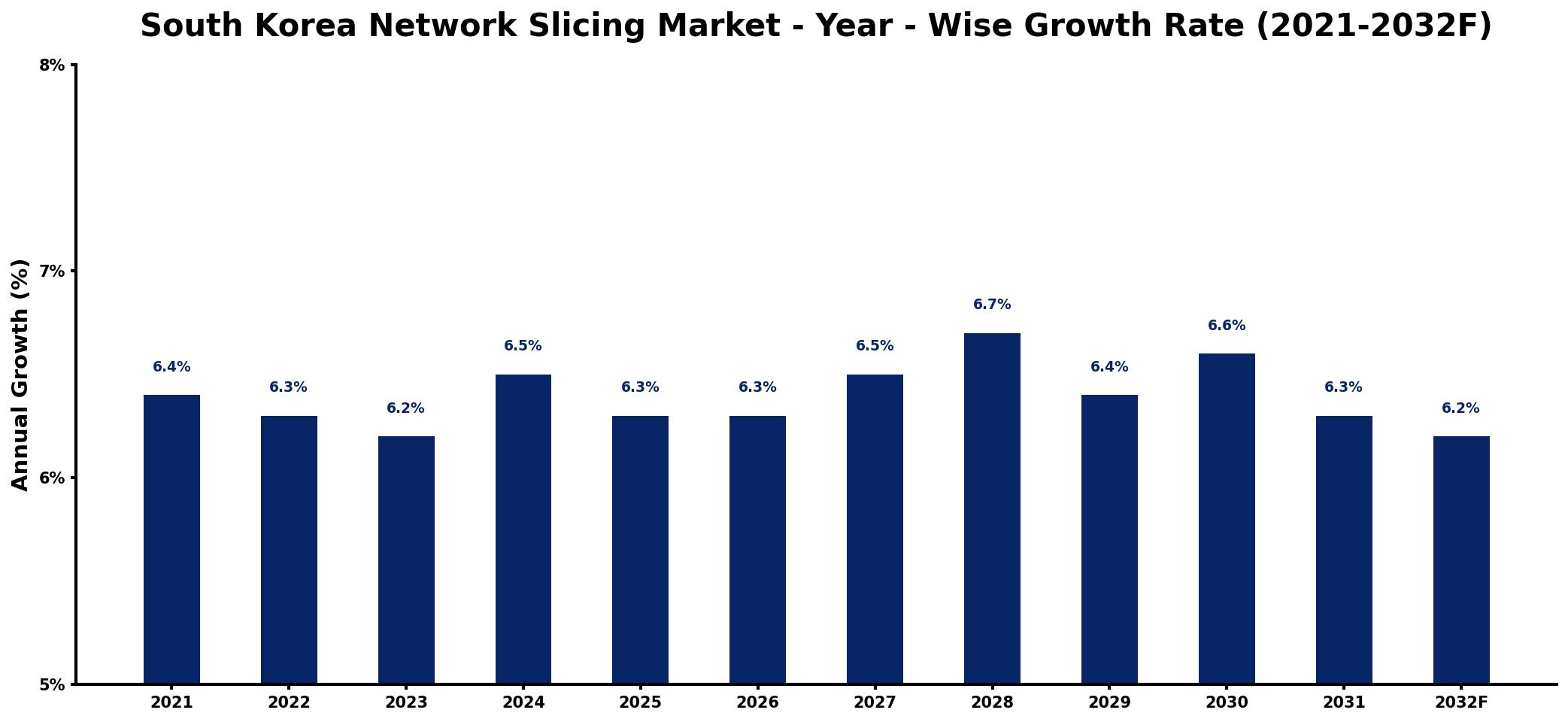
The table below presents the year‑wise growth rates along with the key drivers influencing the market
| Year | Growth Rate | Major Drivers |
| 2021 | 6.4% | Rising demand for 5G applications |
| 2022 | 6.3% | Increased investment in digital infrastructure |
| 2023 | 6.2% | Expansion of IoT connectivity solutions |
| 2024 | 6.5% | Growth in smart city initiatives |
| 2025 | 6.3% | Enhanced mobile broadband experiences |
| 2026 | 6.3% | Adoption of edge computing technologies |
| 2027 | 6.5% | Surge in enterprise digital transformation |
| 2028 | 6.7% | improved raw material availability |
| 2029 | 6.4% | Integration of augmented reality platforms |
| 2030 | 6.6% | Emergence of virtual reality services |
| 2031 | 6.3% | Focus on sustainable technology practices |
| 2032 | 6.2% | Advancements in AI-driven applications |
Note: Market size estimations and growth projections presented in this report are based on 6Wresearch's proprietary forecasting methodology, utilizing the latest available industry data, government publications, and primary research inputs.
South Korea Network Slicing Market Synopsis
In South Korea, the increasing demand for ultra-reliable low-latency communication (URLLC) is steering the network slicing market forward. Businesses are seeking tailored networking solutions that can support diverse applications, from industrial automation to smart city initiatives, underscoring the technology's importance in driving innovation.
With its advanced telecom ecosystem, South Korea stands at the forefront of implementing network slicing. This technology not only optimizes resource allocation but also creates new revenue opportunities for service providers, allowing them to better meet the unique demands of various sectors including healthcare, automotive, and entertainment.
South Korea Network Slicing Market Key Takeaways
- The South Korean government actively promotes 5G technology and network slicing through favorable policies and investment initiatives.
- Network slicing enables the creation of customized network environments, supporting diverse applications and service levels.
- Enterprises in sectors like automotive and healthcare are increasingly adopting network slicing for enhanced operational efficiencies.
- Interoperability and standardization remain key focus areas to enhance the effectiveness of network slicing solutions.
- The competitive landscape is rapidly evolving, with service providers striving to differentiate their offerings through innovative slicing solutions.
Evaluation of Restraints in South Korea Network Slicing Market
While the potential of the South Korea Network Slicing Market is substantial, several constraints impede its full realization. A primary concern revolves around standardization and ensuring interoperability among different vendors solutions. The complexity of dynamically managing network slices to meet the varying needs of applications poses a significant technical hurdle. Additionally, guaranteeing Quality of Service (QoS) across multiple slices is critical, as service providers must deliver consistent performance to retain customer trust and satisfaction. These factors necessitate ongoing collaboration between industry stakeholders to navigate the complexities and unlock the market's full potential.
South Korea Network Slicing Market Trends
The South Korea Network Slicing Market is witnessing notable trends, particularly the rise of edge computing in tandem with 5G deployment. This convergence enhances the capability of network slicing to deliver low-latency services, ideal for applications requiring real-time processing. Additionally, a growing focus on security within sliced networks is prompting operators to implement advanced measures to safeguard data integrity and privacy.
Furthermore, industries are increasingly investing in Internet of Things (IoT) solutions that benefit from the scalability and flexibility of network slicing. The demand for customized connectivity solutions, particularly in critical sectors like healthcare and manufacturing, further drives innovation and investment in slicing technologies.
South Korea Network Slicing Market Opportunities
The opportunities for growth within the South Korea Network Slicing Market are vast, especially as organizations look to leverage the full capabilities of 5G networks. With an emphasis on Industry 4.0, enterprises are keen on adopting solutions that enable seamless communication across devices and applications. There's a significant opportunity for service providers to offer specialized slices for emerging sectors, such as autonomous vehicles and smart infrastructure projects, which require guaranteed performance and reliability.
Government Initiatives in the South Korea Network Slicing Market
The South Korean government actively supports the advancement of network slicing through various initiatives aimed at enhancing 5G technology adoption. These policies include substantial investments in telecommunications infrastructure and research programs focused on developing cutting-edge slicing solutions. Public-private partnerships are encouraged to foster innovation and bring forth industry-specific applications, positioning South Korea as a leader in the global network slicing landscape.
Future Insights of the South Korea Network Slicing Market
Looking ahead to 2026-2032, the South Korea Network Slicing Market is poised for continued expansion. The increasing integration of artificial intelligence and machine learning into network management will enhance the dynamic capabilities of slicing technologies, allowing for more efficient resource allocation and improved user experiences. As businesses increasingly seek to differentiate their services, the demand for sophisticated, tailored network solutions will likely intensify, driving innovative applications across various sectors.
South Korea Network Slicing Market Latest Developments (2025 - 2026)
Recent developments in the South Korea Network Slicing Market indicate a strong focus on collaboration among service providers to enhance interoperability. Industry leaders are prioritizing the establishment of unified standards to facilitate multi-vendor environments. Additionally, advancements in security frameworks are being implemented to address vulnerabilities associated with network slicing, ensuring that both service providers and users can trust their connectivity solutions.
South Korea Network Slicing Market - Key Attractiveness of the Report
- 10 Years of Market Numbers
- Historical Data Starting from 2022 to 2025
- Base Year: 2025
- Forecast Data until 2032
- Key Performance Indicators Impacting the Market
- Major Upcoming Developments and Projects
Key Highlights of the Report:
- South Korea Network Slicing Market Outlook
- Market Size of South Korea Network Slicing Market, 2025
- Forecast of South Korea Network Slicing Market, 2032
- Historical Data and Forecast of South Korea Network Slicing Revenues & Volume for the Period 2022-2032F
- South Korea Network Slicing Market Trend Evolution
- South Korea Network Slicing Market Drivers and Challenges
- South Korea Network Slicing Price Trends
- South Korea Network Slicing Porter's Five Forces
- South Korea Network Slicing Industry Life Cycle
- Historical Data and Forecast of South Korea Network Slicing Market Revenues & Volume By Component for the Period 2022-2032F
- Historical Data and Forecast of South Korea Network Slicing Market Revenues & Volume By Solution for the Period 2022-2032F
- Historical Data and Forecast of South Korea Network Slicing Market Revenues & Volume By Services (Professional & Managed) for the Period 2022-2032F
- Historical Data and Forecast of South Korea Network Slicing Market Revenues & Volume By End User for the Period 2022-2032F
- Historical Data and Forecast of South Korea Network Slicing Market Revenues & Volume By Telecom Operators for the Period 2022-2032F
- Historical Data and Forecast of South Korea Network Slicing Market Revenues & Volume By Enterprises for the Period 2022-2032F
- Historical Data and Forecast of South Korea Network Slicing Market Revenues & Volume By Application for the Period 2022-2032F
- Historical Data and Forecast of South Korea Network Slicing Market Revenues & Volume By Manufacturing for the Period 2022-2032F
- Historical Data and Forecast of South Korea Network Slicing Market Revenues & Volume By Government for the Period 2022-2032F
- Historical Data and Forecast of South Korea Network Slicing Market Revenues & Volume By Automotive for the Period 2022-2032F
- Historical Data and Forecast of South Korea Network Slicing Market Revenues & Volume By Media and Entertainment for the Period 2022-2032F
- South Korea Network Slicing Import Export Trade Statistics
- Market Opportunity Assessment By Component
- Market Opportunity Assessment By End User
- Market Opportunity Assessment By Application
- South Korea Network Slicing Top Companies Market Share
- South Korea Network Slicing Competitive Benchmarking By Technical and Operational Parameters
- South Korea Network Slicing Company Profiles
- South Korea Network Slicing Key Strategic Recommendations






































