South Korea Office Chair Market Size Growth Rate
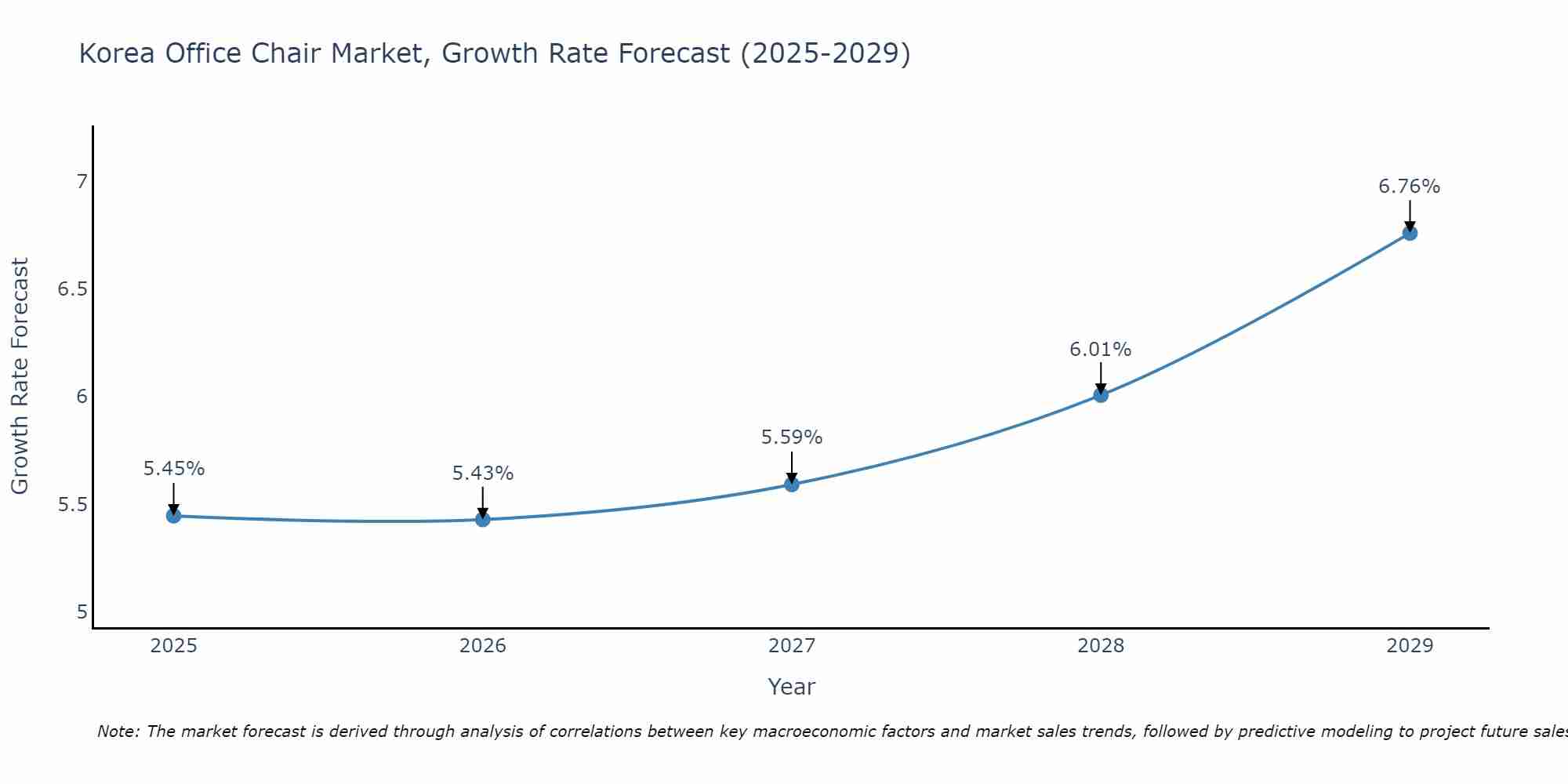
The South Korea Office Chair Market is projected to witness mixed growth rate patterns during 2025 to 2029. From 5.45% in 2025, the growth rate steadily ascends to 6.76% in 2029.
South Korea Office Chair Market Synopsis
The South Korea office chair market is a mature and competitive industry driven by factors such as increasing adoption of ergonomic designs, rising demand for high-quality seating solutions in modern workplaces, and the growing trend of remote working. The market is characterized by a wide range of products offered by both domestic manufacturers and international brands, with a focus on innovative features, sustainability, and customization options. Key players in the market include companies such as Hanssem, Kokuyo, and Nowy Styl Group. With a strong emphasis on employee health and well-being, there is a growing preference for ergonomic chairs that provide comfort and support for long hours of sitting. The market is expected to continue its steady growth trajectory, driven by evolving workplace trends and the need for comfortable and functional seating solutions.
South Korea Office Chair Market Trends
The South Korea office chair market is experiencing a shift towards ergonomic designs and sustainable materials. Companies are focusing on creating chairs that promote better posture and support for long hours of sitting, catering to the rising demand for comfort and health-conscious workspace solutions. Additionally, there is a growing emphasis on environmentally friendly practices, leading to the use of recycled materials and eco-friendly production processes in the manufacturing of office chairs. Online sales and customization options are also gaining popularity, allowing consumers to personalize their office chairs according to their preferences. With the increasing awareness of the importance of ergonomics and sustainability in the workplace, these trends are expected to drive further innovation and growth in the South Korea office chair market.
South Korea Office Chair Market Challenges
In the South Korea Office Chair Market, one of the key challenges faced is intense competition among both domestic and international manufacturers. This competition leads to price wars and puts pressure on profit margins. Additionally, fluctuating raw material prices and currency exchange rates can impact manufacturing costs and pricing strategies. Another challenge is the increasing demand for ergonomic and environmentally-friendly office chairs, requiring manufacturers to invest in research and development to keep up with changing consumer preferences. Moreover, strict regulations and standards related to product safety and quality add complexity to the market landscape. To succeed in this competitive market, companies need to continuously innovate, differentiate their products, and ensure compliance with regulations while maintaining cost efficiency.
South Korea Office Chair Market Investment Opportunities
The South Korea office chair market presents promising investment opportunities due to the country`s strong economic growth and increasing focus on workplace ergonomics. With a growing number of businesses and offices in South Korea, there is a rising demand for high-quality, comfortable, and ergonomic office chairs. Investing in innovative and ergonomic office chair designs that cater to the specific needs of South Korean consumers could yield significant returns. Additionally, incorporating environmentally friendly materials and sustainable practices in office chair manufacturing could appeal to the growing environmentally conscious consumer base in South Korea. Collaborating with local distributors and retailers to penetrate the market effectively and leveraging digital marketing strategies to reach a wider audience would be essential for successful investment in the South Korea office chair market.
Jordan Agar Market Government Policies
In South Korea, the government has implemented policies to promote sustainability and ergonomics in the office chair market. This includes regulations on the use of eco-friendly materials in manufacturing office chairs to reduce environmental impact. Additionally, there are guidelines in place to ensure that office chairs meet ergonomic standards to enhance workplace safety and employee well-being. The government also offers incentives and subsidies to businesses that adopt sustainable and ergonomic practices in their office chair production processes. These policies aim to drive innovation in the market, improve product quality, and create a healthier working environment for employees across different industries in South Korea.
South Korea Office Chair Market Future Outlook
The South Korea office chair market is poised for steady growth in the coming years driven by factors such as the increasing number of commercial spaces and a growing focus on ergonomics in the workplace. With the rise of remote work and flexible office setups, demand for comfortable and supportive office chairs is expected to remain robust. Additionally, advancements in design, materials, and technology are likely to drive innovation in the market, offering consumers a wider range of options to choose from. The market may also see a shift towards sustainable and environmentally-friendly office chairs as companies place greater emphasis on corporate social responsibility. Overall, the South Korea office chair market is anticipated to experience continued growth and evolution as it adapts to changing work trends and consumer preferences.
Key Highlights of the Report:
- South Korea Office Chair Market Outlook
- Market Size of South Korea Office Chair Market, 2021
- Forecast of South Korea Office Chair Market, 2031
- Historical Data and Forecast of South Korea Office Chair Revenues & Volume for the Period 2018 - 2031
- South Korea Office Chair Market Trend Evolution
- South Korea Office Chair Market Drivers and Challenges
- South Korea Office Chair Price Trends
- South Korea Office Chair Porter's Five Forces
- South Korea Office Chair Industry Life Cycle
- Historical Data and Forecast of South Korea Office Chair Market Revenues & Volume By Product Type for the Period 2018 - 2031
- Historical Data and Forecast of South Korea Office Chair Market Revenues & Volume By Executive Office for the Period 2018 - 2031
- Historical Data and Forecast of South Korea Office Chair Market Revenues & Volume By Ergonomic for the Period 2018 - 2031
- Historical Data and Forecast of South Korea Office Chair Market Revenues & Volume By Conference for the Period 2018 - 2031
- Historical Data and Forecast of South Korea Office Chair Market Revenues & Volume By Material for the Period 2018 - 2031
- Historical Data and Forecast of South Korea Office Chair Market Revenues & Volume By Mesh for the Period 2018 - 2031
- Historical Data and Forecast of South Korea Office Chair Market Revenues & Volume By Lather for the Period 2018 - 2031
- Historical Data and Forecast of South Korea Office Chair Market Revenues & Volume By Plastic for the Period 2018 - 2031
- Historical Data and Forecast of South Korea Office Chair Market Revenues & Volume By Fabric for the Period 2018 - 2031
- Historical Data and Forecast of South Korea Office Chair Market Revenues & Volume By Sales Channel for the Period 2018 - 2031
- Historical Data and Forecast of South Korea Office Chair Market Revenues & Volume By Offline for the Period 2018 - 2031
- Historical Data and Forecast of South Korea Office Chair Market Revenues & Volume By Online for the Period 2018 - 2031
- South Korea Office Chair Import Export Trade Statistics
- Market Opportunity Assessment By Product Type
- Market Opportunity Assessment By Material
- Market Opportunity Assessment By Sales Channel
- South Korea Office Chair Top Companies Market Share
- South Korea Office Chair Competitive Benchmarking By Technical and Operational Parameters
- South Korea Office Chair Company Profiles
- South Korea Office Chair Key Strategic Recommendations






































