South Korea Optical Projector Market Size, Share & Growth Rate
The South Korea Optical Projector Market was estimated at USD 389 Million in 2025 and is projected to reach USD 528 Million by 2032, growing at a CAGR of 4.5% from 2026 to 2032. This promising growth trajectory is fueled by the increasing incorporation of digital projectors across educational institutions and corporate environments, as well as a robust demand in the entertainment sector. The continuous advancement in display technologies, such as higher resolution and enhanced connectivity features, is further driving market penetration across diverse applications.
South Korea Optical Projector Market Year-wise Growth Rate and Key Drivers
This graph highlights how the South Korea Optical Projector Market has steadily grown over the years, supported by major growth factors.
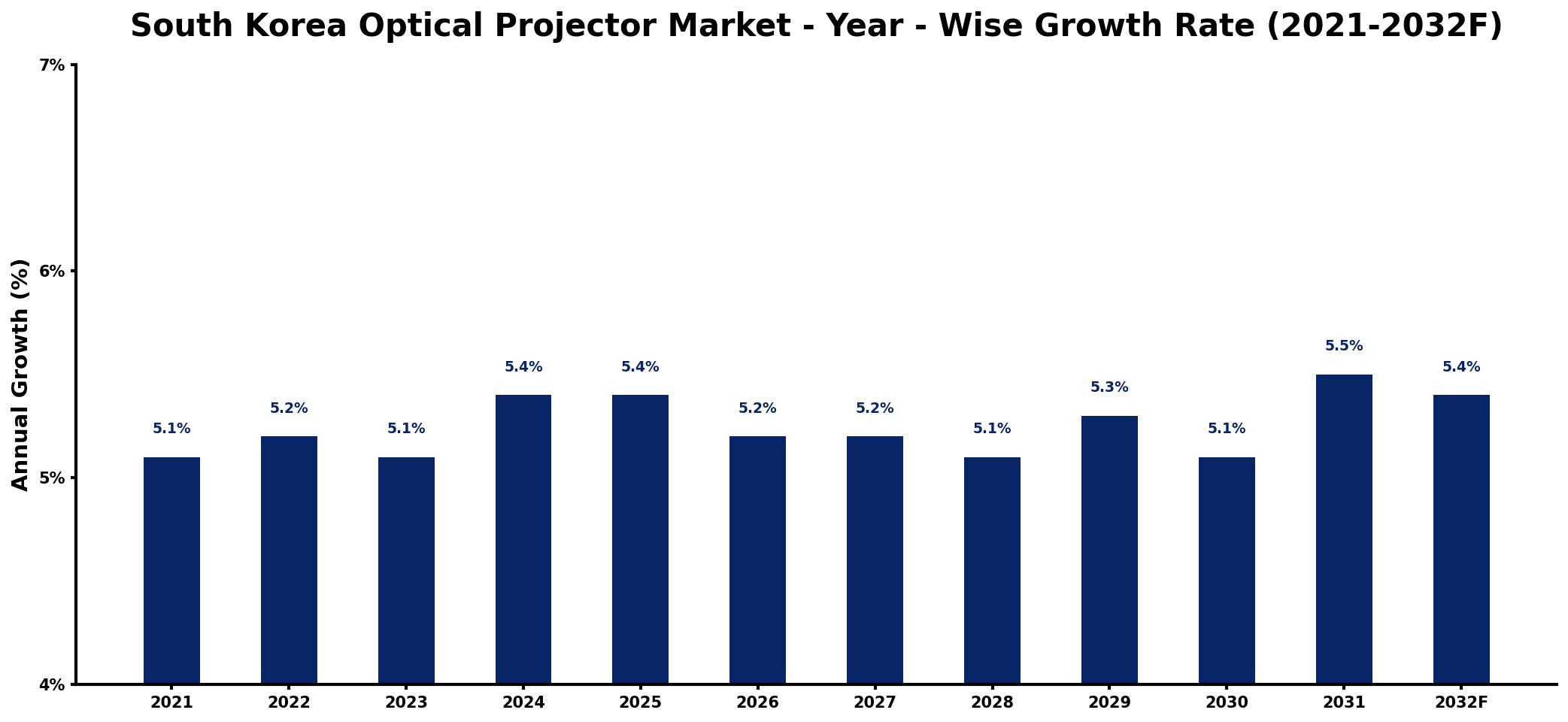
The table below presents the year‑wise growth rates along with the key drivers influencing the market
| Year | Growth Rate | Major Drivers |
| 2021 | 5.1% | Increased consumer entertainment spending |
| 2022 | 5.2% | Growing demand for home theaters |
| 2023 | 5.1% | Rise in educational technology adoption |
| 2024 | 5.4% | Expansion of corporate presentation tools |
| 2025 | 5.4% | Surge in outdoor event venues |
| 2026 | 5.2% | Investments in digital signage solutions |
| 2027 | 5.2% | Demand from hybrid work environments |
| 2028 | 5.1% | Growth in gaming industry investments |
| 2029 | 5.3% | Increased usage in live events |
| 2030 | 5.1% | Expansion in creative content production |
| 2031 | 5.5% | rising export shipment volumes |
| 2032 | 5.4% | Growing popularity of immersive experiences |
Note: Market size estimations and growth projections presented in this report are based on 6Wresearch's proprietary forecasting methodology, utilizing the latest available industry data, government publications, and primary research inputs.
South Korea Optical Projector Market Synopsis
The optical projector market in South Korea stands at a pivotal juncture, poised for significant expansion due to technological advancements and increasing demand across various sectors. The blend of higher resolution displays and improved portability options is making projectors an attractive choice for both educational and corporate presentations.
Furthermore, entertainment venues are also embracing optical projectors as they enhance viewer experiences, thereby contributing to the growing market. The integration of smart technologies and digital content delivery is reshaping how projectors are used and perceived, providing ample opportunities for further market growth.
South Korea Optical Projector Market Key Takeaways
- The market is driven by advancements in display technology and increasing digital projector adoption in various sectors.
- Enhanced resolution and portability features are critical factors influencing consumer choices.
- Government policies support the integration of optical projectors in educational and corporate settings.
- Price sensitivity and technological convergence with smart devices pose challenges to market growth.
- Emerging trends indicate a shift towards more sophisticated projectors that integrate with digital ecosystems.
Evaluation of Restraints in South Korea Optical Projector Market
Despite its growth potential, the South Korea Optical Projector Market grapples with several restraints. Price sensitivity among consumers hampers broader adoption, particularly in budget-conscious educational institutions. Additionally, the rapid commoditization of projector technology creates a highly competitive landscape, pushing prices down and forcing manufacturers to continuously innovate. Furthermore, the convergence of projectors with smart devices poses a challenge in maintaining relevance as consumers increasingly opt for multifunctional devices that integrate various technologies.
South Korea Optical Projector Market Trends
Current trends in the South Korea Optical Projector Market include a growing focus on portable and compact models, driven by the needs of mobile professionals and educators. Additionally, advancements in 4K resolution and laser technology are significantly enhancing the viewing experience, prompting more organizations to upgrade their projection systems. The increasing adoption of wireless connectivity is also reshaping product offerings, enabling seamless integration with smart devices and cloud-based content.
South Korea Optical Projector Market Opportunities
Opportunities for growth in the South Korea Optical Projector Market lie in the expanding corporate and educational sectors. As businesses embrace hybrid work models, the need for effective presentation tools is rising. Additionally, the education sector's ongoing digital transformation is opening doors for innovative projector solutions that enhance learning experiences. Furthermore, the integration of interactive features and augmented reality functionalities presents a significant avenue for investment and development.
Government Initiatives in the South Korea Optical Projector Market
The South Korean government is actively promoting the use of optical projectors within educational and business contexts through various policies and incentives. Standards for display technology have been established, along with regulations surrounding import and export to facilitate a smoother market environment. The government also provides incentives for adopting modern technology in public institutions and private enterprises, further encouraging the uptake of optical projectors across sectors.
Future Insights of the South Korea Optical Projector Market
Looking ahead to 2026-2032, the South Korea Optical Projector Market is expected to evolve significantly, with a surge in demand for high-definition projectors that integrate seamlessly with digital platforms. As corporate environments continue to adapt to remote and hybrid work models, the role of projectors in presentations will likely expand. Moreover, as educational institutions increasingly shift towards interactive and immersive teaching methodologies, projectors will play a pivotal role in enhancing engagement and learning outcomes.
South Korea Optical Projector Market Latest Developments (2025 - 2026)
In the recent months, the optical projector industry in South Korea has seen a notable shift towards integrating smart technologies. Innovations focusing on user-friendly interfaces and connectivity enhancements have been prominent. Furthermore, there is a noticeable increase in collaborative platforms that allow for simultaneous multiple-user connectivity, catering to the new demands in educational and corporate settings. This trend towards versatility and enhanced functionality is expected to define the competitive landscape moving forward.
South Korea Optical Projector Market - Key Attractiveness of the Report
- 10 Years of Market Numbers
- Historical Data Starting from 2022 to 2025
- Base Year: 2025
- Forecast Data until 2032
- Key Performance Indicators Impacting the Market
- Major Upcoming Developments and Projects
Key Highlights of the Report:
- South Korea Optical Projector Market Outlook
- Market Size of South Korea Optical Projector Market, 2025
- Forecast of South Korea Optical Projector Market, 2032
- Historical Data and Forecast of South Korea Optical Projector Revenues & Volume for the Period 2022-2032F
- South Korea Optical Projector Market Trend Evolution
- South Korea Optical Projector Market Drivers and Challenges
- South Korea Optical Projector Price Trends
- South Korea Optical Projector Porter's Five Forces
- South Korea Optical Projector Industry Life Cycle
- Historical Data and Forecast of South Korea Optical Projector Market Revenues & Volume By Type for the Period 2022-2032F
- Historical Data and Forecast of South Korea Optical Projector Market Revenues & Volume By Digital Light Processing (DLP) for the Period 2022-2032F
- Historical Data and Forecast of South Korea Optical Projector Market Revenues & Volume By Liquid Crystal Display (LCD) for the Period 2022-2032F
- Historical Data and Forecast of South Korea Optical Projector Market Revenues & Volume By Liquid Crystal on Silicon (LCoS) for the Period 2022-2032F
- Historical Data and Forecast of South Korea Optical Projector Market Revenues & Volume By Application for the Period 2022-2032F
- Historical Data and Forecast of South Korea Optical Projector Market Revenues & Volume By Residential for the Period 2022-2032F
- Historical Data and Forecast of South Korea Optical Projector Market Revenues & Volume By Commercial for the Period 2022-2032F
- Historical Data and Forecast of South Korea Optical Projector Market Revenues & Volume By Industrial for the Period 2022-2032F
- South Korea Optical Projector Import Export Trade Statistics
- Market Opportunity Assessment By Type
- Market Opportunity Assessment By Application
- South Korea Optical Projector Top Companies Market Share
- South Korea Optical Projector Competitive Benchmarking By Technical and Operational Parameters
- South Korea Optical Projector Company Profiles
- South Korea Optical Projector Key Strategic Recommendations






































