South Korea Packaged Food Market Size Growth Rate
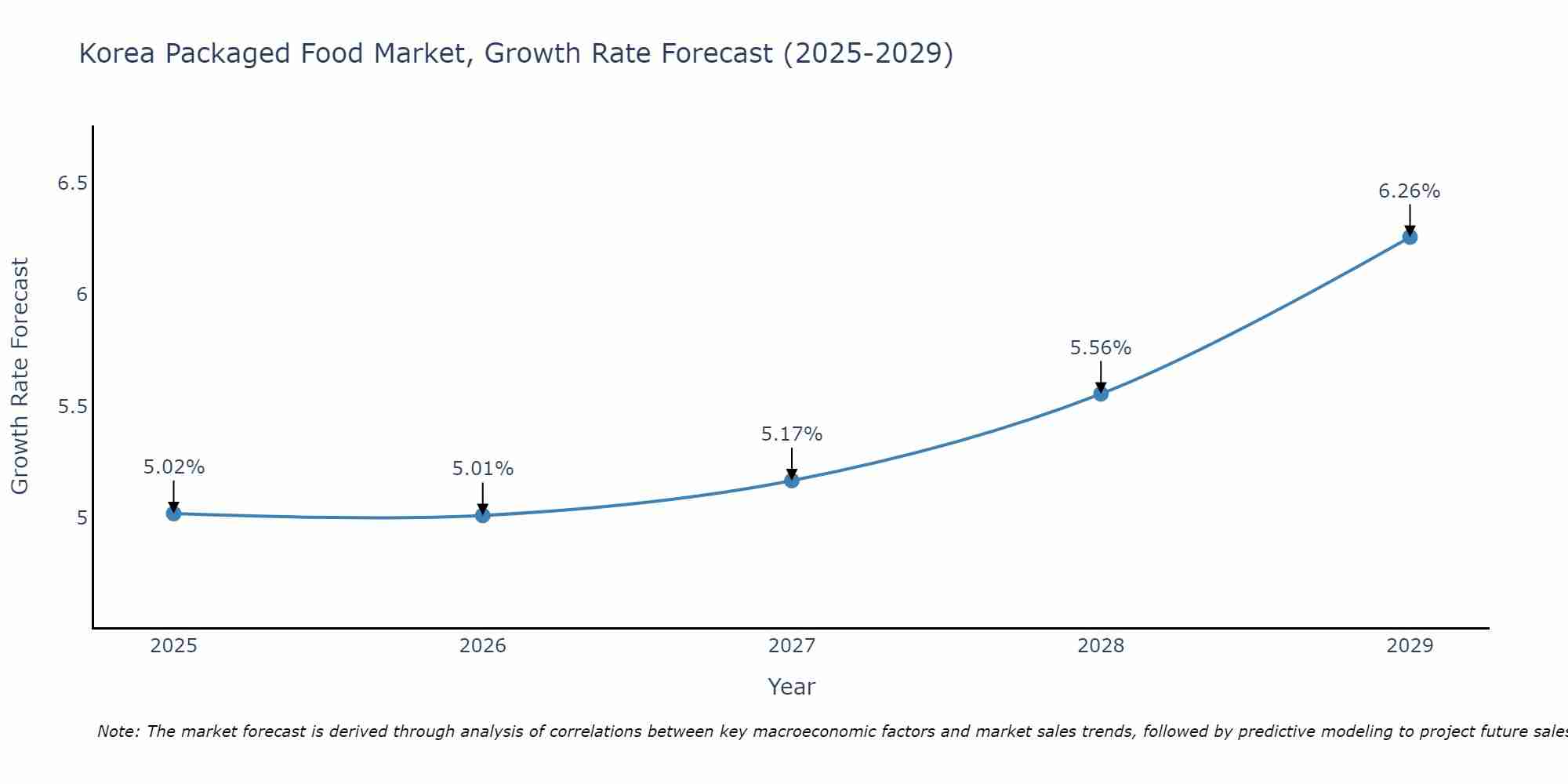
The South Korea Packaged Food Market is projected to witness mixed growth rate patterns during 2025 to 2029. Commencing at 5.02% in 2025, growth builds up to 6.26% by 2029.
Key Highlights of the Report:
- South Korea Packaged Food Market Outlook
- Market Size of South Korea Packaged Food Market, 2024
- Forecast of South Korea Packaged Food Market, 2031
- Historical Data and Forecast of South Korea Packaged Food Revenues & Volume for the Period 2021 - 2031
- South Korea Packaged Food Market Trend Evolution
- South Korea Packaged Food Market Drivers and Challenges
- South Korea Packaged Food Price Trends
- South Korea Packaged Food Porter's Five Forces
- South Korea Packaged Food Industry Life Cycle
- Historical Data and Forecast of South Korea Packaged Food Market Revenues & Volume By Product Type for the Period 2021 - 2031
- Historical Data and Forecast of South Korea Packaged Food Market Revenues & Volume By Dairy Products for the Period 2021 - 2031
- Historical Data and Forecast of South Korea Packaged Food Market Revenues & Volume By Bakery Products for the Period 2021 - 2031
- Historical Data and Forecast of South Korea Packaged Food Market Revenues & Volume By Ready Meals for the Period 2021 - 2031
- Historical Data and Forecast of South Korea Packaged Food Market Revenues & Volume By Confectionery for the Period 2021 - 2031
- Historical Data and Forecast of South Korea Packaged Food Market Revenues & Volume By Breakfast Cereals for the Period 2021 - 2031
- Historical Data and Forecast of South Korea Packaged Food Market Revenues & Volume By Baby Food for the Period 2021 - 2031
- Historical Data and Forecast of South Korea Packaged Food Market Revenues & Volume By Non-alcoholic Beverages for the Period 2021 - 2031
- Historical Data and Forecast of South Korea Dairy Products Packaged Food Market Revenues & Volume By Sauces, Condiments, and Dressings for the Period 2021 - 2031
- Historical Data and Forecast of South Korea Packaged Food Market Revenues & Volume By Distribution Channel for the Period 2021 - 2031
- Historical Data and Forecast of South Korea Packaged Food Market Revenues & Volume By Supermarket/Hypermarket for the Period 2021 - 2031
- Historical Data and Forecast of South Korea Packaged Food Market Revenues & Volume By Convenience Stores for the Period 2021 - 2031
- Historical Data and Forecast of South Korea Packaged Food Market Revenues & Volume By Retail Stores for the Period 2021 - 2031
- Historical Data and Forecast of South Korea Packaged Food Market Revenues & Volume By E-commerce for the Period 2021 - 2031
- South Korea Packaged Food Import Export Trade Statistics
- Market Opportunity Assessment By Product Type
- Market Opportunity Assessment By Distribution Channel
- South Korea Packaged Food Top Companies Market Share
- South Korea Packaged Food Competitive Benchmarking By Technical and Operational Parameters
- South Korea Packaged Food Company Profiles
- South Korea Packaged Food Key Strategic Recommendations






































