South Korea Payment Security Market Size & Growth Rate (2026-2032)
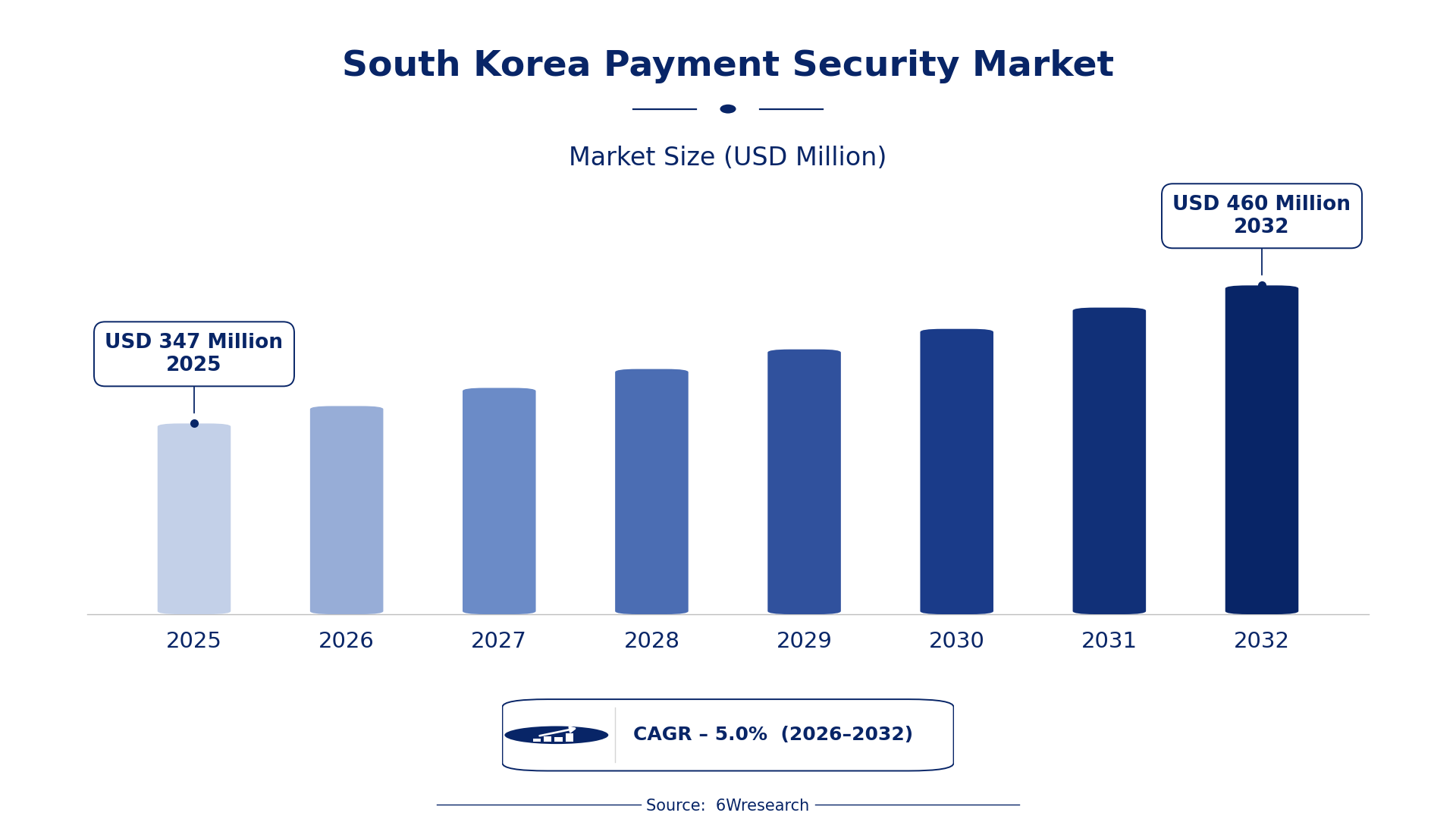
The South Korea Payment Security Market was estimated at USD 347 Million in 2025 and is projected to reach USD 460 Million by 2032, growing at a CAGR of 5.0% from 2026 to 2032.
South Korea Payment Security Market Synopsis
A surge in digital payment adoption is the primary catalyst driving the South Korea Payment Security Market. The transition towards cashless transactions has forced organizations to enhance their security measures to protect sensitive data and maintain customer trust.
As e-commerce continues to grow, the South Korean market faces increasing pressure to innovate in payment security. The demand for advanced technologies, such as biometric authentication and encryption, underscores the urgent need for solutions to combat sophisticated cyber threats.
South Korea Payment Security Market Year-wise Growth Rate and Key Drivers
This graph illustrates the annual growth rates of the South Korea Payment Security Market from 2021 to 2032, highlighting a steady upward trajectory and projected expansion over the forecast period.
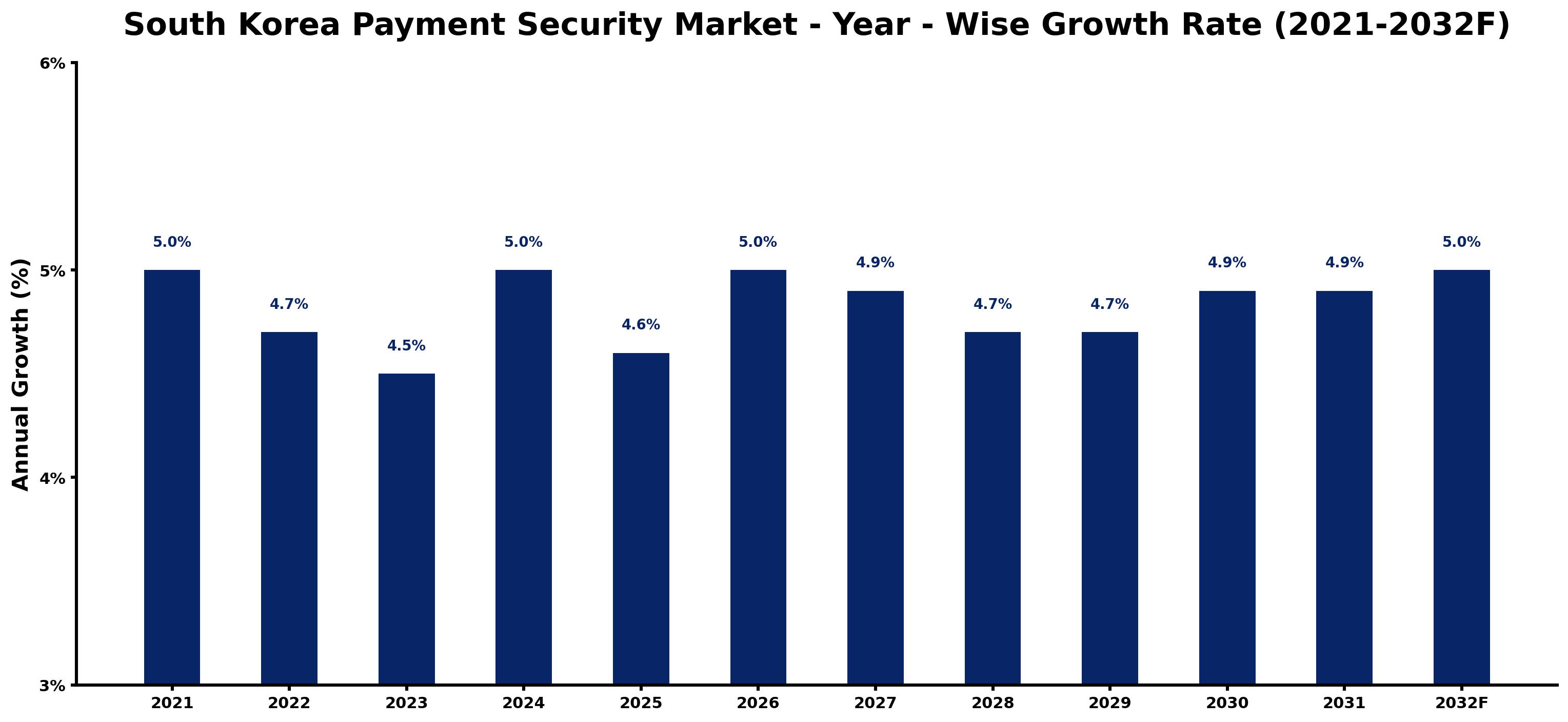
The table below presents the year‑wise growth rates along with the key drivers influencing the market
| Year | Growth Rate | Major Drivers |
| 2021 | 5.0% | Strengthening of P2P transaction security regulations by FSC. |
| 2022 | 4.7% | Rising cybersecurity awareness among South Korean consumers. |
| 2023 | 4.5% | Increased investment in biometric authentication technologies nationwide. |
| 2024 | 5.0% | Launch of Korea's 'Digital Finance Innovation Plan'. |
| 2025 | 4.6% | Surge in online gaming boosting secure payment services. |
| 2026 | 5.0% | Implementation of new anti-fraud measures by KISA. |
| 2027 | 4.9% | Government incentives for fintech startups enhancing security. |
| 2028 | 4.7% | Adoption of blockchain technology by banks for security. |
| 2029 | 4.7% | Growing use of AI for fraud detection systems. |
| 2030 | 4.9% | Increased collaboration between banks and cybersecurity firms. |
| 2031 | 4.9% | Enhanced regulatory focus on protecting consumer payment data. |
| 2032 | 5.0% | Rise in cross-border e-commerce elevating security standards. |
Note: Market size estimations and growth projections presented in this report are based on 6Wresearch's proprietary forecasting methodology, utilizing the latest available industry data, government publications, and primary research inputs.
South Korea Payment Security Market Key Takeaways
Below are some of the specific key takeaways from the market, including:
- The rise in online transactions is driving heightened investment in payment security solutions.
- Compliance with data protection regulations is becoming a priority for businesses.
- Advanced security technologies like tokenization and biometric authentication are gaining traction.
- SMEs often lag in adopting necessary security measures, posing potential risks.
- Government initiatives are enhancing the regulatory framework for payment security.
Evaluation of Restraints in South Korea Payment Security Market
Despite the growing focus on payment security, several restraints hinder market progress. A primary concern is the increasing sophistication of cyber threats, which outpace current security measures. on top of that, compliance with stringent data protection regulations can be burdensome, particularly for small and medium-sized enterprises. Many businesses remain unaware of the critical need for advanced security technologies, leading to a hesitance to invest in the necessary solutions. This knowledge gap coupled with the rapid evolution of payment methods means that companies must stay continuously informed and vigilant against emerging risks.
South Korea Payment Security Market Trends
The payment security market in South Korea is witnessing notable trends aimed at improving transaction safety. Notable advancements in biometric authentication technologies are enhancing user verification processes. Tokenization is becoming a favored method for securing transaction data, as it effectively reduces the risk of data breaches. on top of that, the shift towards mobile payments and e-wallets is pushing the demand for integrated security measures across platforms. Companies are increasingly aligning their payment systems with compliance standards such as PCI DSS, indicating a more structured approach to transaction security.
South Korea Payment Security Market Opportunities
Investment opportunities abound within the South Korea Payment Security Market, primarily fueled by the rising adoption of digital payment systems. Key areas for potential investment include the development of advanced authentication solutions and fraud detection systems. As businesses look to comply with stringent regulations, tools that facilitate compliance management are also in demand. The collaboration between technology vendors and financial institutions can amplify market reach, offering an exciting avenue for growth in this dynamic sector.
Government Initiatives in the South Korea Payment Security Market
Government policy plays a crucial role in shaping the South Korea Payment Security Market, focusing on regulatory compliance and consumer protection. By implementing stringent guidelines and support mechanisms, authorities aim to foster a secure payment environment. These initiatives not only bolster consumer confidence but also encourage businesses to prioritize cybersecurity as part of their operational strategy.
- A national framework for personal information protection was launched in early 2024, enhancing the security protocols for financial institutions.
- The Payment Gateway Act, introduced in late 2023, regulates secure payment processing services across the country.
- The Ministry of Science and ICT has ongoing initiatives to upgrade cybersecurity infrastructures, ensuring robust defenses against digital threats.
- A planned public-private partnership is expected to commence by early 2026, focusing on improving payment security technologies.
- In 2025, guidelines for advanced biometric authentication practices were established to standardize security measures across payment platforms.
Future Insights of the South Korea Payment Security Market
Looking ahead to 2026-2032, the South Korea Payment Security Market is set for substantial expansion. As the digital economy continues to flourish, the need for fortified security measures will become even more pressing. Innovations in technology, particularly in encryption and biometric solutions, will drive market development. The push towards a cashless economy, supported by government initiatives, will likely stimulate further demand for secure payment systems. Companies that prioritize research and development will be best positioned to capitalize on these trends and meet evolving consumer needs.
South Korea Payment Security Market Latest Developments
Recent activity in the South Korea Payment Security Market indicates a strong commitment to enhancing security measures amidst rising cyber threats. Key players are actively investing in innovative technologies to bolster their offerings. This trend reflects a broader recognition of the vital role cybersecurity plays in fostering consumer trust and ensuring transaction safety.
- A major technology vendor launched a new encryption solution aimed at securing online payment transactions in Q1 2025.
- Partnership initiatives among financial institutions and cybersecurity firms are currently underway, focusing on shared security protocols that began in mid-2025.
- An ongoing pilot program designed to integrate biometric authentication into payment systems is expected to conclude by late 2025.
- A rollout of upgraded payment security regulations is scheduled for the second half of 2026, aimed at further protecting consumer data.
- New fraud detection algorithms were implemented by a regional operator in early 2025, enhancing the real-time monitoring capabilities of transactions.
South Korea Payment Security Market - Key Attractiveness of the Report
- 10 Years of Market Numbers
- Historical Data Starting from 2022 to 2025
- Base Year: 2025
- Forecast Data until 2032
- Key Performance Indicators Impacting the Market
- Major Upcoming Developments and Projects
Key Highlights of the Report:
- South Korea Payment Security Market Outlook
- Market Size of South Korea Payment Security Market, 2025
- Forecast of South Korea Payment Security Market, 2032
- Historical Data and Forecast of South Korea Payment Security Revenues & Volume for the Period 2022-2032F
- South Korea Payment Security Market Trend Evolution
- South Korea Payment Security Market Drivers and Challenges
- South Korea Payment Security Price Trends
- South Korea Payment Security Porter's Five Forces
- South Korea Payment Security Industry Life Cycle
- Historical Data and Forecast of South Korea Payment Security Market Revenues & Volume By Solution for the Period 2022-2032F
- Historical Data and Forecast of South Korea Payment Security Market Revenues & Volume By Encryption for the Period 2022-2032F
- Historical Data and Forecast of South Korea Payment Security Market Revenues & Volume By Tokenization for the Period 2022-2032F
- Historical Data and Forecast of South Korea Payment Security Market Revenues & Volume By Fraud Detection for the Period 2022-2032F
- Historical Data and Forecast of South Korea Payment Security Market Revenues & Volume By Prevention for the Period 2022-2032F
- Historical Data and Forecast of South Korea Payment Security Market Revenues & Volume By Service for the Period 2022-2032F
- Historical Data and Forecast of South Korea Payment Security Market Revenues & Volume By Integration for the Period 2022-2032F
- Historical Data and Forecast of South Korea Payment Security Market Revenues & Volume By Support for the Period 2022-2032F
- Historical Data and Forecast of South Korea Payment Security Market Revenues & Volume By Consulting for the Period 2022-2032F
- Historical Data and Forecast of South Korea Payment Security Market Revenues & Volume By Organization Size for the Period 2022-2032F
- Historical Data and Forecast of South Korea Payment Security Market Revenues & Volume By Large Enterprises for the Period 2022-2032F
- Historical Data and Forecast of South Korea Payment Security Market Revenues & Volume By SMEs for the Period 2022-2032F
- Historical Data and Forecast of South Korea Payment Security Market Revenues & Volume By Industry Vertical for the Period 2022-2032F
- South Korea Payment Security Import Export Trade Statistics
- Market Opportunity Assessment By Solution
- Market Opportunity Assessment By Service
- Market Opportunity Assessment By Organization Size
- Market Opportunity Assessment By Industry Vertical
- South Korea Payment Security Top Companies Market Share
- South Korea Payment Security Competitive Benchmarking By Technical and Operational Parameters
- South Korea Payment Security Company Profiles
- South Korea Payment Security Key Strategic Recommendations






































