South Korea Peat Market Size, Share & Growth Rate
The South Korea Peat Market was estimated at USD 240 Million in 2025 and is projected to reach USD 313 Million by 2032, growing at a CAGR of 3.9% from 2026 to 2032. This growth trajectory is primarily driven by the agriculture and horticulture sectors, where peat is valued for its ability to enhance soil quality and promote healthy plant growth. Additionally, urban gardening trends and a shift towards eco-friendly gardening solutions are further contributing to the increasing demand for peat-based products.
South Korea Peat Market Year-wise Growth Rate and Key Drivers
This graph highlights how the South Korea Peat Market has steadily grown over the years, supported by major growth factors.
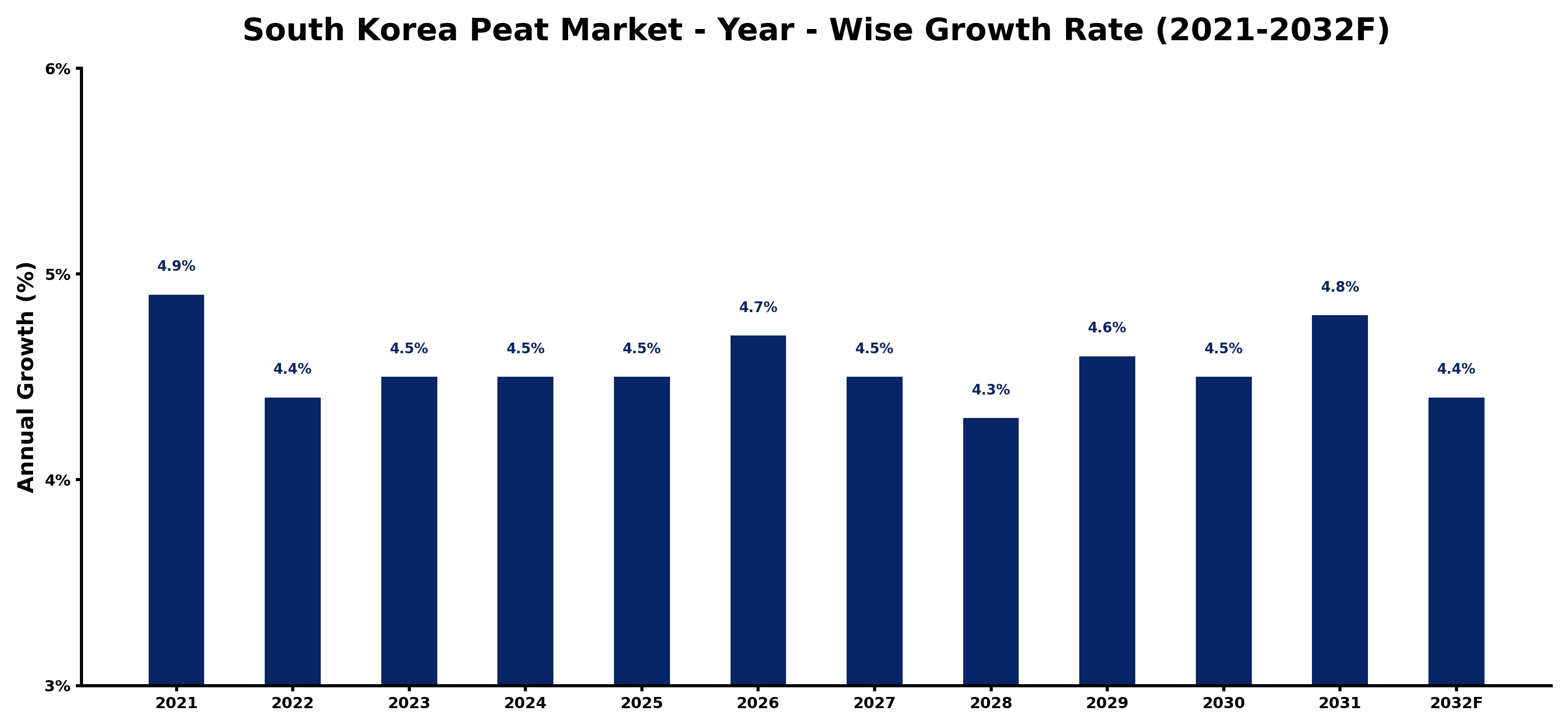
The table below presents the year‑wise growth rates along with the key drivers influencing the market
| Year | Growth Rate | Major Drivers |
| 2021 | 4.9% | Manufacturers invest in peat harvesting technology to boost efficiency |
| 2022 | 4.4% | Advanced extraction technologies boost peat production efficiency in South Korea |
| 2023 | 4.5% | Domestic demand for sustainable construction materials boosts peat extraction efficiency |
| 2024 | 4.5% | Manufacturing investments in sustainable alternatives boost peat product demand |
| 2025 | 4.5% | Higher domestic peat extraction rates boosted regional horticultural supply chains |
| 2026 | 4.7% | Domestic peat extraction facilities enhanced overall thermal energy output |
| 2027 | 4.5% | Increased horticultural exports boosted peat substrate manufacturing activity |
| 2028 | 4.3% | Technological advancements in peat harvesting enhance production efficiency |
| 2029 | 4.6% | Peat harvesting technology advancements boosted production facility investments |
| 2030 | 4.5% | Export driven bioenergy projects boosted peat extraction technology investments |
| 2031 | 4.8% | Peat processing facility upgrades enhance product quality for export |
| 2032 | 4.4% | Sustainable agriculture initiatives drive peat based soil amendment production |
Note - Market size estimations and growth projections presented in this report are based on 6Wresearch's advanced forecasting approach, validated with industry datasets as of June 2026.
South Korea Peat Market Synopsis
In recent years, the South Korea peat market has gained attention due to its significant role in agricultural practices and horticulture. Peat serves as an essential soil amendment, enhancing water retention and nutrient availability, which is vital for plant health and crop yields.
However, the market is also facing critical scrutiny over environmental sustainability. As awareness around ecological impacts grows, many consumers are starting to prefer sustainably sourced or peat-free alternatives, prompting shifts in production strategies across the sector.
South Korea Peat Market Key Takeaways
- There is an increasing trend towards sustainable alternatives to traditional peat products.
- Urban gardening and landscaping practices are driving demand for high-quality peat-based soil amendments.
- Government regulations are shaping market dynamics by promoting eco-friendly practices.
- Investment opportunities are emerging in eco-friendly peat products and peat extraction facilities.
- Growing consumer awareness is compelling companies to innovate in product offerings.
Evaluation of Restraints in South Korea Peat Market
One of the main restraints impacting the South Korea peat market is the environmental concerns associated with peat extraction. The process has been linked to habitat degradation and increased greenhouse gas emissions. Furthermore, limited local peat resources raise sustainability questions and potential future shortages. Additionally, the competition from renewable substitutes such as coconut coir is intensifying, pressuring traditional peat producers to adapt and innovate to stay relevant in this evolving market landscape.
South Korea Peat Market Trends
Emerging trends in the South Korea peat market include a significant pivot towards sustainability. Consumers increasingly prefer peat-free alternatives and responsibly sourced peat products. This shift has encouraged companies to focus on organic growing mediums that are perceived to be more environmentally friendly. Additionally, there is a rising interest in value-added peat products, such as those enriched with nutrients tailored for specific plants, which cater to the needs of urban gardeners and professional horticulturists alike.
South Korea Peat Market Opportunities
The South Korea peat market presents several investment opportunities, particularly in sectors focused on agricultural improvement and eco-friendly products. Companies can explore initiatives in peat extraction and processing facilities to capitalize on the growing demand for soil enhancements. Additionally, developing innovative, peat-based products like enriched fertilizers and eco-conscious substrates offers promising avenues for growth. Furthermore, the rising interest in sustainable agricultural practices positions eco-friendly peat products as an attractive investment option.
Government Initiatives in the South Korea Peat Market
The South Korean government has actively implemented policies aimed at promoting sustainable management of peatlands. Recent regulations introduced by the Ministry of Environment focus on reducing the use of peat in horticulture and landscaping, encouraging the transition to alternative materials. Financial incentives and support for peatland restoration projects underline the government's commitment to environmental conservation and sustainable practices in the industry, reflecting broader goals of biodiversity protection.
Future Insights of the South Korea Peat Market
Looking ahead to 2026-2032, the South Korea peat market is poised for moderate growth, fueled by an increasing interest in agriculture and horticulture. The ongoing trend towards urban gardening, combined with heightened awareness of peat's benefits for soil quality, will likely sustain market expansion. However, companies must remain vigilant regarding sustainability challenges and adapt to evolving consumer preferences, positioning themselves as leaders in innovative, eco-friendly products in order to thrive in the changing landscape.
South Korea Peat Market Latest Developments (May 2025 - June 2026)
Recent developments in the South Korea peat market indicate a growing emphasis on sustainability and innovation. Companies are increasingly exploring alternative materials and enhancing peat products with nutrients to meet rising consumer demands. Furthermore, government policies focused on ecological preservation are pushing businesses to adopt more responsible extraction and processing methods. These trends signal a transformative phase in the industry, where traditional practices will need to adapt to align with modern environmental expectations.
South Korea Peat Market - Key Attractiveness of the Report
- 10 Years of Market Numbers
- Historical Data Starting from 2022 to 2025
- Base Year: 2025
- Forecast Data until 2032
- Key Performance Indicators Impacting the Market
- Major Upcoming Developments and Projects
Key Highlights of the Report:
- South Korea Peat Market Outlook
- Market Size of South Korea Peat Market, 2025
- Forecast of South Korea Peat Market, 2032
- Historical Data and Forecast of South Korea Peat Revenues & Volume for the Period 2022-2032F
- South Korea Peat Market Trend Evolution
- South Korea Peat Market Drivers and Challenges
- South Korea Peat Price Trends
- South Korea Peat Porter's Five Forces
- South Korea Peat Industry Life Cycle
- Historical Data and Forecast of South Korea Peat Market Revenues & Volume By Type for the Period 2022-2032F
- Historical Data and Forecast of South Korea Peat Market Revenues & Volume By Coco Peat for the Period 2022-2032F
- Historical Data and Forecast of South Korea Peat Market Revenues & Volume By Sod Peat for the Period 2022-2032F
- Historical Data and Forecast of South Korea Peat Market Revenues & Volume By Other for the Period 2022-2032F
- Historical Data and Forecast of South Korea Peat Market Revenues & Volume By Material Type for the Period 2022-2032F
- Historical Data and Forecast of South Korea Peat Market Revenues & Volume By Fibric for the Period 2022-2032F
- Historical Data and Forecast of South Korea Peat Market Revenues & Volume By Hemic for the Period 2022-2032F
- Historical Data and Forecast of South Korea Peat Market Revenues & Volume By Sapric for the Period 2022-2032F
- Historical Data and Forecast of South Korea Peat Market Revenues & Volume By Others for the Period 2022-2032F
- Historical Data and Forecast of South Korea Peat Market Revenues & Volume By Application for the Period 2022-2032F
- Historical Data and Forecast of South Korea Peat Market Revenues & Volume By Agriculture for the Period 2022-2032F
- Historical Data and Forecast of South Korea Peat Market Revenues & Volume By Fuel & Energy for the Period 2022-2032F
- Historical Data and Forecast of South Korea Peat Market Revenues & Volume By Others for the Period 2022-2032F
- South Korea Peat Import Export Trade Statistics
- Market Opportunity Assessment By Type
- Market Opportunity Assessment By Material Type
- Market Opportunity Assessment By Application
- South Korea Peat Top Companies Market Share
- South Korea Peat Competitive Benchmarking By Technical and Operational Parameters
- South Korea Peat Company Profiles
- South Korea Peat Key Strategic Recommendations






































