South Korea Personal Computers Market Size, Share & Growth Rate
The South Korea Personal Computers Market was estimated at USD 1272 Million in 2025 and is projected to reach USD 1833 Million by 2032, growing at a CAGR of 5.4% from 2026 to 2032. This growth trajectory is bolstered by the rapid adoption of digital technologies among a tech-savvy population and rising disposable incomes. Furthermore, the ongoing trends of remote work and online learning, intensified by the global pandemic, are driving an increasing need for reliable computing devices across various consumer segments.
South Korea Personal Computers Market Year-wise Growth Rate and Key Drivers
This graph highlights how the South Korea Personal Computers Market has steadily grown over the years, supported by major growth factors.
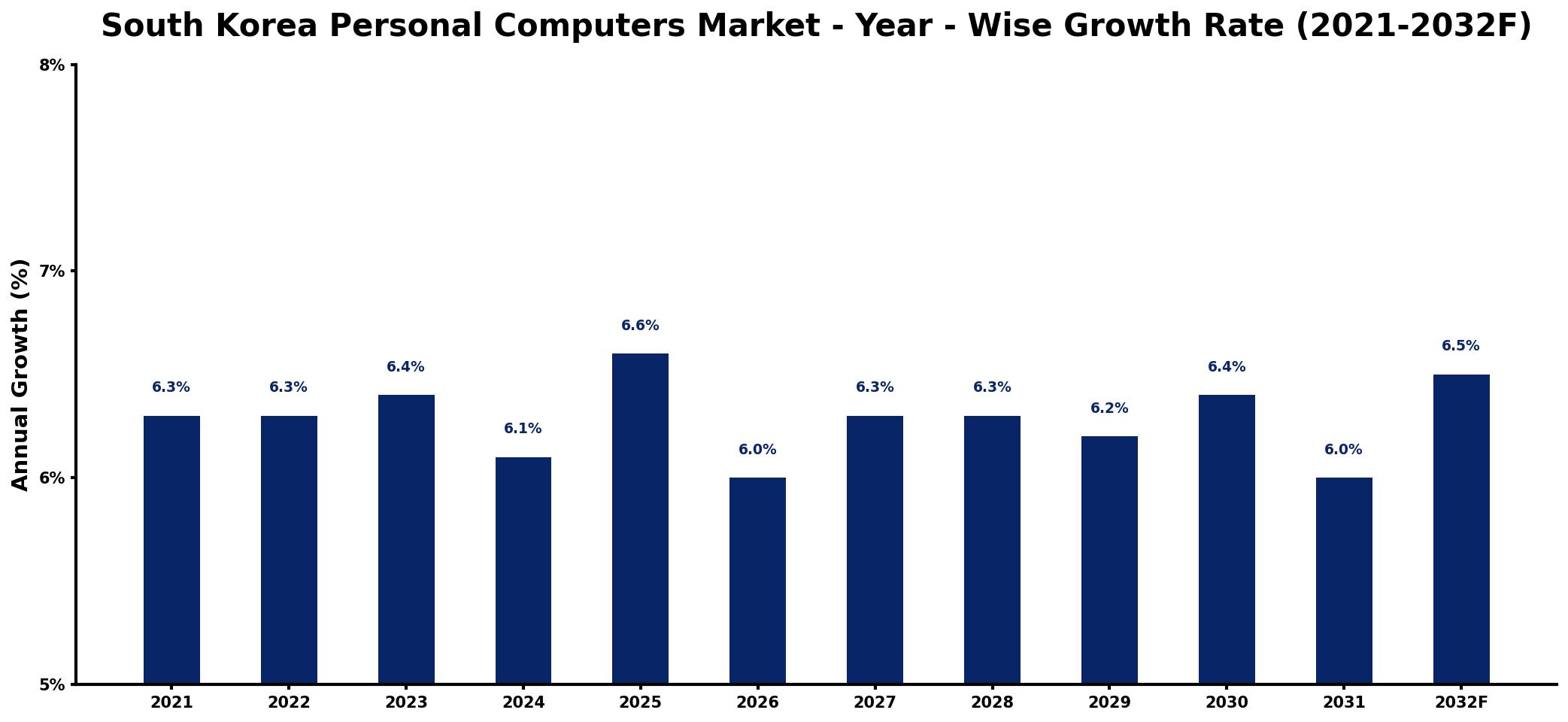
The table below presents the year‑wise growth rates along with the key drivers influencing the market
| Year | Growth Rate | Major Drivers |
| 2021 | 6.3% | Rising demand for remote work |
| 2022 | 6.3% | Expansion of online education platforms |
| 2023 | 6.4% | Growth in gaming industry investments |
| 2024 | 6.1% | Increased focus on cybersecurity solutions |
| 2025 | 6.6% | Surge in cloud computing adoption |
| 2026 | 6.0% | rising infrastructure development spending |
| 2027 | 6.3% | Investment in AI technology applications |
| 2028 | 6.3% | increased domestic production output |
| 2029 | 6.2% | Increased demand for streaming services |
| 2030 | 6.4% | growing automotive sector requirements |
| 2031 | 6.0% | enhanced product quality standards |
| 2032 | 6.5% | strengthening international trade flows |
Note: Market size estimations and growth projections presented in this report are based on 6Wresearch's proprietary forecasting methodology, utilizing the latest available industry data, government publications, and primary research inputs.
South Korea Personal Computers Market Synopsis
Consumer demand for laptops and desktops remains the strongest force shaping the South Korea Personal Computers Market. This demand is further fueled by the increasing popularity of ultra-portable and gaming PCs, appealing particularly to younger demographics eager for mobility and high performance.
Additionally, initiatives promoting digitalization are enabling local brands to innovate continually. As South Korea's workforce becomes increasingly remote, there is an upsurge in interest for devices that enhance connectivity and productivity, setting the stage for a more competitive and diverse market landscape.
South Korea Personal Computers Market Key Takeaways
- The market is experiencing robust growth due to the dual influence of remote work and online education.
- Innovation in design, particularly with ultra-thin and lightweight models, is a primary consumer demand driver.
- Gaming PCs are gaining traction, reflecting the broader cultural acceptance of eSports in South Korea.
- Investment in companies focused on customizable devices could yield favorable returns in this evolving market.
- Government initiatives supporting digital literacy and technological advancement foster a competitive environment for market players.
Evaluation of Restraints in South Korea Personal Computers Market
Despite its promising outlook, the South Korea Personal Computers Market faces significant restraints, predominantly from intense competition among both domestic and international brands. This competitive landscape pressures manufacturers to continually innovate while navigating pricing challenges in an already saturated market. Furthermore, changing consumer preferences leaning towards mobile devices and laptops pose a threat to the traditional desktop segment. To remain relevant, companies must prioritize product differentiation and adapt to evolving consumer needs.
South Korea Personal Computers Market Trends
The demand for ultra-thin and lightweight laptops is on the rise, especially among young professionals and students who value performance and portability. The gaming sector is also witnessing a surge, driven by the popularity of eSports and a growing gaming culture. Additionally, there is a trend towards all-in-one PCs and convertible devices, which provide flexibility for both work and leisure. With increasing reliance on technology for education and remote work, the focus is shifting towards PCs equipped with advanced connectivity features and powerful processors capable of handling multitasking efficiently.
South Korea Personal Computers Market Opportunities
Investment opportunities abound in the South Korea Personal Computers Market, driven by a highly tech-savvy population keen on innovative devices. Companies that manufacture high-quality, competitively priced PCs, particularly those offering customizable options, are well-positioned to capture market share. Furthermore, as remote work and digital learning continue to permeate everyday life, targeting these segments presents a strategic growth avenue for manufacturers and retailers alike.
Government Initiatives in the South Korea Personal Computers Market
The South Korean government has rolled out several initiatives aimed at bolstering the personal computers market. These include funding for research and development in the tech sector, tax incentives for innovation-focused companies, and educational programs designed to enhance digital literacy among the populace. The government is also committed to fostering a regulatory environment conducive to competition and technological advancements, all of which aim to spur growth within the market.
Future Insights of the South Korea Personal Computers Market
Looking ahead to 2026-2032, the South Korea Personal Computers Market is projected to maintain a positive growth trajectory. The increasing need for PCs for remote work, online education, and entertainment will continue to drive demand. Technological advancements, including the integration of artificial intelligence and enhanced processing capabilities, are expected to redefine consumer expectations. Furthermore, the rising interest in gaming and eSports will further stimulate demand for high-performance gaming PCs, positioning the market for steady development despite potential competition from alternative devices.
South Korea Personal Computers Market Latest Developments (2025 - 2026)
Recently, the industry has observed a notable shift towards incorporating advanced features in personal computers, including improved connectivity options and enhanced graphics capabilities tailored for gaming enthusiasts. Manufacturers are increasingly adopting eco-friendly materials and production practices to appeal to a more environmentally conscious consumer base. Additionally, the market has seen collaborative efforts among companies to enhance product offerings and address evolving consumer preferences in a rapidly changing technological landscape.
South Korea Personal Computers Market - Key Attractiveness of the Report
- 10 Years of Market Numbers
- Historical Data Starting from 2022 to 2025
- Base Year: 2025
- Forecast Data until 2032
- Key Performance Indicators Impacting the Market
- Major Upcoming Developments and Projects
Key Highlights of the Report:
- South Korea Personal Computers Market Outlook
- Market Size of South Korea Personal Computers Market, 2025
- Forecast of South Korea Personal Computers Market, 2032
- Historical Data and Forecast of South Korea Personal Computers Revenues & Volume for the Period 2022-2032F
- South Korea Personal Computers Market Trend Evolution
- South Korea Personal Computers Market Drivers and Challenges
- South Korea Personal Computers Price Trends
- South Korea Personal Computers Porter's Five Forces
- South Korea Personal Computers Industry Life Cycle
- Historical Data and Forecast of South Korea Personal Computers Market Revenues & Volume By Product Type for the Period 2022-2032F
- Historical Data and Forecast of South Korea Personal Computers Market Revenues & Volume By Desktop for the Period 2022-2032F
- Historical Data and Forecast of South Korea Personal Computers Market Revenues & Volume By Notebook for the Period 2022-2032F
- Historical Data and Forecast of South Korea Personal Computers Market Revenues & Volume By Workstation for the Period 2022-2032F
- Historical Data and Forecast of South Korea Personal Computers Market Revenues & Volume By Others for the Period 2022-2032F
- Historical Data and Forecast of South Korea Personal Computers Market Revenues & Volume By Distribution Channel for the Period 2022-2032F
- Historical Data and Forecast of South Korea Personal Computers Market Revenues & Volume By Business-To-Business (B2B) for the Period 2022-2032F
- Historical Data and Forecast of South Korea Personal Computers Market Revenues & Volume By Business-To-Consumer (B2C) for the Period 2022-2032F
- Historical Data and Forecast of South Korea Personal Computers Market Revenues & Volume By Application for the Period 2022-2032F
- Historical Data and Forecast of South Korea Personal Computers Market Revenues & Volume By Consumer for the Period 2022-2032F
- Historical Data and Forecast of South Korea Personal Computers Market Revenues & Volume By Commercial for the Period 2022-2032F
- Historical Data and Forecast of South Korea Personal Computers Market Revenues & Volume By Industrial for the Period 2022-2032F
- South Korea Personal Computers Import Export Trade Statistics
- Market Opportunity Assessment By Product Type
- Market Opportunity Assessment By Distribution Channel
- Market Opportunity Assessment By Application
- South Korea Personal Computers Top Companies Market Share
- South Korea Personal Computers Competitive Benchmarking By Technical and Operational Parameters
- South Korea Personal Computers Company Profiles
- South Korea Personal Computers Key Strategic Recommendations






































