South Korea Pest Control Products Market Summary
The south korea pest control products market was estimated at USD 229 Million in 2025 and is projected to reach USD 313 Million by 2032, growing at a CAGR of 5.0% from 2026 to 2032.
South Korea Pest Control Products Market Year-wise Growth Rate and Key Drivers
This graph highlights how the South Korea Pest Control Products Market has steadily grown over the past five years, supported by major growth factors.
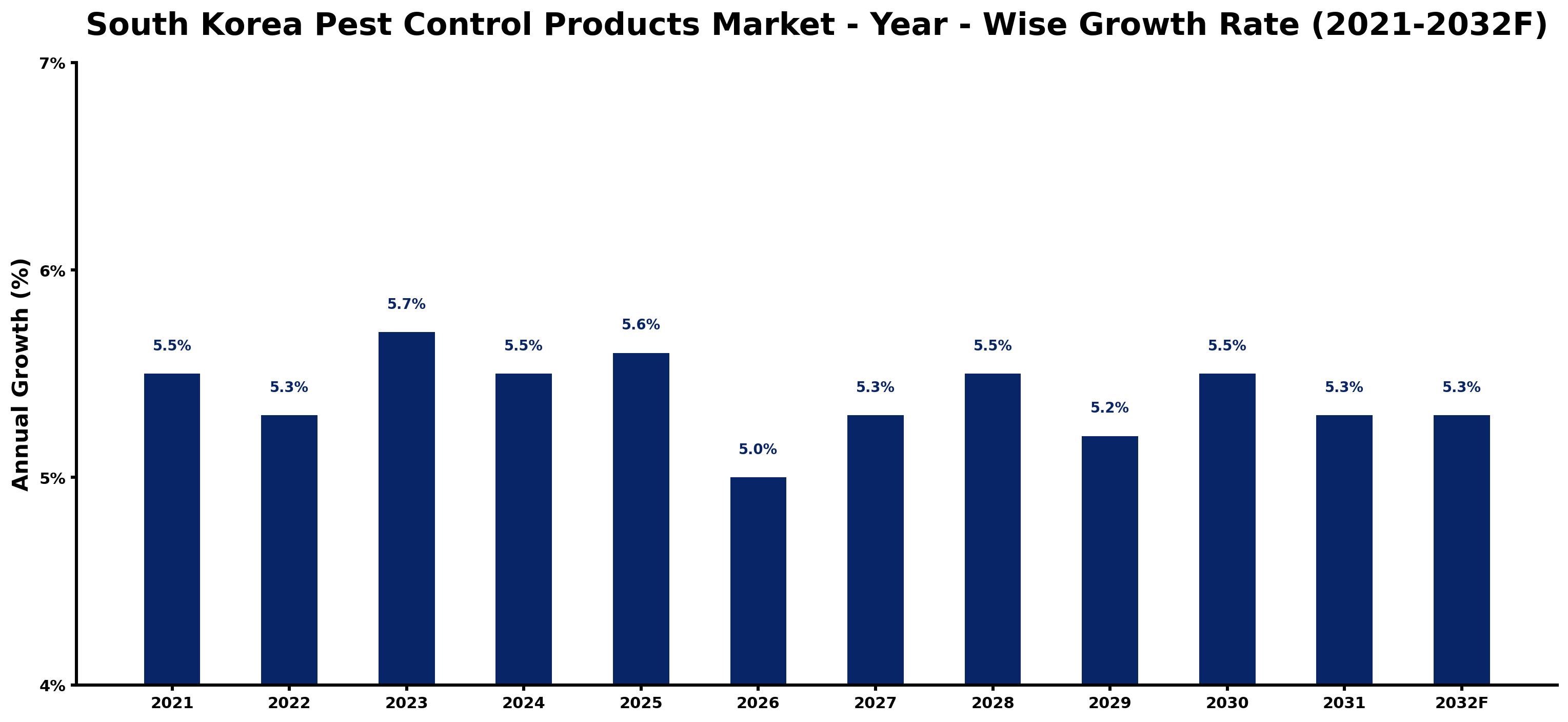
The table below presents the year wise growth rates along with the key drivers influencing the market
| Year | Growth Rate | Major Drivers |
| 2021 | 5.5% | Post-lockdown retail projects increased consumer awareness about household pest control solutions. |
| 2022 | 5.3% | Innovative pest control formulations appealed to environmentally conscious South Korean consumers. |
| 2023 | 5.7% | Continued urbanization led to higher pest populations in densely populated areas. |
| 2024 | 5.5% | E-commerce platforms expanded access to pest control products and services nationwide. |
| 2025 | 5.6% | Emerging health concerns prompted a shift towards safer, non-toxic pest management options. |
| 2026 | 5.0% | Technological advancements in pest detection methods improved service efficiency and effectiveness. |
| 2027 | 5.3% | Rising real estate development projects increased demand for pest control services in new properties. |
| 2028 | 5.5% | Increased media exposure regarding pest-related health risks drove consumer purchasing behavior. |
| 2029 | 5.2% | Sustainable pest control practices gained popularity among businesses focusing on environmental impact. |
| 2030 | 5.5% | Changes in consumer lifestyle trends shifted preferences towards integrated pest management solutions. |
| 2031 | 5.3% | Growing interest in home gardening necessitated effective pest control solutions for urban gardeners. |
| 2032 | 5.3% | Collaborations between tech startups and pest control firms enhanced product delivery and service options. |
Note - Market size estimations and growth projections presented in this report are based on 6Wresearch's advanced forecasting approach, validated with industry datasets as of June 2026.
South Korea Pest Control Products Market Synopsis
The South Korea Pest Control Products Market is projected to reach 5.0% and witness significant growth during the forecast period (2026-2032). The market is expected to record a compound annual growth rate (CAGR) of 6.8%, fueled by rising public health concerns and an increased prevalence of vector-borne diseases. The surge in mosquito populations has led to alarming cases of diseases such as dengue fever, chikungunya, and the Zika virus, creating an urgent demand for effective insecticides that ensure human safety.
South Korea Pest Control Products Market Growth Drivers
Several factors are propelling the growth of the South Korea Pest Control Products Market. Key among these is the escalating awareness among consumers regarding health risks associated with pests. This heightened awareness has led to a marked increase in the demand for pest control products, including pesticides and insecticides. As the domestic population becomes more informed about the dangers posed by pests, the urgency to procure effective pest management solutions has intensified.
- Rising health concerns related to vector-borne diseases are driving consumers to seek pest control solutions tailored to ensure safety and efficacy.
- The increasing availability of innovative pest control technologies and products designed to combat specific pests is enhancing market attractiveness.
- Consumer preferences are shifting towards organic and natural pest management solutions, reflecting a growing demand for environmentally friendly options.
- Urbanization trends in South Korea are contributing to pest proliferation, further necessitating advanced pest control measures in both residential and commercial sectors.
- The ongoing emphasis on hygiene and sanitation, especially post-pandemic, has reinforced the significance of pest control in safeguarding public health.
South Korea Pest Control Products Market Trends and Opportunities
The landscape of the South Korea Pest Control Products Market is evolving, presenting numerous trends and opportunities. A notable trend is the shift towards integrated pest management (IPM) practices, which utilize a combination of biological, cultural, and chemical methods to achieve effective pest control while minimizing environmental impact. The trend towards sustainability is not just a passing phase; it aligns with consumer demand for products that are both effective and safe for human health.
- Growing consumer preference for organic pest control solutions is fostering the development of innovative, eco-friendly products in the market.
- The rise of e-commerce platforms is reshaping the distribution channels for pest control products, making them more accessible to consumers.
- Technological advancements in pest control equipment, such as smart traps and sensors, are creating new market opportunities.
- Investments in research and development are driving the introduction of new formulations and delivery mechanisms that enhance product effectiveness.
- Public education initiatives aimed at promoting pest awareness and prevention are influencing consumer behavior positively towards pest control products.
South Korea Pest Control Products Market Challenges and Restraints
Despite the promising growth forecast for the South Korea Pest Control Products Market, several challenges and restraints could impede its expansion. Regulatory hurdles concerning pest control product formulations and their application could pose a barrier to entry for new players. Additionally, fluctuating raw material prices can impact production costs, potentially leading to higher retail prices for consumers.
- Stringent regulations regarding the use of chemical pesticides may limit product availability and complicate the registration process for new entrants.
- The increasing prevalence of counterfeit and unregulated pest control products could undermine consumer trust in the market.
- Seasonal demand variability can lead to fluctuating revenues for manufacturers and distributors throughout the year.
- The lack of awareness about pest control solutions in rural areas may limit market penetration in these regions.
- Concerns over the environmental impact of certain chemical pest control products may influence public opinion and purchasing decisions.
South Korea Pest Control Products Market Government Investment and Initiatives
The South Korean government has been proactive in addressing public health concerns related to pests, thereby stimulating the Pest Control Products Market. Various initiatives led by the Ministry of Environment (MOE) aim to regulate and reduce environmental pollutants associated with chemical pest control methods. These initiatives not only bolster public health but also encourage the development of safer, eco-friendly pest management solutions.
- The MOE has implemented stringent guidelines for pest control products to ensure their safety, efficacy, and minimal environmental impact.
- Government funding and public awareness campaigns focused on the importance of pest management have increased consumer engagement in the market.
- Investment in research and development for alternative pest control methods, including biological control agents, is being promoted to reduce reliance on chemical pesticides.
- Collaborations between the government and private sector entities are fostering innovation in pest control technologies.
- Regulatory frameworks are being continuously updated to keep pace with technological advancements in the pest control industry.
South Korea Pest Control Products Market Latest Developments (May 2025 - June 2026)
In the recent months leading up to June 2026, the South Korea Pest Control Products Market has experienced significant developments. There is a notable trend towards the adoption of smart technologies and digital solutions for pest management. Companies are increasingly leveraging data analytics and IoT (Internet of Things) for real-time monitoring of pest populations, which enhances the effectiveness of treatment strategies. Furthermore, the industry is witnessing a gradual shift towards using more sustainable, eco-friendly products in response to consumer demand and regulatory pressures.
- Innovations in product formulations are leading to the development of pest control products that are not only effective but also environmentally sustainable.
- Research initiatives focused on integrated pest management practices are gaining traction among industry stakeholders.
- Increased collaboration between academic institutions and the private sector is fostering advancements in pest control research and technology.
- The introduction of user-friendly pest control apps is enabling consumers to manage pest-related issues more efficiently.
- Public health campaigns have become more pronounced, highlighting the connection between pest control and disease prevention.
South Korea Pest Control Products Market - Key Attractiveness of the Report
- 10 Years of Market Numbers
- Historical Data Starting from 2022 to 2025
- Base Year: 2025
- Forecast Data until 2032
- Key Performance Indicators Impacting the Market
- Major Upcoming Developments and Projects
Key Highlights of the Report:
- South Korea Pest Control Products Market Outlook
- Market Size of South Korea Pest Control Products Market, 2025
- Forecast of South Korea Pest Control Products Market, 2032F
- Historical Data and Forecast of South Korea Pest Control Products Revenues & Volume for the Period 2022-2032F
- South Korea Pest Control Products Market Trend Evolution
- South Korea Pest Control Products Market Drivers and Challenges
- South Korea Pest Control Products Price Trends
- South Korea Pest Control Products Porter's Five Forces
- South Korea Pest Control Products Industry Life Cycle
- Historical Data and Forecast of South Korea Pest Control Products Market Revenues & Volume By Type for the Period 2022-2032F
- Historical Data and Forecast of South Korea Pest Control Products Market Revenues & Volume By Chemical for the Period 2022-2032F
- Historical Data and Forecast of South Korea Pest Control Products Market Revenues & Volume By Mechanical for the Period 2022-2032F
- Historical Data and Forecast of South Korea Pest Control Products Market Revenues & Volume By Biological for the Period 2022-2032F
- Historical Data and Forecast of South Korea Pest Control Products Market Revenues & Volume By Others for the Period 2022-2032F
- Historical Data and Forecast of South Korea Pest Control Products Market Revenues & Volume By Pest type for the Period 2022-2032F
- Historical Data and Forecast of South Korea Pest Control Products Market Revenues & Volume By Insects for the Period 2022-2032F
- Historical Data and Forecast of South Korea Pest Control Products Market Revenues & Volume By Termites for the Period 2022-2032F
- Historical Data and Forecast of South Korea Pest Control Products Market Revenues & Volume By Rodents for the Period 2022-2032F
- Historical Data and Forecast of South Korea Pest Control Products Market Revenues & Volume By Others for the Period 2022-2032F
- Historical Data and Forecast of South Korea Pest Control Products Market Revenues & Volume By Application for the Period 2022-2032F
- Historical Data and Forecast of South Korea Pest Control Products Market Revenues & Volume By Commercial for the Period 2022-2032F
- Historical Data and Forecast of South Korea Pest Control Products Market Revenues & Volume By Residential for the Period 2022-2032F
- Historical Data and Forecast of South Korea Pest Control Products Market Revenues & Volume By Agriculture for the Period 2022-2032F
- Historical Data and Forecast of South Korea Pest Control Products Market Revenues & Volume By Industrial for the Period 2022-2032F
- Historical Data and Forecast of South Korea Pest Control Products Market Revenues & Volume By Others for the Period 2022-2032F
- South Korea Pest Control Products Import Export Trade Statistics
- Market Opportunity Assessment By Type
- Market Opportunity Assessment By Pest type
- Market Opportunity Assessment By Application
- South Korea Pest Control Products Top Companies Market Share
- South Korea Pest Control Products Competitive Benchmarking By Technical and Operational Parameters
- South Korea Pest Control Products Company Profiles
- South Korea Pest Control Products Key Strategic Recommendations






































