South Korea Pharmaceutical Packaging Market Summary
The south korea pharmaceutical packaging market was estimated at USD 492 Million in 2025 and is projected to reach USD 700 Million by 2032, growing at a CAGR of 5.9% from 2026 to 2032.
South Korea Pharmaceutical Packaging Market Year-wise Growth Rate and Key Drivers
This graph highlights how the South Korea Pharmaceutical Packaging Market has steadily grown over the past five years, supported by major growth factors.
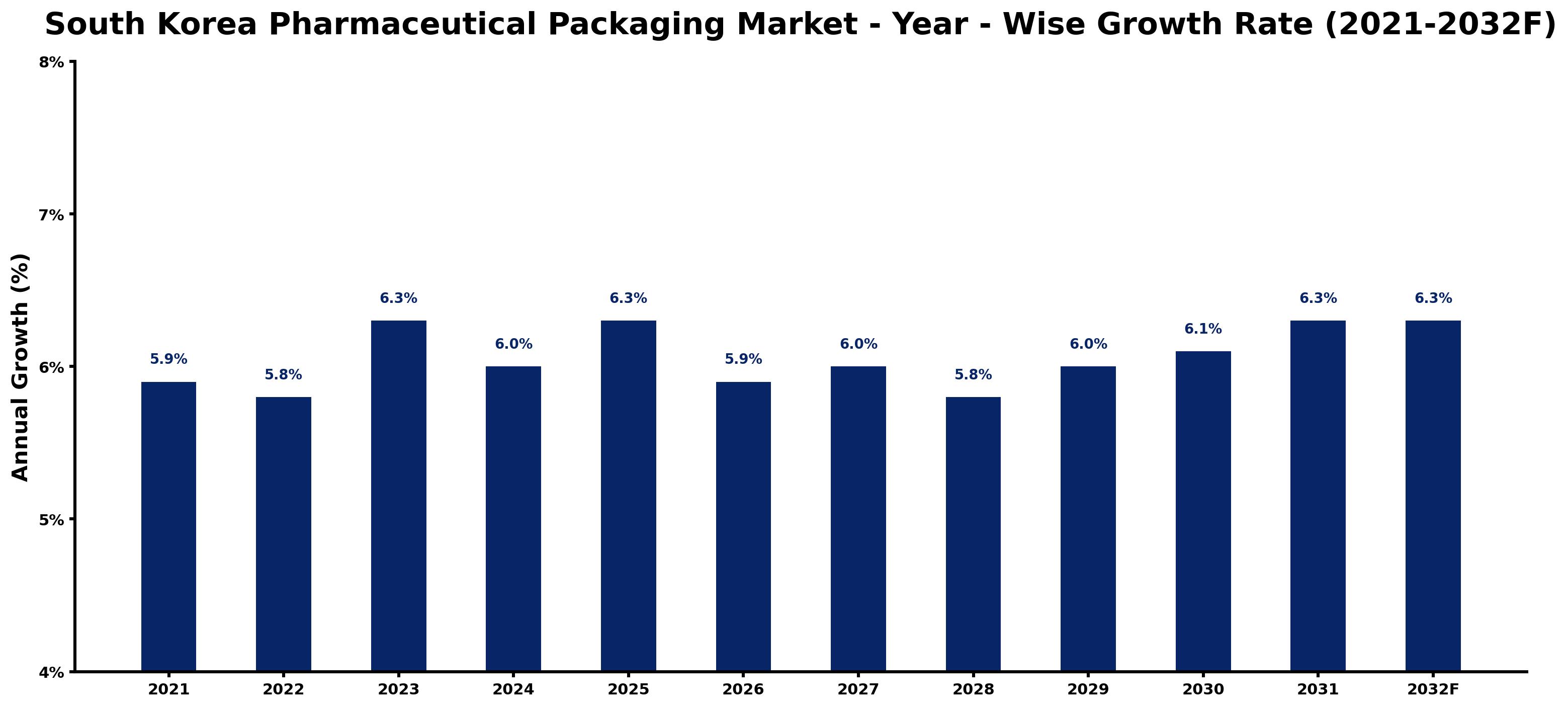
The table below presents the year wise growth rates along with the key drivers influencing the market
| Year | Growth Rate | Major Drivers |
| 2021 | 5.9% | Pharmaceutical firms commenced significant investments in sustainable packaging solutions, enhancing brand reputation. |
| 2022 | 5.8% | Technological innovations in packaging design improved product safety and extended shelf life. |
| 2023 | 6.3% | Consumer awareness regarding eco-friendly packaging materials influenced purchasing decisions significantly. |
| 2024 | 6.0% | Supply chain optimization became crucial due to disruptions caused by ongoing geopolitical tensions. |
| 2025 | 6.3% | Emergence of biopharmaceuticals accelerated demand for specialized packaging tailored to unique requirements. |
| 2026 | 5.9% | Aging population in South Korea increased the necessity for accessible and convenient pharmaceutical packaging. |
| 2027 | 6.0% | E-commerce growth prompted pharmaceutical companies to rethink packaging strategies for online sales. |
| 2028 | 5.8% | Integration of smart packaging technologies enhanced tracking and authentication in the pharmaceutical supply chain. |
| 2029 | 6.0% | Collaboration between startups and established firms fostered innovation in sustainable packaging materials. |
| 2030 | 6.1% | Shifts in consumer preferences towards personalized medications required more adaptable packaging solutions. |
| 2031 | 6.3% | Rising health consciousness among consumers led to increased scrutiny of pharmaceutical packaging safety. |
| 2032 | 6.3% | Global environmental standards pressured local firms to transition to greener packaging alternatives. |
Note - Market size estimations and growth projections presented in this report are based on 6Wresearch's advanced forecasting approach, validated with industry datasets as of June 2026.
South Korea Pharmaceutical Packaging Market Synopsis
The South Korea Pharmaceutical Packaging Market is projected to reach 5.9% and witness significant growth during the forecast period (2026-2032). This growth trajectory is primarily attributed to the increasing demand for high-performance packaging materials, heightened health consciousness among consumers, and supportive government initiatives aimed at enhancing the pharmaceutical sector. Moreover, rapid industrialization observed in recent years is expected to further bolster the development of the pharmaceutical packaging landscape in South Korea.
South Korea Pharmaceutical Packaging Market Growth Drivers
The South Korea Pharmaceutical Packaging Market is being driven by a confluence of factors that are reshaping the industry. Firstly, the demand for innovative packaging solutions is surging, as companies strive to meet consumer expectations for safety and convenience. Secondly, the rise in chronic diseases and the subsequent increase in pharmaceutical product consumption are leading to a greater need for effective packaging that enhances product shelf life and stability. Thirdly, advancements in technology are facilitating the development of smart packaging solutions, which are becoming increasingly popular in the pharmaceutical sector. Additionally, the growing trend towards sustainable packaging is further influencing market dynamics, as both consumers and regulatory bodies are advocating for environmentally friendly practices. Lastly, the escalation of e-commerce in the pharmaceutical domain is necessitating robust and reliable packaging to ensure product integrity during transit.
South Korea Pharmaceutical Packaging Market Trends and Opportunities
Within the South Korea Pharmaceutical Packaging Market, various trends are emerging that present significant opportunities for growth. The shift towards personalized medicine is stimulating demand for specialized packaging solutions that cater to individual patient needs. Furthermore, the integration of digital technologies into packaging is paving the way for enhanced traceability and transparency, crucial elements in combating counterfeit products. The increased focus on patient-centric packaging designs is also noteworthy, as companies aim to improve user experience and compliance through easy-to-access formats. Additionally, the investment in research and development to innovate packaging materials that are not only functional but also sustainable is creating avenues for differentiation in a competitive market. There is also a notable opportunity for companies that can align with the government's initiatives to promote health and safety through better packaging technologies.
South Korea Pharmaceutical Packaging Market Challenges and Restraints
Despite the positive growth outlook, the South Korea Pharmaceutical Packaging Market faces several challenges that could impede its progress. One significant restraint is the stringent regulatory framework governing pharmaceutical packaging, which demands high compliance costs from manufacturers. Furthermore, fluctuating raw material prices can impact production costs and margins, making it challenging for companies to maintain competitive pricing. Another challenge is the technological complexity associated with advanced packaging solutions, which requires skilled personnel and may pose barriers for smaller players in the market. Additionally, as the industry moves towards sustainable practices, there is a risk of technological obsolescence for firms that cannot rapidly adapt to new materials and processes. Lastly, the economic fluctuations stemming from global uncertainties can create an unpredictable environment for investments in the packaging sector.
South Korea Pharmaceutical Packaging Market Government Investment and Initiatives
The South Korean government has implemented various initiatives aimed at fostering growth within the pharmaceutical packaging sector. Key policies have been established to promote innovation and technological advancements within the industry. Investment in R&D for sustainable packaging materials is a priority, with funding allocated to projects that align with national health goals. Additionally, the government is actively supporting partnerships between research institutions and industry players to drive the development of cutting-edge packaging solutions. Regulatory reforms are also being pursued to streamline compliance processes, thereby encouraging investment in high-quality packaging that adheres to safety standards. Furthermore, public health campaigns that emphasize the importance of proper medication use are indirectly boosting the demand for effective packaging solutions, thereby benefiting the overall market.
South Korea Pharmaceutical Packaging Market Latest Developments (May 2025 - June 2026)
Recent developments in the South Korea Pharmaceutical Packaging Market from May 2025 to June 2026 have highlighted the industry's adaptability amidst changing demands. Companies have increasingly focused on integrating digital technologies, such as QR codes and NFC, to enhance product traceability. The push for sustainable packaging has also intensified, resulting in the introduction of biodegradable and recyclable materials into the market. Furthermore, collaborative initiatives between the public and private sectors have emerged, aiming to standardize packaging solutions that meet both domestic and international regulations. Additionally, advancements in packaging technology have led to innovations in tamper-evident features, addressing consumer safety concerns more effectively. Overall, these developments reflect a proactive approach to meeting evolving market needs, driven by both consumer expectations and regulatory requirements.
South Korea Pharmaceutical Packaging Market - Key Attractiveness of the Report
- 10 Years of Market Numbers
- Historical Data Starting from 2022 to 2025
- Base Year: 2025
- Forecast Data until 2032
- Key Performance Indicators Impacting the Market
- Major Upcoming Developments and Projects
Key Highlights of the Report:
- South Korea Pharmaceutical Packaging Market Outlook
- Market Size of South Korea Pharmaceutical Packaging Market, 2025
- Forecast of South Korea Pharmaceutical Packaging Market, 2032F
- Historical Data and Forecast of South Korea Pharmaceutical Packaging Revenues & Volume for the Period 2022-2032F
- South Korea Pharmaceutical Packaging Market Trend Evolution
- South Korea Pharmaceutical Packaging Market Drivers and Challenges
- South Korea Pharmaceutical Packaging Price Trends
- South Korea Pharmaceutical Packaging Porter's Five Forces
- South Korea Pharmaceutical Packaging Industry Life Cycle
- Historical Data and Forecast of South Korea Pharmaceutical Packaging Market Revenues & Volume By Material Types for the Period 2022-2032F
- Historical Data and Forecast of South Korea Pharmaceutical Packaging Market Revenues & Volume By Plastics & Polymers for the Period 2022-2032F
- Historical Data and Forecast of South Korea Pharmaceutical Packaging Market Revenues & Volume By Paper & Paperboard for the Period 2022-2032F
- Historical Data and Forecast of South Korea Pharmaceutical Packaging Market Revenues & Volume By Glass for the Period 2022-2032F
- Historical Data and Forecast of South Korea Pharmaceutical Packaging Market Revenues & Volume By Aluminum Foil for the Period 2022-2032F
- Historical Data and Forecast of South Korea Pharmaceutical Packaging Market Revenues & Volume By Others for the Period 2022-2032F
- Historical Data and Forecast of South Korea Pharmaceutical Packaging Market Revenues & Volume By Product Types for the Period 2022-2032F
- Historical Data and Forecast of South Korea Pharmaceutical Packaging Market Revenues & Volume By Primary Pharmaceutical Packaging for the Period 2022-2032F
- Historical Data and Forecast of South Korea Pharmaceutical Packaging Market Revenues & Volume By Secondary Pharmaceutical Packaging for the Period 2022-2032F
- Historical Data and Forecast of South Korea Pharmaceutical Packaging Market Revenues & Volume By Tertiary Pharmaceutical Packaging for the Period 2022-2032F
- Historical Data and Forecast of South Korea Pharmaceutical Packaging Market Revenues & Volume By End-users for the Period 2022-2032F
- Historical Data and Forecast of South Korea Pharmaceutical Packaging Market Revenues & Volume By Pharmaceutical Manufacturing for the Period 2022-2032F
- Historical Data and Forecast of South Korea Pharmaceutical Packaging Market Revenues & Volume By Retail Pharmacy for the Period 2022-2032F
- Historical Data and Forecast of South Korea Pharmaceutical Packaging Market Revenues & Volume By Contract Packaging for the Period 2022-2032F
- Historical Data and Forecast of South Korea Pharmaceutical Packaging Market Revenues & Volume By Institutional Pharmacy for the Period 2022-2032F
- Historical Data and Forecast of South Korea Pharmaceutical Packaging Market Revenues & Volume By Others for the Period 2022-2032F
- South Korea Pharmaceutical Packaging Import Export Trade Statistics
- Market Opportunity Assessment By Material Types
- Market Opportunity Assessment By Product Types
- Market Opportunity Assessment By End-users
- South Korea Pharmaceutical Packaging Top Companies Market Share
- South Korea Pharmaceutical Packaging Competitive Benchmarking By Technical and Operational Parameters
- South Korea Pharmaceutical Packaging Company Profiles
- South Korea Pharmaceutical Packaging Key Strategic Recommendations






































