South Korea Photo Booth Market Size, Share & Growth Rate
The South Korea Photo Booth Market was estimated at USD 304 Million in 2025 and is projected to reach USD 430 Million by 2032, growing at a CAGR of 5.1% from 2026 to 2032. This upward trajectory is propelled by a burgeoning demand for interactive and shareable experiences, particularly among the youth demographic that heavily utilizes social media platforms. Moreover, the incorporation of advanced technologies such as augmented reality and instant sharing features enhances the appeal of photo booths in diverse settings, from weddings to corporate events.
South Korea Photo Booth Market Year-wise Growth Rate and Key Drivers
This graph highlights how the South Korea Photo Booth Market has steadily grown over the years, supported by major growth factors.
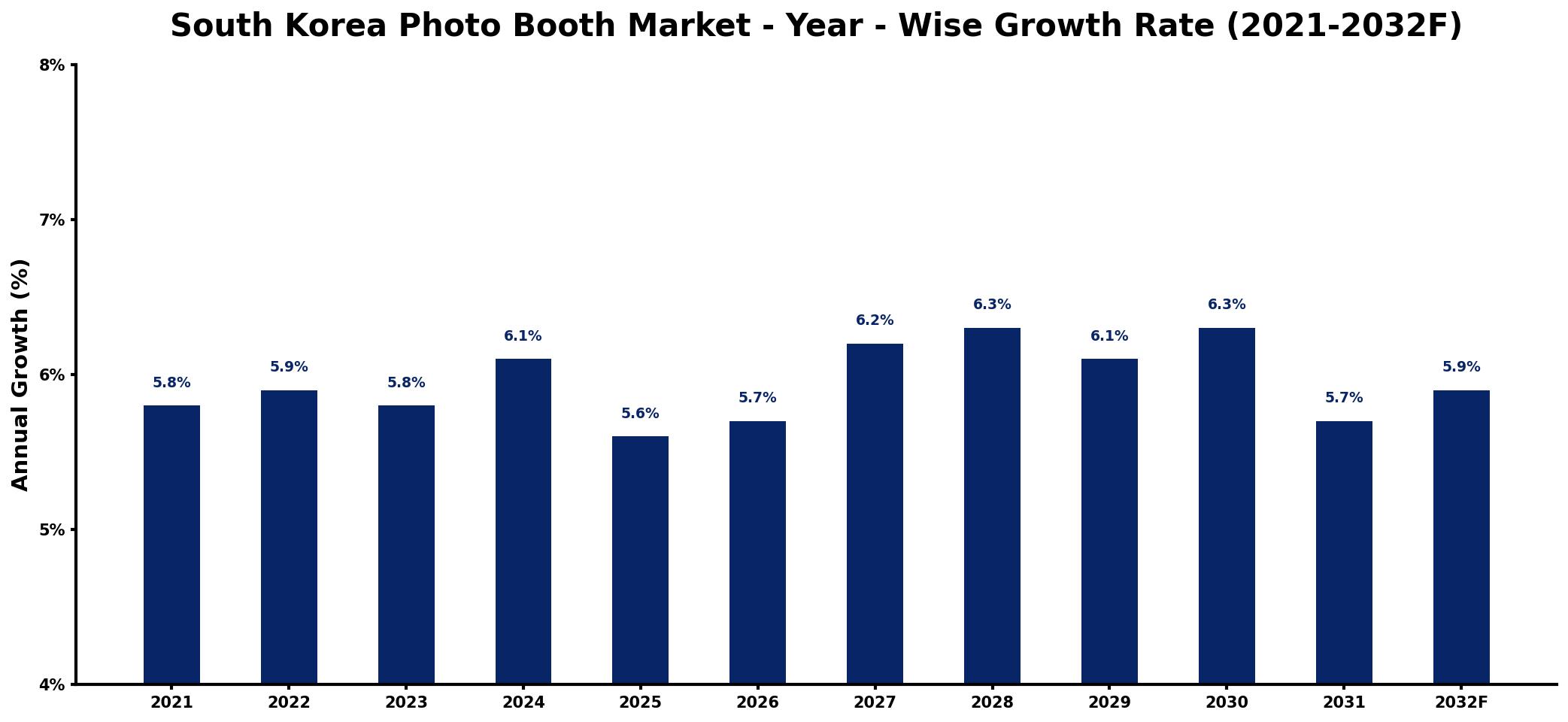
The table below presents the year‑wise growth rates along with the key drivers influencing the market
| Year | Growth Rate | Major Drivers |
| 2021 | 5.8% | Increased demand for entertainment options |
| 2022 | 5.9% | Rising trend in social gatherings |
| 2023 | 5.8% | Growth in event marketing strategies |
| 2024 | 6.1% | Expansion of experiential marketing campaigns |
| 2025 | 5.6% | Increasing popularity of themed events |
| 2026 | 5.7% | Higher investments in leisure activities |
| 2027 | 6.2% | Emergence of innovative event concepts |
| 2028 | 6.3% | growing commercial sector adoption |
| 2029 | 6.1% | improved processing technologies adoption |
| 2030 | 6.3% | enhanced product quality standards |
| 2031 | 5.7% | rising export shipment volumes |
| 2032 | 5.9% | Development of interactive entertainment experiences |
Note: Market size estimations and growth projections presented in this report are based on 6Wresearch's proprietary forecasting methodology, utilizing the latest available industry data, government publications, and primary research inputs.
South Korea Photo Booth Market Synopsis
In South Korea, photo booths have transitioned from simple novelty installations to interactive hubs that cater to the selfie generation. The popularity of social media has ignited interest in these engaging experiences, as they offer immediate gratification through shareable content. Events, shopping malls, and festivals increasingly feature photo booths, becoming a staple in the realm of experiential entertainment.
As user preferences shift towards personalized and unique offerings, the market is witnessing significant innovation. Photo booths now come equipped with features such as digital props and customizable templates, allowing users to create tailored experiences that reflect their personal brand or event theme. With a focus on both fun and creativity, the South Korea photo booth market is set to flourish.
South Korea Photo Booth Market Key Takeaways
- The market is fueled by rising demand for social media integration and high-quality visual content.
- Technological advancements, including augmented reality and instant sharing features, are enhancing user experiences.
- Customization and eco-friendly options are increasingly sought after by consumers and event planners alike.
- The experience economy is driving growth, with photo booths becoming essential at various events.
- Investment opportunities are emerging in rental services and partnerships with event-related businesses.
Evaluation of Restraints in South Korea Photo Booth Market
Despite its robust growth, the South Korea photo booth market faces certain limitations. The increasing popularity of digital photo applications poses a competitive threat, as consumers may opt for more convenient options that can be accessed through their smartphones. Additionally, privacy concerns surrounding data security remain a pressing issue, which may deter potential users from embracing photo booth services. Furthermore, the lingering impacts of the COVID-19 pandemic have changed consumer behavior, resulting in fluctuating demand as foot traffic at traditional locations varies. Companies must adapt to these challenges through innovation and improved customer experiences to maintain their competitive edge.
South Korea Photo Booth Market Trends
A notable trend in the South Korea photo booth market is the integration of advanced technology, such as augmented reality (AR) and virtual backgrounds, which elevates the consumer experience. Additionally, photo booths that allow for instant sharing on social media platforms like Instagram and Facebook are gaining traction, catering to the needs of a digital-savvy audience. Customizable options have become a priority, as users desire a more personalized touch that reflects their individual styles. There is also a growing demand for sustainable photo booth solutions, focusing on eco-friendly materials and energy-efficient designs, aligning with the values of socially conscious consumers.
South Korea Photo Booth Market Opportunities
The South Korea photo booth market presents lucrative investment opportunities as the trend for experiential entertainment continues to rise. High-quality photo booth rental businesses that integrate unique features such as digital filters, customizable props, and enhanced user engagement stand to benefit significantly. Strategic partnerships with event planners, marketing agencies, and venue operators can open new avenues for growth, expanding the reach of photo booth services. Moreover, tapping into niches like corporate events, promotional activities, and themed parties can further capitalize on the increasing demand for memorable experiences.
Government Initiatives in the South Korea Photo Booth Market
The South Korean government plays an active role in regulating the photo booth market through policies that emphasize consumer protection and data security. Stricter guidelines have been established to ensure that photo booth operators adhere to privacy standards and safeguard customer information. These initiatives not only promote fair competition among service providers but also encourage innovation by supporting technological advancements within the industry. The government's emphasis on creating a transparent market environment bodes well for both businesses and consumers alike.
Future Insights of the South Korea Photo Booth Market
Looking ahead to 2026-2032, the South Korea photo booth market is poised for sustained growth. Demand for unique and shareable experiences will continue to rise, fueled by an expanding middle class and increasing disposable incomes. As consumers seek more interactive and engaging event experiences, photo booths will likely evolve with enhanced technological features and customizable offerings. Furthermore, with the integration of eco-friendly practices, the market is set to attract environmentally conscious consumers, solidifying its place in the broader landscape of experiential entertainment.
South Korea Photo Booth Market Latest Developments (2025 - 2026)
In recent months, the South Korea photo booth market has seen a surge in interest in interactive and experiential offerings as event planners adapt to changing consumer preferences. Innovations such as fully customizable digital props and engaging social media integrations are becoming standard features. Additionally, there's been a noticeable pivot towards eco-conscious solutions, with companies exploring sustainable materials and energy-efficient designs. As the market adapts, the focus remains on delivering memorable experiences that resonate with users.
South Korea Photo Booth Market - Key Attractiveness of the Report
- 10 Years of Market Numbers
- Historical Data Starting from 2022 to 2025
- Base Year: 2025
- Forecast Data until 2032
- Key Performance Indicators Impacting the Market
- Major Upcoming Developments and Projects
Key Highlights of the Report:
- South Korea Photo Booth Market Outlook
- Market Size of South Korea Photo Booth Market, 2025
- Forecast of South Korea Photo Booth Market, 2032
- Historical Data and Forecast of South Korea Photo Booth Revenues & Volume for the Period 2022-2032F
- South Korea Photo Booth Market Trend Evolution
- South Korea Photo Booth Market Drivers and Challenges
- South Korea Photo Booth Price Trends
- South Korea Photo Booth Porter's Five Forces
- South Korea Photo Booth Industry Life Cycle
- Historical Data and Forecast of South Korea Photo Booth Market Revenues & Volume By Component for the Period 2022-2032F
- Historical Data and Forecast of South Korea Photo Booth Market Revenues & Volume By Solution for the Period 2022-2032F
- Historical Data and Forecast of South Korea Photo Booth Market Revenues & Volume By Service for the Period 2022-2032F
- Historical Data and Forecast of South Korea Photo Booth Market Revenues & Volume By Type for the Period 2022-2032F
- Historical Data and Forecast of South Korea Photo Booth Market Revenues & Volume By Open for the Period 2022-2032F
- Historical Data and Forecast of South Korea Photo Booth Market Revenues & Volume By Enclosed for the Period 2022-2032F
- Historical Data and Forecast of South Korea Photo Booth Market Revenues & Volume By Application for the Period 2022-2032F
- Historical Data and Forecast of South Korea Photo Booth Market Revenues & Volume By Document Photo for the Period 2022-2032F
- Historical Data and Forecast of South Korea Photo Booth Market Revenues & Volume By Entertainment for the Period 2022-2032F
- Historical Data and Forecast of South Korea Photo Booth Market Revenues & Volume By Amusement parks for the Period 2022-2032F
- Historical Data and Forecast of South Korea Photo Booth Market Revenues & Volume By Shopping centers for the Period 2022-2032F
- Historical Data and Forecast of South Korea Photo Booth Market Revenues & Volume By Retail outlets for the Period 2022-2032F
- Historical Data and Forecast of South Korea Photo Booth Market Revenues & Volume By Events for the Period 2022-2032F
- Historical Data and Forecast of South Korea Photo Booth Market Revenues & Volume By Others for the Period 2022-2032F
- South Korea Photo Booth Import Export Trade Statistics
- Market Opportunity Assessment By Component
- Market Opportunity Assessment By Type
- Market Opportunity Assessment By Application
- South Korea Photo Booth Top Companies Market Share
- South Korea Photo Booth Competitive Benchmarking By Technical and Operational Parameters
- South Korea Photo Booth Company Profiles
- South Korea Photo Booth Key Strategic Recommendations






































