South Korea Plastic Film Market Summary
The south korea plastic film market was estimated at USD 752 Million in 2025 and is projected to reach USD 1085 Million by 2032, growing at a CAGR of 6.4% from 2026 to 2032.
South Korea Plastic Film Market Year-wise Growth Rate and Key Drivers
This graph highlights how the South Korea Plastic Film Market has steadily grown over the past five years, supported by major growth factors.
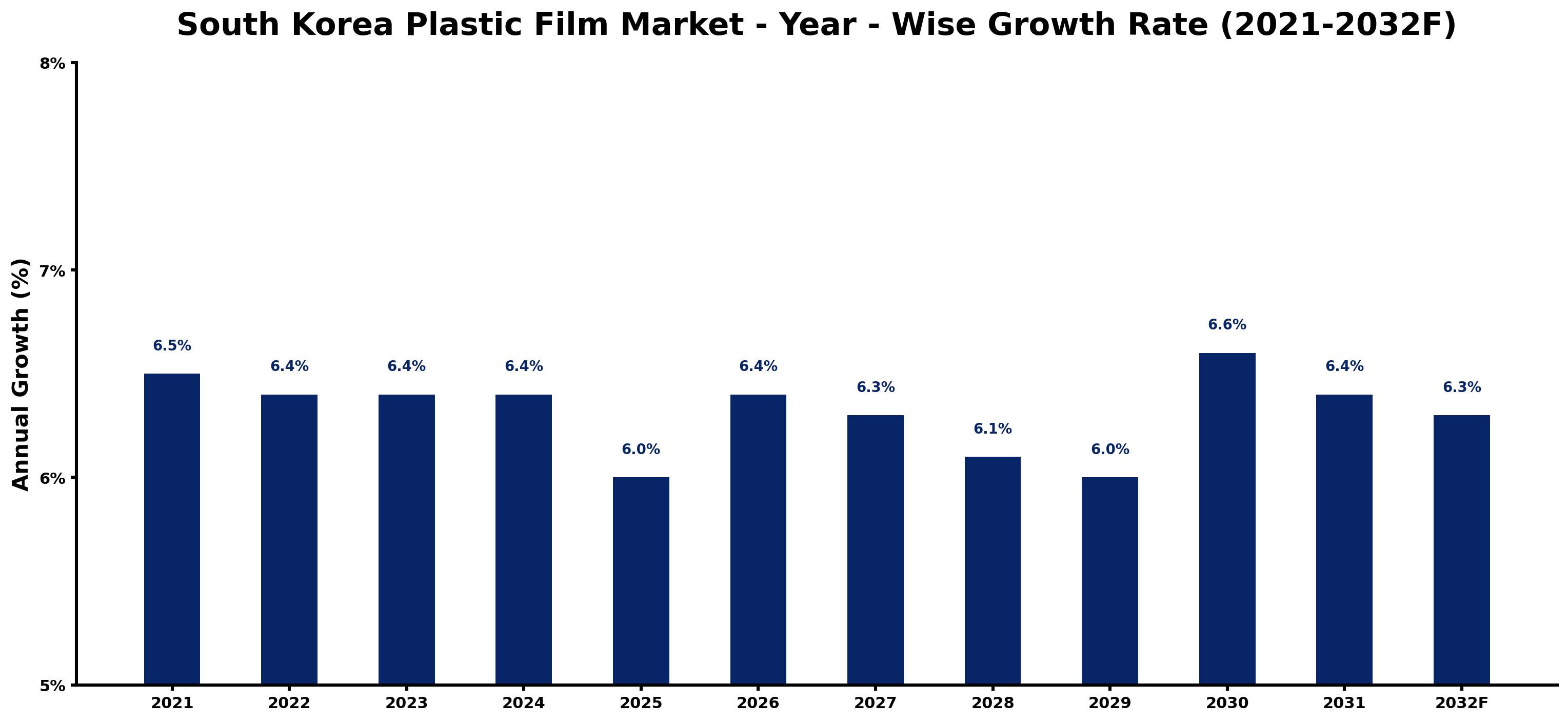
The table below presents the year wise growth rates along with the key drivers influencing the market
| Year | Growth Rate | Major Drivers |
| 2021 | 6.5% | Post-pandemic recovery boosted demand for versatile plastic films in packaging. |
| 2022 | 6.4% | Sustainable packaging trends prompted innovations in biodegradable plastic film solutions. |
| 2023 | 6.4% | The expansion of e-commerce significantly increased the need for protective shipping materials. |
| 2024 | 6.4% | South Korea's electronics industry required advanced films for enhanced product protection. |
| 2025 | 6.0% | Rising urbanization spurred residential projects demanding durable and functional plastic films. |
| 2026 | 6.4% | Significant investments in food preservation increased the use of high-barrier films. |
| 2027 | 6.3% | Emerging sectors like solar energy sought specialized films for efficiency improvements. |
| 2028 | 6.1% | Technological advancements enabled the production of thinner films with improved performance. |
| 2029 | 6.0% | Environmental concerns shifted consumer preferences towards recycled plastic film options. |
| 2030 | 6.6% | Growing automotive sector saw rising need for lightweight and impact-resistant film applications. |
| 2031 | 6.4% | Increased export activities necessitated robust packaging solutions for international markets. |
| 2032 | 6.3% | Local manufacturers focused on innovation to meet diverse sector-specific film requirements. |
Note - Market size estimations and growth projections presented in this report are based on 6Wresearch's advanced forecasting approach, validated with industry datasets as of June 2026.
South Korea Plastic Film Market Synopsis
The South Korea Plastic Film Market is projected to reach 6.4% and witness significant growth during the forecast period (2026-2032). The market is anticipated to expand at a compound annual growth rate (CAGR) of 7.8%, driven by an escalating demand for food packaging solutions, agricultural films, and various industrial applications. This growth trajectory is further fueled by technological advancements, particularly the emergence of bioplastic films that enhance the versatility and sustainability of plastic products across diverse industries in South Korea.
South Korea Plastic Film Market Growth Drivers
Several factors contribute to the robust expansion of the South Korea Plastic Film Market. Firstly, the accelerated demand for food packaging is a primary driver, as consumers increasingly seek convenience in their purchasing habits. The food packaging sector prioritizes materials that provide protection, extend shelf life, and maintain product integrity, all of which are facilitated by advancements in plastic film technology.
- Increasing consumer preference for packaged food options is leading to higher demand for plastic films tailored for food safety.
- Innovations in film materials, such as polyethylene terephthalate (PET) and oriented polypropylene (OPP), are enhancing product functionality and market competitiveness.
- The agricultural sector is harnessing plastic films for crop protection and yield improvement, thus bolstering market growth.
- The ongoing trend towards lightweight and flexible packaging solutions is further propelling the market, as they meet modern consumer demands.
- Technological advancements that focus on the development of recyclable and biodegradable films are aligning with sustainability goals, driving adoption.
South Korea Plastic Film Market Trends and Opportunities
The South Korea Plastic Film Market is observing notable trends that present numerous opportunities for growth. One significant trend is the push towards eco-friendly materials. As consumer awareness regarding environmental sustainability increases, companies are actively investing in research and development to create bioplastics and other sustainable alternatives. This shift not only addresses regulatory pressures but also meets the evolving preferences of environmentally-conscious consumers.
- There is a surge in the use of bioplastics, which are derived from renewable resources, catering to the demand for reduced carbon footprints.
- Investment in advanced manufacturing processes is streamlining production, reducing costs, and enhancing profit margins for manufacturers.
- The rise of e-commerce has led to increased demand for packaging solutions that are both functional and aesthetically pleasing, creating a market for customized plastic films.
- Companies are exploring collaborations and partnerships to innovate and expand product offerings in response to market demands.
- Emerging market players are focusing on niche applications, exploring untapped sectors while contributing to overall market growth.
South Korea Plastic Film Market Challenges and Restraints
Despite the promising growth trajectory, the South Korea Plastic Film Market faces several challenges. One of the foremost concerns is the environmental impact associated with traditional plastic materials. As sustainability becomes paramount, the industry must navigate the complexities of transitioning to more eco-friendly solutions while managing costs. Additionally, global supply chain disruptions have been a persistent issue, affecting the availability of raw materials and production timelines.
- The fluctuating costs of petrochemical-based raw materials can lead to unpredictability in pricing for plastic films.
- Regulatory pressures concerning plastic waste management could result in higher compliance costs for manufacturers.
- Competition from alternative materials, such as paper and metal, may impact market share and growth prospects.
- The need for significant investment in R&D to develop sustainable products could strain shorter-term financial resources for some companies.
- Consumer skepticism regarding the viability of bioplastics and other eco-friendly alternatives could hinder broader acceptance within the market.
South Korea Plastic Film Market Government Investment and Initiatives
The South Korean government has recognized the importance of the plastic film industry in supporting economic vitality and sustainability initiatives. Consequently, there have been various policies and incentives aimed at encouraging innovation and investment in the sector. The government's focus on reducing plastic waste has led to funding and support for research initiatives aimed at developing sustainable materials and technologies.
- Government programs promoting the use of biodegradable plastics are gaining traction, facilitating grants for companies that meet environmental standards.
- Initiatives aimed at enhancing recycling infrastructure are being rolled out to support the circular economy, contributing to the longevity of the market.
- Public-private partnerships are being encouraged to foster collaboration on sustainability projects, enhancing resource sharing and innovation.
- Investment in educational programs about waste reduction and recycling is increasing, aimed at raising public awareness and acceptance of eco-friendly products.
- Regulatory frameworks are being established to guide the industry towards sustainable practices while maintaining economic growth.
South Korea Plastic Film Market Latest Developments (May 2025 - June 2026)
The landscape of the South Korea Plastic Film Market is evolving with significant developments observed from May 2025 to June 2026. This period has seen a notable increase in investment towards green technologies and the adoption of materials that comply with sustainability guidelines. Many companies have ramped up their research efforts to create films that are not only functional but also environmentally friendly, positioning themselves strategically to meet future market demands. Innovations in production techniques that enhance efficiency and reduce waste have also been a priority, with a growing emphasis on optimizing manufacturing processes to cut costs and improve product quality.
- Research collaborations have led to breakthroughs in bioplastic formulations, enhancing their applicability and performance in various segments.
- The industry has witnessed an uptick in participation from startups focused on sustainability, indicating a shift towards innovative practices.
- Regulatory updates are prompting industry-wide adjustments, ensuring compliance with new environmental guidelines.
- Emerging trends in smart packaging solutions are being explored, integrating technology for enhanced functionality and consumer engagement.
- Engagement with international sustainability standards is becoming increasingly common, showcasing the industry's commitment to global best practices.
South Korea Plastic Film Market - Key Attractiveness of the Report
- 10 Years of Market Numbers
- Historical Data Starting from 2022 to 2025
- Base Year: 2025
- Forecast Data until 2032
- Key Performance Indicators Impacting the Market
- Major Upcoming Developments and Projects
Key Highlights of the Report:
- South Korea Plastic Film Market Outlook
- Market Size of South Korea Plastic Film Market, 2025
- Forecast of South Korea Plastic Film Market, 2032F
- Historical Data and Forecast of South Korea Plastic Film Revenues & Volume for the Period 2022-2032F
- South Korea Plastic Film Market Trend Evolution
- South Korea Plastic Film Market Drivers and Challenges
- South Korea Plastic Film Price Trends
- South Korea Plastic Film Porter's Five Forces
- South Korea Plastic Film Industry Life Cycle
- Historical Data and Forecast of South Korea Plastic Film Market Revenues & Volume By Product Types for the Period 2022-2032F
- Historical Data and Forecast of South Korea Plastic Film Market Revenues & Volume By Polyethylene (PE) for the Period 2022-2032F
- Historical Data and Forecast of South Korea Plastic Film Market Revenues & Volume By Polypropylene (PP) for the Period 2022-2032F
- Historical Data and Forecast of South Korea Plastic Film Market Revenues & Volume By Polyvinyl chloride (PVC) for the Period 2022-2032F
- Historical Data and Forecast of South Korea Plastic Film Market Revenues & Volume By Polyethylene terephthalate (PET) for the Period 2022-2032F
- Historical Data and Forecast of South Korea Plastic Film Market Revenues & Volume By Others for the Period 2022-2032F
- Historical Data and Forecast of South Korea Plastic Film Market Revenues & Volume By Applications for the Period 2022-2032F
- Historical Data and Forecast of South Korea Plastic Film Market Revenues & Volume By Packaging for the Period 2022-2032F
- Historical Data and Forecast of South Korea Plastic Film Market Revenues & Volume By Construction for the Period 2022-2032F
- Historical Data and Forecast of South Korea Plastic Film Market Revenues & Volume By Electricals & Electronics for the Period 2022-2032F
- Historical Data and Forecast of South Korea Plastic Film Market Revenues & Volume By Automotive for the Period 2022-2032F
- Historical Data and Forecast of South Korea Plastic Film Market Revenues & Volume By Pharmaceutical for the Period 2022-2032F
- Historical Data and Forecast of South Korea Plastic Film Market Revenues & Volume By Agriculture for the Period 2022-2032F
- Historical Data and Forecast of South Korea Plastic Film Market Revenues & Volume By Consumer Goods for the Period 2022-2032F
- Historical Data and Forecast of South Korea Plastic Film Market Revenues & Volume By Utility for the Period 2022-2032F
- South Korea Plastic Film Import Export Trade Statistics
- Market Opportunity Assessment By Product Types
- Market Opportunity Assessment By Applications
- South Korea Plastic Film Top Companies Market Share
- South Korea Plastic Film Competitive Benchmarking By Technical and Operational Parameters
- South Korea Plastic Film Company Profiles
- South Korea Plastic Film Key Strategic Recommendations






































