South Korea Plastic Processing Equipment Market Size, Share & Growth Rate
The South Korea Plastic Processing Equipment Market was estimated at USD 1410 Million in 2025 and is projected to reach USD 2013 Million by 2032, growing at a CAGR of 5.2% from 2026 to 2032. This growth trajectory is propelled by an uptick in industrial activities and the rising demand for high-performance plastic products. Additionally, advancements in technology are paving the way for increased automation and efficiency in manufacturing processes.
South Korea Plastic Processing Equipment Market Year-wise Growth Rate and Key Drivers
This graph highlights how the South Korea Plastic Processing Equipment Market has steadily grown over the years, supported by major growth factors.
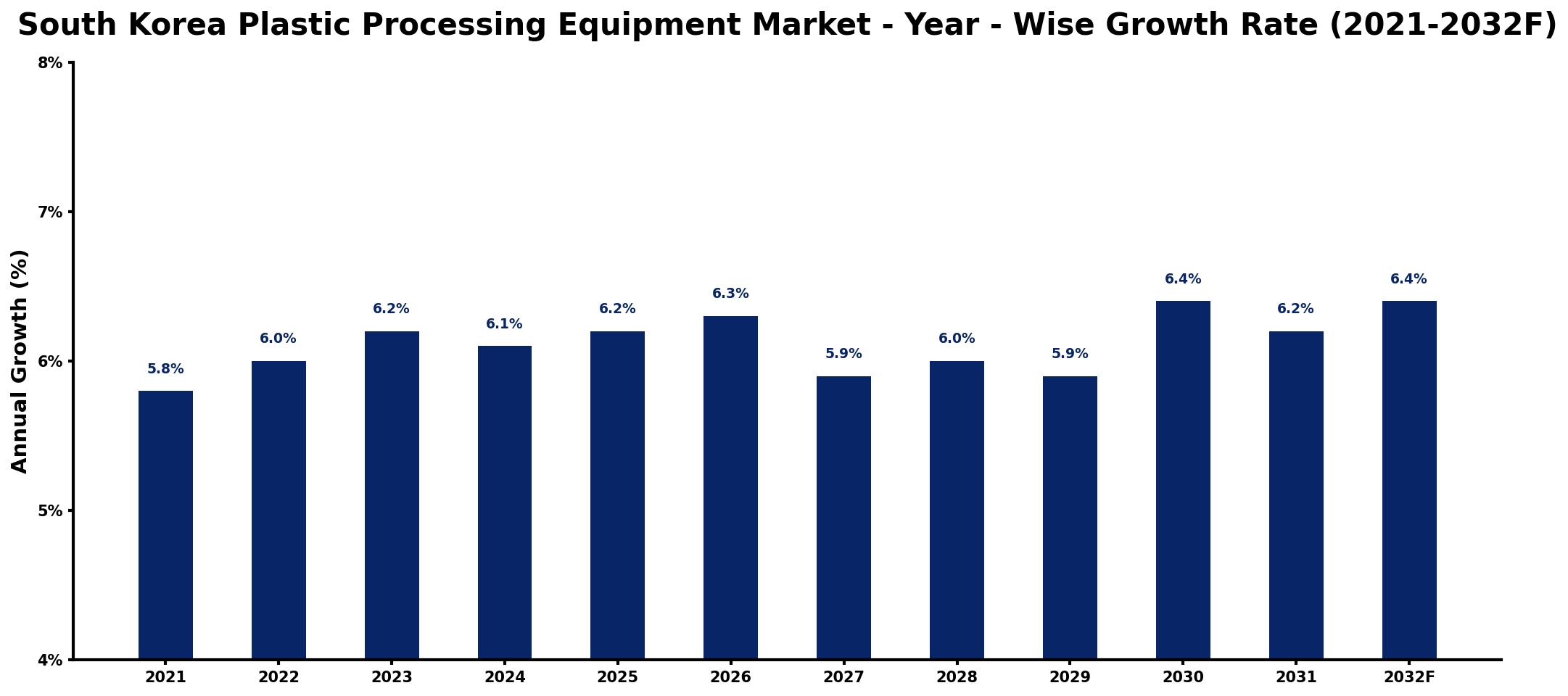
The table below presents the year‑wise growth rates along with the key drivers influencing the market
| Year | Growth Rate | Major Drivers |
| 2021 | 5.8% | Rising demand from automotive sector |
| 2022 | 6.0% | Growth in packaging industry applications |
| 2023 | 6.2% | Increased investments in sustainability |
| 2024 | 6.1% | Expansion of construction market needs |
| 2025 | 6.2% | Technological advancements in production |
| 2026 | 6.3% | Growing consumer goods market demand |
| 2027 | 5.9% | Emergence of innovative recycling solutions |
| 2028 | 6.0% | Surge in medical sector requirements |
| 2029 | 5.9% | Strengthening of electronics manufacturing base |
| 2030 | 6.4% | Boost in agricultural applications usage |
| 2031 | 6.2% | Heightened focus on lightweight materials |
| 2032 | 6.4% | Development of smart manufacturing processes |
Note: Market size estimations and growth projections presented in this report are based on 6Wresearch's proprietary forecasting methodology, utilizing the latest available industry data, government publications, and primary research inputs.
South Korea Plastic Processing Equipment Market Synopsis
The South Korea Plastic Processing Equipment Market is currently in a phase of steady development, largely fueled by innovations in machinery and the urgent need for sustainability in production practices. With various industries like automotive and packaging ramping up their production capabilities, the demand for sophisticated processing equipment is on the rise.
Environmental concerns are reshaping the market landscape as businesses strive to implement eco-friendly practices. As a result, companies are increasingly investing in advanced technologies that not only improve efficiency but also minimize waste, reflecting a broader commitment to sustainable manufacturing.
South Korea Plastic Processing Equipment Market Key Takeaways
- The market is witnessing consistent growth due to rising demands from various sectors, including automotive and packaging.
- Technological innovations and automation are enhancing operational efficiencies and product quality.
- Environmental sustainability is a driving force behind the adoption of new equipment technologies.
- Key market players are focusing on developing flexible and customizable processing solutions to meet diverse industry needs.
- Government initiatives aimed at promoting eco-friendly materials are expected to bolster market expansion.
Evaluation of Restraints in South Korea Plastic Processing Equipment Market
Despite its growth potential, the South Korea Plastic Processing Equipment Market faces challenges primarily stemming from intense competition, particularly from manufacturers in countries like China. This competition drives local players to innovate continuously in order to maintain their market position. Furthermore, evolving regulatory landscapes concerning environmental standards necessitate frequent equipment upgrades and adaptations. Companies also grapple with the rapid pace of technological advancements, demanding significant investment in research and development to stay relevant.
South Korea Plastic Processing Equipment Market Trends
The current trends in the South Korea Plastic Processing Equipment Market highlight a growing demand for sustainability, with manufacturers increasingly seeking eco-friendly processing technologies. Advanced automation, including the integration of robotics and artificial intelligence, is becoming standard practice, enabling higher efficiency and product quality. A notable shift towards digital manufacturing solutions is also observed, as connectivity and data-driven approaches enhance production lines.
South Korea Plastic Processing Equipment Market Opportunities
Investment opportunities within the South Korea Plastic Processing Equipment Market are abundant, particularly in sectors with strong growth potential like healthcare and electronics. The increasing need for state-of-the-art injection molding, extrusion, and blow molding machines offers lucrative prospects for investors. Moreover, the drive towards sustainable manufacturing opens avenues for companies that specialize in environmentally friendly equipment and practices. Strategic partnerships with local manufacturers can also provide a competitive edge in tapping into the evolving market demands.
Government Initiatives in the South Korea Plastic Processing Equipment Market
The South Korean government has established several policies designed to promote sustainability within the Plastic Processing Equipment Market. Initiatives like the Effective Resource Circulation Promotion Act encourage recycling and responsible waste management among manufacturers. Financial incentives, such as subsidies for eco-friendly technology adoption, further support businesses aiming to align with national sustainability goals. These government-backed efforts reflect a commitment to fostering an environmentally conscious industrial landscape.
Future Insights of the South Korea Plastic Processing Equipment Market
Looking ahead, the South Korea Plastic Processing Equipment Market is poised for robust growth. The ongoing demand for plastic products across various industries is anticipated to fuel equipment innovation and production enhancements. As companies increasingly adopt automation and sustainable practices, advancements in equipment technology will cater to evolving market needs. Government initiatives focused on sustainability will likely reinforce this trajectory, making the market an attractive landscape for investment and development through 2032.
South Korea Plastic Processing Equipment Market Latest Developments (2025 - 2026)
Recent developments in the South Korea Plastic Processing Equipment Market have highlighted a significant push toward automation and advanced manufacturing techniques. Industry players are increasingly investing in digital solutions that enhance operational efficiency and product quality. The emphasis on eco-friendly equipment has led to collaborations between manufacturers and technology firms, aiming to innovate sustainable processing technologies. Furthermore, new regulatory guidelines are prompting companies to enhance their recycling capabilities, thereby influencing equipment design and functionality.
South Korea Plastic Processing Equipment Market - Key Attractiveness of the Report
- 10 Years of Market Numbers
- Historical Data Starting from 2022 to 2025
- Base Year: 2025
- Forecast Data until 2032
- Key Performance Indicators Impacting the Market
- Major Upcoming Developments and Projects
Key Highlights of the Report:
- South Korea Plastic Processing Equipment Market Outlook
- Market Size of South Korea Plastic Processing Equipment Market, 2025
- Forecast of South Korea Plastic Processing Equipment Market, 2032
- Historical Data and Forecast of South Korea Plastic Processing Equipment Revenues & Volume for the Period 2022-2032F
- South Korea Plastic Processing Equipment Market Trend Evolution
- South Korea Plastic Processing Equipment Market Drivers and Challenges
- South Korea Plastic Processing Equipment Price Trends
- South Korea Plastic Processing Equipment Porter's Five Forces
- South Korea Plastic Processing Equipment Industry Life Cycle
- Historical Data and Forecast of South Korea Plastic Processing Equipment Market Revenues & Volume By Product for the Period 2022-2032F
- Historical Data and Forecast of South Korea Plastic Processing Equipment Market Revenues & Volume By Screw for the Period 2022-2032F
- Historical Data and Forecast of South Korea Plastic Processing Equipment Market Revenues & Volume By Twin Screw for the Period 2022-2032F
- Historical Data and Forecast of South Korea Plastic Processing Equipment Market Revenues & Volume By Barrel for the Period 2022-2032F
- Historical Data and Forecast of South Korea Plastic Processing Equipment Market Revenues & Volume By Nozzle System for the Period 2022-2032F
- Historical Data and Forecast of South Korea Plastic Processing Equipment Market Revenues & Volume By End Caps for the Period 2022-2032F
- Historical Data and Forecast of South Korea Plastic Processing Equipment Market Revenues & Volume By Others for the Period 2022-2032F
- Historical Data and Forecast of South Korea Plastic Processing Equipment Market Revenues & Volume By Material for the Period 2022-2032F
- Historical Data and Forecast of South Korea Plastic Processing Equipment Market Revenues & Volume By Bimetallic for the Period 2022-2032F
- Historical Data and Forecast of South Korea Plastic Processing Equipment Market Revenues & Volume By Nitride for the Period 2022-2032F
- Historical Data and Forecast of South Korea Plastic Processing Equipment Market Revenues & Volume By Carbide for the Period 2022-2032F
- Historical Data and Forecast of South Korea Plastic Processing Equipment Market Revenues & Volume By Steel for the Period 2022-2032F
- Historical Data and Forecast of South Korea Plastic Processing Equipment Market Revenues & Volume By Chrome for the Period 2022-2032F
- Historical Data and Forecast of South Korea Plastic Processing Equipment Market Revenues & Volume By Others for the Period 2022-2032F
- Historical Data and Forecast of South Korea Plastic Processing Equipment Market Revenues & Volume By Industry for the Period 2022-2032F
- Historical Data and Forecast of South Korea Plastic Processing Equipment Market Revenues & Volume By Automotive for the Period 2022-2032F
- Historical Data and Forecast of South Korea Plastic Processing Equipment Market Revenues & Volume By Packaging for the Period 2022-2032F
- Historical Data and Forecast of South Korea Plastic Processing Equipment Market Revenues & Volume By Electronics for the Period 2022-2032F
- Historical Data and Forecast of South Korea Plastic Processing Equipment Market Revenues & Volume By Healthcare for the Period 2022-2032F
- Historical Data and Forecast of South Korea Plastic Processing Equipment Market Revenues & Volume By Consumer Goods for the Period 2022-2032F
- Historical Data and Forecast of South Korea Plastic Processing Equipment Market Revenues & Volume By Others for the Period 2022-2032F
- Historical Data and Forecast of South Korea Plastic Processing Equipment Market Revenues & Volume By Application for the Period 2022-2032F
- Historical Data and Forecast of South Korea Plastic Processing Equipment Market Revenues & Volume By Extrusion for the Period 2022-2032F
- Historical Data and Forecast of South Korea Plastic Processing Equipment Market Revenues & Volume By Injection Molding for the Period 2022-2032F
- Historical Data and Forecast of South Korea Plastic Processing Equipment Market Revenues & Volume By Sales Channel for the Period 2022-2032F
- Historical Data and Forecast of South Korea Plastic Processing Equipment Market Revenues & Volume By OEM for the Period 2022-2032F
- Historical Data and Forecast of South Korea Plastic Processing Equipment Market Revenues & Volume By After Market for the Period 2022-2032F
- South Korea Plastic Processing Equipment Import Export Trade Statistics
- Market Opportunity Assessment By Product
- Market Opportunity Assessment By Material
- Market Opportunity Assessment By Industry
- Market Opportunity Assessment By Application
- Market Opportunity Assessment By Sales Channel
- South Korea Plastic Processing Equipment Top Companies Market Share
- South Korea Plastic Processing Equipment Competitive Benchmarking By Technical and Operational Parameters
- South Korea Plastic Processing Equipment Company Profiles
- South Korea Plastic Processing Equipment Key Strategic Recommendations






































