South Korea Point Of Sale Terminals Market Size, Share & Growth Rate
The South Korea Point Of Sale Terminals Market was estimated at USD 303 Million in 2025 and is projected to reach USD 396 Million by 2032, growing at a CAGR of 3.9% from 2026 to 2032. This growth trajectory is predominantly fueled by the rapid embrace of digital payment solutions within key sectors, especially retail and hospitality, as consumers increasingly favor cashless transactions. Additionally, advancements such as mobile payment integration and fortified security measures are further propelling the adoption of POS terminals across various industries.
South Korea Point Of Sale Terminals Market Year-wise Growth Rate and Key Drivers
This graph highlights how the South Korea Point Of Sale Terminals Market has steadily grown over the years, supported by major growth factors.
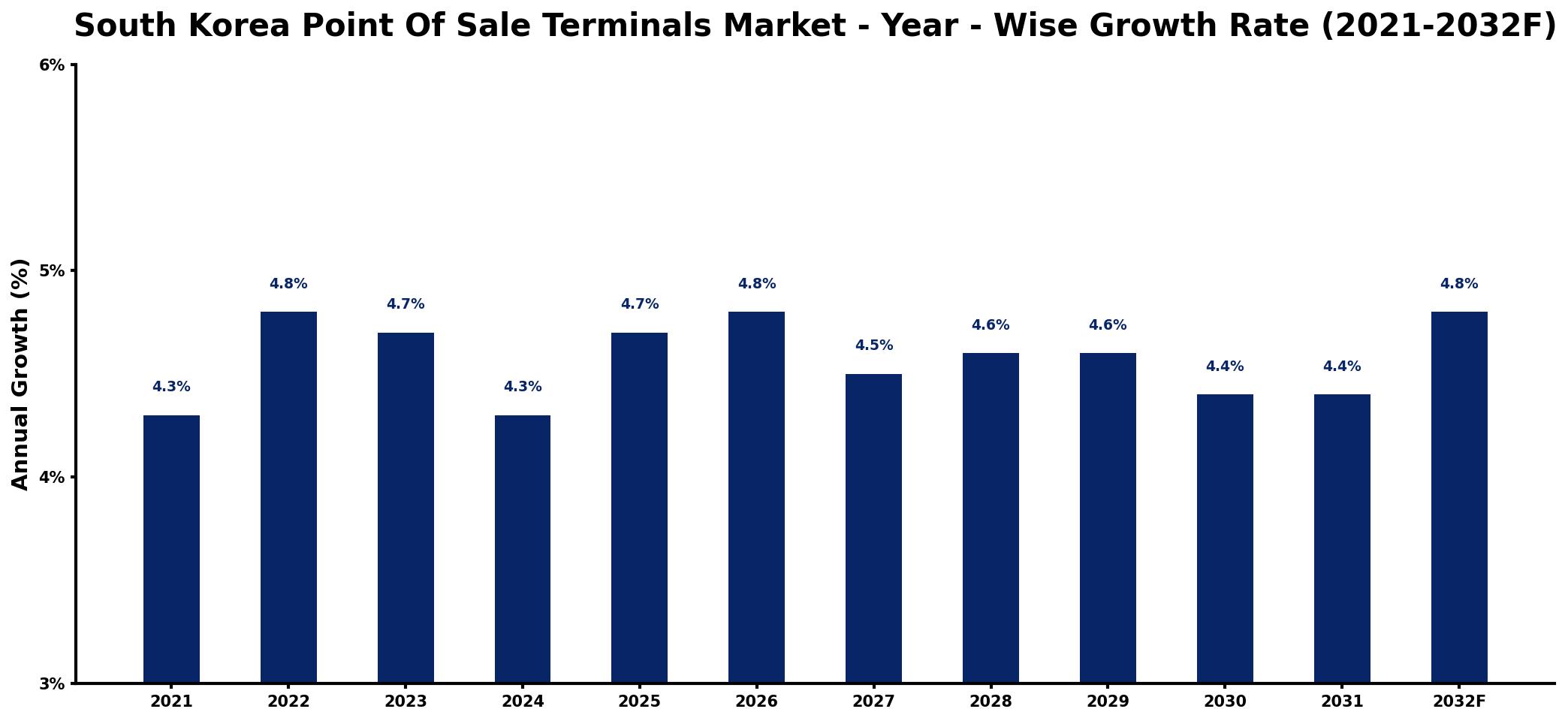
The table below presents the year‑wise growth rates along with the key drivers influencing the market
| Year | Growth Rate | Major Drivers |
| 2021 | 4.3% | Rising demand for digital payments |
| 2022 | 4.8% | Increased retail sector investments |
| 2023 | 4.7% | Growth in e-commerce transactions |
| 2024 | 4.3% | Expansion of mobile payment solutions |
| 2025 | 4.7% | Adoption of contactless payment methods |
| 2026 | 4.8% | Enhancements in cybersecurity measures |
| 2027 | 4.5% | Integration of AI technologies |
| 2028 | 4.6% | Growing popularity of loyalty programs |
| 2029 | 4.6% | Emergence of fintech innovations |
| 2030 | 4.4% | Development of smart city initiatives |
| 2031 | 4.4% | increased capital investment inflows |
| 2032 | 4.8% | Rising consumer preference for convenience |
Note: Market size estimations and growth projections presented in this report are based on 6Wresearch's proprietary forecasting methodology, utilizing the latest available industry data, government publications, and primary research inputs.
South Korea Point Of Sale Terminals Market Synopsis
As South Korea moves towards a more digitally-focused economy, the Point Of Sale terminals market is witnessing transformative growth. Retailers and service providers are increasingly upgrading their systems to leverage advanced payment technologies that cater to consumer expectations for convenience and security.
Moreover, the robust infrastructure supporting e-payments and the government's proactive role in promoting digital transactions create a conducive environment for the POS terminals market. As businesses seek to improve customer experiences, the demand for sophisticated POS solutions continues to rise, leading to a competitive landscape ripe for innovation.
South Korea Point Of Sale Terminals Market Key Takeaways
- The market is driven by the increased adoption of contactless payment systems across various sectors.
- Technological advancements and integration with mobile payment solutions are pivotal for growth.
- Government initiatives aim to enhance transaction security and support digital economy policies.
- Challenges related to cybersecurity and rapid technological changes necessitate ongoing innovation.
- The hospitality sector significantly contributes to the rising demand for advanced POS systems.
Evaluation of Restraints in South Korea Point Of Sale Terminals Market
The South Korean POS terminals market faces notable constraints primarily stemming from the fast-paced nature of technological advancements. As businesses strive to stay competitive, integrating the latest payment technologies can lead to significant operational challenges and increased costs. Furthermore, the omnipresent threat of cybersecurity breaches poses substantial risks, instilling a level of hesitance among both businesses and consumers regarding new system adoptions. Balancing innovation with the need for data protection remains a crucial hurdle for stakeholders in this evolving market.
South Korea Point Of Sale Terminals Market Trends
Key trends influencing the South Korea POS terminals market include the widespread adoption of mobile payments, which allow consumers to complete transactions seamlessly from their smartphones. Additionally, the incorporation of advanced analytics capabilities within POS systems provides businesses with invaluable insights into consumer behavior and inventory management. Enhanced security features, such as encryption and biometric authentication, are also becoming essential as the demand for secure transactions increases amidst rising digital threats.
South Korea Point Of Sale Terminals Market Opportunities
Amidst the rapidly changing landscape, significant opportunities exist for vendors in the South Korea POS terminals market. The ongoing transition towards a cashless society is likely to stimulate demand for sophisticated payment solutions. Moreover, the integration of value-added services, such as loyalty programs and customer engagement tools within POS systems, presents a lucrative avenue for differentiation. The healthcare sector also stands out as a burgeoning area for growth, as medical facilities increasingly adopt efficient payment systems for improved patient experiences.
Government Initiatives in the South Korea Point Of Sale Terminals Market
The South Korean government plays a crucial role in shaping the POS terminals market through policies that promote the growth of the digital economy. Initiatives focus on enhancing transaction security, establishing interoperability standards, and ensuring compliance with international payment protocols. Collaborative efforts between the Ministry of Science and ICT (MSIT) and the Financial Services Commission (FSC) are aimed at fostering innovation in payment technologies while safeguarding consumer interests and encouraging market competitiveness.
Future Insights of the South Korea Point Of Sale Terminals Market
Looking ahead to 2026-2032, the South Korea Point Of Sale terminals market is expected to continue its upward trajectory, driven by technological innovations and a growing preference for digital transactions. As more sectors embrace cashless solutions, the demand for robust, secure, and user-friendly POS systems will grow. Furthermore, emerging technologies like AI and blockchain may introduce new functionalities, enhancing the overall consumer experience and operational efficiency for businesses. The synergy between government initiatives and market dynamics will likely catalyze sustainable growth in this sector.
South Korea Point Of Sale Terminals Market Latest Developments (2025 - 2026)
Recent developments within the South Korea Point Of Sale terminals market reflect an increasing focus on integrating cutting-edge technologies and improving user experience. Industry players are actively exploring partnerships to enhance their service offerings, while businesses are upgrading to more sophisticated systems to remain competitive. Moreover, there is a notable trend toward the implementation of AI-driven analytics within POS systems to provide tailored insights into customer preferences and inventory management, ensuring a strategic advantage in a crowded marketplace.
South Korea Point Of Sale Terminals Market - Key Attractiveness of the Report
- 10 Years of Market Numbers
- Historical Data Starting from 2022 to 2025
- Base Year: 2025
- Forecast Data until 2032
- Key Performance Indicators Impacting the Market
- Major Upcoming Developments and Projects
Key Highlights of the Report:
- South Korea Point Of Sale Terminals Market Outlook
- Market Size of South Korea Point Of Sale Terminals Market, 2025
- Forecast of South Korea Point Of Sale Terminals Market, 2032
- Historical Data and Forecast of South Korea Point Of Sale Terminals Revenues & Volume for the Period 2022-2032F
- South Korea Point Of Sale Terminals Market Trend Evolution
- South Korea Point Of Sale Terminals Market Drivers and Challenges
- South Korea Point Of Sale Terminals Price Trends
- South Korea Point Of Sale Terminals Porter's Five Forces
- South Korea Point Of Sale Terminals Industry Life Cycle
- Historical Data and Forecast of South Korea Point Of Sale Terminals Market Revenues & Volume By Product for the Period 2022-2032F
- Historical Data and Forecast of South Korea Point Of Sale Terminals Market Revenues & Volume By Fixed for the Period 2022-2032F
- Historical Data and Forecast of South Korea Point Of Sale Terminals Market Revenues & Volume By Mobile for the Period 2022-2032F
- Historical Data and Forecast of South Korea Point Of Sale Terminals Market Revenues & Volume By Component for the Period 2022-2032F
- Historical Data and Forecast of South Korea Point Of Sale Terminals Market Revenues & Volume By Hardware for the Period 2022-2032F
- Historical Data and Forecast of South Korea Point Of Sale Terminals Market Revenues & Volume By Software for the Period 2022-2032F
- Historical Data and Forecast of South Korea Point Of Sale Terminals Market Revenues & Volume By Services for the Period 2022-2032F
- Historical Data and Forecast of South Korea Point Of Sale Terminals Market Revenues & Volume By Deployment for the Period 2022-2032F
- Historical Data and Forecast of South Korea Point Of Sale Terminals Market Revenues & Volume By Cloud for the Period 2022-2032F
- Historical Data and Forecast of South Korea Point Of Sale Terminals Market Revenues & Volume By On-premise for the Period 2022-2032F
- Historical Data and Forecast of South Korea Point Of Sale Terminals Market Revenues & Volume By End Use for the Period 2022-2032F
- Historical Data and Forecast of South Korea Point Of Sale Terminals Market Revenues & Volume By Restaurants for the Period 2022-2032F
- Historical Data and Forecast of South Korea Point Of Sale Terminals Market Revenues & Volume By Retail for the Period 2022-2032F
- Historical Data and Forecast of South Korea Point Of Sale Terminals Market Revenues & Volume By Hospitality for the Period 2022-2032F
- Historical Data and Forecast of South Korea Point Of Sale Terminals Market Revenues & Volume By Healthcare for the Period 2022-2032F
- Historical Data and Forecast of South Korea Point Of Sale Terminals Market Revenues & Volume By Warehouse for the Period 2022-2032F
- Historical Data and Forecast of South Korea Point Of Sale Terminals Market Revenues & Volume By Entertainment for the Period 2022-2032F
- Historical Data and Forecast of South Korea Point Of Sale Terminals Market Revenues & Volume By Others for the Period 2022-2032F
- South Korea Point Of Sale Terminals Import Export Trade Statistics
- Market Opportunity Assessment By Product
- Market Opportunity Assessment By Component
- Market Opportunity Assessment By Deployment
- Market Opportunity Assessment By End Use
- South Korea Point Of Sale Terminals Top Companies Market Share
- South Korea Point Of Sale Terminals Competitive Benchmarking By Technical and Operational Parameters
- South Korea Point Of Sale Terminals Company Profiles
- South Korea Point Of Sale Terminals Key Strategic Recommendations






































