South Korea Prepaid Cards Market Size, Share & Growth Rate
The South Korea Prepaid Cards Market was estimated at USD 588 Million in 2025 and is projected to reach USD 991 Million by 2032, growing at a CAGR of 7.7% from 2026 to 2032. This remarkable growth trajectory is primarily driven by the burgeoning demand for cashless payment options, which resonates with the preferences of tech-savvy consumers. Additionally, the rise of e-commerce and the convenience provided by prepaid cards are propelling their adoption in various sectors, notably retail and transportation.
South Korea Prepaid Cards Market Year-wise Growth Rate and Key Drivers
This graph highlights how the South Korea Prepaid Cards Market has steadily grown over the years, supported by major growth factors.
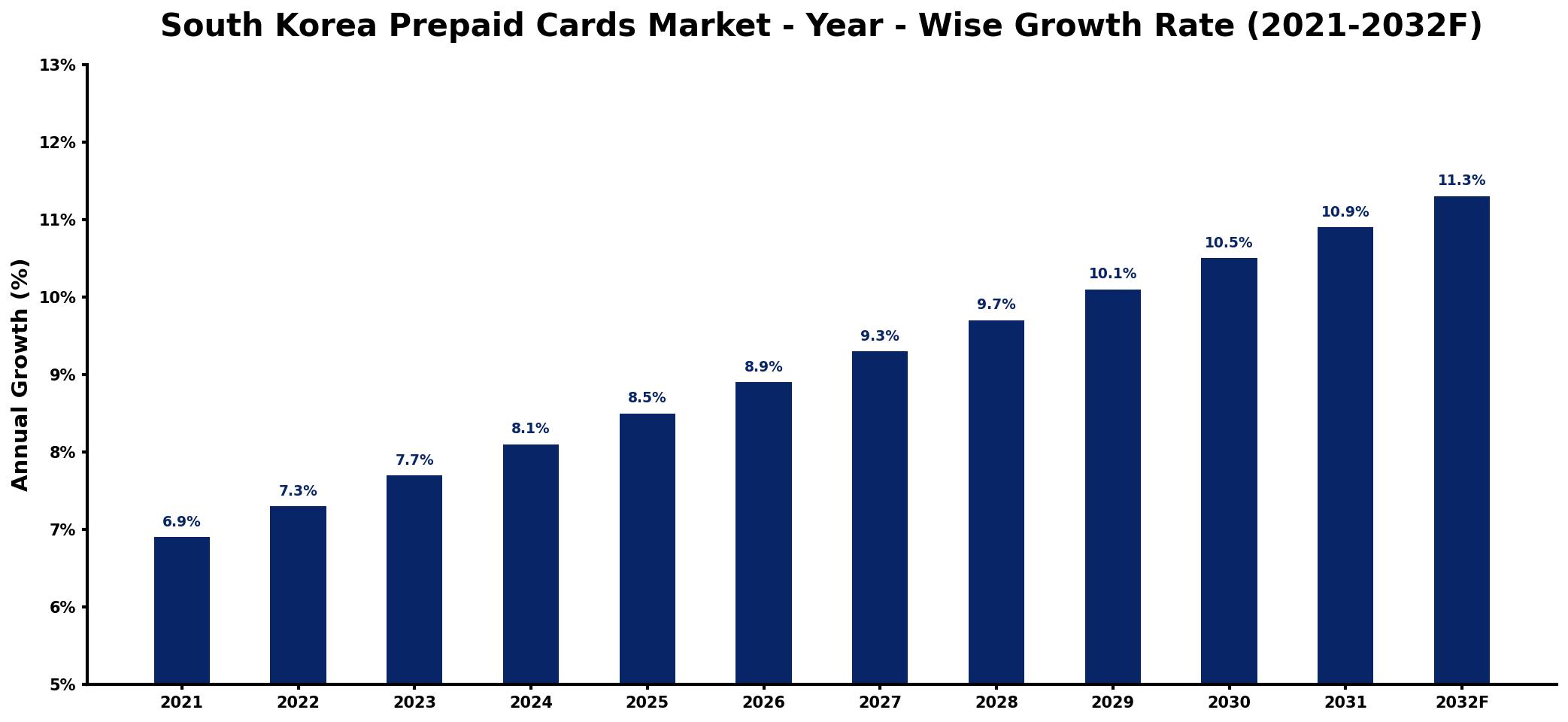
The table below presents the year‑wise growth rates along with the key drivers influencing the market
| Year | Growth Rate | Major Drivers |
| 2021 | 6.9% | Rising digital payment adoption |
| 2022 | 7.3% | Increased consumer spending confidence |
| 2023 | 7.7% | Growth in e-commerce transactions |
| 2024 | 8.1% | Expansion of loyalty programs |
| 2025 | 8.5% | Technological advancements in payments |
| 2026 | 8.9% | Rising demand for mobile wallets |
| 2027 | 9.3% | Increased merchant acceptance rates |
| 2028 | 9.7% | strengthening international trade flows |
| 2029 | 10.1% | expanding healthcare application demand |
| 2030 | 10.5% | Increased focus on security features |
| 2031 | 10.9% | growing automotive sector requirements |
| 2032 | 11.3% | rising end-use demand growth |
Note: Market size estimations and growth projections presented in this report are based on 6Wresearch's proprietary forecasting methodology, utilizing the latest available industry data, government publications, and primary research inputs.
South Korea Prepaid Cards Market Synopsis
A significant force shaping the South Korea Prepaid Cards Market is the increasing consumer shift towards cashless transactions. This preference is reinforced by the ongoing digital transformation and rising smartphone penetration, which together enhance the utility and accessibility of prepaid cards.
Moreover, government initiatives aimed at fostering financial inclusion are creating a conducive environment for prepaid card usage. The evolving landscape is characterized by an increase in both personal and corporate adoption, reflecting a versatile financial tool that appeals to diverse user demographics.
South Korea Prepaid Cards Market Key Takeaways
- Growing consumer preference for cashless solutions boosts prepaid card adoption.
- The market is benefitting from advancements in digital payment technologies.
- Government initiatives are actively promoting prepaid cards as part of digital payment strategies.
- Millennials and Gen Z are increasingly utilizing prepaid cards for budgeting and convenience.
- Challenges from alternative payment methods, such as mobile wallets, require strategic responses.
Evaluation of Restraints in South Korea Prepaid Cards Market
While the South Korean prepaid cards market is poised for growth, several restraints are at play. Consumer inclination towards mobile wallets and other alternative payment methods poses a challenge to the growth of prepaid cards. Regulatory changes surrounding card issuance can further complicate market dynamics, necessitating adaptation from service providers. Additionally, the growing necessity for enhanced security measures remains a critical concern, as the rise in digital payments comes hand-in-hand with increased risks of fraud and unauthorized transactions.
South Korea Prepaid Cards Market Trends
Emerging trends in the South Korea prepaid cards market indicate a shift towards customized solutions that cater to specific consumer needs. Personalization through mobile applications and integration with loyalty programs is becoming more prevalent, making prepaid cards more appealing. Furthermore, the collaboration between fintech companies and traditional financial institutions is fostering innovation, allowing for the introduction of enhanced features and functionalities that align with consumer expectations.
South Korea Prepaid Cards Market Opportunities
Significant growth opportunities lie in the development of tailored prepaid card solutions targeting specific demographics, such as students and travelers. Additionally, partnerships with e-commerce platforms and emerging retailers can expand the use cases for prepaid cards, driving further adoption. There is also considerable potential in enhancing cybersecurity measures, thus instilling consumer confidence and attracting a wider audience.
Government Initiatives in the South Korea Prepaid Cards Market
The South Korean government is playing an integral role in promoting digital payments, with policies aimed at encouraging financial inclusion and reducing reliance on cash transactions. Various programs are focused on enhancing the security of electronic payments, and regulatory frameworks are continuously evolving to protect consumers in the prepaid cards space. These initiatives not only facilitate a conducive environment for prepaid card proliferation but also align with broader national objectives of digital transformation.
Future Insights of the South Korea Prepaid Cards Market
Looking ahead to the period from 2026 to 2032, the South Korea prepaid cards market is expected to thrive amidst ongoing digital transformation. With projected growth fueled by a continuous shift towards cashless transactions, the adoption of prepaid cards will likely rise in both personal finance management and corporate environments. Furthermore, as technological advancements drive innovation, prepaid cards will evolve to meet the changing preferences of consumers, creating a dynamic and competitive marketplace.
South Korea Prepaid Cards Market Latest Developments (2025 - 2026)
Recent developments in the South Korea prepaid cards market have seen a focus on enhancing digital payment capabilities. Companies are increasingly integrating advanced technology such as biometric authentication to bolster security. Additionally, the proliferation of new partnerships with e-commerce platforms aims to streamline the customer experience and expand the use cases of prepaid cards across different sectors.
South Korea Prepaid Cards Market - Key Attractiveness of the Report
- 10 Years of Market Numbers
- Historical Data Starting from 2022 to 2025
- Base Year: 2025
- Forecast Data until 2032
- Key Performance Indicators Impacting the Market
- Major Upcoming Developments and Projects
Key Highlights of the Report:
- South Korea Prepaid Cards Market Outlook
- Market Size of South Korea Prepaid Cards Market, 2025
- Forecast of South Korea Prepaid Cards Market, 2032
- Historical Data and Forecast of South Korea Prepaid Cards Revenues & Volume for the Period 2022-2032F
- South Korea Prepaid Cards Market Trend Evolution
- South Korea Prepaid Cards Market Drivers and Challenges
- South Korea Prepaid Cards Price Trends
- South Korea Prepaid Cards Porter's Five Forces
- South Korea Prepaid Cards Industry Life Cycle
- Historical Data and Forecast of South Korea Prepaid Cards Market Revenues & Volume By Offering for the Period 2022-2032F
- Historical Data and Forecast of South Korea Prepaid Cards Market Revenues & Volume By General Purpose Card for the Period 2022-2032F
- Historical Data and Forecast of South Korea Prepaid Cards Market Revenues & Volume By Gift Card for the Period 2022-2032F
- Historical Data and Forecast of South Korea Prepaid Cards Market Revenues & Volume By Government Benefit/Disbursement Card for the Period 2022-2032F
- Historical Data and Forecast of South Korea Prepaid Cards Market Revenues & Volume By Incentive/Payroll Card for the Period 2022-2032F
- Historical Data and Forecast of South Korea Prepaid Cards Market Revenues & Volume By Others for the Period 2022-2032F
- Historical Data and Forecast of South Korea Prepaid Cards Market Revenues & Volume By Card Type for the Period 2022-2032F
- Historical Data and Forecast of South Korea Prepaid Cards Market Revenues & Volume By Closed Loop Card for the Period 2022-2032F
- Historical Data and Forecast of South Korea Prepaid Cards Market Revenues & Volume By Open Loop Card for the Period 2022-2032F
- Historical Data and Forecast of South Korea Prepaid Cards Market Revenues & Volume By End User for the Period 2022-2032F
- Historical Data and Forecast of South Korea Prepaid Cards Market Revenues & Volume By Retail for the Period 2022-2032F
- Historical Data and Forecast of South Korea Prepaid Cards Market Revenues & Volume By Corporate for the Period 2022-2032F
- Historical Data and Forecast of South Korea Prepaid Cards Market Revenues & Volume By Government/Public Sector for the Period 2022-2032F
- South Korea Prepaid Cards Import Export Trade Statistics
- Market Opportunity Assessment By Offering
- Market Opportunity Assessment By Card Type
- Market Opportunity Assessment By End User
- South Korea Prepaid Cards Top Companies Market Share
- South Korea Prepaid Cards Competitive Benchmarking By Technical and Operational Parameters
- South Korea Prepaid Cards Company Profiles
- South Korea Prepaid Cards Key Strategic Recommendations






































