South Korea Print Label Market Size Growth Rate
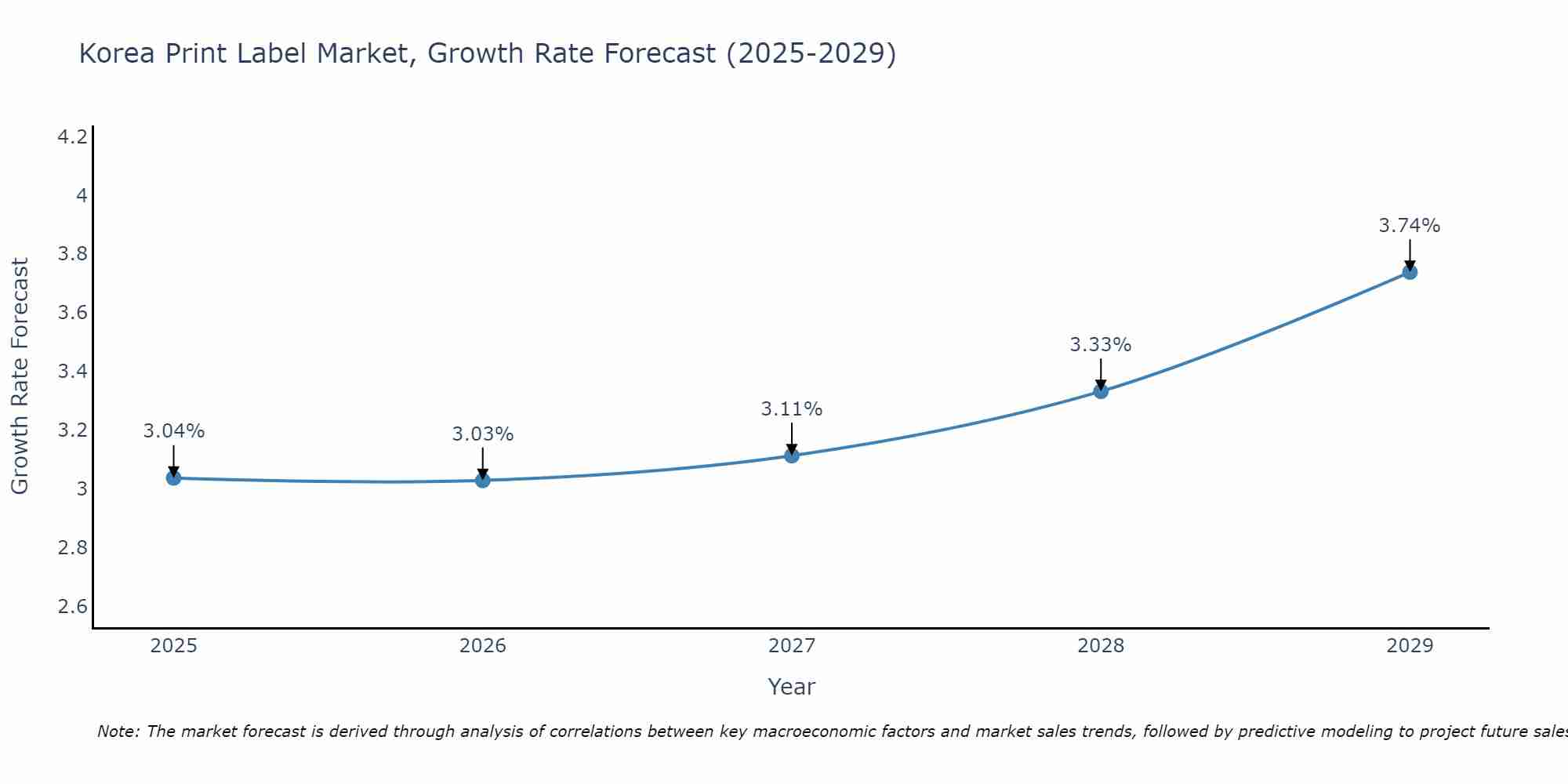
The South Korea Print Label Market is projected to witness mixed growth rate patterns during 2025 to 2029. Commencing at 3.04% in 2025, growth builds up to 3.74% by 2029.
South Korea Print Label Market Overview
The South Korea Print Label Market is witnessing steady growth driven by factors such as increasing demand for product labeling in various industries including food and beverage, pharmaceuticals, and retail. The market is characterized by a growing emphasis on high-quality, aesthetically appealing labels that provide information to consumers and enhance brand visibility. Technological advancements in printing techniques, such as digital printing, are also contributing to market growth by offering cost-effective and efficient label printing solutions. Additionally, the focus on sustainability and eco-friendly labeling materials is shaping the market landscape as companies seek to align with environmental regulations and consumer preferences. Overall, the South Korea Print Label Market is poised for continued expansion as businesses prioritize effective labeling strategies to differentiate their products in a competitive market environment.
South Korea Print Label Market Trends
The South Korea Print Label Market is experiencing a shift towards sustainable and eco-friendly labeling solutions, driven by increasing consumer awareness and government regulations on environmental protection. Companies are adopting materials such as biodegradable films, recycled paper, and water-based inks to reduce their carbon footprint. Digital printing technology is also gaining traction in the market due to its flexibility, cost-effectiveness, and ability to cater to shorter print runs with high customization. Personalized labels, security features, and smart labeling with RFID technology are other emerging trends in the South Korea Print Label Market as companies seek to enhance brand visibility, product differentiation, and supply chain efficiency.
South Korea Print Label Market Challenges
In the South Korea Print Label Market, some challenges faced include intense competition among players driving down prices and profit margins, the need to constantly innovate and offer unique solutions to stand out in the market, and the pressure to meet strict regulatory requirements for labeling in various industries. Additionally, the market is also impacted by fluctuations in raw material prices and the need for sustainable and eco-friendly labeling solutions to align with changing consumer preferences. Companies in the South Korea Print Label Market must navigate these challenges by investing in technology, focusing on product differentiation, building strong relationships with customers, and ensuring compliance with regulations to maintain a competitive edge in the market.
South Korea Print Label Market Investment Opportunities
The South Korea Print Label Market offers promising investment opportunities due to the growing demand for efficient labeling solutions across various industries such as food and beverage, pharmaceuticals, and consumer goods. With a focus on innovative technologies and increasing emphasis on product customization and branding, there is a rising need for high-quality and visually appealing labels. Investing in companies that provide advanced printing technologies, digital printing services, and environmentally friendly label solutions can be lucrative in this market. Additionally, with South Korea`s strong manufacturing base and export-oriented economy, there is a significant potential for growth and expansion in the print label industry, making it an attractive investment option for investors looking to capitalize on the country`s industrial development and market demand.
South Korea Print Label Market Government Policy
The South Korean government has implemented strict regulations regarding print labels to ensure consumer safety and fair trade practices. The Ministry of Food and Drug Safety oversees the labeling requirements for food products, including mandatory information such as product name, expiration date, ingredients, and nutritional information. The government also enforces regulations on the labeling of textiles, electronics, and other consumer goods to protect consumers from misleading or false information. Additionally, there are specific regulations on environmentally friendly labels to promote sustainability in the market. Overall, the government`s policies aim to enhance transparency, consumer protection, and market competitiveness in the South Korea print label market.
South Korea Print Label Market Future Outlook
The South Korea Print Label Market is expected to experience steady growth in the coming years, driven by increasing demand from industries such as food and beverage, pharmaceuticals, and retail. With a growing emphasis on product customization and branding, businesses are increasingly turning to printed labels to differentiate their products in a competitive market. Technological advancements in printing techniques and materials are also expected to drive market growth by offering more efficient and cost-effective solutions. Additionally, the rise of e-commerce and online retail platforms is likely to further boost the demand for print labels for packaging and branding purposes. Overall, the South Korea Print Label Market is forecasted to expand as companies prioritize quality packaging and labeling to enhance their products` visibility and appeal to consumers.
Key Highlights of the Report:
- South Korea Print Label Market Outlook
- Market Size of South Korea Print Label Market, 2021
- Forecast of South Korea Print Label Market, 2031
- Historical Data and Forecast of South Korea Print Label Revenues & Volume for the Period 2018 - 2031
- South Korea Print Label Market Trend Evolution
- South Korea Print Label Market Drivers and Challenges
- South Korea Print Label Price Trends
- South Korea Print Label Porter's Five Forces
- South Korea Print Label Industry Life Cycle
- Historical Data and Forecast of South Korea Print Label Market Revenues & Volume By Print Process for the Period 2018 - 2031
- Historical Data and Forecast of South Korea Print Label Market Revenues & Volume By Offset lithography for the Period 2018 - 2031
- Historical Data and Forecast of South Korea Print Label Market Revenues & Volume By Gravure for the Period 2018 - 2031
- Historical Data and Forecast of South Korea Print Label Market Revenues & Volume By Flexography for the Period 2018 - 2031
- Historical Data and Forecast of South Korea Print Label Market Revenues & Volume By Screen for the Period 2018 - 2031
- Historical Data and Forecast of South Korea Print Label Market Revenues & Volume By Letterpress for the Period 2018 - 2031
- Historical Data and Forecast of South Korea Print Label Market Revenues & Volume By Electrophotography for the Period 2018 - 2031
- Historical Data and Forecast of South Korea Print Label Market Revenues & Volume By Inkjet for the Period 2018 - 2031
- Historical Data and Forecast of South Korea Print Label Market Revenues & Volume By Label Format for the Period 2018 - 2031
- Historical Data and Forecast of South Korea Print Label Market Revenues & Volume By Wet-glue labels for the Period 2018 - 2031
- Historical Data and Forecast of South Korea Print Label Market Revenues & Volume By Pressure-sensitive labels for the Period 2018 - 2031
- Historical Data and Forecast of South Korea Print Label Market Revenues & Volume By Linerless labels for the Period 2018 - 2031
- Historical Data and Forecast of South Korea Print Label Market Revenues & Volume By Multi-part tracking labels for the Period 2018 - 2031
- Historical Data and Forecast of South Korea Print Label Market Revenues & Volume By In-mold labels for the Period 2018 - 2031
- Historical Data and Forecast of South Korea Print Label Market Revenues & Volume By Sleeves for the Period 2018 - 2031
- Historical Data and Forecast of South Korea Print Label Market Revenues & Volume By End-User for the Period 2018 - 2031
- Historical Data and Forecast of South Korea Print Label Market Revenues & Volume By Food for the Period 2018 - 2031
- Historical Data and Forecast of South Korea Print Label Market Revenues & Volume By Beverage for the Period 2018 - 2031
- Historical Data and Forecast of South Korea Print Label Market Revenues & Volume By Healthcare for the Period 2018 - 2031
- Historical Data and Forecast of South Korea Print Label Market Revenues & Volume By Cosmetics for the Period 2018 - 2031
- Historical Data and Forecast of South Korea Print Label Market Revenues & Volume By Household for the Period 2018 - 2031
- Historical Data and Forecast of South Korea Print Label Market Revenues & Volume By Industrial for the Period 2018 - 2031
- Historical Data and Forecast of South Korea Print Label Market Revenues & Volume By Logistics for the Period 2018 - 2031
- Historical Data and Forecast of South Korea Print Label Market Revenues & Volume By Other for the Period 2018 - 2031
- South Korea Print Label Import Export Trade Statistics
- Market Opportunity Assessment By Print Process
- Market Opportunity Assessment By Label Format
- Market Opportunity Assessment By End-User
- South Korea Print Label Top Companies Market Share
- South Korea Print Label Competitive Benchmarking By Technical and Operational Parameters
- South Korea Print Label Company Profiles
- South Korea Print Label Key Strategic Recommendations






































