South Korea Processed Food Market Size Growth Rate
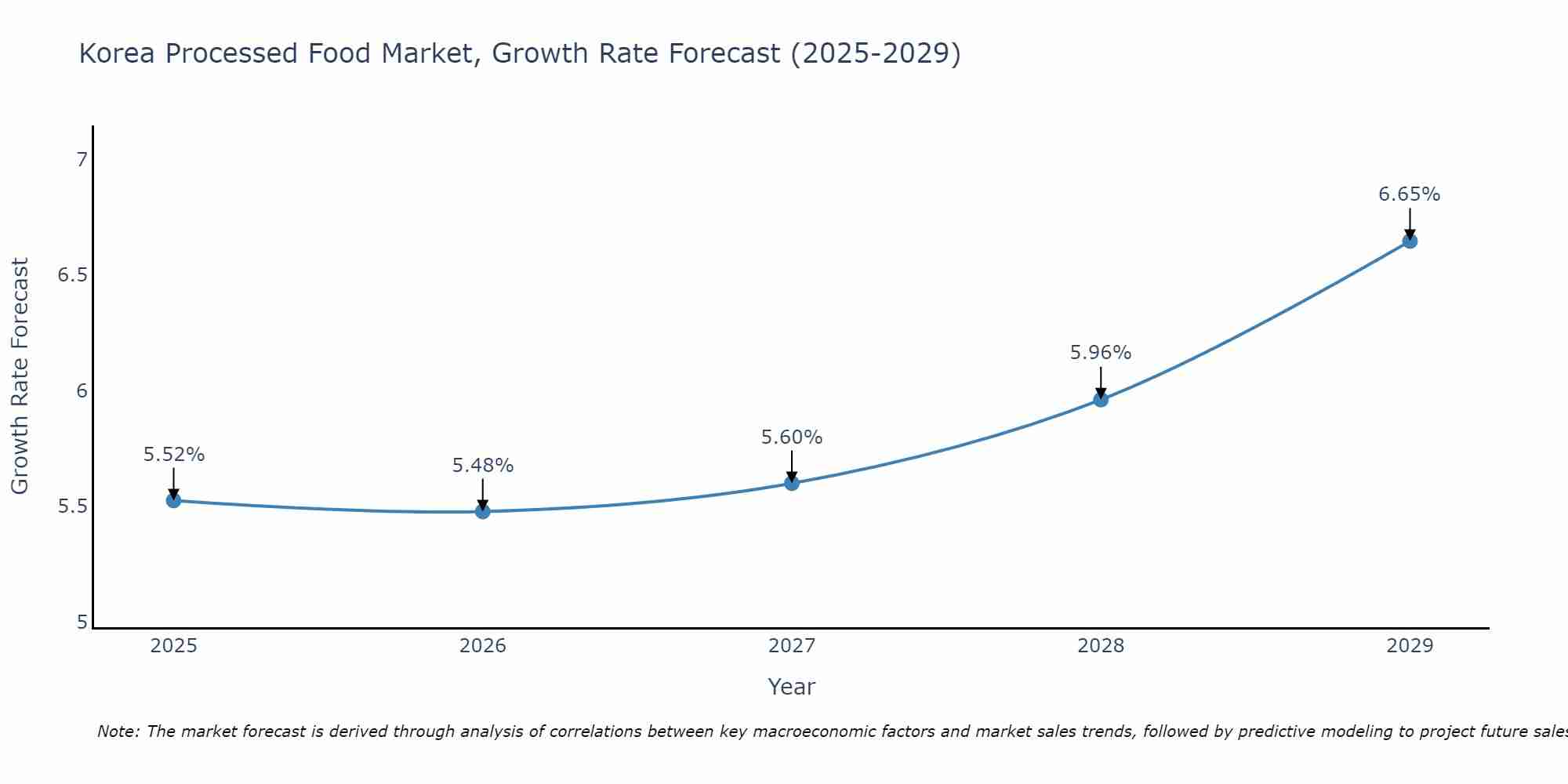
The South Korea Processed Food Market is projected to witness mixed growth rate patterns during 2025 to 2029. The growth rate starts at 5.52% in 2025 and reaches 6.65% by 2029.
South Korea Processed Food Market Overview
The processed food market in South Korea is expanding as busy lifestyles and urbanization drive demand for convenient and ready-to-eat meal options. Consumers are increasingly seeking nutritious and high-quality processed food products that offer convenience without compromising on taste and health benefits. Market players are focusing on product innovation, clean labeling, and sustainable packaging to align with evolving consumer preferences and regulatory standards.
Drivers of the market
The processed food market in South Korea is growing due to shifting consumer preferences towards convenient and ready-to-eat food options. Urbanization, busy lifestyles, and increasing disposable incomes are driving the demand for packaged, preserved, and frozen food products.
Challenges of the market
The Processed Food market in South Korea encounters challenges driven by consumer trends, regulatory requirements, and supply chain complexities. Changing consumer preferences towards natural and organic ingredients necessitate reformulation and innovation in product offerings. Stringent food safety regulations and labeling requirements impose compliance burdens on manufacturers, requiring robust quality control measures and documentation. Additionally, global supply chain disruptions and fluctuating raw material costs impact production schedules and pricing strategies, affecting market competitiveness and profitability.
Government Policy of the market
In the processed food sector, South Korea implements stringent regulations to ensure product safety, quality, and nutritional value. Government policies encompass food labeling requirements, hygiene standards in production facilities, and continuous monitoring to safeguard public health and promote exports of high-quality processed food products.
Key Highlights of the Report:
- South Korea Processed Food Market Outlook
- Market Size of South Korea Processed Food Market, 2021
- Forecast of South Korea Processed Food Market, 2028
- Historical Data and Forecast of South Korea Processed Food Revenues & Volume for the Period 2018 - 2028
- South Korea Processed Food Market Trend Evolution
- South Korea Processed Food Market Drivers and Challenges
- South Korea Processed Food Price Trends
- South Korea Processed Food Porter's Five Forces
- South Korea Processed Food Industry Life Cycle
- Historical Data and Forecast of South Korea Processed Food Market Revenues & Volume By Process for the Period 2018 - 2028
- Historical Data and Forecast of South Korea Processed Food Market Revenues & Volume By Minimally for the Period 2018 - 2028
- Historical Data and Forecast of South Korea Processed Food Market Revenues & Volume By Highly for the Period 2018 - 2028
- Historical Data and Forecast of South Korea Processed Food Market Revenues & Volume By Product type for the Period 2018 - 2028
- Historical Data and Forecast of South Korea Processed Food Market Revenues & Volume By Plant based for the Period 2018 - 2028
- Historical Data and Forecast of South Korea Processed Food Market Revenues & Volume By Fruits for the Period 2018 - 2028
- Historical Data and Forecast of South Korea Processed Food Market Revenues & Volume By Vegetables for the Period 2018 - 2028
- Historical Data and Forecast of South Korea Processed Food Market Revenues & Volume By Legumes for the Period 2018 - 2028
- Historical Data and Forecast of South Korea Processed Food Market Revenues & Volume By Extracted foods for the Period 2018 - 2028
- Historical Data and Forecast of South Korea Processed Food Market Revenues & Volume By Others for the Period 2018 - 2028
- Historical Data and Forecast of South Korea Processed Food Market Revenues & Volume By Animal based for the Period 2018 - 2028
- Historical Data and Forecast of South Korea Processed Food Market Revenues & Volume By Milk for the Period 2018 - 2028
- Historical Data and Forecast of South Korea Processed Food Market Revenues & Volume By Application for the Period 2018 - 2028
- Historical Data and Forecast of South Korea Processed Food Market Revenues & Volume By Baked foods for the Period 2018 - 2028
- Historical Data and Forecast of South Korea Processed Food Market Revenues & Volume By Baby food for the Period 2018 - 2028
- Historical Data and Forecast of South Korea Processed Food Market Revenues & Volume By Breakfast Cereal for the Period 2018 - 2028
- Historical Data and Forecast of South Korea Processed Food Market Revenues & Volume By Biscuits for the Period 2018 - 2028
- Historical Data and Forecast of South Korea Processed Food Market Revenues & Volume By Cheese for the Period 2018 - 2028
- Historical Data and Forecast of South Korea Processed Food Market Revenues & Volume By Chocolate confectionary for the Period 2018 - 2028
- Historical Data and Forecast of South Korea Processed Food Market Revenues & Volume By Ice creams for the Period 2018 - 2028
- Historical Data and Forecast of South Korea Processed Food Market Revenues & Volume By Instant Noodles for the Period 2018 - 2028
- South Korea Processed Food Import Export Trade Statistics
- Market Opportunity Assessment By Process
- Market Opportunity Assessment By Product type
- Market Opportunity Assessment By Application
- South Korea Processed Food Top Companies Market Share
- South Korea Processed Food Competitive Benchmarking By Technical and Operational Parameters
- South Korea Processed Food Company Profiles
- South Korea Processed Food Key Strategic Recommendations






































