South Korea Professional Lighting Market Summary
The south korea professional lighting market was estimated at USD 307 Million in 2025 and is projected to reach USD 406 Million by 2032, growing at a CAGR of 5.0% from 2026 to 2032.
South Korea Professional Lighting Market Year-wise Growth Rate and Key Drivers
This graph highlights how the South Korea Professional Lighting Market has steadily grown over the past five years, supported by major growth factors.
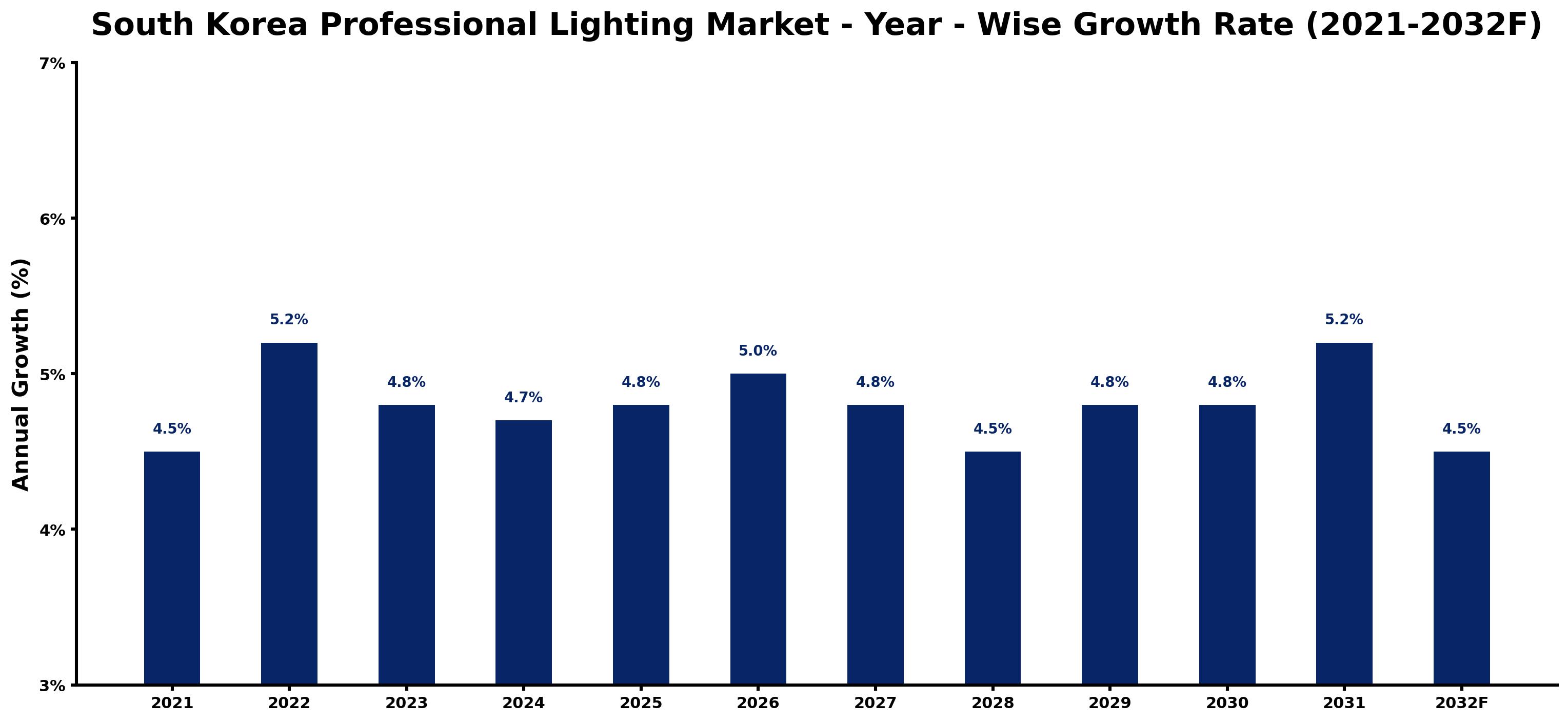
The table below presents the year wise growth rates along with the key drivers influencing the market
| Year | Growth Rate | Major Drivers |
| 2021 | 4.5% | Post-lockdown retail projects emphasize energy-efficient lighting solutions in urban spaces. |
| 2022 | 5.2% | Corporate sustainability goals encourage investment in smart lighting technologies across industries. |
| 2023 | 4.8% | Innovations in LED technology enhance performance and lower operational costs for businesses. |
| 2024 | 4.7% | The hospitality sector increasingly adopts ambient lighting for enhanced guest experiences. |
| 2025 | 4.8% | Smart city initiatives introduce integrated lighting systems for improved urban management. |
| 2026 | 5.0% | Architectural design trends favor unique lighting fixtures that complement modern aesthetics. |
| 2027 | 4.8% | Continued urbanization creates opportunities for advanced lighting in residential developments. |
| 2028 | 4.5% | Construction sector recovery promotes demand for durable, high-performance lighting installations. |
| 2029 | 4.8% | Emerging technologies in IoT enable real-time lighting control, enhancing efficiency and usability. |
| 2030 | 4.8% | Increased focus on health and well-being drives demand for circadian lighting solutions. |
| 2031 | 5.2% | Sustainable building certifications require adherence to energy-efficient lighting standards. |
| 2032 | 4.5% | Cultural shifts toward eco-conscious living amplify interest in renewable lighting technologies. |
Note - Market size estimations and growth projections presented in this report are based on 6Wresearch's advanced forecasting approach, validated with industry datasets as of June 2026.
South Korea Professional Lighting Market Synopsis
The South Korea Professional Lighting Market is projected to reach 5.0% and witness significant growth during the forecast period (2026-2032). The anticipated growth, estimated at a compound annual growth rate (CAGR) of 5.09%, is fundamentally supported by multiple factors including an increasing demand for energy-efficient lighting solutions, the rising adoption of smart lighting systems, and a growing emphasis on sustainable infrastructure and green buildings. Urbanization trends and substantial investments from both domestic and international stakeholders are poised to further bolster the South Korean professional lighting industry over the next several years.
South Korea Professional Lighting Market Growth Drivers
Several key drivers are shaping the trajectory of the South Korea Professional Lighting Market. The increasing consumer and commercial focus on energy efficiency has prompted a shift towards solutions that not only lower operational costs but also enhance environmental sustainability. Additionally, the rapid urbanization in South Korea is leading to an increased demand for efficient lighting in public and commercial spaces.
- Energy-efficient lighting solutions are becoming a priority for both consumers and businesses, spurring growth in this sector.
- The integration of smart technology into lighting systems is attracting investments and facilitating higher operational efficiency.
- Urbanization is resulting in a higher demand for effective lighting solutions in both residential and commercial developments.
- Government incentives for energy-efficient products have reduced the financial burden on consumers, boosting adoption rates.
- Awareness of green building practices is driving the market as companies adopt sustainable designs and technologies.
South Korea Professional Lighting Market Trends and Opportunities
A notable trend within the South Korea Professional Lighting Market is the increasing adoption of LED technology, which is preferred for its efficacy and cost-saving potential. The rise of connected devices and IoT platforms has enhanced the functionality and appeal of modern lighting solutions, positioning them as a crucial component within smart city initiatives.
- The transition to LED lighting is expected to continue, propelled by innovations in energy efficiency and overall performance.
- Smart lighting systems, integrated with IoT capabilities, are becoming standard in new developments, offering dynamic and adaptive lighting solutions.
- The focus on creating smart cities is enhancing opportunities for advanced lighting solutions that interact with other urban systems.
- Green initiatives are pushing for sustainable architecture, which in turn creates demand for innovative professional lighting installations.
- Increased research and development activities in the lighting industry are paving the way for smarter, more energy-efficient products.
South Korea Professional Lighting Market Challenges and Restraints
Despite the positive outlook, the South Korea Professional Lighting Market faces several challenges. The initial investment costs for advanced lighting technologies, such as smart lighting systems, can deter potential customers. Furthermore, the competition from lower-cost conventional lighting products remains a significant hurdle for premium products.
- The high upfront costs associated with advanced lighting technologies may lead to slower adoption rates among price-sensitive consumers.
- Market saturation from established conventional lighting products poses a challenge for the uptake of new technologies.
- Regulatory hurdles and compliance with ongoing government standards can present barriers for new entrants into the market.
- The rapid pace of technological innovation requires continuous upgrades and investments, which may strain smaller companies.
- Inconsistent standards for lighting quality and performance can lead to consumer hesitation in choosing new products.
South Korea Professional Lighting Market Government Investment and Initiatives
The South Korean government's commitment to sustainable development is glaring through various initiatives and investments aimed at enhancing the professional lighting market. Policies supporting the transition to LED lighting, including financial incentives, have played a pivotal role in decreasing the cost barrier for consumers. Furthermore, governmental frameworks are being established to promote smart city designs that incorporate advanced lighting solutions. These efforts are accompanied by significant public spending directed towards infrastructure developments integrating innovative lighting technologies.
- Government subsidies and incentives for LED technology adoption are aimed at reducing the price gap with conventional lighting.
- Investment in urban infrastructure projects is increasingly focusing on smart lighting as a key component of modern designs.
- Initiatives to promote energy-efficient practices are being implemented in both public and private sectors, ensuring alignment with sustainability goals.
- Collaborations between government bodies and private sectors are being encouraged to foster innovation within the lighting industry.
- Governmental policies aimed at reducing carbon emissions are stimulating demand for professional lighting solutions that adhere to environmental standards.
South Korea Professional Lighting Market Latest Developments (May 2025 - June 2026)
Recent developments in the South Korea Professional Lighting Market indicate a robust shift towards integrated lighting solutions that reflect advancements in technology. The period has seen a growing emphasis on innovations in smart lighting systems, with an increased focus on IoT capabilities that enhance user control and energy management. The industry is witnessing a surge in research initiatives aimed at developing more efficient LED options and smarter lighting infrastructures.
- Smart lighting deployments are becoming more common across various sectors, indicating a shift towards integrated systems.
- Increased focus on product innovation has led to the development of energy-efficient lighting technologies.
- Collaboration between tech firms and lighting manufacturers is becoming more pronounced to achieve synergies in product offerings.
- Funding and public-private partnerships are accelerating advancements in professional lighting technologies.
- Consumer demand for energy-efficient, smart lighting solutions is driving significant changes in product development strategies.
South Korea Professional Lighting Market - Key Attractiveness of the Report
- 10 Years of Market Numbers
- Historical Data Starting from 2022 to 2025
- Base Year: 2025
- Forecast Data until 2032
- Key Performance Indicators Impacting the Market
- Major Upcoming Developments and Projects
Key Highlights of the Report:
- South Korea Professional Lighting Market Outlook
- Market Size of South Korea Professional Lighting Market, 2025
- Forecast of South Korea Professional Lighting Market, 2032F
- Historical Data and Forecast of South Korea Professional Lighting Revenues & Volume for the Period 2022-2032F
- South Korea Professional Lighting Market Trend Evolution
- South Korea Professional Lighting Market Drivers and Challenges
- South Korea Professional Lighting Price Trends
- South Korea Professional Lighting Porter's Five Forces
- South Korea Professional Lighting Industry Life Cycle
- Historical Data and Forecast of South Korea Professional Lighting Market Revenues & Volume By Light Source for the Period 2022-2032F
- Historical Data and Forecast of South Korea Professional Lighting Market Revenues & Volume By LEDs for the Period 2022-2032F
- Historical Data and Forecast of South Korea Professional Lighting Market Revenues & Volume By Others (halogen lamps, xenon bulbs, incandescent lamps) for the Period 2022-2032F
- Historical Data and Forecast of South Korea Professional Lighting Market Revenues & Volume By Applications for the Period 2022-2032F
- Historical Data and Forecast of South Korea Professional Lighting Market Revenues & Volume By Entertainment for the Period 2022-2032F
- Historical Data and Forecast of South Korea Professional Lighting Market Revenues & Volume By Stage lighting for the Period 2022-2032F
- Historical Data and Forecast of South Korea Professional Lighting Market Revenues & Volume By Medical for the Period 2022-2032F
- Historical Data and Forecast of South Korea Professional Lighting Market Revenues & Volume By UV Lamps for the Period 2022-2032F
- Historical Data and Forecast of South Korea Professional Lighting Market Revenues & Volume By Others for the Period 2022-2032F
- South Korea Professional Lighting Import Export Trade Statistics
- Market Opportunity Assessment By Light Source
- Market Opportunity Assessment By Applications
- South Korea Professional Lighting Top Companies Market Share
- South Korea Professional Lighting Competitive Benchmarking By Technical and Operational Parameters
- South Korea Professional Lighting Company Profiles
- South Korea Professional Lighting Key Strategic Recommendations






































