South Korea Public Safety Analytics Market Size & Growth Rate (2026-2032)
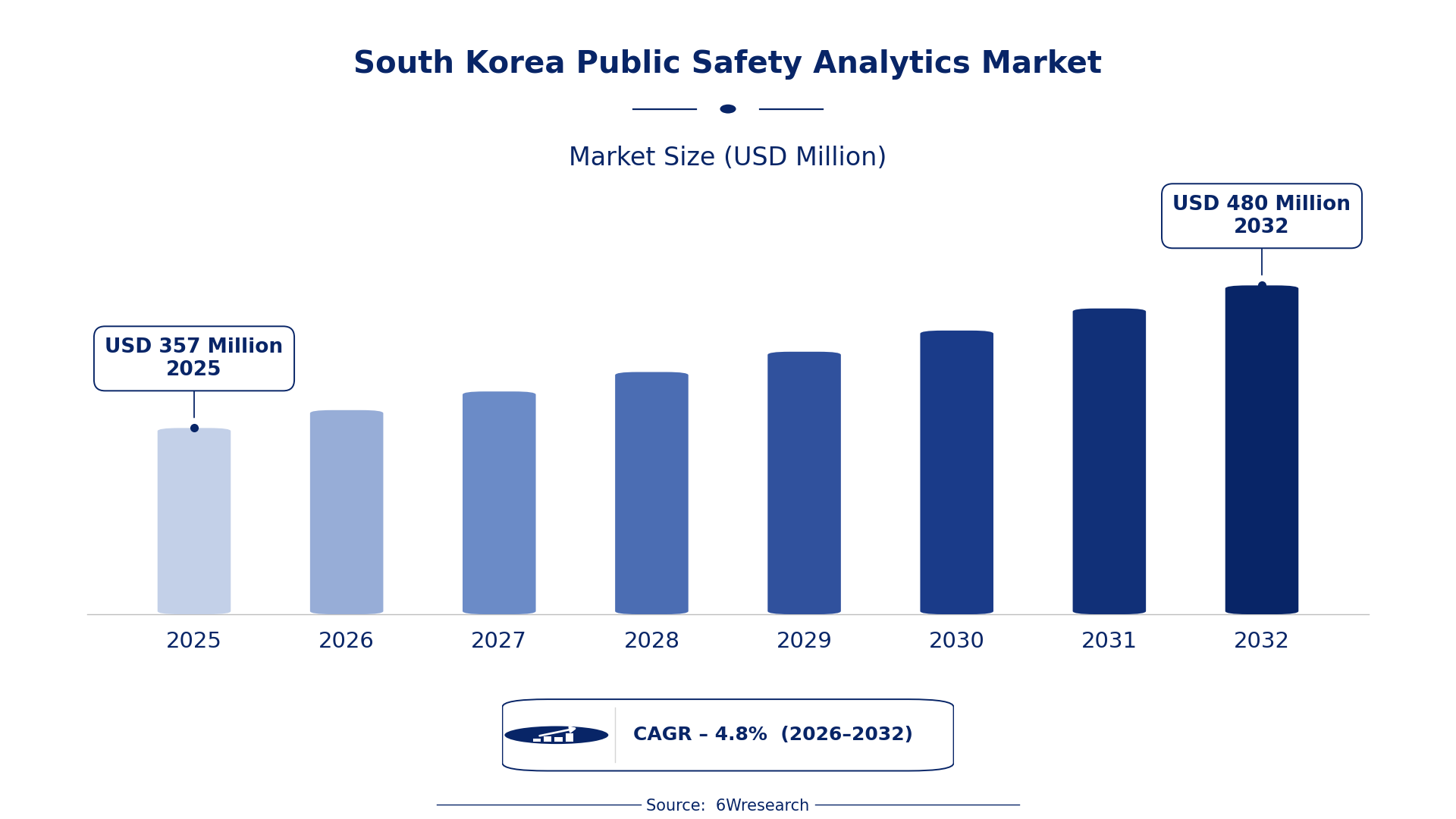
The South Korea Public Safety Analytics Market was estimated at USD 357 Million in 2025 and is projected to reach USD 480 Million by 2032, growing at a CAGR of 4.8% from 2026 to 2032.
South Korea Public Safety Analytics Market Synopsis
The demand for advanced public safety analytics in South Korea is being fueled by the increasing need for real-time data processing and predictive analytics to combat crime and enhance emergency response capabilities. Law enforcement agencies are adopting these technologies not only to streamline their operations but also to improve public trust and transparency.
The integration of artificial intelligence and machine learning into surveillance systems is a prominent trend. This shift aims to provide law enforcement with sophisticated tools for analyzing crime patterns, which significantly aids in resource allocation and strategic planning. The competitive nature of public safety demands an unwavering commitment to innovation and efficiency.
South Korea Public Safety Analytics Market Year-wise Growth Rate and Key Drivers
This graph illustrates the annual growth rates of the South Korea Public Safety Analytics Market from 2021 to 2032, highlighting a steady upward trajectory and projected expansion over the forecast period.
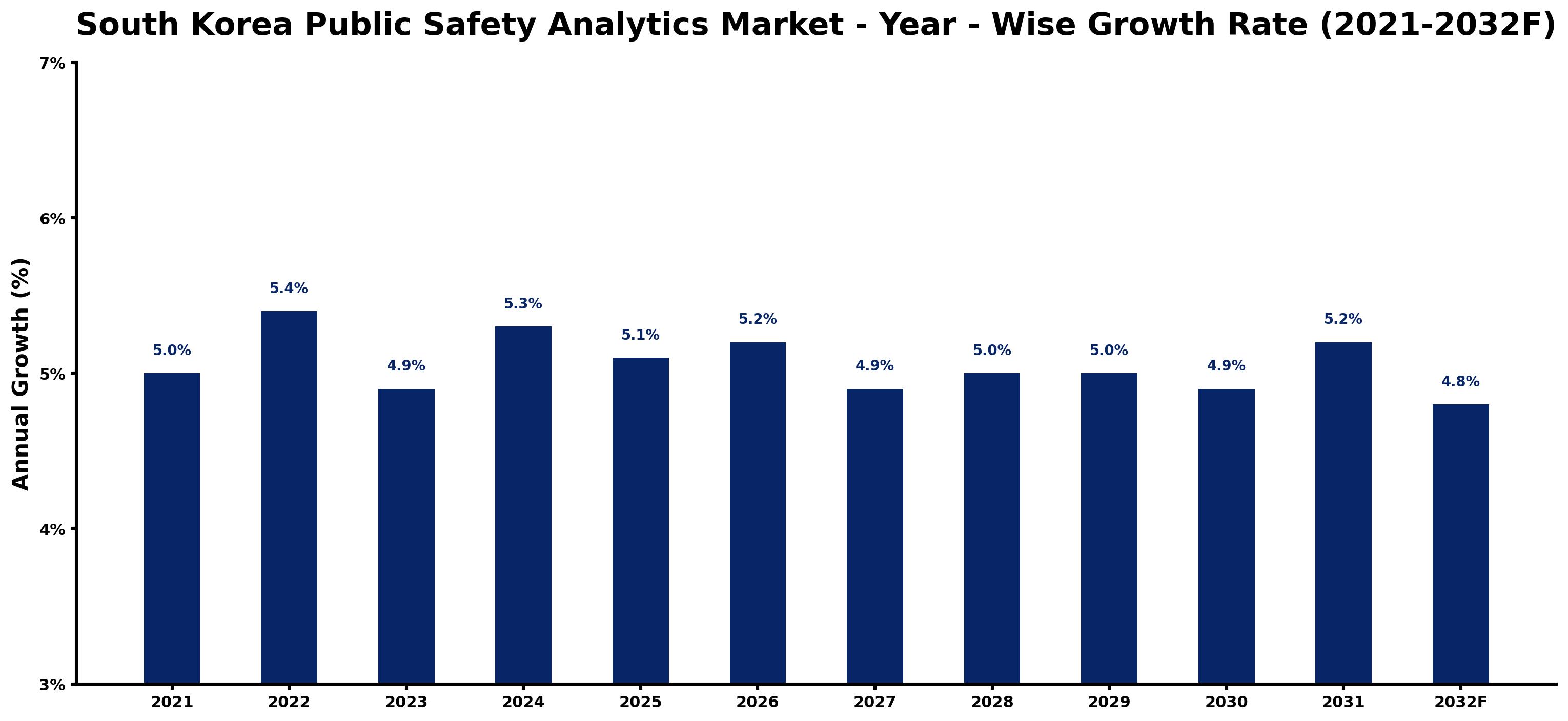
The table below presents the year‑wise growth rates along with the key drivers influencing the market
| Year | Growth Rate | Major Drivers |
| 2021 | 5.0% | Increased investment in smart city safety technologies. |
| 2022 | 5.4% | Government funding boost for crime prevention analytics. |
| 2023 | 4.9% | Emerging regulatory focus on public safety data integration. |
| 2024 | 5.3% | Growth in citizen engagement through real-time safety apps. |
| 2025 | 5.1% | Enhanced collaboration with local law enforcement agencies. |
| 2026 | 5.2% | Adoption of IoT devices for urban safety monitoring. |
| 2027 | 4.9% | Rising consumer trust in secure data handling practices. |
| 2028 | 5.0% | Advances in machine learning for emergency response. |
| 2029 | 5.0% | Supportive legislation for data-driven public safety solutions. |
| 2030 | 4.9% | Increasing public awareness of urban crime analytics. |
| 2031 | 5.2% | Localized crime trends driving targeted analytics investments. |
| 2032 | 4.8% | Advocacy for community participation in safety initiatives. |
Note: Market size estimations and growth projections presented in this report are based on 6Wresearch's proprietary forecasting methodology, utilizing the latest available industry data, government publications, and primary research inputs.
South Korea Public Safety Analytics Market Key Takeaways
Below are some of the specific key takeaways from the market, including:
- The adoption of AI and data analytics by law enforcement is reshaping operational protocols.
- Predictive analytics is enhancing crime prevention strategies across urban areas.
- Real-time data monitoring is becoming a standard practice for emergency services.
- Integration challenges around data privacy continue to present hurdles for agencies.
- Government initiatives are driving investment in public safety technologies.
Evaluation of Restraints in South Korea Public Safety Analytics Market
While growth is evident, the public safety analytics sector in South Korea grapples with several significant restraints. A primary concern revolves around the integration of diverse data sources, where agencies often struggle to ensure data privacy while making use of extensive information. on top of that, financial constraints limit many organizations' capacity to adopt advanced analytics solutions. This lack of funding, combined with the ongoing necessity for skilled personnel, poses a substantial barrier to market expansion. It’s evident that overcoming these limitations will be crucial for future development in this sector.
South Korea Public Safety Analytics Market Trends
The current trend of integrating artificial intelligence into analytics systems is significantly shaping how public safety measures are implemented. Law enforcement agencies are increasingly prioritizing predictive models that can forecast criminal activity, allowing them to allocate resources more effectively. on top of that, there’s a rising focus on collaboration between public and private sectors to enhance infrastructure that supports public safety analytics. This partnership is vital for fostering innovation and facilitating the deployment of next-generation technologies in public safety.
South Korea Public Safety Analytics Market Opportunities
Opportunities for growth in the South Korea Public Safety Analytics Market are abundant, particularly for technologies that facilitate real-time monitoring and rapid response. Investment in smart city initiatives is particularly promising, as these projects often include robust safety components driven by analytics. on top of that, the rise of mobile technology presents avenues to enhance accessibility and effectiveness in public safety solutions. Addressing data integration challenges will open doors for companies willing to innovate and support law enforcement efforts in their quest for public safety.
Government Initiatives in the South Korea Public Safety Analytics Market
Government policies in South Korea are significantly shaping the public safety analytics market, focusing on the integration of data-driven technologies to enhance emergency responses and crime prevention strategies. The emphasis on big data analytics ensures that law enforcement agencies can utilize sophisticated tools to protect citizens more effectively, making regulatory support vital for fostering market growth.
- A recently completed initiative established a national database for crime analytics, enabling law enforcement to share critical data across jurisdictions.
- A currently ongoing program focuses on upgrading surveillance technologies in major metropolitan areas, enhancing real-time monitoring capabilities.
- A planned public-private partnership aims to develop new predictive analytics tools tailored for disaster management by 2028.
- Ongoing workshops are being conducted to train law enforcement personnel in effectively utilizing analytics tools for operational efficiency.
- A framework introduced in 2026 aims to establish clearer guidelines for data privacy in public safety analytics, ensuring compliance across agencies.
Future Insights of the South Korea Public Safety Analytics Market
Looking ahead to the period from 2026 to 2032, the South Korea Public Safety Analytics Market is anticipated to evolve with further advancements in data analytics technologies. The integration of more sophisticated AI models will likely enhance the predictive capabilities of law enforcement agencies. As urban centers grow and security challenges become more complex, demand for innovative analytics solutions that can adapt to these changes will only increase. The emphasis on collaboration among public and private sectors will drive future developments, paving the way for a safer environment.
South Korea Public Safety Analytics Market Latest Developments
In the last year, the South Korea Public Safety Analytics Market has seen several notable developments that signal a strong push towards enhanced public safety capabilities. As agencies upgrade their technological frameworks, the overall industry momentum is increasingly focused on innovation and efficiency in analytics.
- A major technology vendor launched a new AI-driven analytics platform in early 2025, designed to improve predictive policing methods across urban areas.
- An ongoing partnership between regional law enforcement and tech companies has established a pilot program for real-time data sharing, initiated in mid-2025.
- A national seminar held in late 2025 focused on data privacy regulations surrounding public safety analytics, fostering dialogue among stakeholders.
- Upcoming legislation expected by early 2026 aims to increase funding for public safety technology initiatives, targeting underserved areas.
- A pilot project for integrating drone surveillance analytics began in Q1 2026, focusing on urban crime prevention efforts.
South Korea Public Safety Analytics Market - Key Attractiveness of the Report
- 10 Years of Market Numbers
- Historical Data Starting from 2022 to 2025
- Base Year: 2025
- Forecast Data until 2032
- Key Performance Indicators Impacting the Market
- Major Upcoming Developments and Projects
Key Highlights of the Report:
- South Korea Public Safety Analytics Market Outlook
- Market Size of South Korea Public Safety Analytics Market, 2025
- Forecast of South Korea Public Safety Analytics Market, 2032
- Historical Data and Forecast of South Korea Public Safety Analytics Revenues & Volume for the Period 2022-2032F
- South Korea Public Safety Analytics Market Trend Evolution
- South Korea Public Safety Analytics Market Drivers and Challenges
- South Korea Public Safety Analytics Price Trends
- South Korea Public Safety Analytics Porter's Five Forces
- South Korea Public Safety Analytics Industry Life Cycle
- Historical Data and Forecast of South Korea Public Safety Analytics Market Revenues & Volume By Component for the Period 2022-2032F
- Historical Data and Forecast of South Korea Public Safety Analytics Market Revenues & Volume By Solution for the Period 2022-2032F
- Historical Data and Forecast of South Korea Public Safety Analytics Market Revenues & Volume By Service for the Period 2022-2032F
- Historical Data and Forecast of South Korea Public Safety Analytics Market Revenues & Volume By Analytics Type for the Period 2022-2032F
- Historical Data and Forecast of South Korea Public Safety Analytics Market Revenues & Volume By Predictive for the Period 2022-2032F
- Historical Data and Forecast of South Korea Public Safety Analytics Market Revenues & Volume By Prescriptive for the Period 2022-2032F
- Historical Data and Forecast of South Korea Public Safety Analytics Market Revenues & Volume By Descriptive for the Period 2022-2032F
- Historical Data and Forecast of South Korea Public Safety Analytics Market Revenues & Volume By Deployment Mode for the Period 2022-2032F
- Historical Data and Forecast of South Korea Public Safety Analytics Market Revenues & Volume By On-premises for the Period 2022-2032F
- Historical Data and Forecast of South Korea Public Safety Analytics Market Revenues & Volume By Hosted for the Period 2022-2032F
- Historical Data and Forecast of South Korea Public Safety Analytics Market Revenues & Volume By Application for the Period 2022-2032F
- Historical Data and Forecast of South Korea Public Safety Analytics Market Revenues & Volume By Pattern Recognition for the Period 2022-2032F
- Historical Data and Forecast of South Korea Public Safety Analytics Market Revenues & Volume By Incident detection for the Period 2022-2032F
- Historical Data and Forecast of South Korea Public Safety Analytics Market Revenues & Volume By Person of Interest Screening for the Period 2022-2032F
- Historical Data and Forecast of South Korea Public Safety Analytics Market Revenues & Volume By Surveillance for the Period 2022-2032F
- Historical Data and Forecast of South Korea Public Safety Analytics Market Revenues & Volume By Industry Vertical for the Period 2022-2032F
- Historical Data and Forecast of South Korea Public Safety Analytics Market Revenues & Volume By Law Enforcement and Intelligence Agencies for the Period 2022-2032F
- Historical Data and Forecast of South Korea Public Safety Analytics Market Revenues & Volume By Border Control (Land, Sea, and Air) for the Period 2022-2032F
- Historical Data and Forecast of South Korea Public Safety Analytics Market Revenues & Volume By Public Transportation Security for the Period 2022-2032F
- Historical Data and Forecast of South Korea Public Safety Analytics Market Revenues & Volume By Critical Infrastructure Security for the Period 2022-2032F
- Historical Data and Forecast of South Korea Public Safety Analytics Market Revenues & Volume By Others (manufacturing and emergency services) for the Period 2022-2032F
- South Korea Public Safety Analytics Import Export Trade Statistics
- Market Opportunity Assessment By Component
- Market Opportunity Assessment By Analytics Type
- Market Opportunity Assessment By Deployment Mode
- Market Opportunity Assessment By Application
- Market Opportunity Assessment By Industry Vertical
- South Korea Public Safety Analytics Top Companies Market Share
- South Korea Public Safety Analytics Competitive Benchmarking By Technical and Operational Parameters
- South Korea Public Safety Analytics Company Profiles
- South Korea Public Safety Analytics Key Strategic Recommendations






































