South Korea Radio Broadcast Receivers Market Size, Share & Growth Rate
The South Korea Radio Broadcast Receivers Market was estimated at USD 1116 Million in 2025 and is projected to reach USD 1607 Million by 2032, growing at a CAGR of 5.3% from 2026 to 2032. This steady growth trajectory is driven by the increasing demand for high-quality audio experiences among consumers and the ongoing advancement in broadcast technologies. Additionally, government initiatives to enhance digital services and a competitive marketplace foster attractive consumer offers, fueling market expansion.
South Korea Radio Broadcast Receivers Market Growth Rate Analysis (2021-2032)
The South Korea radio broadcast receivers market has exhibited robust growth, with an annual increase of 6.1% in 2021, slightly rising to 6.6% in 2022. This upward trend can be attributed to heightened consumer demand for diverse audio content and advancements in digital broadcasting technology. The growth continued at 6.5% in 2023 and is anticipated to remain stable, albeit with minor fluctuations, at around 6.2% to 6.4% through 2032. This stability reflects the ongoing digitalization of media consumption and a shift toward integrated smart devices. Policy support for digital infrastructure further enhances the market appeal, solidifying South Korea's position in the global broadcasting landscape.
South Korea Radio Broadcast Receivers Market Year-wise Growth Rate and Key Drivers
This graph highlights how the South Korea Radio Broadcast Receivers Market has steadily grown over the past five years, supported by major growth factors.
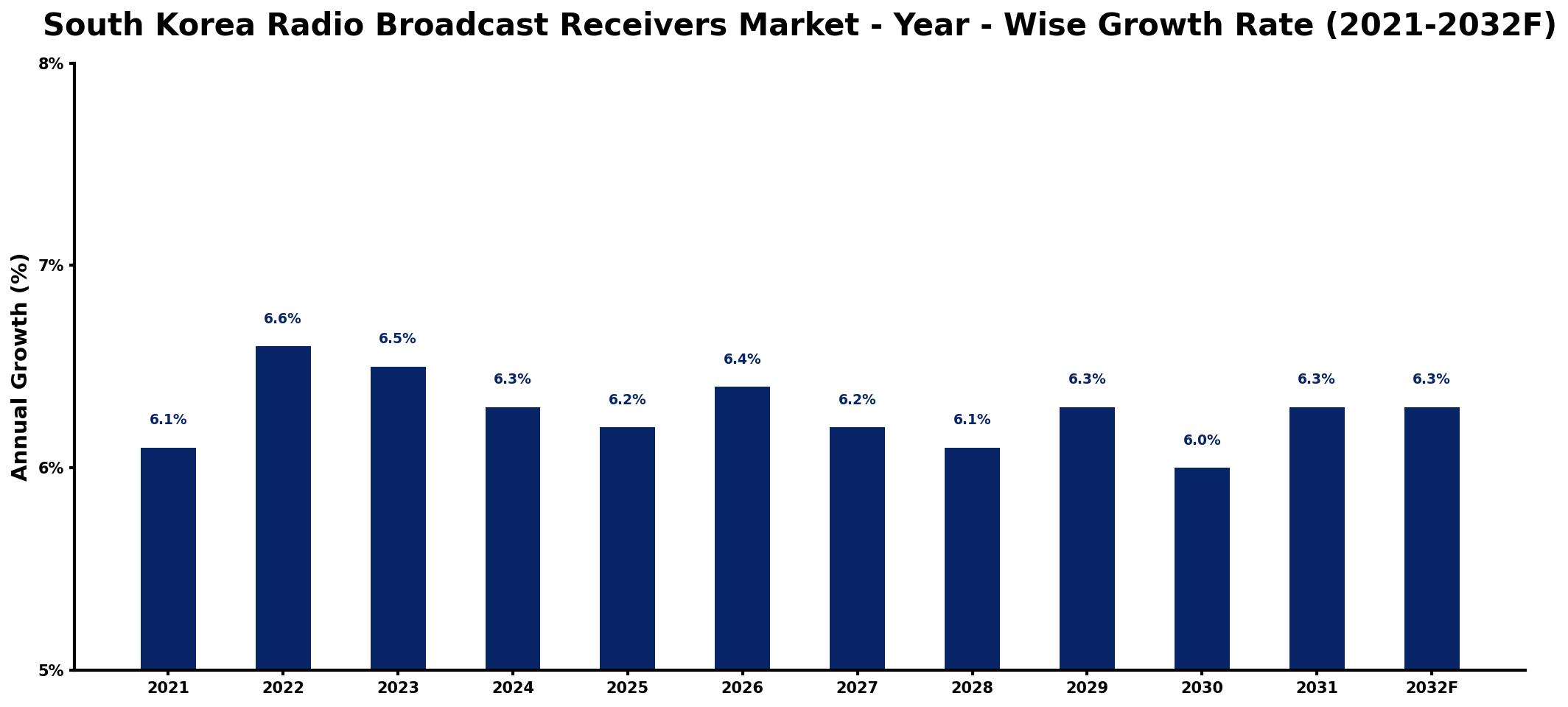
The table below presents the year‑wise growth rates along with the key drivers influencing the market
| Year | Growth Rate | Major Drivers |
| 2021 | 6.1% | Rising consumer interest in audio |
| 2022 | 6.6% | Increased adoption of streaming services |
| 2023 | 6.5% | Growth in portable audio devices |
| 2024 | 6.3% | Expansion of digital content offerings |
| 2025 | 6.2% | Investments in smart technology integration |
| 2026 | 6.4% | Enhanced connectivity features demand |
| 2027 | 6.2% | Popularity of personalized listening experiences |
| 2028 | 6.1% | Emergence of new content platforms |
| 2029 | 6.3% | Growing use in automotive applications |
| 2030 | 6.0% | Focus on sustainable product development |
| 2031 | 6.3% | Advancements in audio quality standards |
| 2032 | 6.3% | Strengthening of online retail channels |
Note: Market size estimations and growth projections presented in this report are based on 6Wresearch's proprietary forecasting methodology, utilizing the latest available industry data, government publications, and primary research inputs.
South Korea Radio Broadcast Receivers Market Synopsis
The most potent force shaping the South Korea Radio Broadcast Receivers Market right now is the rapid advancement of digital broadcasting technologies. Consumers are gravitating towards innovative solutions that not only enhance sound quality but also integrate seamlessly with other smart devices. This trend is compelling manufacturers to continuously refine their product offerings.
Furthermore, the growing proliferation of high-speed internet access has enabled a streaming culture that complements traditional radio broadcasting. As consumers increasingly engage with multiple platforms for their audio needs, the synergy between radio broadcasts and digital content access becomes a pivotal element in shaping market dynamics.
South Korea Radio Broadcast Receivers Market Key Takeaways
- Government initiatives promoting digital broadcasting are driving market growth.
- Increased internet penetration is reshaping consumer behavior and preferences.
- Competition among local manufacturers encourages attractive pricing and promotional deals.
- Technological advancements are enhancing product offerings and quality standards.
- The integration of smart technology in receivers is becoming a significant trend.
Evaluation of Restraints in South Korea Radio Broadcast Receivers Market
Despite the optimistic growth forecast for the South Korea Radio Broadcast Receivers Market, several restraints hinder its potential. One notable concern is the saturation of the market with existing products, leading to fierce competition and pricing pressures among manufacturers. Additionally, consumer preferences are shifting towards streaming services, which may challenge the traditional radio broadcasting model. This shift necessitates continuous innovation and adaptation from manufacturers to stay relevant.
South Korea Radio Broadcast Receivers Market Trends
A key trend shaping the South Korea Radio Broadcast Receivers Market is the integration of smart technology into devices. Consumers increasingly favor receivers that connect to various smart home systems, enhancing the overall user experience. Furthermore, the shift towards portable and versatile receiver designs is also notable, as users seek convenience and flexibility in their audio consumption. Finally, personalized audio content delivery through targeted marketing strategies is on the rise, aligning with consumer preferences.
South Korea Radio Broadcast Receivers Market Opportunities
The South Korea Radio Broadcast Receivers Market presents genuine growth opportunities, particularly in emerging technologies such as Internet of Things (IoT) applications. As consumers demand more connectivity options, manufacturers that innovate in creating interoperable devices are likely to capture significant market share. Additionally, expanding into untapped regions or niche markets with tailored products could offer lucrative avenues for investment and growth.
Government Initiatives in the South Korea Radio Broadcast Receivers Market
The South Korean government has been active in promoting digital broadcasting through initiatives that encourage the development of free digital terrestrial television (DTT) services. This has provided consumers access to a plethora of channels without additional costs, apart from installation fees. Such policies not only enhance media accessibility but also stimulate competition among broadcasters, thereby enriching the market landscape for radio broadcast receivers.
Future Insights of the South Korea Radio Broadcast Receivers Market
Looking ahead to 2026-2032, the South Korea Radio Broadcast Receivers Market is poised for steady advancement, bolstered by continuous technological innovations and evolving consumer preferences. The anticipated growth in digital broadcasting services, coupled with a growing appetite for high-quality audio experiences, will underpin demand. Manufacturers are expected to focus on developing multifunctional receivers that cater to a tech-savvy audience, setting the stage for an exciting market evolution.
South Korea Radio Broadcast Receivers Market Latest Developments (2025 - 2026)
In recent months, the South Korea Radio Broadcast Receivers Market has seen a trend towards integrating advanced features such as voice assistance and enhanced connectivity options in new product launches. Manufacturers are also responding to consumer feedback by implementing design changes that cater to portable usage and aesthetic preferences. Moreover, promotional campaigns highlighting exclusive offers have become increasingly common, aiming to boost consumer interest amid stiff competition.
South Korea Radio Broadcast Receivers Market - Key Attractiveness of the Report
- 10 Years of Market Numbers
- Historical Data Starting from 2022 to 2025
- Base Year: 2025
- Forecast Data until 2032
- Key Performance Indicators Impacting the Market
- Major Upcoming Developments and Projects
Key Highlights of the Report:
- South Korea Radio Broadcast Receivers Market Outlook
- Market Size of South Korea Radio Broadcast Receivers Market, 2025
- Forecast of South Korea Radio Broadcast Receivers Market, 2032
- Historical Data and Forecast of South Korea Radio Broadcast Receivers Revenues & Volume for the Period 2022-2032F
- South Korea Radio Broadcast Receivers Market Trend Evolution
- South Korea Radio Broadcast Receivers Market Drivers and Challenges
- South Korea Radio Broadcast Receivers Price Trends
- South Korea Radio Broadcast Receivers Porter's Five Forces
- South Korea Radio Broadcast Receivers Industry Life Cycle
- Historical Data and Forecast of South Korea Radio Broadcast Receivers Market Revenues & Volume By Equipment for the Period 2022-2032F
- Historical Data and Forecast of South Korea Radio Broadcast Receivers Market Revenues & Volume By Modulators for the Period 2022-2032F
- Historical Data and Forecast of South Korea Radio Broadcast Receivers Market Revenues & Volume By Transmitters And Receivers for the Period 2022-2032F
- Historical Data and Forecast of South Korea Radio Broadcast Receivers Market Revenues & Volume By Encoders for the Period 2022-2032F
- Historical Data and Forecast of South Korea Radio Broadcast Receivers Market Revenues & Volume By Switches for the Period 2022-2032F
- Historical Data and Forecast of South Korea Radio Broadcast Receivers Market Revenues & Volume By Filters for the Period 2022-2032F
- Historical Data and Forecast of South Korea Radio Broadcast Receivers Market Revenues & Volume By Amplifiers for the Period 2022-2032F
- Historical Data and Forecast of South Korea Radio Broadcast Receivers Market Revenues & Volume By Frequency for the Period 2022-2032F
- Historical Data and Forecast of South Korea Radio Broadcast Receivers Market Revenues & Volume By Low Frequency for the Period 2022-2032F
- Historical Data and Forecast of South Korea Radio Broadcast Receivers Market Revenues & Volume By Medium Frequency for the Period 2022-2032F
- Historical Data and Forecast of South Korea Radio Broadcast Receivers Market Revenues & Volume By High Frequency for the Period 2022-2032F
- South Korea Radio Broadcast Receivers Import Export Trade Statistics
- Market Opportunity Assessment By Equipment
- Market Opportunity Assessment By Frequency
- South Korea Radio Broadcast Receivers Top Companies Market Share
- South Korea Radio Broadcast Receivers Competitive Benchmarking By Technical and Operational Parameters
- South Korea Radio Broadcast Receivers Company Profiles
- South Korea Radio Broadcast Receivers Key Strategic Recommendations






































