South Korea Raw Cane Sugar Market Size, Share & Growth Rate
The South Korea Raw Cane Sugar Market was estimated at USD 196 Million in 2025 and is projected to reach USD 273 Million by 2032, growing at a CAGR of 4.8% from 2026 to 2032. This growth trajectory is propelled by a rising consumer inclination towards natural sweeteners, underpinned by health trends favoring minimally processed food products. Moreover, the burgeoning food and beverage sector, combined with effective distribution networks, enhances the accessibility of raw cane sugar across diverse applications.
South Korea Raw Cane Sugar Market Year-wise Growth Rate and Key Drivers
This graph highlights how the South Korea Raw Cane Sugar Market has steadily grown over the years, supported by major growth factors.
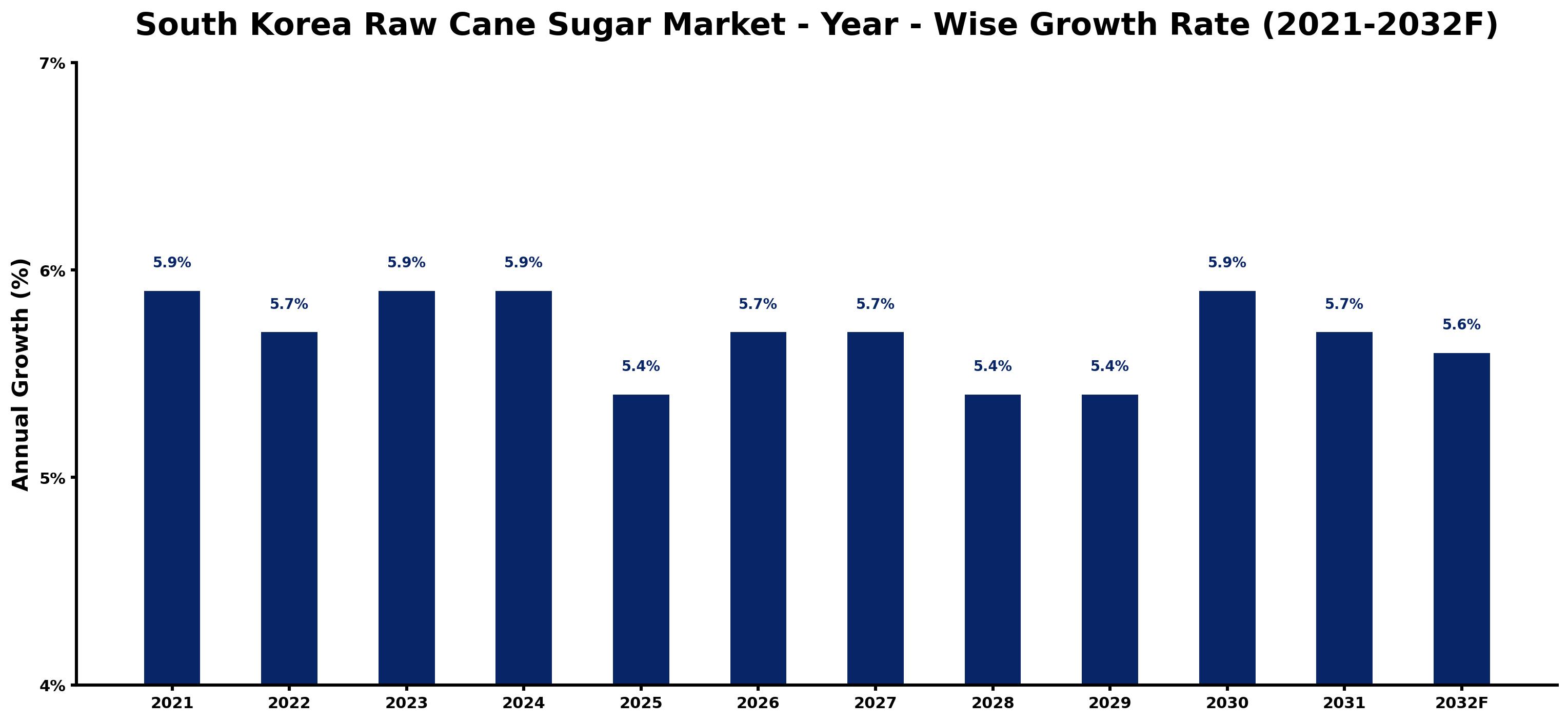
The table below presents the year‑wise growth rates along with the key drivers influencing the market
| Year | Growth Rate | Major Drivers |
| 2021 | 5.9% | Increasing smart city development projects |
| 2022 | 5.7% | Government infrastructure modernization initiatives |
| 2023 | 5.9% | Government infrastructure modernization initiatives |
| 2024 | 5.9% | Rapid growth in telecom and data center sectors |
| 2025 | 5.4% | Expansion of manufacturing activities |
| 2026 | 5.7% | Expansion of transportation and logistics networks |
| 2027 | 5.7% | Government infrastructure modernization initiatives |
| 2028 | 5.4% | Growing renewable energy integration projects |
| 2029 | 5.4% | Government infrastructure modernization initiatives |
| 2030 | 5.9% | Rising electricity demand across industries |
| 2031 | 5.7% | Increasing industrial infrastructure investments |
| 2032 | 5.6% | Expansion of commercial construction activities |
Note - Market size estimations and growth projections presented in this report are based on 6Wresearch’s advanced forecasting approach, validated with industry datasets as of June 2026.
South Korea Raw Cane Sugar Market Synopsis
Recent momentum in the South Korean raw cane sugar market reflects an increasing shift towards organic and minimally processed ingredients, aligning with global health trends. However, as consumer preferences evolve, the market is poised for further expansion, driven by innovation in product formulations and the demand for higher quality sweeteners.
The future of the South Korea raw cane sugar market appears optimistic, influenced by regulatory support and the global movement towards healthier diets. As import regulations evolve, producers are adapting their strategies to meet rising consumer expectations while maintaining affordability and sustainability in production practices.
South Korea Raw Cane Sugar Market Key Takeaways
- The market is projected to grow significantly, driven by increasing consumer demand for natural sweeteners.
- Health-conscious consumers are shifting preferences towards minimally processed sugars.
- Import regulations and trade agreements play a crucial role in market dynamics.
- Domestic production efforts are supported by government policies to enhance competitiveness.
- Challenges such as fluctuating global prices require careful strategic planning by stakeholders.
Evaluation of Restraints in South Korea Raw Cane Sugar Market
Despite the promising growth prospects, the South Korea raw cane sugar market grapples with several restraints that could impede its advancement. Stringent import regulations and trade tariffs can limit market access for foreign producers, creating potential shortages or price surges in certain segments. Additionally, fluctuations in global sugar prices can affect local profitability, particularly for importers reliant on cost-effective sourcing. As the demand for healthier alternatives intensifies, producers also face the challenge of balancing affordability with high-quality, sustainably sourced products, which may not always align with consumer expectations for price.
South Korea Raw Cane Sugar Market Trends
Current trends indicate a marked increase in consumer education regarding the benefits of natural sweeteners, further propelling the raw cane sugar market. As more consumers become aware of the implications of refined sugars on health, the interest in organic and ethically sourced products grows. Furthermore, innovative food and beverage companies are developing novel applications for raw cane sugar, thus expanding its usage beyond traditional contexts, incorporating it into health-focused snacks and beverages.
South Korea Raw Cane Sugar Market Opportunities
Investment opportunities in the South Korea raw cane sugar market are becoming more apparent as demand for high-quality, organic products increases. Domestic producers can capitalize on the growing health-conscious consumer segment by enhancing product lines to include specialty raw cane sugars. Additionally, leveraging digital marketing strategies to educate consumers about the benefits of raw cane sugar could drive brand loyalty and market share. Expanding distribution networks will also be essential in reaching underserved markets within the region.
Government Initiatives in the South Korea Raw Cane Sugar Market
The South Korean government plays an active role in regulating the raw cane sugar market, focusing on policies that promote both domestic production and sustainable imports. By implementing tariff adjustments and offering subsidies to local cane growers, the government aims to bolster the domestic sugar industry while ensuring that consumer demand is met. Additionally, quality standards for imported sugars are enforced to maintain food safety and product consistency, further enhancing market stability.
Future Insights of the South Korea Raw Cane Sugar Market
Looking ahead to the period from 2026 to 2032, the South Korea raw cane sugar market is set to experience transformative growth. Innovations in product development, particularly in the realm of health and wellness, will drive demand, while government policies will continue to shape import and production strategies. As sustainability remains at the forefront of consumer concerns, businesses that prioritize ethical sourcing and transparency in their operations are likely to gain a competitive edge in this evolving landscape.
South Korea Raw Cane Sugar Market Latest Developments (May 2025 - June 2026)
In recent months, the South Korea raw cane sugar market has witnessed a shift towards more sustainable practices, with several initiatives launched to promote organic farming among domestic cane producers. Additionally, food and beverage companies are increasingly exploring unique formulations that incorporate raw cane sugar as a key ingredient, appealing to health-oriented consumers. There is also a noticeable trend in establishing direct trade relationships with sugar-producing countries to ensure quality and authenticity in supply.
South Korea Raw Cane Sugar Market - Key Attractiveness of the Report
- 10 Years of Market Numbers
- Historical Data Starting from 2022 to 2025
- Base Year: 2025
- Forecast Data until 2032
- Key Performance Indicators Impacting the Market
- Major Upcoming Developments and Projects
Key Highlights of the Report:
- South Korea Raw Cane Sugar Market Outlook
- Market Size of South Korea Raw Cane Sugar Market, 2025
- Forecast of South Korea Raw Cane Sugar Market, 2032
- Historical Data and Forecast of South Korea Raw Cane Sugar Revenues & Volume for the Period 2022-2032F
- South Korea Raw Cane Sugar Market Trend Evolution
- South Korea Raw Cane Sugar Market Drivers and Challenges
- South Korea Raw Cane Sugar Price Trends
- South Korea Raw Cane Sugar Porter's Five Forces
- South Korea Raw Cane Sugar Industry Life Cycle
- Historical Data and Forecast of South Korea Raw Cane Sugar Market Revenues & Volume By Product Type for the Period 2022-2032F
- Historical Data and Forecast of South Korea Raw Cane Sugar Market Revenues & Volume By Demerara-style Sugar for the Period 2022-2032F
- Historical Data and Forecast of South Korea Raw Cane Sugar Market Revenues & Volume By Organic Sugar for the Period 2022-2032F
- Historical Data and Forecast of South Korea Raw Cane Sugar Market Revenues & Volume By End User for the Period 2022-2032F
- Historical Data and Forecast of South Korea Raw Cane Sugar Market Revenues & Volume By Food Processors for the Period 2022-2032F
- Historical Data and Forecast of South Korea Raw Cane Sugar Market Revenues & Volume By Livestock Feed for the Period 2022-2032F
- Historical Data and Forecast of South Korea Raw Cane Sugar Market Revenues & Volume By Retailers for the Period 2022-2032F
- Historical Data and Forecast of South Korea Raw Cane Sugar Market Revenues & Volume By Industrial Uses for the Period 2022-2032F
- South Korea Raw Cane Sugar Import Export Trade Statistics
- Market Opportunity Assessment By Product Type
- Market Opportunity Assessment By End User
- South Korea Raw Cane Sugar Top Companies Market Share
- South Korea Raw Cane Sugar Competitive Benchmarking By Technical and Operational Parameters
- South Korea Raw Cane Sugar Company Profiles
- South Korea Raw Cane Sugar Key Strategic Recommendations






































