South Korea Recordable Optical Disc Market Size, Share & Growth Rate
The South Korea Recordable Optical Disc Market was estimated at USD 272 Million in 2025 and is projected to reach USD 371 Million by 2032, growing at a CAGR of 4.5% from 2026 to 2032. This growth trajectory is anchored in the enduring demand for reliable data storage solutions, particularly in industries that prioritize physical media for archival purposes. The healthcare, education, and broadcasting sectors continue to rely on optical discs, countering the overall decline in consumer engagement with physical formats.
South Korea Recordable Optical Disc Market Year-wise Growth Rate and Key Drivers
This graph highlights how the South Korea Recordable Optical Disc Market has steadily grown over the years, supported by major growth factors.
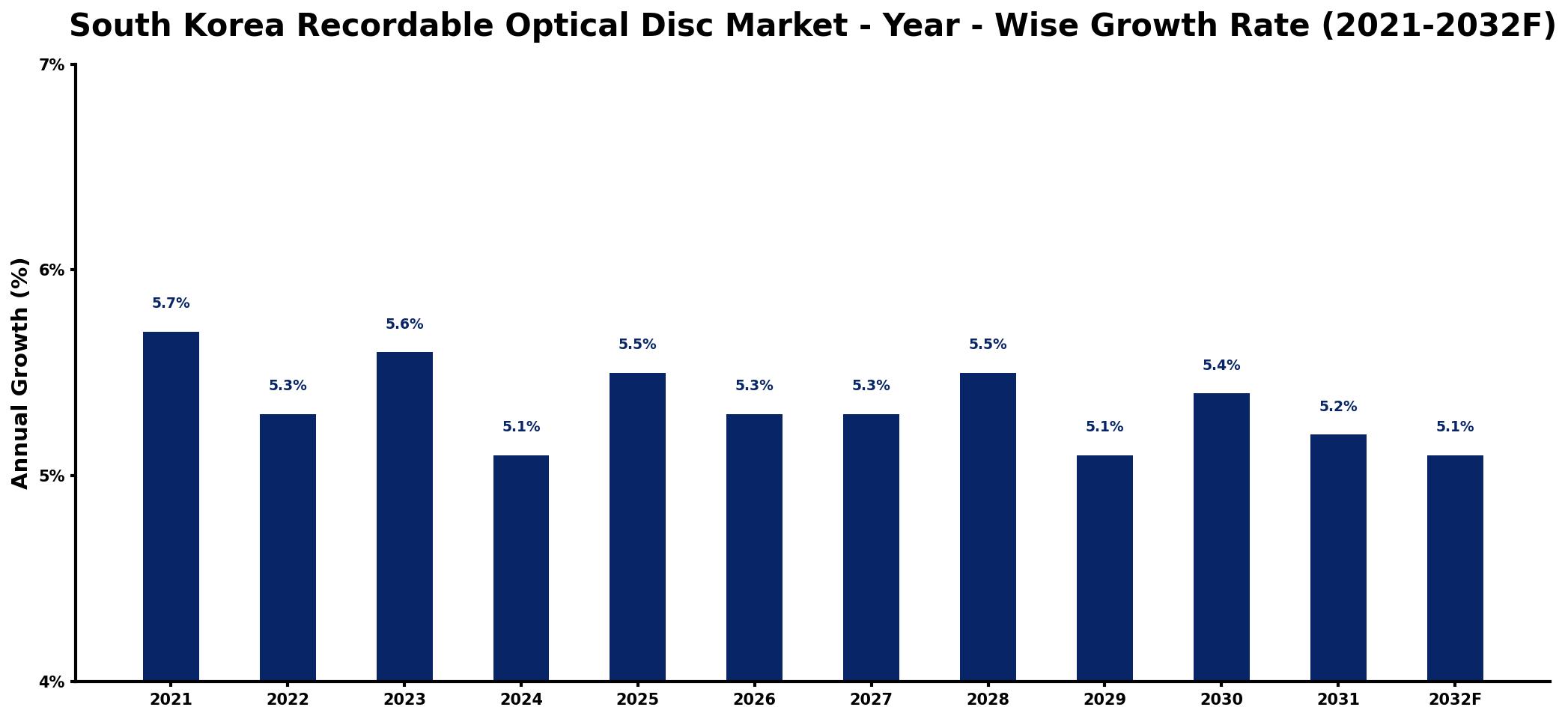
The table below presents the year‑wise growth rates along with the key drivers influencing the market
| Year | Growth Rate | Major Drivers |
| 2021 | 5.7% | Increased demand for data storage |
| 2022 | 5.3% | Growth in multimedia content production |
| 2023 | 5.6% | Expansion of home entertainment systems |
| 2024 | 5.1% | Rising interest in archival solutions |
| 2025 | 5.5% | Increased consumer electronics investments |
| 2026 | 5.3% | Surge in digital media consumption |
| 2027 | 5.3% | rising procurement volume requirements |
| 2028 | 5.5% | increased domestic production output |
| 2029 | 5.1% | Increased use in event recording |
| 2030 | 5.4% | enhanced product quality standards |
| 2031 | 5.2% | Rising demand for media preservation |
| 2032 | 5.1% | growing commercial sector adoption |
Note: Market size estimations and growth projections presented in this report are based on 6Wresearch's proprietary forecasting methodology, utilizing the latest available industry data, government publications, and primary research inputs.
South Korea Recordable Optical Disc Market Synopsis
A significant portion of the demand for recordable optical discs in South Korea stems from the need for secure data storage options. Many businesses and institutions prefer optical discs for backup and archiving due to their durability and long-term data retention capabilities. This has kept production levels stable, as manufacturers cater to niche markets that value these qualities.
Moreover, regulatory frameworks and intellectual property protections in South Korea further bolster the market by encouraging the legitimate use of optical media. These laws protect against piracy, ensuring that content creators are supported, thus driving the demand for legal distribution of media in the form of recordable optical discs.
South Korea Recordable Optical Disc Market Key Takeaways
- The market is projected to experience growth despite the rise of digital alternatives, driven by strong industry demand.
- Physical media remains preferred in sectors such as healthcare and education for data security and long-term archival needs.
- Government measures against piracy support the legitimacy and ongoing relevance of the optical disc market.
- The adaptability of manufacturers to niche applications presents opportunities for sustainable market growth.
- Investments in eco-friendly production methods will likely become increasingly important amidst environmental concerns.
Evaluation of Restraints in South Korea Recordable Optical Disc Market
The South Korea Recordable Optical Disc Market faces significant constraints primarily due to the global shift toward digital consumption. As consumers increasingly gravitate toward streaming services and cloud storage options, manufacturers encounter a shrinking customer base for physical media. This trend complicates pricing strategies and impacts profitability, as maintaining production efficiency becomes more critical in a declining market. Additionally, evolving technologies may lead to obsolescence concerns among potential buyers, necessitating innovative approaches to retain relevance.
South Korea Recordable Optical Disc Market Trends
Current trends indicate a burgeoning interest in hybrid storage solutions, where optical discs are used in conjunction with digital storage systems for enhanced data security. This hybrid approach caters to industries requiring redundancy in data storage while allowing for the seamless integration of both physical and digital platforms. Moreover, advancements in disc technology are improving capacity and durability, which may reignite interest among tech-savvy consumers.
Furthermore, the rise of personalization in media consumption is giving way to customized optical discs for individual or promotional use, making them appealing for small businesses and special events. This trend underscores a potential pivot in marketing strategies, allowing manufacturers to tap into the growing demand for unique media offerings.
South Korea Recordable Optical Disc Market Opportunities
There are compelling growth opportunities in the market as industries seek reliable data storage solutions. Companies focusing on archival storage services can leverage the durability and reliability of recordable optical discs to cater to businesses that must comply with stringent data retention regulations. Additionally, as educational institutions continue to adapt to digital methodologies, there may be an increased demand for optical discs that serve as a transitional medium for learning materials.
Investment in environmentally friendly production processes also presents a vital opportunity. As sustainability becomes a growing concern for consumers, manufacturers adopting green practices may gain a competitive edge while contributing positively to environmental stewardship.
Government Initiatives in the South Korea Recordable Optical Disc Market
The South Korean government actively implements policies aimed at protecting intellectual property and combating piracy, thereby promoting a safe environment for the recordable optical disc market. By enforcing strict anti-piracy measures, the government supports legitimate businesses and encourages the production of optical media. Moreover, initiatives targeting environmentally sustainable manufacturing practices provide an added layer of regulatory support, fostering innovation within the industry.
Future Insights of the South Korea Recordable Optical Disc Market
Looking ahead to 2026-2032, the South Korea Recordable Optical Disc Market is poised for a period of cautious optimism. The projected growth of 4.5% CAGR indicates resilience, fueled by niche demand and the application of new technologies. As industries increasingly recognize the importance of data preservation, optical discs will likely remain an essential component of long-term storage strategies. Collaborative efforts between manufacturers and content creators will be crucial to adapt to evolving market needs and consumer preferences.
South Korea Recordable Optical Disc Market Latest Developments (2025 - 2026)
Recent developments in the South Korean recordable optical disc market showcase a renewed focus on enhancing product innovation and environmental sustainability. Companies are exploring advanced manufacturing techniques that minimize waste and promote eco-friendly materials. Additionally, collaborative initiatives between educational institutions and media producers aim to develop tailored optical disc solutions, thus addressing the specific needs of students and educators alike. This alignment with market demands demonstrates a strategic shift toward preserving the relevance of optical media in an increasingly digital landscape.
South Korea Recordable Optical Disc Market - Key Attractiveness of the Report
- 10 Years of Market Numbers
- Historical Data Starting from 2022 to 2025
- Base Year: 2025
- Forecast Data until 2032
- Key Performance Indicators Impacting the Market
- Major Upcoming Developments and Projects
Key Highlights of the Report:
- South Korea Recordable Optical Disc Market Outlook
- Market Size of South Korea Recordable Optical Disc Market, 2025
- Forecast of South Korea Recordable Optical Disc Market, 2032
- Historical Data and Forecast of South Korea Recordable Optical Disc Revenues & Volume for the Period 2022-2032F
- South Korea Recordable Optical Disc Market Trend Evolution
- South Korea Recordable Optical Disc Market Drivers and Challenges
- South Korea Recordable Optical Disc Price Trends
- South Korea Recordable Optical Disc Porter's Five Forces
- South Korea Recordable Optical Disc Industry Life Cycle
- Historical Data and Forecast of South Korea Recordable Optical Disc Market Revenues & Volume By Product Type for the Period 2022-2032F
- Historical Data and Forecast of South Korea Recordable Optical Disc Market Revenues & Volume By Compact Discs (CD) for the Period 2022-2032F
- Historical Data and Forecast of South Korea Recordable Optical Disc Market Revenues & Volume By Digital Versatile Discs (DVD) for the Period 2022-2032F
- Historical Data and Forecast of South Korea Recordable Optical Disc Market Revenues & Volume By Sales Channel for the Period 2022-2032F
- Historical Data and Forecast of South Korea Recordable Optical Disc Market Revenues & Volume By Online Sales of Recordable Optical Discs for the Period 2022-2032F
- Historical Data and Forecast of South Korea Recordable Optical Disc Market Revenues & Volume By Offline Sales of Recordable Optical Discs for the Period 2022-2032F
- Historical Data and Forecast of South Korea Recordable Optical Disc Market Revenues & Volume By Sales of Recordable Optical Discs by Distributors for the Period 2022-2032F
- Historical Data and Forecast of South Korea Recordable Optical Disc Market Revenues & Volume By Sales of Recordable Optical Discs by Resellers for the Period 2022-2032F
- Historical Data and Forecast of South Korea Recordable Optical Disc Market Revenues & Volume By Direct Sales of Sales of Recordable Optical Discs for the Period 2022-2032F
- Historical Data and Forecast of South Korea Recordable Optical Disc Market Revenues & Volume By End Use for the Period 2022-2032F
- Historical Data and Forecast of South Korea Recordable Optical Disc Market Revenues & Volume By Consumers for the Period 2022-2032F
- Historical Data and Forecast of South Korea Recordable Optical Disc Market Revenues & Volume By Professionals for the Period 2022-2032F
- Historical Data and Forecast of South Korea Recordable Optical Disc Market Revenues & Volume By Storage Capacity for the Period 2022-2032F
- Historical Data and Forecast of South Korea Recordable Optical Disc Market Revenues & Volume By Below 5GB Recordable Optical Discs for the Period 2022-2032F
- Historical Data and Forecast of South Korea Recordable Optical Disc Market Revenues & Volume By 5-10 GB Recordable Optical Discs for the Period 2022-2032F
- Historical Data and Forecast of South Korea Recordable Optical Disc Market Revenues & Volume By Above 10 GB Recordable Optical Discs for the Period 2022-2032F
- South Korea Recordable Optical Disc Import Export Trade Statistics
- Market Opportunity Assessment By Product Type
- Market Opportunity Assessment By Sales Channel
- Market Opportunity Assessment By End Use
- Market Opportunity Assessment By Storage Capacity
- South Korea Recordable Optical Disc Top Companies Market Share
- South Korea Recordable Optical Disc Competitive Benchmarking By Technical and Operational Parameters
- South Korea Recordable Optical Disc Company Profiles
- South Korea Recordable Optical Disc Key Strategic Recommendations






































