South Korea Remote Control Products Hobby Market Size, Share & Growth Rate
The South Korea Remote Control Products Hobby Market was estimated at USD 199 Million in 2025 and is projected to reach USD 267 Million by 2032, growing at a CAGR of 4.3% from 2026 to 2032. This growth is fueled by a burgeoning interest in advanced remote-controlled technologies, particularly among younger demographics who are increasingly drawn to high-tech features in drones and customizable vehicles. Furthermore, the strong presence of hobbyist communities in South Korea plays a significant role in propelling the market, with consumers seeking superior performance and innovative designs.
South Korea Remote Control Products Hobby Market Year-wise Growth Rate and Key Drivers
This graph highlights how the South Korea Remote Control Products Hobby Market has steadily grown over the years, supported by major growth factors.
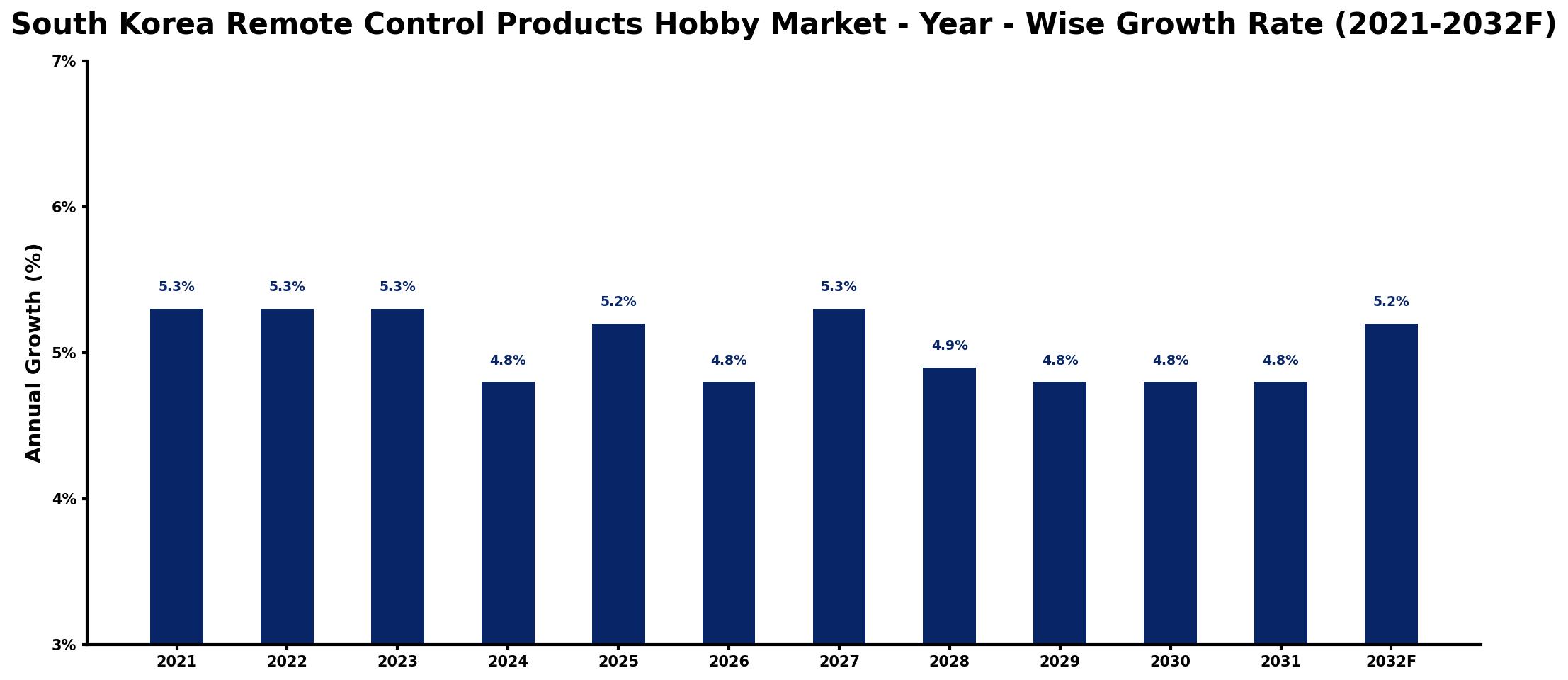
The table below presents the year‑wise growth rates along with the key drivers influencing the market
| Year | Growth Rate | Major Drivers |
| 2021 | 5.3% | Increased consumer interest in technology |
| 2022 | 5.3% | Expansion of online retail channels |
| 2023 | 5.3% | Growth in leisure activity participation |
| 2024 | 4.8% | Rise in disposable income levels |
| 2025 | 5.2% | Emergence of new entertainment trends |
| 2026 | 4.8% | Technological advancements in innovation |
| 2027 | 5.3% | Increased investment in startups |
| 2028 | 4.9% | rising export shipment volumes |
| 2029 | 4.8% | Surge in social media influence |
| 2030 | 4.8% | Development of educational programs |
| 2031 | 4.8% | increased domestic production output |
| 2032 | 5.2% | Increase in collaborative partnerships |
Note: Market size estimations and growth projections presented in this report are based on 6Wresearch's proprietary forecasting methodology, utilizing the latest available industry data, government publications, and primary research inputs.
South Korea Remote Control Products Hobby Market Synopsis
Currently, the South Korea Remote Control Products Hobby Market is witnessing an unprecedented surge, characterized by a diverse range of products that cater to various interests and skill levels. From high-speed racing drones equipped with 4K cameras to customizable RC cars, the market showcases a fusion of technology and creativity.
As consumers become more discerning, there is a marked shift towards eco-friendly options, with a growing preference for electric models over gas-powered counterparts. This transition reflects a broader trend towards sustainability, further driving innovation and competition within the market.
South Korea Remote Control Products Hobby Market Key Takeaways
- The market is experiencing steady growth, supported by advancements in technology and increasing consumer engagement.
- Hobbyist communities are becoming integral to market dynamics, facilitating knowledge sharing and fostering innovation.
- The shift towards electric-powered remote control vehicles is reshaping product offerings and consumer preferences.
- Online retail is emerging as a vital channel for distribution, catering to the demand for convenience among consumers.
- Investment in research and development is critical to meet the sophisticated demands of tech-savvy hobbyists.
Evaluation of Restraints in South Korea Remote Control Products Hobby Market
Despite its rapid growth, the South Korea Remote Control Products Hobby Market faces notable restraints. Intense competition from both local and international players places pressure on pricing and innovation. Moreover, rising import taxes can affect pricing strategies for foreign manufacturers. The complexity of regulatory compliance concerning safety standards also poses challenges for businesses, as companies must navigate a multifaceted landscape to remain compliant while fostering growth. Limited retail spaces further restrict physical market presence, compelling businesses to adapt their strategies.
South Korea Remote Control Products Hobby Market Trends
Several trends are currently shaping the South Korea Remote Control Products Hobby Market. First, high-speed racing drones equipped with advanced features are gaining traction among enthusiasts who prioritize performance and quality. Additionally, compact and portable remote-controlled vehicles are becoming increasingly popular, appealing to hobbyists with diverse lifestyles. Another emerging trend is the DIY remote control kits, which allow users to customize their vehicles, blending personal expression with technical skill.
South Korea Remote Control Products Hobby Market Opportunities
Investment opportunities abound in the South Korea Remote Control Products Hobby Market. Companies focusing on research and development can create innovative, high-quality products that cater to the evolving preferences of consumers. Furthermore, the online retail space is ripe for expansion, providing a convenient purchasing channel for hobbyists. Strategic partnerships with local distributors or manufacturers can help established brands and newcomers alike to solidify their presence in this competitive landscape.
Government Initiatives in the South Korea Remote Control Products Hobby Market
The South Korean government has implemented regulations to ensure consumer safety within the remote control products hobby market. The Ministry of Science and ICT oversees the certification process to maintain compliance with safety standards. Additionally, the government fosters innovation by supporting local manufacturers and encouraging the growth of the hobbyist community. Regulatory frameworks aim to balance consumer protection with market growth, ensuring the industry thrives in a responsible manner.
Future Insights of the South Korea Remote Control Products Hobby Market
The future of the South Korea Remote Control Products Hobby Market looks promising, driven by ongoing technological advancements and increasing disposable income levels. As the market continues to evolve, consumers will increasingly seek innovative products that offer enhanced features and functionalities. The rise of online communities and social media platforms will further cultivate interest and engagement, facilitating collaboration among hobbyists and stimulating demand. Overall, this market is poised for substantial growth and innovation, presenting significant opportunities for both established companies and new entrants.
South Korea Remote Control Products Hobby Market Latest Developments (2025 - 2026)
In recent months, the South Korea Remote Control Products Hobby Market has seen an influx of innovative products that leverage advanced technologies such as augmented reality and artificial intelligence. These developments are attracting a new generation of hobbyists eager for immersive experiences. Additionally, the online retail sector is witnessing increased investment, with platforms expanding their offerings to include a wider variety of remote control products. Hobbyist events and competitions are also gaining popularity, promoting community engagement and brand awareness.
South Korea Remote Control Products Hobby Market - Key Attractiveness of the Report
- 10 Years of Market Numbers
- Historical Data Starting from 2022 to 2025
- Base Year: 2025
- Forecast Data until 2032
- Key Performance Indicators Impacting the Market
- Major Upcoming Developments and Projects
Key Highlights of the Report:
- South Korea Remote Control Products Hobby Market Outlook
- Market Size of South Korea Remote Control Products Hobby Market, 2025
- Forecast of South Korea Remote Control Products Hobby Market, 2032
- Historical Data and Forecast of South Korea Remote Control Products Hobby Revenues & Volume for the Period 2022-2032F
- South Korea Remote Control Products Hobby Market Trend Evolution
- South Korea Remote Control Products Hobby Market Drivers and Challenges
- South Korea Remote Control Products Hobby Price Trends
- South Korea Remote Control Products Hobby Porter's Five Forces
- South Korea Remote Control Products Hobby Industry Life Cycle
- Historical Data and Forecast of South Korea Remote Control Products Hobby Market Revenues & Volume By Product Type for the Period 2022-2032F
- Historical Data and Forecast of South Korea Remote Control Products Hobby Market Revenues & Volume By Drones for the Period 2022-2032F
- Historical Data and Forecast of South Korea Remote Control Products Hobby Market Revenues & Volume By Airplanes for the Period 2022-2032F
- Historical Data and Forecast of South Korea Remote Control Products Hobby Market Revenues & Volume By Cars for the Period 2022-2032F
- Historical Data and Forecast of South Korea Remote Control Products Hobby Market Revenues & Volume By Trains for the Period 2022-2032F
- Historical Data and Forecast of South Korea Remote Control Products Hobby Market Revenues & Volume By Others for the Period 2022-2032F
- Historical Data and Forecast of South Korea Remote Control Products Hobby Market Revenues & Volume By Age Group Type for the Period 2022-2032F
- Historical Data and Forecast of South Korea Remote Control Products Hobby Market Revenues & Volume By Below 18 Years for the Period 2022-2032F
- Historical Data and Forecast of South Korea Remote Control Products Hobby Market Revenues & Volume By 18-35 Years for the Period 2022-2032F
- Historical Data and Forecast of South Korea Remote Control Products Hobby Market Revenues & Volume By 36-60 Years for the Period 2022-2032F
- Historical Data and Forecast of South Korea Remote Control Products Hobby Market Revenues & Volume By More Than 60 Years for the Period 2022-2032F
- Historical Data and Forecast of South Korea Remote Control Products Hobby Market Revenues & Volume By Distribution Channel Type for the Period 2022-2032F
- Historical Data and Forecast of South Korea Remote Control Products Hobby Market Revenues & Volume By Offline for the Period 2022-2032F
- Historical Data and Forecast of South Korea Remote Control Products Hobby Market Revenues & Volume By Online for the Period 2022-2032F
- Historical Data and Forecast of South Korea Remote Control Products Hobby Market Revenues & Volume By End Users for the Period 2022-2032F
- Historical Data and Forecast of South Korea Remote Control Products Hobby Market Revenues & Volume By Entertainment for the Period 2022-2032F
- Historical Data and Forecast of South Korea Remote Control Products Hobby Market Revenues & Volume By Professional Competition for the Period 2022-2032F
- Historical Data and Forecast of South Korea Remote Control Products Hobby Market Revenues & Volume By Others for the Period 2022-2032F
- South Korea Remote Control Products Hobby Import Export Trade Statistics
- Market Opportunity Assessment By Product Type
- Market Opportunity Assessment By Age Group Type
- Market Opportunity Assessment By Distribution Channel Type
- Market Opportunity Assessment By End Users
- South Korea Remote Control Products Hobby Top Companies Market Share
- South Korea Remote Control Products Hobby Competitive Benchmarking By Technical and Operational Parameters
- South Korea Remote Control Products Hobby Company Profiles
- South Korea Remote Control Products Hobby Key Strategic Recommendations






































