South Korea Rubber Vulcanization Market Size, Share & Growth Rate
The South Korea Rubber Vulcanization Market was estimated at USD 249 Million in 2025 and is projected to reach USD 329 Million by 2032, growing at a CAGR of 4.1% from 2026 to 2032. This growth trajectory is being significantly influenced by the robust demand from the automotive sector for high-quality and durable rubber products, particularly in applications such as tires and belts. Additionally, the push towards innovative vulcanization methods and sustainable practices is positioning local manufacturers to enhance their competitiveness and meet the evolving regulatory landscape.
South Korea Rubber Vulcanization Market Year-wise Growth Rate and Key Drivers
This graph highlights how the South Korea Rubber Vulcanization Market has steadily grown over the years, supported by major growth factors.
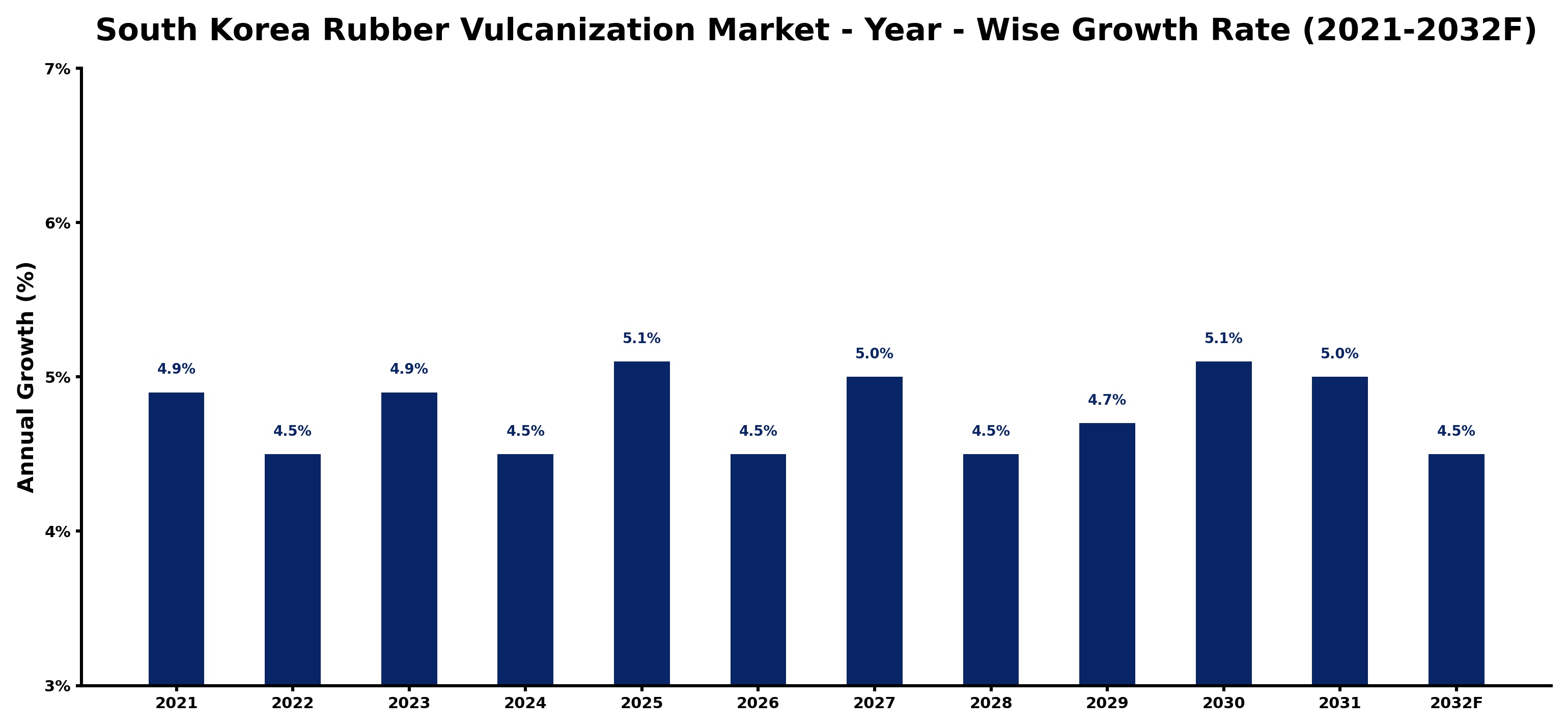
The table below presents the year‑wise growth rates along with the key drivers influencing the market
| Year | Growth Rate | Major Drivers |
| 2021 | 4.9% | Export driven automotive sector demand boosts rubber vulcanization capacity expansion |
| 2022 | 4.5% | Automotive sector recovery drives increased rubber component manufacturing demand |
| 2023 | 4.9% | Robust domestic automotive demand boosts rubber vulcanization production volumes |
| 2024 | 4.5% | New rubber production facilities boost vulcanization capacity significantly |
| 2025 | 5.1% | Technology integration in rubber processing enhanced product quality and output |
| 2026 | 4.5% | Strengthened rubber manufacturing capacities optimized vulcanization process efficiency |
| 2027 | 5.0% | Manufacturing investments in automation boost rubber vulcanization efficiency |
| 2028 | 4.5% | Automotive sector rebound spurred rubber product manufacturing investment |
| 2029 | 4.7% | Adoption of advanced machinery improved rubber processing efficiency |
| 2030 | 5.1% | Increased factory output rates boosted rubber vulcanization demand significantly |
| 2031 | 5.0% | OEM partnerships boosted demand for rubber vulcanization machinery upgrades |
| 2032 | 4.5% | Increased rubber processing capacity boosted vulcanization efficiency across facilities |
Note - Market size estimations and growth projections presented in this report are based on 6Wresearch's advanced forecasting approach, validated with industry datasets as of June 2026.
South Korea Rubber Vulcanization Market Synopsis
Demand for high-performance rubber products is particularly notable in South Korea's automotive sector, where vulcanization plays a critical role in ensuring product longevity and safety. The continuous integration of advanced technologies into the manufacturing processes is also helping local companies optimize their output quality and efficiency, which is crucial in maintaining competitiveness against international players.
Furthermore, there is an increasing shift among manufacturers towards environmentally friendly vulcanization processes. This trend not only aligns with global sustainability goals but also meets the growing consumer demand for eco-conscious products, reflecting a broader market transformation that emphasizes quality and responsibility.
South Korea Rubber Vulcanization Market Key Takeaways
- The market is experiencing steady growth due to increasing demand from the automotive industry.
- Innovation in vulcanization techniques is enhancing product quality and sustainability.
- Competition from imported rubber products poses challenges for local manufacturers.
- Government policies are supporting advancements in the rubber industry through incentives and regulations.
- Investment opportunities exist in providing new technologies and services to enhance manufacturing processes.
Evaluation of Restraints in South Korea Rubber Vulcanization Market
Despite the favorable growth outlook, the South Korea Rubber Vulcanization Market faces real constraints. Local manufacturers contend with fierce competition from cheaper imported rubber products, which threatens to erode market share and compel price adjustments. Moreover, compliance with stringent environmental regulations can necessitate significant investments in cleaner, eco-friendly technologies, adding further complexity to operational costs. Lastly, volatility in the pricing of raw materials, including rubber and various chemicals used in vulcanization, poses a financial challenge that can impact profitability margins.
South Korea Rubber Vulcanization Market Trends
Several current and emerging trends are shaping the South Korea Rubber Vulcanization Market. One notable trend is the rise in the adoption of sustainable practices, as companies increasingly seek to utilize eco-friendly vulcanization agents and processes. This shift is reinforced by consumer expectations and regulatory mandates for lower environmental impact. Additionally, the integration of automation and smart technologies into vulcanization processes is enhancing operational efficiency and product quality control. As the market evolves, innovative additives and advanced materials are also gaining traction, further improving the durability and performance of vulcanized products.
South Korea Rubber Vulcanization Market Opportunities
The South Korea Rubber Vulcanization Market presents several genuine growth and investment opportunities. As the automotive and manufacturing sectors expand, there is an increasing demand for high-performance rubber products, which paves the way for advanced vulcanization technologies. Investors can capitalize on this demand by supplying state-of-the-art vulcanization equipment and chemicals, as well as services tailored to improve efficiency. Furthermore, collaborating with established local companies to innovate and customize solutions can create lucrative avenues for growth. Overall, the evolving landscape of the market offers promising potential for stakeholders willing to engage with its dynamics.
Government Initiatives in the South Korea Rubber Vulcanization Market
The South Korean government has taken proactive steps to bolster the rubber vulcanization market through various initiatives. These include significant support for research and development aimed at enhancing product quality and technological innovation. Environmental sustainability is also a focal point, with regulations in place to ensure adherence to safety and eco-friendly standards within the industry. Furthermore, the government provides incentives and subsidies designed to encourage companies in the rubber vulcanization market to invest in growth and improve their competitive edge.
Future Insights of the South Korea Rubber Vulcanization Market
Looking ahead to 2026-2032, the South Korea Rubber Vulcanization Market appears poised for promising developments driven by the escalating demand for rubber products across diverse sectors, including automotive, construction, and healthcare. The market is anticipated to benefit from ongoing technological advancements in rubber processing, coupled with a heightened focus on sustainability. With government support promoting innovation and competitiveness, South Korea is likely to strengthen its position as a significant player in the global rubber vulcanization market, inviting further investments and long-term growth opportunities.
South Korea Rubber Vulcanization Market Latest Developments (May 2025 - June 2026)
In recent months, the South Korea Rubber Vulcanization Market has been directed towards innovation, particularly in adopting new sustainable practices. Companies are investing in research to explore advanced vulcanization techniques that utilize environmentally friendly materials. Additionally, there has been a notable shift towards automation, with manufacturers integrating smart technologies to enhance production efficiency. This focus on innovation reflects the market's commitment to improving quality while addressing both consumer and regulatory demands.
South Korea Rubber Vulcanization Market - Key Attractiveness of the Report
- 10 Years of Market Numbers
- Historical Data Starting from 2022 to 2025
- Base Year: 2025
- Forecast Data until 2032
- Key Performance Indicators Impacting the Market
- Major Upcoming Developments and Projects
Key Highlights of the Report:
- South Korea Rubber Vulcanization Market Outlook
- Market Size of South Korea Rubber Vulcanization Market, 2025
- Forecast of South Korea Rubber Vulcanization Market, 2032
- Historical Data and Forecast of South Korea Rubber Vulcanization Revenues & Volume for the Period 2022-2032F
- South Korea Rubber Vulcanization Market Trend Evolution
- South Korea Rubber Vulcanization Market Drivers and Challenges
- South Korea Rubber Vulcanization Price Trends
- South Korea Rubber Vulcanization Porter's Five Forces
- South Korea Rubber Vulcanization Industry Life Cycle
- Historical Data and Forecast of South Korea Rubber Vulcanization Market Revenues & Volume By Type for the Period 2022-2032F
- Historical Data and Forecast of South Korea Rubber Vulcanization Market Revenues & Volume By Accelerator for the Period 2022-2032F
- Historical Data and Forecast of South Korea Rubber Vulcanization Market Revenues & Volume By Vulcanizing Agent for the Period 2022-2032F
- Historical Data and Forecast of South Korea Rubber Vulcanization Market Revenues & Volume By Activator for the Period 2022-2032F
- Historical Data and Forecast of South Korea Rubber Vulcanization Market Revenues & Volume By Other for the Period 2022-2032F
- Historical Data and Forecast of South Korea Rubber Vulcanization Market Revenues & Volume By Application for the Period 2022-2032F
- Historical Data and Forecast of South Korea Rubber Vulcanization Market Revenues & Volume By Automotive for the Period 2022-2032F
- Historical Data and Forecast of South Korea Rubber Vulcanization Market Revenues & Volume By Medical for the Period 2022-2032F
- Historical Data and Forecast of South Korea Rubber Vulcanization Market Revenues & Volume By Industrial for the Period 2022-2032F
- Historical Data and Forecast of South Korea Rubber Vulcanization Market Revenues & Volume By Consumer Goods for the Period 2022-2032F
- Historical Data and Forecast of South Korea Rubber Vulcanization Market Revenues & Volume By Other for the Period 2022-2032F
- South Korea Rubber Vulcanization Import Export Trade Statistics
- Market Opportunity Assessment By Type
- Market Opportunity Assessment By Application
- South Korea Rubber Vulcanization Top Companies Market Share
- South Korea Rubber Vulcanization Competitive Benchmarking By Technical and Operational Parameters
- South Korea Rubber Vulcanization Company Profiles
- South Korea Rubber Vulcanization Key Strategic Recommendations






































