South Korea Sail Canvas Market Size, Share & Growth Rate
The South Korea Sail Canvas Market was estimated at USD 978 Million in 2025 and is projected to reach USD 1676 Million by 2032, growing at a CAGR of 8.0% from 2026 to 2032. This significant growth trajectory is fueled by the increasing popularity of recreational boating and marine activities along South Korea's extensive coastline. Furthermore, as outdoor lifestyles gain traction, the demand for high-performance, weather-resistant sail materials is on the rise, enhancing the overall market outlook.
South Korea Sail Canvas Market Year-wise Growth Rate and Key Drivers
This graph highlights how the South Korea Sail Canvas Market has steadily grown over the years, supported by major growth factors.
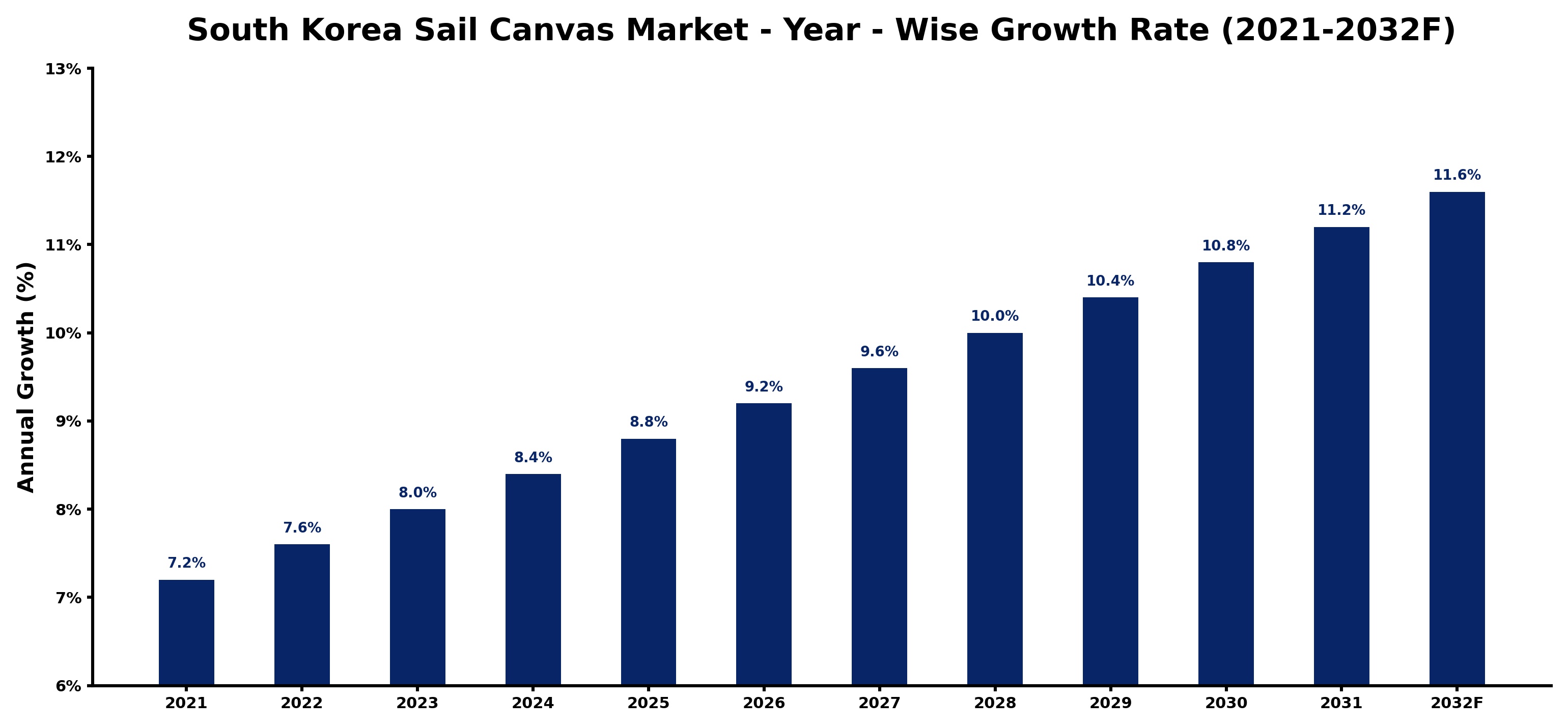
The table below presents the year‑wise growth rates along with the key drivers influencing the market
| Year | Growth Rate | Major Drivers |
| 2021 | 7.2% | Improved maritime infrastructure projects boosted sail canvas production capacity |
| 2022 | 7.6% | Domestic sail manufacturers adopt advanced textiles for lightweight designs |
| 2023 | 8.0% | Increased demand for marine vessels spurred sail canvas production growth |
| 2024 | 8.4% | Advanced materials research boosts sail canvas production capabilities |
| 2025 | 8.8% | Increased shipbuilding activities bolstered demand for specialized sail fabrics |
| 2026 | 9.2% | Export driven demand for marine applications boosted sail canvas production |
| 2027 | 9.6% | Domestic sail manufacturers boost production efficiency through automation investments |
| 2028 | 10.0% | Domestic boat manufacturing expansion drives sail canvas demand increase |
| 2029 | 10.4% | Sailboat production enhancements boosted demand for high performance sail fabrics |
| 2030 | 10.8% | Advancements in sail production technology boost export capabilities significantly |
| 2031 | 11.2% | Technology adoption in sail production enhanced material durability and performance |
| 2032 | 11.6% | Domestic sail manufacturers ramped up production to meet export demands |
Note - Market size estimations and growth projections presented in this report are based on 6Wresearch's advanced forecasting approach, validated with industry datasets as of June 2026.
South Korea Sail Canvas Market Synopsis
In South Korea, the sail canvas market is uniquely positioned to benefit from the country's burgeoning marine infrastructure and the rising number of sailing enthusiasts. The integration of innovative textile technologies is fostering the development of eco-friendly, lightweight materials that cater to both performance and environmental sustainability.
As the outdoor recreation industry expands, manufacturers are increasingly focusing on producing high-quality fabrics that meet stringent industry standards. The adoption of advanced waterproofing and UV-resistant properties is becoming imperative for sail canvas producers to remain competitive in this evolving landscape.
South Korea Sail Canvas Market Key Takeaways
- The market is driven by the growth of the marine and outdoor recreation industries.
- High-performance materials with enhanced durability and eco-friendliness are in demand.
- Innovations in textile technology are crucial for maintaining market competitiveness.
- Government initiatives aim to support sustainable practices in sail canvas manufacturing.
- Emerging trends highlight a shift towards lightweight materials in sail production.
Evaluation of Restraints in South Korea Sail Canvas Market
Despite its growth potential, the South Korea Sail Canvas Market faces specific constraints that can hinder progress. The need for continuous material innovation is paramount, as manufacturers must adapt to the increasing preference for lightweight and eco-friendly alternatives over traditional canvas. This shift poses challenges for existing manufacturers, who must invest in new technologies to compete with the rising popularity of synthetic and laminated materials. Furthermore, the increasing competition in global markets pressures local producers to enhance their value proposition, thereby adding complexity to their operational strategies.
South Korea Sail Canvas Market Trends
Current trends in the South Korea Sail Canvas Market showcase a growing inclination towards sustainability. Manufacturers are prioritizing eco-friendly materials that align with consumer expectations for environmental responsibility. Additionally, advancements in textile technology are leading to the development of multifunctional fabrics that provide enhanced performance, such as improved breathability and weather resistance. As outdoor activities gain further popularity, the integration of smart textiles, which can adapt to changing conditions, is emerging as a focal point for innovation.
South Korea Sail Canvas Market Opportunities
The South Korea Sail Canvas Market presents numerous growth opportunities, particularly through collaborations with sailmakers and yacht designers to tailor products for specific applications. Expansion into emerging markets within the region, coupled with investment in advanced textile research, can provide manufacturers with a competitive edge. Furthermore, increasing participation in international sailing events and competitions is likely to spur demand for high-quality sail materials, opening additional revenue streams for producers.
Government Initiatives in the South Korea Sail Canvas Market
The South Korean government is actively supporting the maritime and outdoor recreation industries through various initiatives. These include setting standards for sail canvas materials, promoting eco-friendly practices, and providing incentives for manufacturers to adopt sustainable production processes. Additionally, the government is focused on enhancing market access for domestic producers through export promotion strategies, ensuring that local businesses can compete effectively on the global stage.
Future Insights of the South Korea Sail Canvas Market
Looking ahead to 2026-2032, the South Korea Sail Canvas Market is expected to continue its upward trajectory, driven by an increasingly engaged boating community and an expanding outdoor lifestyle demographic. Technological advancements in fabric development will likely play a critical role in shaping the market, enabling manufacturers to meet evolving consumer demands. As environmental considerations become more prominent, companies that invest in sustainable practices will be better positioned to capture market share and secure long-term success.
South Korea Sail Canvas Market Latest Developments (May 2025 - June 2026)
Recent developments within the South Korea Sail Canvas Market indicate a shift towards more innovative textile solutions. Manufacturers are increasingly focused on integrating smart technology into their fabrics, enhancing both functionality and consumer appeal. Additionally, industry stakeholders are collaborating to explore new sustainable materials that can replace traditional options, fostering an environment of growth and adaptation. This proactive approach is expected to strengthen South Korea's position in the competitive global sail canvas arena.
South Korea Sail Canvas Market - Key Attractiveness of the Report
- 10 Years of Market Numbers
- Historical Data Starting from 2022 to 2025
- Base Year: 2025
- Forecast Data until 2032
- Key Performance Indicators Impacting the Market
- Major Upcoming Developments and Projects
Key Highlights of the Report:
- South Korea Sail Canvas Market Outlook
- Market Size of South Korea Sail Canvas Market, 2025
- Forecast of South Korea Sail Canvas Market, 2032
- Historical Data and Forecast of South Korea Sail Canvas Revenues & Volume for the Period 2022-2032F
- South Korea Sail Canvas Market Trend Evolution
- South Korea Sail Canvas Market Drivers and Challenges
- South Korea Sail Canvas Price Trends
- South Korea Sail Canvas Porter's Five Forces
- South Korea Sail Canvas Industry Life Cycle
- Historical Data and Forecast of South Korea Sail Canvas Market Revenues & Volume By Type for the Period 2022-2032F
- Historical Data and Forecast of South Korea Sail Canvas Market Revenues & Volume By 8 Ann Canvas for the Period 2022-2032F
- Historical Data and Forecast of South Korea Sail Canvas Market Revenues & Volume By 12 Ann Canvas for the Period 2022-2032F
- Historical Data and Forecast of South Korea Sail Canvas Market Revenues & Volume By Polyester Canvas for the Period 2022-2032F
- Historical Data and Forecast of South Korea Sail Canvas Market Revenues & Volume By Others for the Period 2022-2032F
- Historical Data and Forecast of South Korea Sail Canvas Market Revenues & Volume By Application for the Period 2022-2032F
- Historical Data and Forecast of South Korea Sail Canvas Market Revenues & Volume By Sailing for the Period 2022-2032F
- Historical Data and Forecast of South Korea Sail Canvas Market Revenues & Volume By Yacht for the Period 2022-2032F
- Historical Data and Forecast of South Korea Sail Canvas Market Revenues & Volume By Others for the Period 2022-2032F
- South Korea Sail Canvas Import Export Trade Statistics
- Market Opportunity Assessment By Type
- Market Opportunity Assessment By Application
- South Korea Sail Canvas Top Companies Market Share
- South Korea Sail Canvas Competitive Benchmarking By Technical and Operational Parameters
- South Korea Sail Canvas Company Profiles
- South Korea Sail Canvas Key Strategic Recommendations






































