South Korea Scissors and Shears Market Summary
The south korea scissors and shears market was estimated at USD 153 Million in 2025 and is projected to reach USD 206 Million by 2032, growing at a CAGR of 4.8% from 2026 to 2032.
South Korea Scissors and Shears Market Year-wise Growth Rate and Key Drivers
This graph highlights how the South Korea Scissors and Shears Market has steadily grown over the past five years, supported by major growth factors.
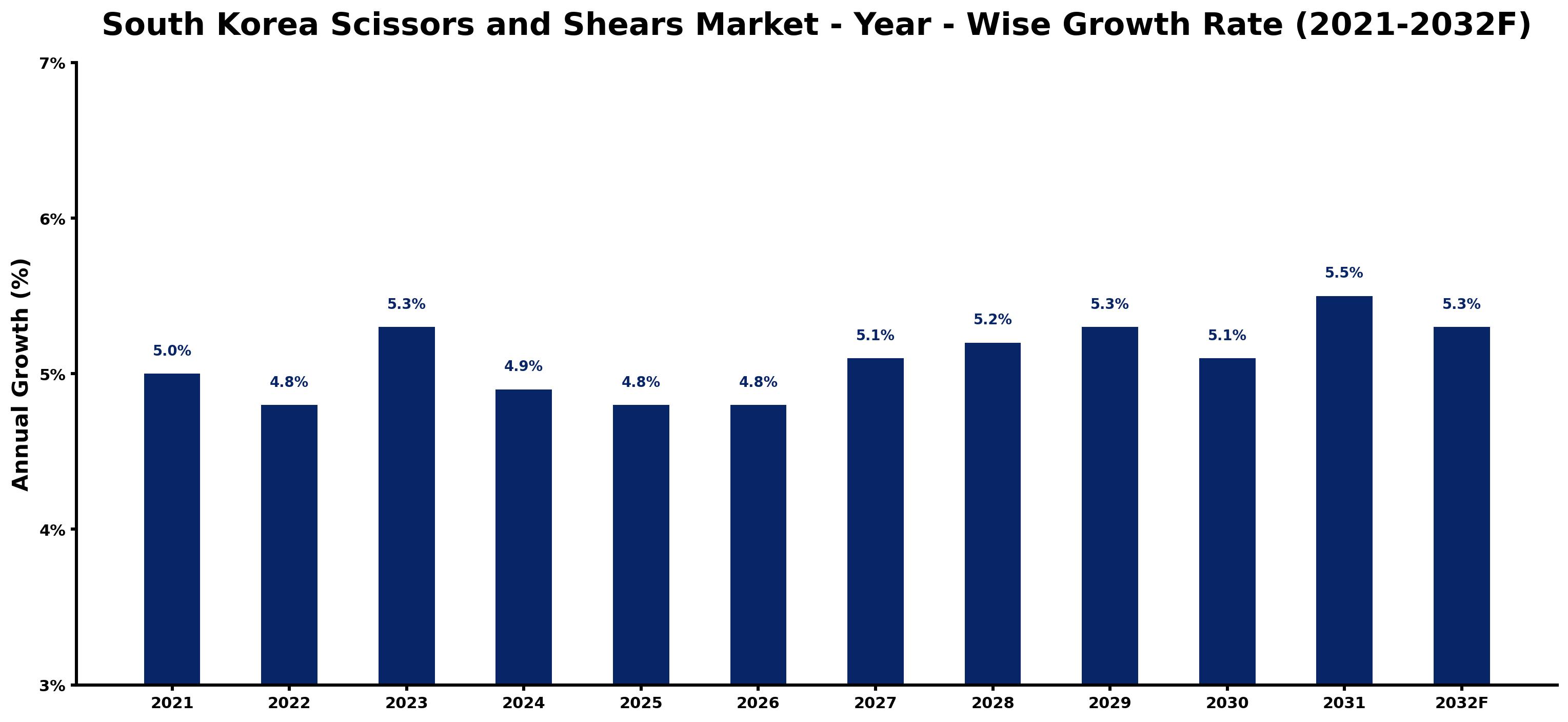
The table below presents the year wise growth rates along with the key drivers influencing the market
| Year | Growth Rate | Major Drivers |
| 2021 | 5.0% | Post-lockdown retail projects sparked interest in home and professional grooming tools. |
| 2022 | 4.8% | Innovative designs in scissors attracted attention from both hobbyists and professionals. |
| 2023 | 5.3% | The shift towards sustainable materials boosted eco-friendly shear production and sales. |
| 2024 | 4.9% | Increased DIY trends influenced consumer spending on high-quality scissor brands. |
| 2025 | 4.8% | Enhanced online shopping platforms made specialized scissors more accessible to consumers. |
| 2026 | 4.8% | Collaborations with fashion designers expanded the visibility of premium shear collections. |
| 2027 | 5.1% | Education and training programs for stylists emphasized the importance of quality tools. |
| 2028 | 5.2% | Emerging Korean beauty trends prompted demand for specialized cutting instruments. |
| 2029 | 5.3% | Investments in local manufacturing capabilities reduced reliance on imported shear products. |
| 2030 | 5.1% | Technological upgrades in production enhanced the durability and precision of scissors. |
| 2031 | 5.5% | Cultural emphasis on craftsmanship increased appreciation for artisanal scissor brands globally. |
| 2032 | 5.3% | Market diversification strategies are set to enhance product offerings for niche segments. |
Note - Market size estimations and growth projections presented in this report are based on 6Wresearch's advanced forecasting approach, validated with industry datasets as of June 2026.
South Korea Scissors and Shears Market Synopsis
The South Korea Scissors and Shears Market is projected to reach 4.8% and witness significant growth during the forecast period (2026-2032). This growth is driven by various factors including increasing demand for hairdressing tools, the necessity for high-quality cutting instruments across diverse industries such as manufacturing and healthcare, as well as the rising disposable incomes among South Korean households. The trend toward personal grooming is expected to further enhance market dynamics, leading to increased consumption of premium-grade scissors and shears.
South Korea Scissors and Shears Market Growth Drivers
The expansion of the South Korea Scissors and Shears Market can be attributed to several key growth drivers:
- The rising popularity of hairdressing services has led to higher demand for professional-grade scissors and shears, facilitating advancements in design and functionality.
- Increased disposable income has allowed consumers to purchase high-quality cutting tools for personal grooming, creating a shift towards premium products in the market.
- Technological advancements such as the introduction of electric trimmers have contributed to consumer preference for convenient grooming solutions, positively influencing scissors and shears sales.
- The growth of the medical sector, which requires precision cutting tools for surgical and other medical applications, further stimulates demand for high-quality scissors and shears.
- Innovation in product design focusing on ergonomics and user-friendliness enhances the overall consumer experience, encouraging repeat purchases.
South Korea Scissors and Shears Market Trends and Opportunities
Current trends within the South Korea Scissors and Shears Market reflect a broader acceptance and demand for innovative and advanced tools. Key opportunities include:
- The rise of online retail platforms is making it easier for consumers to access a wider range of scissors and shears, thus broadening market reach.
- There is an increasing trend towards sustainable and environmentally friendly products, creating an opportunity for manufacturers to introduce eco-conscious cutting tools.
- With the escalating popularity of DIY grooming, particularly during the pandemic, consumers are investing in home grooming tools, including scissors and shears, fostering market growth.
- Personal grooming trends in male demographics have seen significant growth, opening avenues for specialized products catering to this segment.
- Collaborations between manufacturers and designers to develop limited-edition products can attract attention and invigorate brand loyalty.
South Korea Scissors and Shears Market Challenges and Restraints
Despite the promising growth prospects, several challenges could impede the South Korea Scissors and Shears Market:
- The market may be affected by fluctuations in raw material prices, which could lead to increased production costs and impact pricing strategies.
- Increased competition from low-cost imports may challenge local manufacturers, particularly those focused on premium products.
- Consumer familiarity with established brands may pose a barrier to entry for new companies attempting to capture market share.
- Economic downturns and reduced consumer spending can lead to lower demand for non-essential grooming tools.
- Rapidly changing consumer preferences necessitate continuous market research, which can strain resources for firms attempting to keep up with trends.
South Korea Scissors and Shears Market Government Investment and Initiatives
The South Korean government has recognized the importance of supporting the manufacturing sector, including the production of scissors and shears. Various initiatives aim to boost research and development in this industry, encouraging innovation and technological advancements. Additionally, investments in vocational training for hairdressers and artisans foster a skilled workforce, ensuring that high-quality tools are utilized. Public spending on healthcare also contributes to the demand for surgical scissors, highlighting the interconnection between government initiatives and market growth. Furthermore, initiatives promoting eco-friendly products align with global trends toward sustainability, offering manufacturers an opportunity to innovate while benefiting from government support.
South Korea Scissors and Shears Market Latest Developments (May 2025 - June 2026)
Recent developments in the South Korea Scissors and Shears Market indicate a growing focus on integrating advanced technology into cutting tools. Manufacturers are increasingly employing smart technologies, including Bluetooth capabilities and ergonomic designs, to enhance user experience. In addition, there has been a marked increase in the variety of available products, driven by consumer preference for customization. Furthermore, significant market players are placing emphasis on online sales channels, allowing for a more streamlined purchasing experience for consumers. The trend of DIY grooming continues to rise, leading to an uptick in retail sales of both professional-grade and consumer-grade scissors and shears. Market sentiment remains optimistic, fueled by consumer trends favoring quality and performance.
South Korea Scissors and Shears Market - Key Attractiveness of the Report
- 10 Years of Market Numbers
- Historical Data Starting from 2022 to 2025
- Base Year: 2025
- Forecast Data until 2032
- Key Performance Indicators Impacting the Market
- Major Upcoming Developments and Projects
Key Highlights of the Report:
- South Korea Scissors and Shears Market Outlook
- Market Size of South Korea Scissors and Shears Market, 2025
- Forecast of South Korea Scissors and Shears Market, 2032F
- Historical Data and Forecast of South Korea Scissors and Shears Revenues & Volume for the Period 2022-2032F
- South Korea Scissors and Shears Market Trend Evolution
- South Korea Scissors and Shears Market Drivers and Challenges
- South Korea Scissors and Shears Price Trends
- South Korea Scissors and Shears Porter's Five Forces
- South Korea Scissors and Shears Industry Life Cycle
- Historical Data and Forecast of South Korea Scissors and Shears Market Revenues & Volume By Type for the Period 2022-2032F
- Historical Data and Forecast of South Korea Scissors and Shears Market Revenues & Volume By Scissors for the Period 2022-2032F
- Historical Data and Forecast of South Korea Scissors and Shears Market Revenues & Volume By Shears for the Period 2022-2032F
- Historical Data and Forecast of South Korea Scissors and Shears Market Revenues & Volume By Application for the Period 2022-2032F
- Historical Data and Forecast of South Korea Scissors and Shears Market Revenues & Volume By Residential for the Period 2022-2032F
- Historical Data and Forecast of South Korea Scissors and Shears Market Revenues & Volume By Non-Residential for the Period 2022-2032F
- South Korea Scissors and Shears Import Export Trade Statistics
- Market Opportunity Assessment By Type
- Market Opportunity Assessment By Application
- South Korea Scissors and Shears Top Companies Market Share
- South Korea Scissors and Shears Competitive Benchmarking By Technical and Operational Parameters
- South Korea Scissors and Shears Company Profiles
- South Korea Scissors and Shears Key Strategic Recommendations






































