South Korea Semiconductor Foundry Market Size, Share & Growth Rate
The South Korea Semiconductor Foundry Market was estimated at USD 163 Million in 2025 and is projected to reach USD 215 Million by 2032, growing at a CAGR of 4.0% from 2026 to 2032. This growth trajectory is largely propelled by the increasing demand for advanced semiconductor solutions across key sectors, including consumer electronics and automotive applications. The market's momentum is supported by South Korea's commitment to innovation, with significant investments in R&D and the adoption of next-generation manufacturing technologies.
South Korea Semiconductor Foundry Market Year-wise Growth Rate and Key Drivers
This graph highlights how the South Korea Semiconductor Foundry Market has steadily grown over the years, supported by major growth factors.
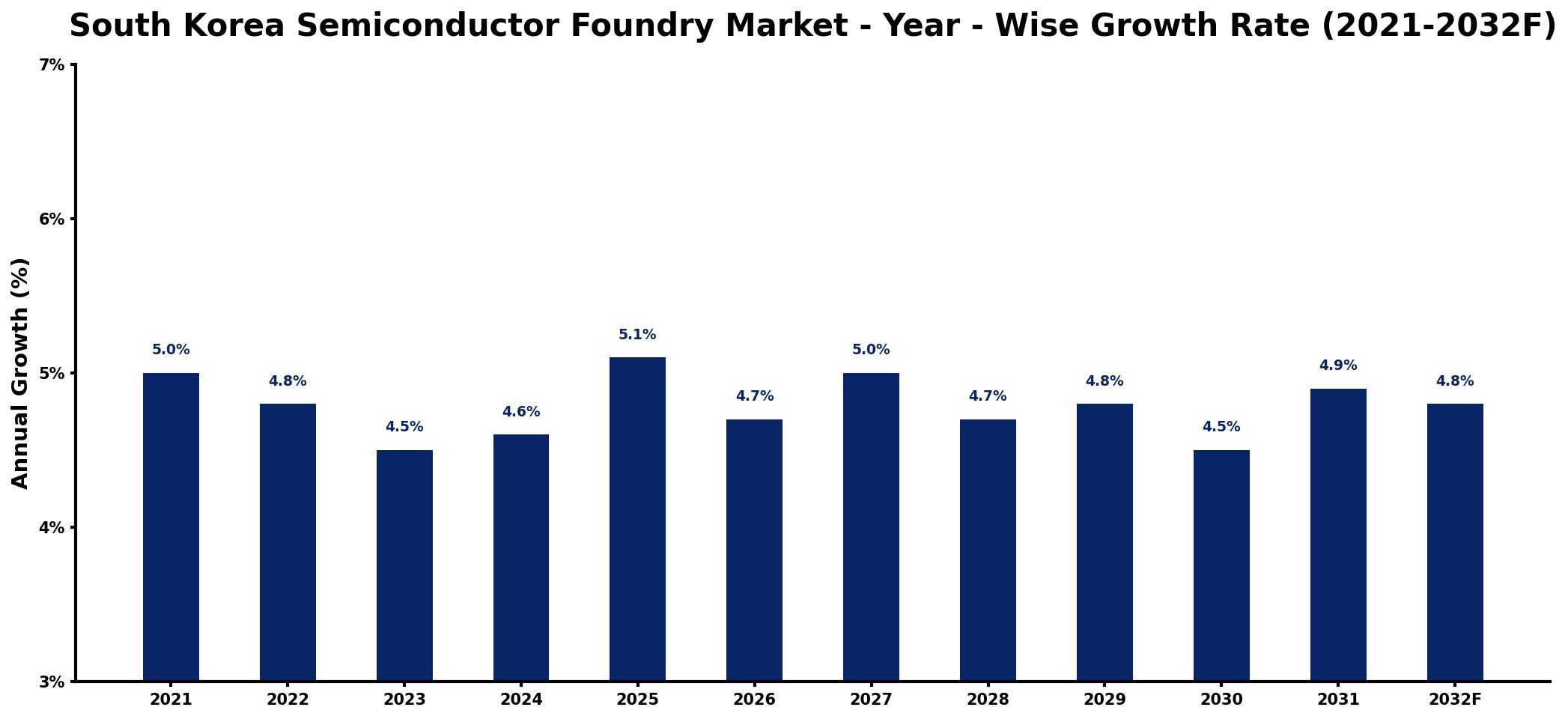
The table below presents the year‑wise growth rates along with the key drivers influencing the market
| Year | Growth Rate | Major Drivers |
| 2021 | 5.0% | Rising demand for consumer electronics |
| 2022 | 4.8% | Increased investment in technology infrastructure |
| 2023 | 4.5% | Expansion of automotive electronics market |
| 2024 | 4.6% | Growth in artificial intelligence applications |
| 2025 | 5.1% | Surge in 5G network deployment |
| 2026 | 4.7% | Growing presence of IoT devices |
| 2027 | 5.0% | Demand for high-performance computing |
| 2028 | 4.7% | Investments in renewable energy solutions |
| 2029 | 4.8% | Advancements in mobile communication technology |
| 2030 | 4.5% | Rising adoption of edge computing |
| 2031 | 4.9% | Emerging trends in wearable technology |
| 2032 | 4.8% | Increase in cloud computing services |
Note: Market size estimations and growth projections presented in this report are based on 6Wresearch's proprietary forecasting methodology, utilizing the latest available industry data, government publications, and primary research inputs.
South Korea Semiconductor Foundry Market Synopsis
Recent years have seen the South Korea Semiconductor Foundry Market gain substantial traction, underpinned by robust technological advancements and rising global demand. Moving forward, the market is positioned to benefit from accelerating trends in miniaturization, efficiency, and the integration of next-generation technologies like AI and IoT.
As the industry evolves, South Korea's foundries are reinforcing their competitive edge through enhanced manufacturing capabilities and strategic partnerships. This forward momentum is crucial, given the competitive landscape that includes emerging players from other regions, particularly Taiwan and China.
South Korea Semiconductor Foundry Market Key Takeaways
- The market is expected to grow steadily, driven by technological advancements and industry demand.
- Research and development investments are crucial for maintaining competitiveness in an evolving landscape.
- Key sectors driving demand include electronics, automotive, and telecommunications.
- Government support plays a significant role in enhancing market growth and stability.
- The introduction of innovative processes, such as EUV lithography, is setting new benchmarks for performance.
Evaluation of Restraints in South Korea Semiconductor Foundry Market
Despite its robust prospects, the South Korea Semiconductor Foundry Market faces several inherent challenges. The fierce competition from other semiconductor powerhouses, particularly in Asia, necessitates continuous innovation and investment in cutting-edge technologies. Foundries must also navigate fluctuations in global demand, which can lead to volatility in production and pricing strategies. Furthermore, the escalating costs associated with R&D and facility upgrades create additional pressure on profit margins, requiring strategic resource allocation to remain viable.
South Korea Semiconductor Foundry Market Trends
A noteworthy trend shaping the South Korea Semiconductor Foundry Market is the push towards smaller and more efficient semiconductor chips. This aligns with the global demand for high-performance computing and the burgeoning IoT ecosystem. Additionally, advanced packaging techniques are gaining traction, as they enhance chip performance while minimizing energy consumption. The integration of EUV lithography is another critical focus area, promising to revolutionize production capabilities and deliver unprecedented precision in chip manufacturing.
South Korea Semiconductor Foundry Market Opportunities
The market is ripe with investment opportunities, particularly in the context of emerging technologies. With the rise of 5G networks, AI applications, and smart technology innovations, demand for advanced semiconductor solutions is set to surge. Furthermore, the governments commitment to fostering the semiconductor sector through various incentives is creating an attractive landscape for both domestic and international investors. Establishing strategic alliances with tech companies can also amplify growth potential and drive innovation.
Government Initiatives in the South Korea Semiconductor Foundry Market
The South Korean government has been instrumental in supporting the semiconductor foundry sector through a series of proactive policies and initiatives. The "Semiconductor Industry Development Strategy" aims to solidify the country's standing as a global leader in semiconductor manufacturing. Financial incentives and subsidies are provided to encourage investment in R&D and infrastructure development, fostering a thriving ecosystem for technological advancement. Moreover, trade policies have been implemented to facilitate the international export of semiconductor products, enhancing global collaboration within the industry.
Future Insights of the South Korea Semiconductor Foundry Market
Looking ahead to 2026-2032, the South Korea Semiconductor Foundry Market is poised for sustained growth, driven by the increasing integration of semiconductors in diverse applications. The country's established infrastructure and skilled workforce will continue to attract investment, making it a central hub for semiconductor manufacturing. As technology evolves and consumer demands shift towards smarter and more efficient solutions, South Korean foundries will likely expand their capabilities to meet these emerging needs.
South Korea Semiconductor Foundry Market Latest Developments (2025 - 2026)
In recent months, the South Korea Semiconductor Foundry Market has seen a surge in strategic partnerships aimed at enhancing production capabilities and exploring new technologies. Firms are increasingly focusing on upgrading their manufacturing processes to adopt next-generation solutions, such as EUV lithography. Additionally, there has been a marked increase in government-backed initiatives designed to stimulate investment and growth within the sector, paving the way for a more competitive environment.
South Korea Semiconductor Foundry Market - Key Attractiveness of the Report
- 10 Years of Market Numbers
- Historical Data Starting from 2022 to 2025
- Base Year: 2025
- Forecast Data until 2032
- Key Performance Indicators Impacting the Market
- Major Upcoming Developments and Projects
Key Highlights of the Report:
- South Korea Semiconductor Foundry Market Outlook
- Market Size of South Korea Semiconductor Foundry Market, 2025
- Forecast of South Korea Semiconductor Foundry Market, 2032
- Historical Data and Forecast of South Korea Semiconductor Foundry Revenues & Volume for the Period 2022-2032F
- South Korea Semiconductor Foundry Market Trend Evolution
- South Korea Semiconductor Foundry Market Drivers and Challenges
- South Korea Semiconductor Foundry Price Trends
- South Korea Semiconductor Foundry Porter's Five Forces
- South Korea Semiconductor Foundry Industry Life Cycle
- Historical Data and Forecast of South Korea Semiconductor Foundry Market Revenues & Volume By Technology Node for the Period 2022-2032F
- Historical Data and Forecast of South Korea Semiconductor Foundry Market Revenues & Volume By 10/7/5 nm for the Period 2022-2032F
- Historical Data and Forecast of South Korea Semiconductor Foundry Market Revenues & Volume By 16/14 nm for the Period 2022-2032F
- Historical Data and Forecast of South Korea Semiconductor Foundry Market Revenues & Volume By 20 nm for the Period 2022-2032F
- Historical Data and Forecast of South Korea Semiconductor Foundry Market Revenues & Volume By 28 nm for the Period 2022-2032F
- Historical Data and Forecast of South Korea Semiconductor Foundry Market Revenues & Volume By 45/40 nm for the Period 2022-2032F
- Historical Data and Forecast of South Korea Semiconductor Foundry Market Revenues & Volume By 65 nm for the Period 2022-2032F
- Historical Data and Forecast of South Korea Semiconductor Foundry Market Revenues & Volume By Other for the Period 2022-2032F
- Historical Data and Forecast of South Korea Semiconductor Foundry Market Revenues & Volume By Application for the Period 2022-2032F
- Historical Data and Forecast of South Korea Semiconductor Foundry Market Revenues & Volume By Consumer Electronics and Communication for the Period 2022-2032F
- Historical Data and Forecast of South Korea Semiconductor Foundry Market Revenues & Volume By Automotive for the Period 2022-2032F
- Historical Data and Forecast of South Korea Semiconductor Foundry Market Revenues & Volume By Industrial for the Period 2022-2032F
- Historical Data and Forecast of South Korea Semiconductor Foundry Market Revenues & Volume By HPC for the Period 2022-2032F
- Historical Data and Forecast of South Korea Semiconductor Foundry Market Revenues & Volume By Other Applications for the Period 2022-2032F
- South Korea Semiconductor Foundry Import Export Trade Statistics
- Market Opportunity Assessment By Technology Node
- Market Opportunity Assessment By Application
- South Korea Semiconductor Foundry Top Companies Market Share
- South Korea Semiconductor Foundry Competitive Benchmarking By Technical and Operational Parameters
- South Korea Semiconductor Foundry Company Profiles
- South Korea Semiconductor Foundry Key Strategic Recommendations






































