South Korea Shapewear Market Size, Share & Growth Rate
The South Korea Shapewear Market was estimated at USD 370 Million in 2025 and is projected to reach USD 489 Million by 2032, growing at a CAGR of 4.1% from 2026 to 2032. This steady growth trajectory is fueled by an increasing consumer focus on wellness and body aesthetics, significantly influenced by the countrys dynamic pop culture and fashion trends. As Korean beauty standards evolve, so too does the demand for shapewear that enhances physical appearance while emphasizing comfort and functionality.
South Korea Shapewear Market Year-wise Growth Rate and Key Drivers
This graph highlights how the South Korea Shapewear Market has steadily grown over the years, supported by major growth factors.
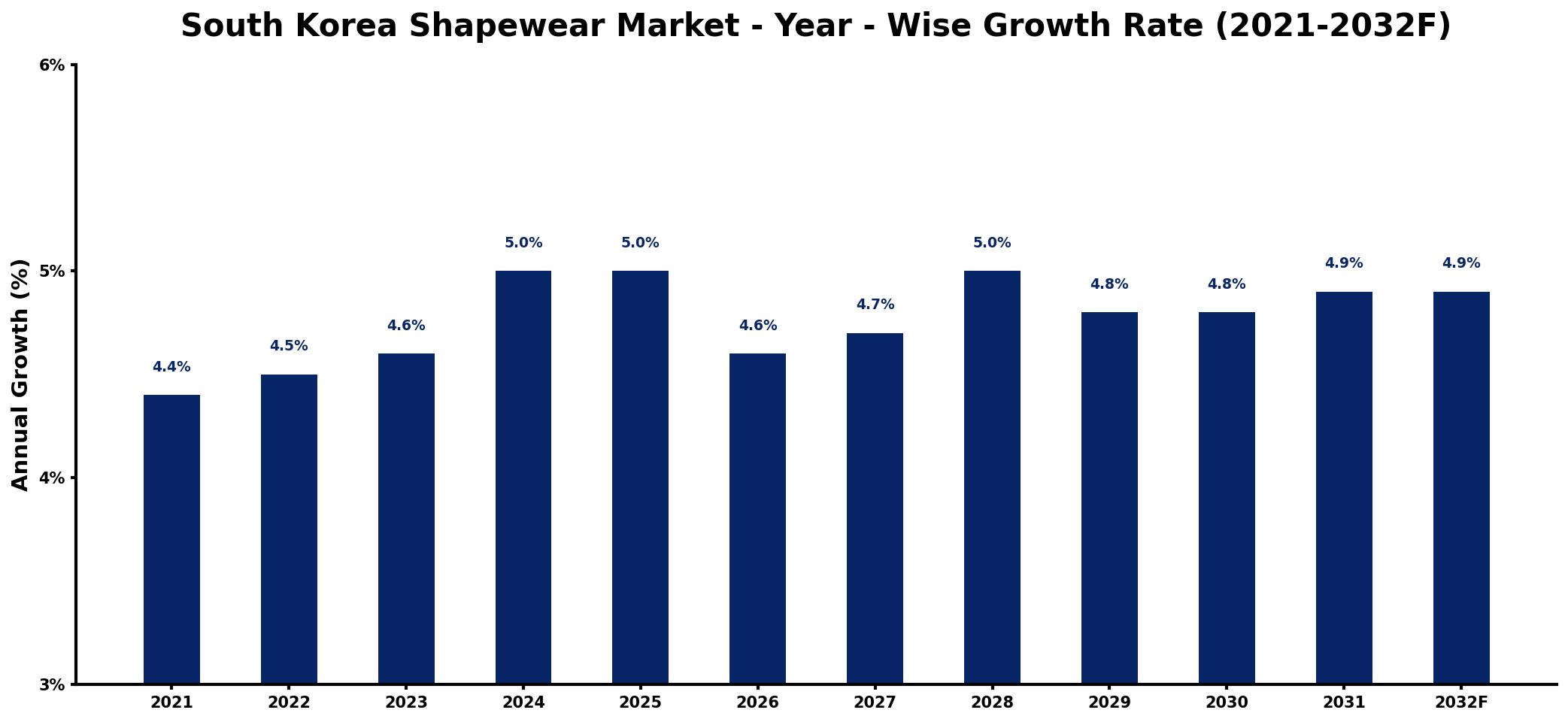
The table below presents the year‑wise growth rates along with the key drivers influencing the market
| Year | Growth Rate | Major Drivers |
| 2021 | 4.4% | Rising health consciousness among consumers |
| 2022 | 4.5% | Increased focus on body positivity |
| 2023 | 4.6% | Expansion of online retail channels |
| 2024 | 5.0% | Growth in athleisure fashion trends |
| 2025 | 5.0% | Increased investment in sustainable materials |
| 2026 | 4.6% | Emergence of innovative fabric technologies |
| 2027 | 4.7% | growing automotive sector requirements |
| 2028 | 5.0% | increased production capacity utilization |
| 2029 | 4.8% | Growth of personalized shopping experiences |
| 2030 | 4.8% | Increase in celebrity endorsements |
| 2031 | 4.9% | Enhanced consumer education initiatives |
| 2032 | 4.9% | Development of inclusive sizing options |
Note: Market size estimations and growth projections presented in this report are based on 6Wresearch's proprietary forecasting methodology, utilizing the latest available industry data, government publications, and primary research inputs.
South Korea Shapewear Market Synopsis
The South Korea shapewear market has recently witnessed a surge in interest, propelled by consumers seeking products that not only shape their bodies but also prioritize comfort. In this competitive landscape, brands are innovating with advanced materials and designs that cater to a diverse range of body types and preferences. As the market matures, it is expected to evolve further, responding to shifting cultural perceptions surrounding body image.
Looking ahead, the South Korean shapewear sector appears poised for robust growth, driven by rising health consciousness and an emphasis on body positivity. Social media's influence continues to play a significant role, promoting new trends and encouraging consumers to explore shapewear solutions that enhance both aesthetic appeal and self-esteem.
South Korea Shapewear Market Key Takeaways
- Growing consumer awareness regarding body positivity is reshaping demand dynamics.
- Technological advancements are leading to innovative shapewear designs focused on comfort.
- There is a rising trend towards sustainable materials, aligning with conscious consumerism.
- Social media and K-pop culture significantly impact consumer preferences and market growth.
- Expansion of inclusive sizing options enhances the appeal of shapewear products.
Evaluation of Restraints in South Korea Shapewear Market
While the South Korea shapewear market is set for growth, it faces certain restraints that could hinder its full potential. Cultural stigmas around discussing body image continue to create barriers, causing reluctance among some consumers to openly embrace shapewear solutions. Furthermore, competition from traditional undergarments poses a challenge as some consumers still prefer more conventional options. The markets rapid evolution demands that brands remain agile and innovative, keeping pace with changing fashion trends and consumer expectations, which can complicate long-term planning.
South Korea Shapewear Market Trends
Several trends are shaping the South Korea shapewear market as it adapts to contemporary demands. Firstly, there's an increasing appetite for technologically advanced products that provide both effective body shaping and health benefits. The rise of athleisure continues to influence shapewear designs, promoting versatility and comfort. Moreover, a growing focus on eco-friendly materials aligns with broader consumer preferences for sustainable fashion. Lastly, the market is witnessing an expansion in product lines to accommodate diverse body types, further reflecting the trend towards inclusivity and body positivity.
South Korea Shapewear Market Opportunities
The South Korea shapewear market presents numerous investment opportunities, particularly in the realms of innovation and marketing. Companies that focus on developing advanced shapewear with breathable fabrics and ergonomic designs are well-positioned to capture the attention of health-conscious consumers. Collaborations with influential local celebrities and social media personalities can significantly enhance brand visibility and consumer trust. As the market grows, strategic investments in e-commerce and direct-to-consumer channels will be crucial for capturing the emerging demographic interested in personalized body solutions.
Government Initiatives in the South Korea Shapewear Market
Currently, the South Korean government does not have specific regulations targeting the shapewear market. However, broader consumer safety regulations and textile product standards apply to shapewear, ensuring that products are safe and accurately marketed. The Fair Trade Commission oversees fair trade practices, promoting competition and transparency. Additionally, any shapewear products making health claims must comply with guidelines from the Ministry of Food and Drug Safety, highlighting the government's commitment to consumer protection.
Future Insights of the South Korea Shapewear Market
Looking toward 2026-2032, the South Korea shapewear market is anticipated to experience consistent expansion, underpinned by a shift towards wellness and body confidence. Innovations in fabric technology and sustainable materials will likely enhance product offerings, catering to a consumer base that values both function and style. Furthermore, the influence of e-commerce will drive accessibility, allowing brands to reach a broader audience. As the conversation around body image continues to evolve, the market is expected to reflect increasingly diverse and positive representations of beauty.
South Korea Shapewear Market Latest Developments (2025 - 2026)
Recent developments in the South Korea shapewear market indicate a surge in demand for innovative product features, such as moisture-wicking and temperature-regulating fabrics. Additionally, several brands have begun to adopt more sustainable production practices, responding to growing consumer concern over environmental issues. The integration of smart technology into shapewear is also emerging, promising enhanced functionality and user experience. Overall, the market is evolving rapidly, aligning itself with modern consumer values and lifestyle choices.
South Korea Shapewear Market - Key Attractiveness of the Report
- 10 Years of Market Numbers
- Historical Data Starting from 2022 to 2025
- Base Year: 2025
- Forecast Data until 2032
- Key Performance Indicators Impacting the Market
- Major Upcoming Developments and Projects
Key Highlights of the Report:
- South Korea Shapewear Market Outlook
- Market Size of South Korea Shapewear Market, 2025
- Forecast of South Korea Shapewear Market, 2032
- Historical Data and Forecast of South Korea Shapewear Revenues & Volume for the Period 2022-2032F
- South Korea Shapewear Market Trend Evolution
- South Korea Shapewear Market Drivers and Challenges
- South Korea Shapewear Price Trends
- South Korea Shapewear Porter's Five Forces
- South Korea Shapewear Industry Life Cycle
- Historical Data and Forecast of South Korea Shapewear Market Revenues & Volume By End-user for the Period 2022-2032F
- Historical Data and Forecast of South Korea Shapewear Market Revenues & Volume By Male for the Period 2022-2032F
- Historical Data and Forecast of South Korea Shapewear Market Revenues & Volume By Female for the Period 2022-2032F
- Historical Data and Forecast of South Korea Shapewear Market Revenues & Volume By Distribution Channel for the Period 2022-2032F
- Historical Data and Forecast of South Korea Shapewear Market Revenues & Volume By Hypermarkets & Supermarkets for the Period 2022-2032F
- Historical Data and Forecast of South Korea Shapewear Market Revenues & Volume By Specialty Stores for the Period 2022-2032F
- Historical Data and Forecast of South Korea Shapewear Market Revenues & Volume By Online for the Period 2022-2032F
- Historical Data and Forecast of South Korea Shapewear Market Revenues & Volume By Others for the Period 2022-2032F
- South Korea Shapewear Import Export Trade Statistics
- Market Opportunity Assessment By End-user
- Market Opportunity Assessment By Distribution Channel
- South Korea Shapewear Top Companies Market Share
- South Korea Shapewear Competitive Benchmarking By Technical and Operational Parameters
- South Korea Shapewear Company Profiles
- South Korea Shapewear Key Strategic Recommendations






































