South Korea Small Wind Turbine Market Size, Share & Growth Rate
The South Korea Small Wind Turbine Market was estimated at USD 169 Million in 2025 and is projected to reach USD 239 Million by 2032, growing at a CAGR of 5.1% from 2026 to 2032. This growth is primarily fueled by increasing awareness of renewable energy sources among consumers and small businesses, alongside substantial government support aimed at enhancing clean energy adoption. With advances in technology that improve efficiency and reduce costs, small wind turbines are becoming an increasingly attractive option for energy independence.
South Korea Small Wind Turbine Market Year-wise Growth Rate and Key Drivers
This graph highlights how the South Korea Small Wind Turbine Market has steadily grown over the years, supported by major growth factors.
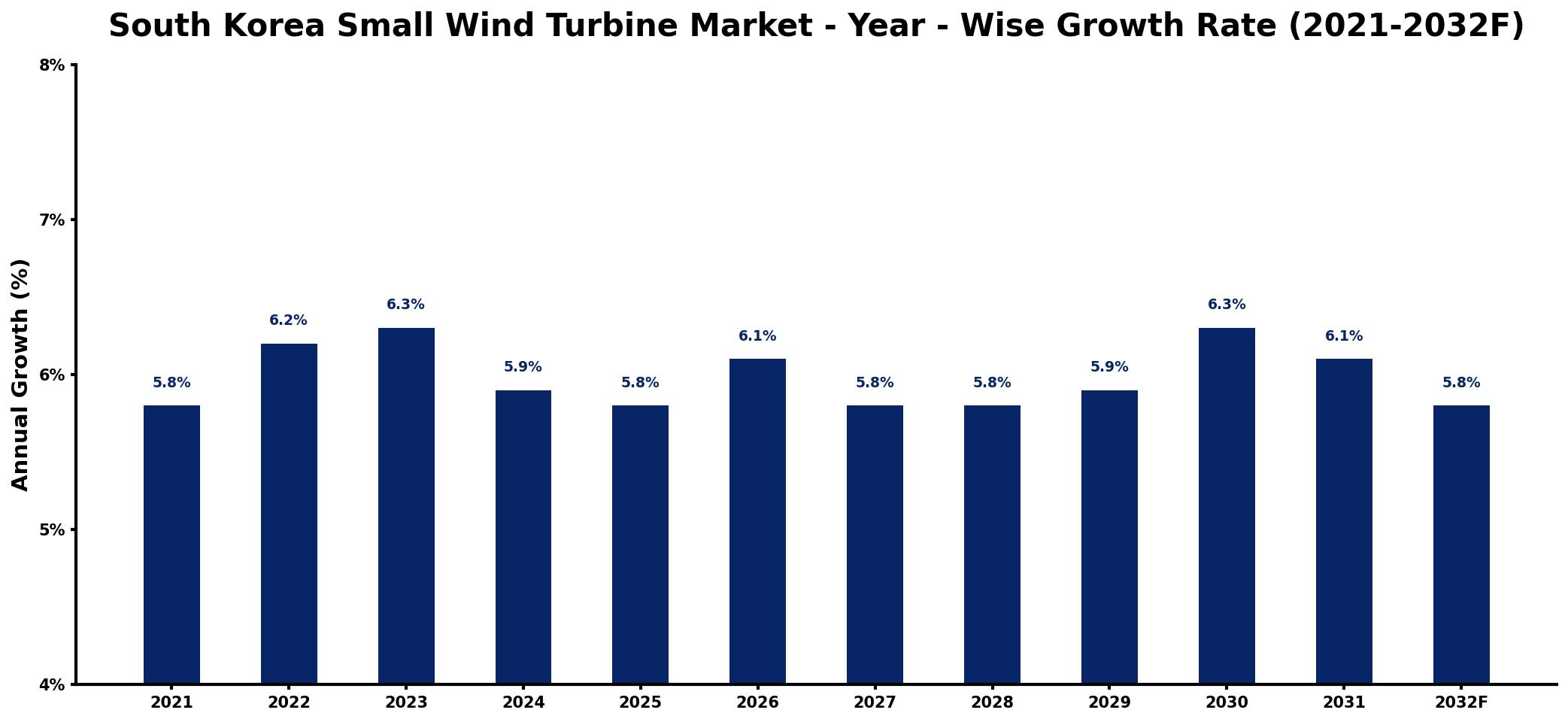
The table below presents the year‑wise growth rates along with the key drivers influencing the market
| Year | Growth Rate | Major Drivers |
| 2021 | 5.8% | Rising demand for renewable energy |
| 2022 | 6.2% | Government incentives for clean energy |
| 2023 | 6.3% | Increased investment in green technology |
| 2024 | 5.9% | Growing awareness of sustainability benefits |
| 2025 | 5.8% | Advancements in energy storage solutions |
| 2026 | 6.1% | Expansion of eco-friendly infrastructure |
| 2027 | 5.8% | Higher consumer interest in alternatives |
| 2028 | 5.8% | Development of local manufacturing capabilities |
| 2029 | 5.9% | Strengthened partnerships in energy sector |
| 2030 | 6.3% | Increased focus on energy independence |
| 2031 | 6.1% | Emerging technologies enhancing efficiency |
| 2032 | 5.8% | Continued support for environmental policies |
Note: Market size estimations and growth projections presented in this report are based on 6Wresearch's proprietary forecasting methodology, utilizing the latest available industry data, government publications, and primary research inputs.
South Korea Small Wind Turbine Market Synopsis
Recent momentum in the South Korea small wind turbine market showcases a significant shift towards embracing renewable energy, especially among residential and small-scale commercial users. However, as the market matures, challenges related to land availability and regulatory frameworks are becoming more pronounced.
Looking ahead, the market is well-positioned for sustained growth, propelled by ongoing government incentives and a cultural shift towards sustainability. As more stakeholders recognize the long-term benefits of small wind turbines, demand is expected to surge, providing an exciting landscape for investors and businesses.
South Korea Small Wind Turbine Market Key Takeaways
- The market is set for steady growth driven by rising awareness of renewable energy.
- Government incentives, including financial support, are crucial for market expansion.
- Technological advancements are enhancing the efficiency and cost-effectiveness of small wind turbines.
- Increasing demand from both residential and small business sectors is fueling market interest.
- Challenges such as land availability and regulatory hurdles need addressing for optimal growth.
Evaluation of Restraints in South Korea Small Wind Turbine Market
Despite a positive outlook, the South Korea small wind turbine market faces significant restraints. Limited land availability in urbanized areas hampers the installation of wind turbines, making it a daunting task for potential customers. Furthermore, navigating through regulatory barriers can be an arduous process, often delaying project approvals and deterring investment. The high initial costs for purchasing and installing these systems can also act as a deterrent for individuals and small businesses, complicating efforts to capitalize on available incentives. Addressing these challenges will be crucial for the market's overall growth.
South Korea Small Wind Turbine Market Trends
The current trend within the South Korea small wind turbine market indicates a rising adoption rate among residential and commercial users. This shift is largely attributed to government policies promoting renewable energy sources and financial incentives for turbine installations. Additionally, advancements in turbine technology are making these systems more efficient and cost-effective. Sustainability is becoming a priority, with small wind turbines emerging as viable solutions for reducing dependence on traditional fossil fuels.
South Korea Small Wind Turbine Market Opportunities
Investment opportunities within the South Korea small wind turbine market are becoming increasingly appealing. As the government enhances support for renewable energy initiatives, including various grants and feed-in tariffs, a conducive environment for investment is being created. The demand for sustainable energy solutions is on the rise, with both businesses and individuals seeking to reduce their carbon footprints. Advancements in wind technology are also lowering maintenance costs, making small wind turbines a more attractive proposition for potential investors.
Government Initiatives in the South Korea Small Wind Turbine Market
The South Korean government has undertaken a series of initiatives to bolster the small wind turbine market. These include the Renewable Portfolio Standard (RPS), which mandates that a certain percentage of electricity generated must come from renewable sources, including wind power. Financial incentives like feed-in tariffs and tax credits are also in place to promote the adoption of small wind turbines. Furthermore, a certification system ensures the quality and safety of installed turbines, fostering trust among consumers and investors.
Future Insights of the South Korea Small Wind Turbine Market
The future of the South Korea small wind turbine market appears robust, characterized by a continuous upward trajectory from 2026 to 2032. With an increasing focus on renewable energy initiatives, governmental support, and a more environmentally conscious populace, the demand for small wind turbines is set to expand. Technological improvements coupled with decreasing costs are likely to make these systems more accessible, establishing a foundation for growth across residential, commercial, and industrial applications.
South Korea Small Wind Turbine Market Latest Developments (2025 - 2026)
Recent industry developments indicate a shift towards more advanced small wind turbine technology, enhancing both efficiency and reliability. Furthermore, there has been a noticeable increase in pilot projects focusing on community-based wind initiatives, aiming to engage local populations in renewable energy generation. The government is also actively refining its incentive programs, ensuring that they align with contemporary market needs and technological advancements.
South Korea Small Wind Turbine Market - Key Attractiveness of the Report
- 10 Years of Market Numbers
- Historical Data Starting from 2022 to 2025
- Base Year: 2025
- Forecast Data until 2032
- Key Performance Indicators Impacting the Market
- Major Upcoming Developments and Projects
Key Highlights of the Report:
- South Korea Small Wind Turbine Market Outlook
- Market Size of South Korea Small Wind Turbine Market, 2025
- Forecast of South Korea Small Wind Turbine Market, 2032
- Historical Data and Forecast of South Korea Small Wind Turbine Revenues & Volume for the Period 2022-2032F
- South Korea Small Wind Turbine Market Trend Evolution
- South Korea Small Wind Turbine Market Drivers and Challenges
- South Korea Small Wind Turbine Price Trends
- South Korea Small Wind Turbine Porter's Five Forces
- South Korea Small Wind Turbine Industry Life Cycle
- Historical Data and Forecast of South Korea Small Wind Turbine Market Revenues & Volume By Axis Type for the Period 2022-2032F
- Historical Data and Forecast of South Korea Small Wind Turbine Market Revenues & Volume By Horizontal Axis Wind Turbine for the Period 2022-2032F
- Historical Data and Forecast of South Korea Small Wind Turbine Market Revenues & Volume By Vertical Axis Wind Turbine for the Period 2022-2032F
- Historical Data and Forecast of South Korea Small Wind Turbine Market Revenues & Volume By Application for the Period 2022-2032F
- Historical Data and Forecast of South Korea Small Wind Turbine Market Revenues & Volume By On-grid for the Period 2022-2032F
- Historical Data and Forecast of South Korea Small Wind Turbine Market Revenues & Volume By Off-grid for the Period 2022-2032F
- South Korea Small Wind Turbine Import Export Trade Statistics
- Market Opportunity Assessment By Axis Type
- Market Opportunity Assessment By Application
- South Korea Small Wind Turbine Top Companies Market Share
- South Korea Small Wind Turbine Competitive Benchmarking By Technical and Operational Parameters
- South Korea Small Wind Turbine Company Profiles
- South Korea Small Wind Turbine Key Strategic Recommendations






































