South Korea Smart Weapons Market Size, Share & Growth Rate
The South Korea Smart Weapons Market was estimated at USD 517 Million in 2025 and is projected to reach USD 876 Million by 2032, growing at a CAGR of 7.8% from 2026 to 2032. This upward trajectory is driven by the South Korean government's increased defense spending, an urgent need to modernize military capabilities in response to regional security threats, and significant advancements in military technology. With a focus on indigenous development, South Korea aims to enhance self-reliance in defense production while continuing to leverage international partnerships.
South Korea Smart Weapons Market Year-wise Growth Rate and Key Drivers
This graph highlights how the South Korea Smart Weapons Market has steadily grown over the years, supported by major growth factors.
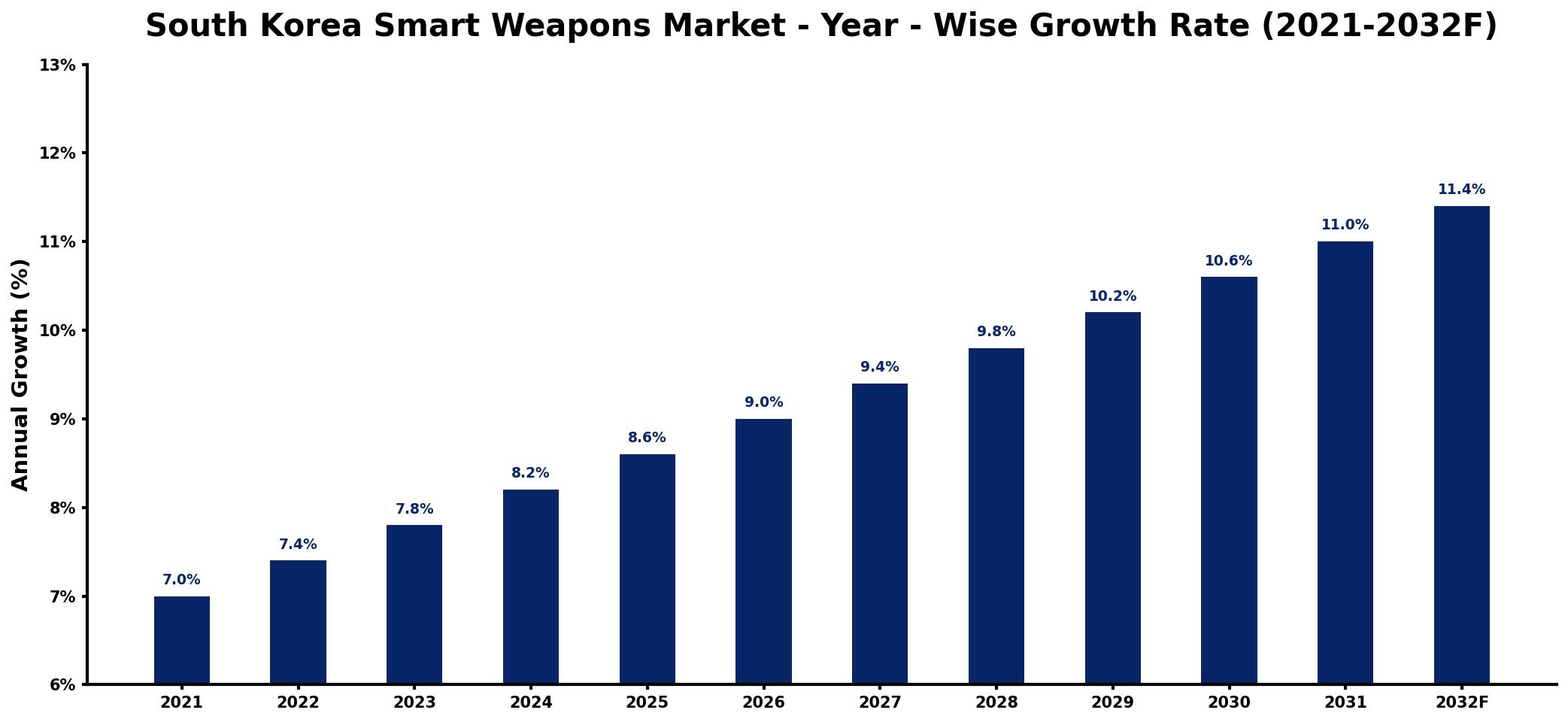
The table below presents the year‑wise growth rates along with the key drivers influencing the market
| Year | Growth Rate | Major Drivers |
| 2021 | 7.0% | improved raw material availability |
| 2022 | 7.4% | Increased focus on modernization |
| 2023 | 7.8% | Growing geopolitical tensions globally |
| 2024 | 8.2% | Advancements in technology integration |
| 2025 | 8.6% | Emerging threats driving investments |
| 2026 | 9.0% | Enhanced collaboration among allies |
| 2027 | 9.4% | Demand for precision targeting solutions |
| 2028 | 9.8% | Expansion of military capabilities |
| 2029 | 10.2% | Investments in research and development |
| 2030 | 10.6% | Focus on cybersecurity enhancements |
| 2031 | 11.0% | Increased military procurement initiatives |
| 2032 | 11.4% | Development of next-gen systems |
Note: Market size estimations and growth projections presented in this report are based on 6Wresearch's proprietary forecasting methodology, utilizing the latest available industry data, government publications, and primary research inputs.
South Korea Smart Weapons Market Synopsis
The South Korea Smart Weapons Market is currently experiencing robust growth, characterized by rapid technological advancements and heightened defense strategies. As the nation invests heavily in smart weaponry, the market is poised for substantial evolution, driven by initiatives to bolster military effectiveness and deter regional threats.
Looking ahead, the integration of artificial intelligence and autonomous systems into weaponry represents a transformative shift. Strategic collaborations with international defense contractors further enrich the technological landscape, ensuring South Korea remains at the forefront of smart weapons development.
South Korea Smart Weapons Market Key Takeaways
- The market is fueled by increased defense budgets and modernization initiatives aimed at enhancing military capabilities.
- Investment in precision-guided munitions and missile systems is notably rising, with a particular emphasis on domestic production.
- Collaborations with global defense firms are critical for technology transfer and innovation.
- Challenges remain due to stringent export regulations and reliance on foreign technology.
- The integration of cybersecurity measures is becoming paramount to safeguard smart weapon systems from potential threats.
Evaluation of Restraints in South Korea Smart Weapons Market
The growth potential of the South Korea Smart Weapons Market is tempered by various restraints. Strict regulations surrounding arms exports limit domestic manufacturers' ability to expand globally, hindering market competitiveness. Additionally, limited budget allocations for research and development restrict the local industry's capacity to innovate and create cutting-edge smart weapons. A heavy reliance on foreign technology transfers presents challenges in building self-reliance, which is essential for the long-term sustainability of the defense sector in South Korea.
South Korea Smart Weapons Market Trends
Several notable trends are shaping the South Korea Smart Weapons Market. First, there is a marked demand for advanced missile defense systems that enhance national security against potential threats. The development of indigenous smart weapon systems is gaining momentum, allowing for tailored solutions that meet specific military requirements. Moreover, the integration of artificial intelligence in weapon systems is paving the way for autonomous capabilities, which could redefine operational strategies in modern warfare. Lastly, with increasing cyber threats, a robust emphasis on cybersecurity is becoming integral to protect advanced weaponry from potential vulnerabilities.
South Korea Smart Weapons Market Opportunities
Significant investment opportunities exist within the South Korea Smart Weapons Market, largely driven by the need to modernize military capabilities in response to heightened geopolitical tensions. Investors can find promising avenues in precision-guided munitions and missile defense systems, particularly as local defense manufacturers strive to innovate. Strategic partnerships and acquisitions are likely to yield beneficial outcomes, especially as South Korea continues to emphasize self-reliance in defense production. The government's steadfast commitment to bolstering defense spending enhances the attractiveness of investments in this market segment.
Government Initiatives in the South Korea Smart Weapons Market
The South Korean government has implemented several initiatives to promote the development and production of smart weapons. Policies focusing on investment in research and development aim to spur innovation within the defense industry. Collaborations with domestic companies are encouraged to enhance self-reliance and reduce dependence on foreign technologies. Furthermore, strategic partnerships with international allies are prioritized to facilitate technology transfer and foster joint development projects. These initiatives collectively aim to establish South Korea as a key player in the global smart weapons arena while adhering to international arms control standards.
Future Insights of the South Korea Smart Weapons Market
The future outlook for the South Korea Smart Weapons Market is bright, with sustained growth expected through 2032. The increasing emphasis on military modernization and the ongoing geopolitical tensions in the region will significantly drive demand for advanced weapon systems. As South Korea integrates cutting-edge technologies like artificial intelligence and unmanned systems into its military framework, the scope for innovation will widen. Coupled with strong government support for the domestic defense sector, these factors position the South Korea Smart Weapons Market for remarkable advancements and an expanding role on the global stage.
South Korea Smart Weapons Market Latest Developments (2025 - 2026)
Recent developments in the South Korea Smart Weapons Market reflect a growing commitment to innovation and technological superiority. Defense manufacturers have ramped up efforts to enhance precision-guided munitions and missile defense systems, responding to evolving security threats. Collaborative projects with international defense contractors have been initiated to leverage cutting-edge technologies, ensuring that South Korea remains competitive. Additionally, ongoing government policies continue to support research and development initiatives aimed at strengthening the nations self-reliance in defense capabilities.
South Korea Smart Weapons Market - Key Attractiveness of the Report
- 10 Years of Market Numbers
- Historical Data Starting from 2022 to 2025
- Base Year: 2025
- Forecast Data until 2032
- Key Performance Indicators Impacting the Market
- Major Upcoming Developments and Projects
Key Highlights of the Report:
- South Korea Smart Weapons Market Outlook
- Market Size of South Korea Smart Weapons Market, 2025
- Forecast of South Korea Smart Weapons Market, 2032
- Historical Data and Forecast of South Korea Smart Weapons Revenues & Volume for the Period 2022-2032F
- South Korea Smart Weapons Market Trend Evolution
- South Korea Smart Weapons Market Drivers and Challenges
- South Korea Smart Weapons Price Trends
- South Korea Smart Weapons Porter's Five Forces
- South Korea Smart Weapons Industry Life Cycle
- Historical Data and Forecast of South Korea Smart Weapons Market Revenues & Volume By Product for the Period 2022-2032F
- Historical Data and Forecast of South Korea Smart Weapons Market Revenues & Volume By Missiles for the Period 2022-2032F
- Historical Data and Forecast of South Korea Smart Weapons Market Revenues & Volume By Munitions for the Period 2022-2032F
- Historical Data and Forecast of South Korea Smart Weapons Market Revenues & Volume By Guided Projectiles for the Period 2022-2032F
- Historical Data and Forecast of South Korea Smart Weapons Market Revenues & Volume By Guided Rockets for the Period 2022-2032F
- Historical Data and Forecast of South Korea Smart Weapons Market Revenues & Volume By Guided Firearms for the Period 2022-2032F
- Historical Data and Forecast of South Korea Smart Weapons Market Revenues & Volume By Directed Energy Weapons for the Period 2022-2032F
- Historical Data and Forecast of South Korea Smart Weapons Market Revenues & Volume By Technology for the Period 2022-2032F
- Historical Data and Forecast of South Korea Smart Weapons Market Revenues & Volume By Laser for the Period 2022-2032F
- Historical Data and Forecast of South Korea Smart Weapons Market Revenues & Volume By Infrared for the Period 2022-2032F
- Historical Data and Forecast of South Korea Smart Weapons Market Revenues & Volume By Radar for the Period 2022-2032F
- Historical Data and Forecast of South Korea Smart Weapons Market Revenues & Volume By GPS for the Period 2022-2032F
- Historical Data and Forecast of South Korea Smart Weapons Market Revenues & Volume By Others for the Period 2022-2032F
- Historical Data and Forecast of South Korea Smart Weapons Market Revenues & Volume By Platform for the Period 2022-2032F
- Historical Data and Forecast of South Korea Smart Weapons Market Revenues & Volume By Air for the Period 2022-2032F
- Historical Data and Forecast of South Korea Smart Weapons Market Revenues & Volume By Land for the Period 2022-2032F
- Historical Data and Forecast of South Korea Smart Weapons Market Revenues & Volume By Naval for the Period 2022-2032F
- South Korea Smart Weapons Import Export Trade Statistics
- Market Opportunity Assessment By Product
- Market Opportunity Assessment By Technology
- Market Opportunity Assessment By Platform
- South Korea Smart Weapons Top Companies Market Share
- South Korea Smart Weapons Competitive Benchmarking By Technical and Operational Parameters
- South Korea Smart Weapons Company Profiles
- South Korea Smart Weapons Key Strategic Recommendations






































