South Korea Sodium fluoride Market Size, Share & Growth Rate
The South Korea Sodium fluoride Market was estimated at USD 306 Million in 2025 and is projected to reach USD 402 Million by 2032, growing at a CAGR of 4.0% from 2026 to 2032. This growth trajectory is largely driven by the increasing utilization of sodium fluoride in dental care products and rising investments in water treatment facilities. As public awareness around oral health continues to expand, demand for effective dental care solutions is expected to rise, reinforcing the market's upward momentum.
South Korea Sodium fluoride Market Year-wise Growth Rate and Key Drivers
This graph highlights how the South Korea Sodium fluoride Market has steadily grown over the years, supported by major growth factors.
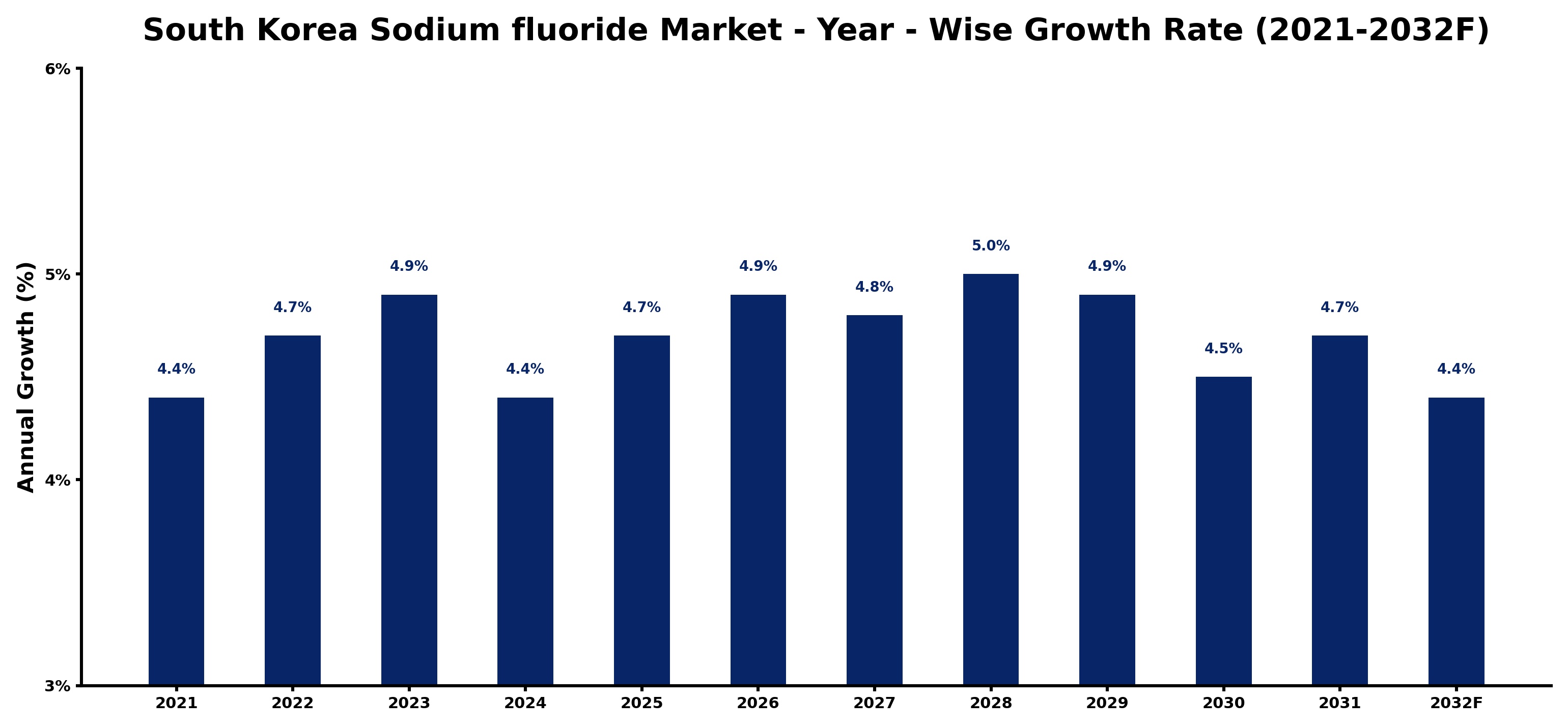
The table below presents the year‑wise growth rates along with the key drivers influencing the market
| Year | Growth Rate | Major Drivers |
| 2021 | 4.4% | Chemical manufacturers boost sodium fluoride production for battery applications |
| 2022 | 4.7% | Demand for eco friendly products drives sodium fluoride manufacturing innovations |
| 2023 | 4.9% | Manufacturing investments in lithium ion batteries boost sodium fluoride demand |
| 2024 | 4.4% | Local chemical manufacturers boost sodium fluoride output through efficiency upgrades |
| 2025 | 4.7% | Local manufacturers boost sodium fluoride output for export opportunities |
| 2026 | 4.9% | Export driven investments in advanced fluorination technology boost production efficiency |
| 2027 | 4.8% | Production line upgrades boosted sodium fluoride manufacturing efficiencies |
| 2028 | 5.0% | Technology integration boosts sodium fluoride production process efficiencies |
| 2029 | 4.9% | Sodium fluoride applications in lithium ion batteries drive domestic production efficiency |
| 2030 | 4.5% | Sodium fluoride production capacity expansions meet growing domestic semiconductor needs |
| 2031 | 4.7% | Chemical production expansion fuels sodium fluoride market demand recovery |
| 2032 | 4.4% | Manufacturing investments boost domestic sodium fluoride production capabilities |
Note - Market size estimations and growth projections presented in this report are based on 6Wresearch's advanced forecasting approach, validated with industry datasets as of June 2026.
South Korea Sodium fluoride Market Synopsis
Recent momentum in the South Korea Sodium fluoride market highlights a burgeoning recognition of the compound's benefits, particularly in dental health. As industries such as healthcare and water treatment expand, projections indicate that this market will continue to gain strength, indicating a vibrant future.
However, while growth remains robust, challenges regarding regulatory standards and consumer perceptions could temper the rate of expansion. Continuous research and innovation will be critical to ensuring that sodium fluoride maintains its standing as a vital component in various applications.
South Korea Sodium fluoride Market Key Takeaways
- The market is poised for growth driven by demand in dental care and water treatment sectors.
- Government policies are promoting safe and regulated usage of sodium fluoride in various industries.
- Technological advancements are leading to innovative formulations and applications of sodium fluoride.
- Increased public awareness about oral hygiene is fostering consumer demand for fluoride-based products.
- Competitive pressures from alternative products may impact market dynamics.
Evaluation of Restraints in South Korea Sodium fluoride Market
Despite its growth prospects, the South Korea Sodium fluoride market faces significant restraints. Regulatory hurdles related to product approvals may delay the introduction of innovative formulations. Additionally, concerns surrounding health risks associated with fluoride could spark public backlash, potentially hindering market acceptance. Moreover, competition from alternative compounds and the volatility of raw material costs can strain profitability, necessitating strategic foresight from manufacturers.
South Korea Sodium fluoride Market Trends
Current trends indicate a shift toward incorporating sodium fluoride in various industrial applications, including glass and ceramics manufacturing. Furthermore, there's an increasing focus on water fluoridation initiatives that aim to improve public dental health, reflecting a broader societal commitment to wellness. The continual advancement of technology is also paving the way for more effective sodium fluoride formulations, aligning with consumer preferences for enhanced oral care products.
South Korea Sodium fluoride Market Opportunities
Investment opportunities in the South Korea Sodium fluoride market are ripe, particularly as demand surges for dental care products fortified with sodium fluoride. Companies can benefit from tapping into water treatment applications, especially in urban areas where fluoride levels need supplementation. Moreover, innovative R&D efforts in product development can yield new applications and competitive advantages in a rapidly evolving marketplace.
Government Initiatives in the South Korea Sodium fluoride Market
The South Korean government has implemented stringent regulations aimed at ensuring the safe usage of sodium fluoride across various sectors. Oversight by the Ministry of Food and Drug Safety (MFDS) mandates that sodium fluoride products meet specific safety and efficacy standards. Additionally, initiatives to enhance public health through water fluoridation underscore the government's commitment to promoting oral health, directly impacting the sodium fluoride market positively.
Future Insights of the South Korea Sodium fluoride Market
Looking ahead to 2026-2032, the South Korea Sodium fluoride market is projected to thrive, propelled by rising awareness of oral health's significance and expanding industrial applications. As healthcare infrastructure improves and dental care becomes increasingly prioritized, sodium fluoride will remain a cornerstone ingredient in enhancing community health outcomes. While regulatory scrutiny may pose challenges, proactive adaptation to these environments will be crucial for sustained growth.
South Korea Sodium fluoride Market Latest Developments (May 2025 - June 2026)
Recent developments in the South Korea Sodium fluoride market have focused on technological innovations that enhance product efficacy. Industry players are also adapting to evolving regulations by implementing more rigorous safety protocols. Collaborative initiatives aimed at promoting public health through awareness campaigns have been gaining traction, reflecting a commitment to responsible fluoride usage in both consumer products and water treatment processes.
South Korea Sodium fluoride Market - Key Attractiveness of the Report
- 10 Years of Market Numbers
- Historical Data Starting from 2022 to 2025
- Base Year: 2025
- Forecast Data until 2032
- Key Performance Indicators Impacting the Market
- Major Upcoming Developments and Projects
Key Highlights of the Report:
- South Korea Sodium fluoride Market Outlook
- Market Size of South Korea Sodium fluoride Market, 2025
- Forecast of South Korea Sodium fluoride Market, 2032
- Historical Data and Forecast of South Korea Sodium fluoride Revenues & Volume for the Period 2022-2032F
- South Korea Sodium fluoride Market Trend Evolution
- South Korea Sodium fluoride Market Drivers and Challenges
- South Korea Sodium fluoride Price Trends
- South Korea Sodium fluoride Porter's Five Forces
- South Korea Sodium fluoride Industry Life Cycle
- Historical Data and Forecast of South Korea Sodium fluoride Market Revenues & Volume By Grade for the Period 2022-2032F
- Historical Data and Forecast of South Korea Sodium fluoride Market Revenues & Volume By Food Grade for the Period 2022-2032F
- Historical Data and Forecast of South Korea Sodium fluoride Market Revenues & Volume By Pharmaceutical Grade for the Period 2022-2032F
- Historical Data and Forecast of South Korea Sodium fluoride Market Revenues & Volume By Industrial Grade for the Period 2022-2032F
- Historical Data and Forecast of South Korea Sodium fluoride Market Revenues & Volume By Applications for the Period 2022-2032F
- Historical Data and Forecast of South Korea Sodium fluoride Market Revenues & Volume By Dental Products for the Period 2022-2032F
- Historical Data and Forecast of South Korea Sodium fluoride Market Revenues & Volume By Water Treatment for the Period 2022-2032F
- Historical Data and Forecast of South Korea Sodium fluoride Market Revenues & Volume By Insecticides & Pesticides for the Period 2022-2032F
- Historical Data and Forecast of South Korea Sodium fluoride Market Revenues & Volume By Pharmaceuticals for the Period 2022-2032F
- Historical Data and Forecast of South Korea Sodium fluoride Market Revenues & Volume By Others for the Period 2022-2032F
- South Korea Sodium fluoride Import Export Trade Statistics
- Market Opportunity Assessment By Grade
- Market Opportunity Assessment By Applications
- South Korea Sodium fluoride Top Companies Market Share
- South Korea Sodium fluoride Competitive Benchmarking By Technical and Operational Parameters
- South Korea Sodium fluoride Company Profiles
- South Korea Sodium fluoride Key Strategic Recommendations






































