South Korea Stone Crushing Equipment Market Size, Share & Growth Rate
The South Korea Stone Crushing Equipment Market was estimated at USD 175 Million in 2025 and is projected to reach USD 243 Million by 2032, growing at a CAGR of 4.8% from 2026 to 2032. This growth trajectory is primarily fueled by a booming construction industry and substantial government investments in infrastructure development. The increasing demand for high-quality aggregates for various construction projects, such as roads, railways, and urban facilities, underscores the critical role of stone crushing equipment in South Korea.
South Korea Stone Crushing Equipment Market Year-wise Growth Rate and Key Drivers
This graph highlights how the South Korea Stone Crushing Equipment Market has steadily grown over the years, supported by major growth factors.
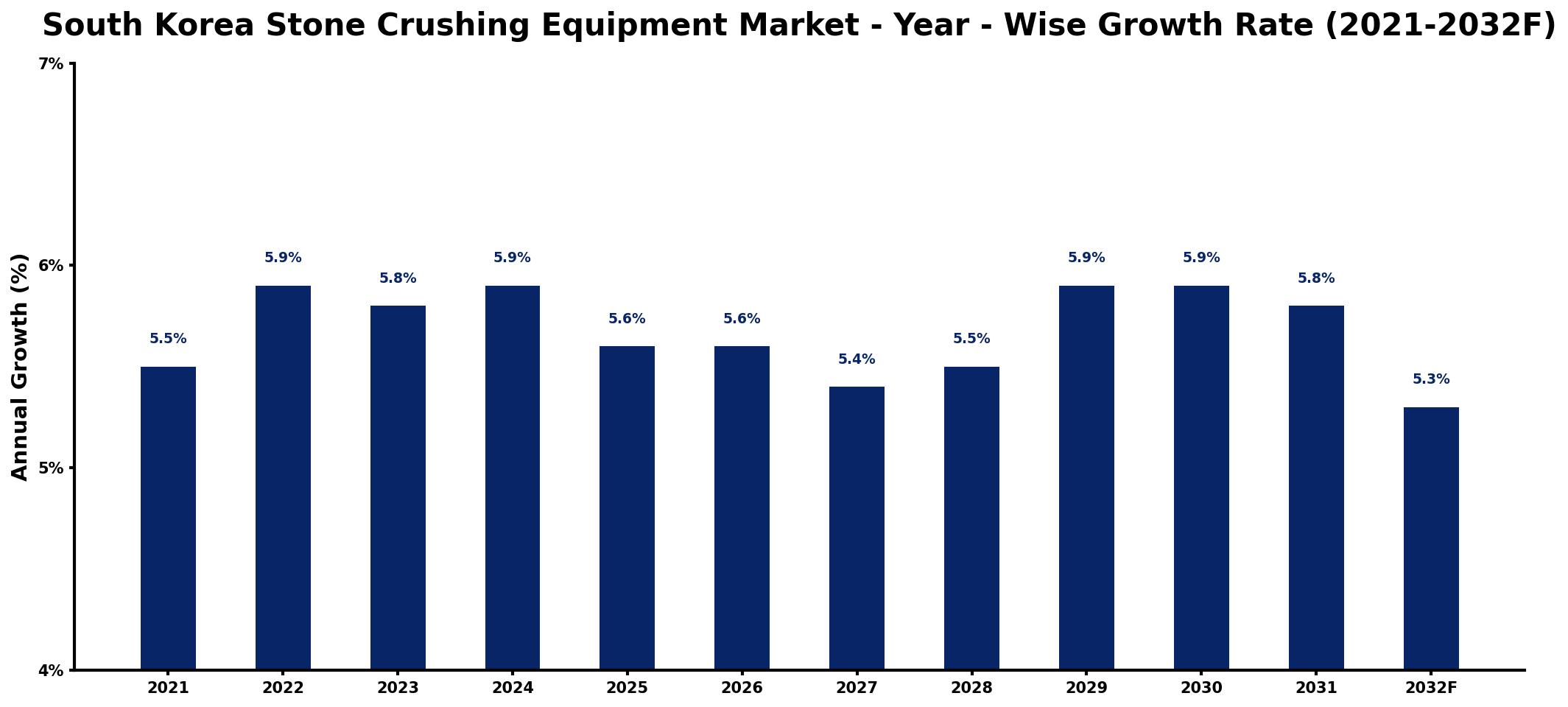
The table below presents the year‑wise growth rates along with the key drivers influencing the market
| Year | Growth Rate | Major Drivers |
| 2021 | 5.5% | Infrastructure projects driving demand growth |
| 2022 | 5.9% | Increased construction activity nationwide |
| 2023 | 5.8% | Rising investments in mining sector |
| 2024 | 5.9% | Urbanization trends boosting material needs |
| 2025 | 5.6% | Government initiatives supporting industry expansion |
| 2026 | 5.6% | Advancements in technology enhancing efficiency |
| 2027 | 5.4% | Rising exports of construction materials |
| 2028 | 5.5% | strengthening international trade flows |
| 2029 | 5.9% | Growing recycling initiatives for materials |
| 2030 | 5.9% | Expansion of transportation networks ongoing |
| 2031 | 5.8% | Sustainability efforts driving material innovations |
| 2032 | 5.3% | Strategic partnerships enhancing market reach |
Note: Market size estimations and growth projections presented in this report are based on 6Wresearch's proprietary forecasting methodology, utilizing the latest available industry data, government publications, and primary research inputs.
South Korea Stone Crushing Equipment Market Synopsis
The most significant force shaping the South Korea Stone Crushing Equipment Market is the surge in construction activities and extensive infrastructure projects. This momentum is expected to continue as the government prioritizes urban development and connectivity, leading to a greater reliance on stone crushing machinery for producing essential aggregates.
Furthermore, manufacturers are increasingly focusing on advanced technological solutions to enhance operational efficiency. Automation and IoT integration have become focal points for product innovation, reflecting the market's shift towards more intelligent and effective stone crushing operations.
South Korea Stone Crushing Equipment Market Key Takeaways
- Significant growth driven by increased construction activities and infrastructure projects.
- Focus on technology advancements, including automation and digitalization, to boost efficiency.
- Environmental sustainability is a growing concern, leading to eco-friendly equipment development.
- Intense competition among local and international manufacturers is shaping market dynamics.
- Government support for infrastructure development creates a favorable investment climate.
Evaluation of Restraints in South Korea Stone Crushing Equipment Market
Despite the optimistic growth outlook, the South Korea Stone Crushing Equipment Market faces several restraints. The landscape is marked by fierce competition, which compresses profit margins and compels companies to continuously innovate. Additionally, fluctuations in raw material prices and compliance with stringent environmental regulations add layers of complexity to operational costs. The specialized nature of equipment often necessitates skilled labor for maintenance, further straining operational budgets. Manufacturers must navigate these challenges to maintain growth and profitability.
South Korea Stone Crushing Equipment Market Trends
Several trends are currently shaping the South Korea Stone Crushing Equipment Market. The increasing adoption of mobile cone crushers and impact crushers is notable, given their flexibility and efficiency across various applications. Automation and digital solutions are gaining traction, allowing operators to optimize production processes and reduce downtime. Furthermore, the industry is witnessing a paradigm shift towards sustainable practices, driving demand for energy-efficient and environmentally friendly crushing equipment.
South Korea Stone Crushing Equipment Market Opportunities
Opportunities abound within the South Korea Stone Crushing Equipment Market, particularly in segments focused on sustainable technology and automation. The rising need for eco-friendly equipment presents a lucrative avenue for manufacturers and investors. Moreover, as infrastructure development accelerates, there is significant demand for reliable stone crushing machinery and associated maintenance services. Investing in innovative technologies can also enhance competitive advantage and operational efficiency.
Government Initiatives in the South Korea Stone Crushing Equipment Market
The South Korean government plays a pivotal role in shaping the Stone Crushing Equipment Market through various policies aimed at environmental protection and infrastructure development. Regulations are in place to ensure compliance with emission standards and workplace safety measures, fostering a responsible operational environment. Additionally, government initiatives encourage the adoption of advanced technologies that promote sustainability, further driving growth within the market.
Future Insights of the South Korea Stone Crushing Equipment Market
Looking ahead to 2026-2032, the South Korea Stone Crushing Equipment Market is poised for steady growth as the construction sector continues to expand. The demand for efficient and reliable crushing equipment will be propelled by ongoing infrastructure projects and urbanization trends. Technological innovations and an emphasis on sustainable practices will remain at the forefront, shaping the direction of the market. The government's commitment to infrastructure development will also create a favorable environment for growth and investment opportunities.
South Korea Stone Crushing Equipment Market Latest Developments (2025 - 2026)
Recent developments in the South Korea Stone Crushing Equipment Market indicate a strong trend towards automation and IoT integration, with manufacturers focusing on enhancing equipment intelligence. The push for sustainable solutions has led to investments in research and development aimed at creating energy-efficient machinery. Additionally, strategic partnerships within the industry have been observed, as companies seek to leverage shared technologies and resources to address the evolving demands of the market.
South Korea Stone Crushing Equipment Market - Key Attractiveness of the Report
- 10 Years of Market Numbers
- Historical Data Starting from 2022 to 2025
- Base Year: 2025
- Forecast Data until 2032
- Key Performance Indicators Impacting the Market
- Major Upcoming Developments and Projects
Key Highlights of the Report:
- South Korea Stone Crushing Equipment Market Outlook
- Market Size of South Korea Stone Crushing Equipment Market, 2025
- Forecast of South Korea Stone Crushing Equipment Market, 2032
- Historical Data and Forecast of South Korea Stone Crushing Equipment Revenues & Volume for the Period 2022-2032F
- South Korea Stone Crushing Equipment Market Trend Evolution
- South Korea Stone Crushing Equipment Market Drivers and Challenges
- South Korea Stone Crushing Equipment Price Trends
- South Korea Stone Crushing Equipment Porter's Five Forces
- South Korea Stone Crushing Equipment Industry Life Cycle
- Historical Data and Forecast of South Korea Stone Crushing Equipment Market Revenues & Volume By Type for the Period 2022-2032F
- Historical Data and Forecast of South Korea Stone Crushing Equipment Market Revenues & Volume By Jaw Crusher for the Period 2022-2032F
- Historical Data and Forecast of South Korea Stone Crushing Equipment Market Revenues & Volume By Cone Crusher for the Period 2022-2032F
- Historical Data and Forecast of South Korea Stone Crushing Equipment Market Revenues & Volume By Impact Crusher for the Period 2022-2032F
- Historical Data and Forecast of South Korea Stone Crushing Equipment Market Revenues & Volume By Others for the Period 2022-2032F
- Historical Data and Forecast of South Korea Stone Crushing Equipment Market Revenues & Volume By End Users for the Period 2022-2032F
- Historical Data and Forecast of South Korea Stone Crushing Equipment Market Revenues & Volume By Mining for the Period 2022-2032F
- Historical Data and Forecast of South Korea Stone Crushing Equipment Market Revenues & Volume By Quarrying for the Period 2022-2032F
- Historical Data and Forecast of South Korea Stone Crushing Equipment Market Revenues & Volume By Recycling for the Period 2022-2032F
- Historical Data and Forecast of South Korea Stone Crushing Equipment Market Revenues & Volume By Construction & Infrastructure for the Period 2022-2032F
- Historical Data and Forecast of South Korea Stone Crushing Equipment Market Revenues & Volume By Others for the Period 2022-2032F
- South Korea Stone Crushing Equipment Import Export Trade Statistics
- Market Opportunity Assessment By Type
- Market Opportunity Assessment By End Users
- South Korea Stone Crushing Equipment Top Companies Market Share
- South Korea Stone Crushing Equipment Competitive Benchmarking By Technical and Operational Parameters
- South Korea Stone Crushing Equipment Company Profiles
- South Korea Stone Crushing Equipment Key Strategic Recommendations






































