South Korea Swing Market Size, Share & Growth Rate
The South Korea Swing Market was estimated at USD 263 Million in 2025 and is projected to reach USD 363 Million by 2032, growing at a CAGR of 4.7% from 2026 to 2032. This growth trajectory is primarily fueled by the rising disposable incomes of South Korean households and an increasing emphasis on outdoor recreational activities. As urbanization continues to shape lifestyles, the demand for high-quality, aesthetically pleasing swing products is gaining momentum, reflecting consumers desire for versatile recreational options.
South Korea Swing Market Year-wise Growth Rate and Key Drivers
This graph highlights how the South Korea Swing Market has steadily grown over the years, supported by major growth factors.
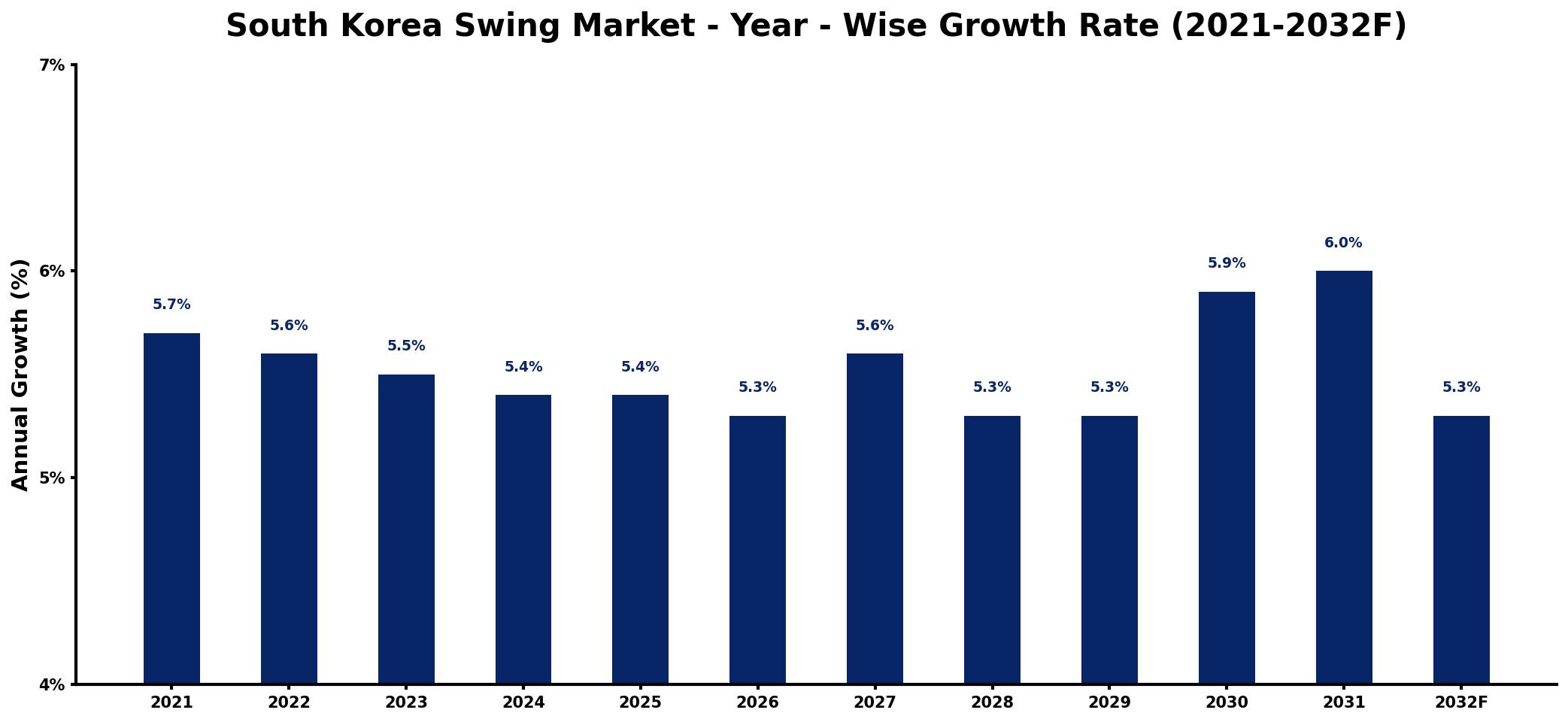
The table below presents the year‑wise growth rates along with the key drivers influencing the market
| Year | Growth Rate | Major Drivers |
| 2021 | 5.7% | Increased consumer spending patterns |
| 2022 | 5.6% | Growth in outdoor recreational activities |
| 2023 | 5.5% | Expansion of e-commerce platforms |
| 2024 | 5.4% | Rise in disposable income levels |
| 2025 | 5.4% | Growing popularity of health trends |
| 2026 | 5.3% | Investment in leisure infrastructure projects |
| 2027 | 5.6% | Surge in tourism and travel |
| 2028 | 5.3% | Development of urban green spaces |
| 2029 | 5.3% | Emergence of new lifestyle brands |
| 2030 | 5.9% | Increased participation in recreational sports |
| 2031 | 6.0% | Adoption of eco-friendly practices |
| 2032 | 5.3% | expanding industrial usage applications |
Note: Market size estimations and growth projections presented in this report are based on 6Wresearch's proprietary forecasting methodology, utilizing the latest available industry data, government publications, and primary research inputs.
South Korea Swing Market Synopsis
Innovation is the strongest force currently shaping the South Korea Swing Market. Consumers are actively seeking swings that not only serve traditional purposes but also align with their personal aesthetics and lifestyle needs. The growing trend towards home fitness and outdoor leisure activities is further driving the demand for customizable and durable swing products.
Safety and quality are paramount for South Korean consumers, as they demand swings that meet stringent safety standards without compromising on style. Eco-friendliness is also becoming a vital consideration, leading manufacturers to explore sustainable materials and practices in their product offerings, catering to a more environmentally conscious consumer base.
South Korea Swing Market Key Takeaways
- The market is heavily influenced by urbanization and evolving leisure preferences.
- Customization options are gaining traction as consumers look for personalized swing solutions.
- Health and wellness trends are contributing to increased interest in outdoor activities.
- Regulatory measures are focusing on consumer safety and product compliance.
- There is a noticeable shift towards eco-friendly materials and sustainable practices.
Evaluation of Restraints in South Korea Swing Market
Despite its growth potential, the South Korea Swing Market faces significant constraints. The increasing competition from alternative recreational activities such as digital gaming and immersive experiences is a major limiting factor. Moreover, changing consumer preferences are steering demand towards more technologically advanced offerings, potentially sidelining traditional swing products. Economic uncertainties can impact disposable incomes, which may lead to fluctuating consumer spending patterns on leisure goods. Lastly, stringent safety regulations require continuous compliance, which can strain operational efficiencies for manufacturers and retailers alike.
South Korea Swing Market Trends
Current trends in the South Korea Swing Market emphasize durability, safety, and aesthetics. An increasing number of consumers are interested in swing sets that feature innovative designs and high-quality materials. The demand for customizable options is also on the rise, allowing consumers to tailor products to their specific needs. As health and wellness become focal points in lifestyle choices, swings that facilitate physical activity and encourage family interactions are gaining popularity. Furthermore, sustainability trends are leading consumers to favor eco-friendly swing products, prompting manufacturers to rethink their sourcing and production processes.
South Korea Swing Market Opportunities
The South Korea Swing Market presents a variety of opportunities for growth and investment. The intersection of technology and recreation offers a fertile ground for innovative swing products that integrate smart features, appealing to tech-savvy consumers. Additionally, the booming e-commerce landscape is creating avenues for online sales, allowing brands to reach a broader audience. Investments in sustainable materials and production practices can cater to the growing demand for eco-friendly products. Overall, the market is ripe for entrants that can leverage these trends to meet evolving consumer expectations.
Government Initiatives in the South Korea Swing Market
The South Korean government has put various regulations in place to promote a safe and transparent swing market. These initiatives focus on enforcing stringent quality and safety standards for swing products, ensuring regular inspections of manufacturing facilities, and establishing penalties for non-compliance. Additionally, the governments guidelines on advertising and marketing practices aim to protect consumers from misleading claims. There is also a framework addressing product recalls and warranty issues, further enhancing consumer trust and safeguarding public interests.
Future Insights of the South Korea Swing Market
Looking ahead to 2026-2032, the South Korea Swing Market is positioned for continued growth, driven by an increased focus on health, wellness, and family engagement in outdoor activities. We can expect innovations that blend technology with recreational products, creating more interactive and user-friendly experiences. The shift towards sustainable living will likely become more pronounced, prompting companies to prioritize eco-conscious practices. As consumers increasingly seek leisure products that enrich their outdoor spaces, the swing market is set to evolve dynamically, aligning with broader lifestyle trends.
South Korea Swing Market Latest Developments (2025 - 2026)
Recent developments in the South Korea Swing Market indicate a strong push towards integrating technology into swing design, enhancing user experience through smart features and connectivity options. Manufacturers are also showcasing a growing emphasis on sustainability, with many introducing eco-friendly materials into their swing offerings. The popularity of outdoor recreational spaces has surged, resulting in increased investments in swing sets for public parks and private homes alike. Market players are actively engaging in collaborations to expand their product lines and meet the diverse needs of consumers.
South Korea Swing Market - Key Attractiveness of the Report
- 10 Years of Market Numbers
- Historical Data Starting from 2022 to 2025
- Base Year: 2025
- Forecast Data until 2032
- Key Performance Indicators Impacting the Market
- Major Upcoming Developments and Projects
Key Highlights of the Report:
- South Korea Swing Market Outlook
- Market Size of South Korea Swing Market, 2025
- Forecast of South Korea Swing Market, 2032
- Historical Data and Forecast of South Korea Swing Revenues & Volume for the Period 2022-2032F
- South Korea Swing Market Trend Evolution
- South Korea Swing Market Drivers and Challenges
- South Korea Swing Price Trends
- South Korea Swing Porter's Five Forces
- South Korea Swing Industry Life Cycle
- Historical Data and Forecast of South Korea Swing Market Revenues & Volume By Product Type for the Period 2022-2032F
- Historical Data and Forecast of South Korea Swing Market Revenues & Volume By Full-sized swing for the Period 2022-2032F
- Historical Data and Forecast of South Korea Swing Market Revenues & Volume By Portable Swing for the Period 2022-2032F
- Historical Data and Forecast of South Korea Swing Market Revenues & Volume By Application for the Period 2022-2032F
- Historical Data and Forecast of South Korea Swing Market Revenues & Volume By Household for the Period 2022-2032F
- Historical Data and Forecast of South Korea Swing Market Revenues & Volume By Nursery for the Period 2022-2032F
- Historical Data and Forecast of South Korea Swing Market Revenues & Volume By Hospital for the Period 2022-2032F
- Historical Data and Forecast of South Korea Swing Market Revenues & Volume By Garden for the Period 2022-2032F
- Historical Data and Forecast of South Korea Swing Market Revenues & Volume By Distribution Channel for the Period 2022-2032F
- Historical Data and Forecast of South Korea Swing Market Revenues & Volume By Modern Trade for the Period 2022-2032F
- Historical Data and Forecast of South Korea Swing Market Revenues & Volume By Departmental Stores for the Period 2022-2032F
- Historical Data and Forecast of South Korea Swing Market Revenues & Volume By Specialty Stores for the Period 2022-2032F
- Historical Data and Forecast of South Korea Swing Market Revenues & Volume By Online Stores for the Period 2022-2032F
- Historical Data and Forecast of South Korea Swing Market Revenues & Volume By Others for the Period 2022-2032F
- South Korea Swing Import Export Trade Statistics
- Market Opportunity Assessment By Product Type
- Market Opportunity Assessment By Application
- Market Opportunity Assessment By Distribution Channel
- South Korea Swing Top Companies Market Share
- South Korea Swing Competitive Benchmarking By Technical and Operational Parameters
- South Korea Swing Company Profiles
- South Korea Swing Key Strategic Recommendations






































