South Korea Text Analytics Market Size & Growth Rate (2026-2032)
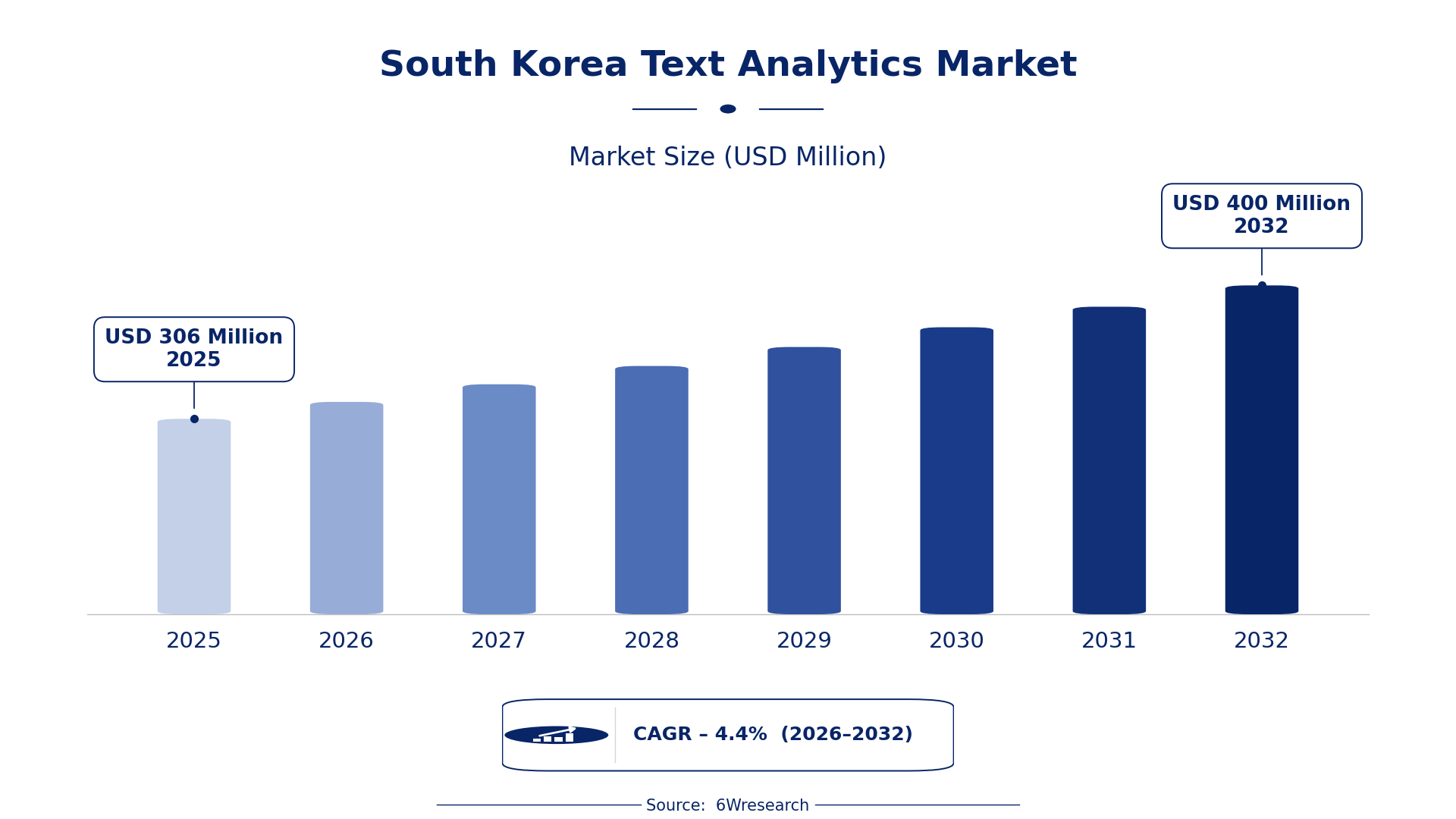
The South Korea Text Analytics Market was estimated at USD 306 Million in 2025 and is projected to reach USD 400 Million by 2032, growing at a CAGR of 4.4% from 2026 to 2032.
South Korea Text Analytics Market Synopsis
The South Korea Text Analytics Market is gaining momentum as organizations increasingly recognize the power of data. The blend of big data and artificial intelligence is transforming traditional approaches to data interpretation, allowing businesses to extract actionable insights from an ever-growing pool of unstructured information.
Looking ahead, the market's trajectory seems promising, particularly in sectors like finance and healthcare. As companies intensify their focus on customer experience and risk management, the demand for sophisticated text analytics solutions is set to rise, solidifying South Korea's position as a regional leader in analytics innovation.
South Korea Text Analytics Market Year-wise Growth Rate and Key Drivers
This graph illustrates the annual growth rates of the South Korea Text Analytics Market from 2021 to 2032, highlighting a steady upward trajectory and projected expansion over the forecast period.
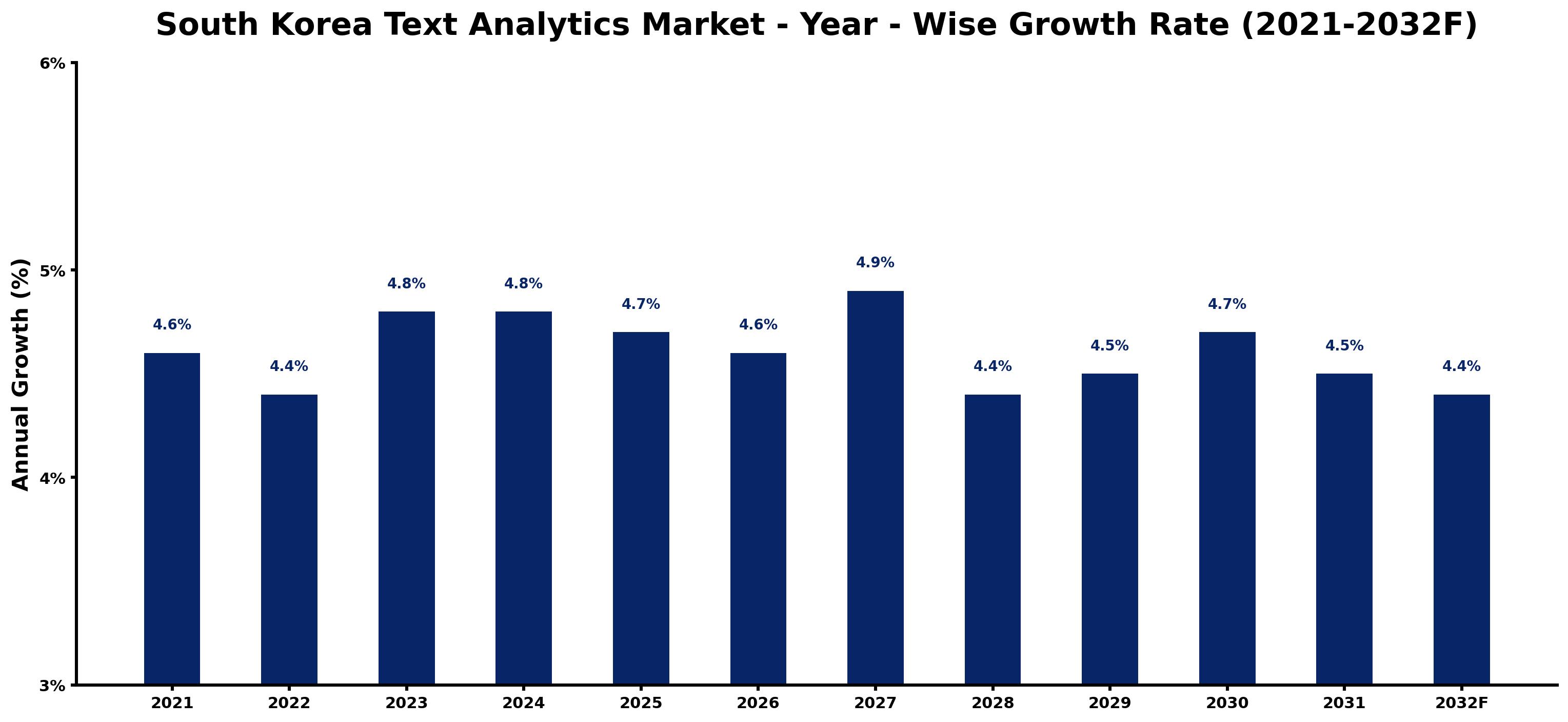
The table below presents the year‑wise growth rates along with the key drivers influencing the market
| Year | Growth Rate | Major Drivers |
| 2021 | 4.6% | Government AI initiative boosting local text analytics firms |
| 2022 | 4.4% | Increased demand for automated customer service solutions |
| 2023 | 4.8% | Rise of e-commerce necessitating advanced sentiment analysis tools |
| 2024 | 4.8% | Growing focus on multilingual support in businesses |
| 2025 | 4.7% | Accelerated adoption of machine learning in marketing strategies |
| 2026 | 4.6% | Surge in social media analytics for brand monitoring |
| 2027 | 4.9% | Regulatory push for data privacy enhancing text analysis needs |
| 2028 | 4.4% | Local startups pioneering innovative natural language processing techniques |
| 2029 | 4.5% | Corporate investment in customer feedback analytics increasing |
| 2030 | 4.7% | Advancements in semantic technologies driving market expansion |
| 2031 | 4.5% | Strong growth in healthcare analytics requiring text interpretation |
| 2032 | 4.4% | Enhanced user experience focus spurring demand for text insights |
Note: Market size estimations and growth projections presented in this report are based on 6Wresearch's proprietary forecasting methodology, utilizing the latest available industry data, government publications, and primary research inputs.
South Korea Text Analytics Market Key Takeaways
Below are some of the specific key takeaways from the market, including:
- The market is characterized by advanced solutions in sentiment analysis, entity recognition, and text categorization.
- Growing unstructured data from social media and customer interactions is driving demand for text analytics tools.
- The challenges of processing the Korean language present unique opportunities for specialized analytics providers.
- Government support is fostering innovation and compliance within the text analytics sector.
- Investment in multilingual capabilities is crucial for addressing diverse consumer needs.
Evaluation of Restraints in South Korea Text Analytics Market
Despite the robust growth prospects, the South Korea Text Analytics Market faces significant hurdles. One notable constraint is the complexity inherent in the Korean language. Its contextual nuances and use of honorifics can lead to misinterpretations by analytics tools, complicating data extraction and analysis.
Additionally, the scarcity of high-quality Korean language datasets limits the effectiveness of machine learning models. Companies must also navigate stringent data privacy laws, which can impede their ability to leverage text analytics fully while ensuring compliance with local regulations.
South Korea Text Analytics Market Trends
Several trends are shaping the South Korea Text Analytics Market. The integration of artificial intelligence and natural language processing is becoming increasingly prevalent. Businesses are capitalizing on these technologies to derive insights from vast amounts of unstructured data, enhancing their decision-making processes.
Real-time analytics is gaining traction, with companies demanding solutions that can process data as it arrives. Additionally, the push for multilingual processing capabilities reflects the diverse linguistic landscape of the region, allowing businesses to cater to a broader audience effectively.
South Korea Text Analytics Market Opportunities
The South Korea Text Analytics Market holds substantial investment potential, particularly in sectors like healthcare, finance, and retail. As organizations strive to harness insights from growing volumes of unstructured data, there is a clear demand for advanced analytics tools that can facilitate informed decision-making.
Key investment areas include sentiment analysis, social media monitoring, and customer feedback analysis. Companies focusing on developing innovative text analytics technologies that effectively address the intricacies of the Korean language will likely find considerable growth opportunities.
Government Initiatives in the South Korea Text Analytics Market
The South Korean government is actively nurturing the text analytics market through a range of policies and initiatives. By promoting the adoption of artificial intelligence and big data analytics, the government aims to enhance the country's technological capabilities. This regulatory environment is crucial for ensuring ethical practices while facilitating innovation within the sector.
- A recently launched AI National Strategy focuses on enhancing the country's capabilities in artificial intelligence, including the text analytics segment.
- A current initiative by the Ministry of Science and ICT is providing funding for research institutions and businesses developing text analytics solutions.
- Regulations around data privacy, introduced in 2025, aim to ensure responsible use of text analytics technologies while protecting consumer interests.
- Upcoming public-private partnerships are planned to expand infrastructure for data analytics across various sectors, enhancing accessibility.
- Ongoing training programs for professionals in AI and data analytics are being rolled out to build a skilled workforce.
Future Insights of the South Korea Text Analytics Market
Between 2026 and 2032, the South Korea Text Analytics Market is expected to flourish. Companies will increasingly invest in technology that enhances their ability to extract insights from unstructured data. This evolution is driven by the need for better customer engagement and data-driven decision-making.
The market's growth will be propelled by advancements in natural language processing and machine learning, allowing for more accurate analysis of complex Korean language data. As digital transformation initiatives gain momentum across sectors, text analytics will become a critical component in achieving strategic business objectives.
South Korea Text Analytics Market Latest Developments
Recent activity in the South Korea Text Analytics Market indicates a strong push toward innovation and technology integration. Over the last year, numerous developments have highlighted the growing importance of analytics solutions in various industries.
- A leading technology vendor launched a new text analytics platform in early 2025, designed specifically for the healthcare sector to improve patient insights.
- An initiative that began in late 2024 and remains underway is focused on enhancing multilingual capabilities for text analytics solutions, addressing the diverse needs of the market.
- A major analytics provider is currently expanding its operations in South Korea, with plans to introduce new products aimed at financial services by mid-2026.
- A partnership formed in early 2025 between academic institutions and businesses is working on developing advanced natural language processing models tailored to the Korean language.
- A rollout of an updated regulatory framework aimed at enhancing data privacy compliance is expected to begin in the second half of 2026.
South Korea Text Analytics Market - Key Attractiveness of the Report
- 10 Years of Market Numbers
- Historical Data Starting from 2022 to 2025
- Base Year: 2025
- Forecast Data until 2032
- Key Performance Indicators Impacting the Market
- Major Upcoming Developments and Projects
Key Highlights of the Report:
- South Korea Text Analytics Market Outlook
- Market Size of South Korea Text Analytics Market, 2025
- Forecast of South Korea Text Analytics Market, 2032
- Historical Data and Forecast of South Korea Text Analytics Revenues & Volume for the Period 2022-2032F
- South Korea Text Analytics Market Trend Evolution
- South Korea Text Analytics Market Drivers and Challenges
- South Korea Text Analytics Price Trends
- South Korea Text Analytics Porter's Five Forces
- South Korea Text Analytics Industry Life Cycle
- Historical Data and Forecast of South Korea Text Analytics Market Revenues & Volume By Component for the Period 2022-2032F
- Historical Data and Forecast of South Korea Text Analytics Market Revenues & Volume By Software for the Period 2022-2032F
- Historical Data and Forecast of South Korea Text Analytics Market Revenues & Volume By Services for the Period 2022-2032F
- Historical Data and Forecast of South Korea Text Analytics Market Revenues & Volume By Application for the Period 2022-2032F
- Historical Data and Forecast of South Korea Text Analytics Market Revenues & Volume By Customer experience management for the Period 2022-2032F
- Historical Data and Forecast of South Korea Text Analytics Market Revenues & Volume By Marketing management for the Period 2022-2032F
- Historical Data and Forecast of South Korea Text Analytics Market Revenues & Volume By Governance, risk, and compliance management for the Period 2022-2032F
- Historical Data and Forecast of South Korea Text Analytics Market Revenues & Volume By Document management for the Period 2022-2032F
- Historical Data and Forecast of South Korea Text Analytics Market Revenues & Volume By Workforce management for the Period 2022-2032F
- Historical Data and Forecast of South Korea Text Analytics Market Revenues & Volume By Others for the Period 2022-2032F
- Historical Data and Forecast of South Korea Text Analytics Market Revenues & Volume By Deployment Model for the Period 2022-2032F
- Historical Data and Forecast of South Korea Text Analytics Market Revenues & Volume By On-premises for the Period 2022-2032F
- Historical Data and Forecast of South Korea Text Analytics Market Revenues & Volume By Cloud for the Period 2022-2032F
- Historical Data and Forecast of South Korea Text Analytics Market Revenues & Volume By Industry Vertical for the Period 2022-2032F
- Historical Data and Forecast of South Korea Text Analytics Market Revenues & Volume By Banking, Financial Services, and Insurance (BFSI) for the Period 2022-2032F
- Historical Data and Forecast of South Korea Text Analytics Market Revenues & Volume By Telecommunications and Information Technology (IT) for the Period 2022-2032F
- Historical Data and Forecast of South Korea Text Analytics Market Revenues & Volume By Retail and eCommerce for the Period 2022-2032F
- Historical Data and Forecast of South Korea Text Analytics Market Revenues & Volume By Healthcare and life sciences for the Period 2022-2032F
- Historical Data and Forecast of South Korea Text Analytics Market Revenues & Volume By Manufacturing for the Period 2022-2032F
- Historical Data and Forecast of South Korea Text Analytics Market Revenues & Volume By Government and defense for the Period 2022-2032F
- Historical Data and Forecast of South Korea Text Analytics Market Revenues & Volume By Energy and utilities for the Period 2022-2032F
- Historical Data and Forecast of South Korea Text Analytics Market Revenues & Volume By Media and entertainment for the Period 2022-2032F
- Historical Data and Forecast of South Korea Text Analytics Market Revenues & Volume By Organization Size for the Period 2022-2032F
- Historical Data and Forecast of South Korea Text Analytics Market Revenues & Volume By Large Enterprises for the Period 2022-2032F
- Historical Data and Forecast of South Korea Text Analytics Market Revenues & Volume By Small and Medium-sized Enterprises (SMEs) for the Period 2022-2032F
- South Korea Text Analytics Import Export Trade Statistics
- Market Opportunity Assessment By Component
- Market Opportunity Assessment By Application
- Market Opportunity Assessment By Deployment Model
- Market Opportunity Assessment By Industry Vertical
- Market Opportunity Assessment By Organization Size
- South Korea Text Analytics Top Companies Market Share
- South Korea Text Analytics Competitive Benchmarking By Technical and Operational Parameters
- South Korea Text Analytics Company Profiles
- South Korea Text Analytics Key Strategic Recommendations






































