South Korea Traffic Management Market Size & Growth Rate (2026-2032)
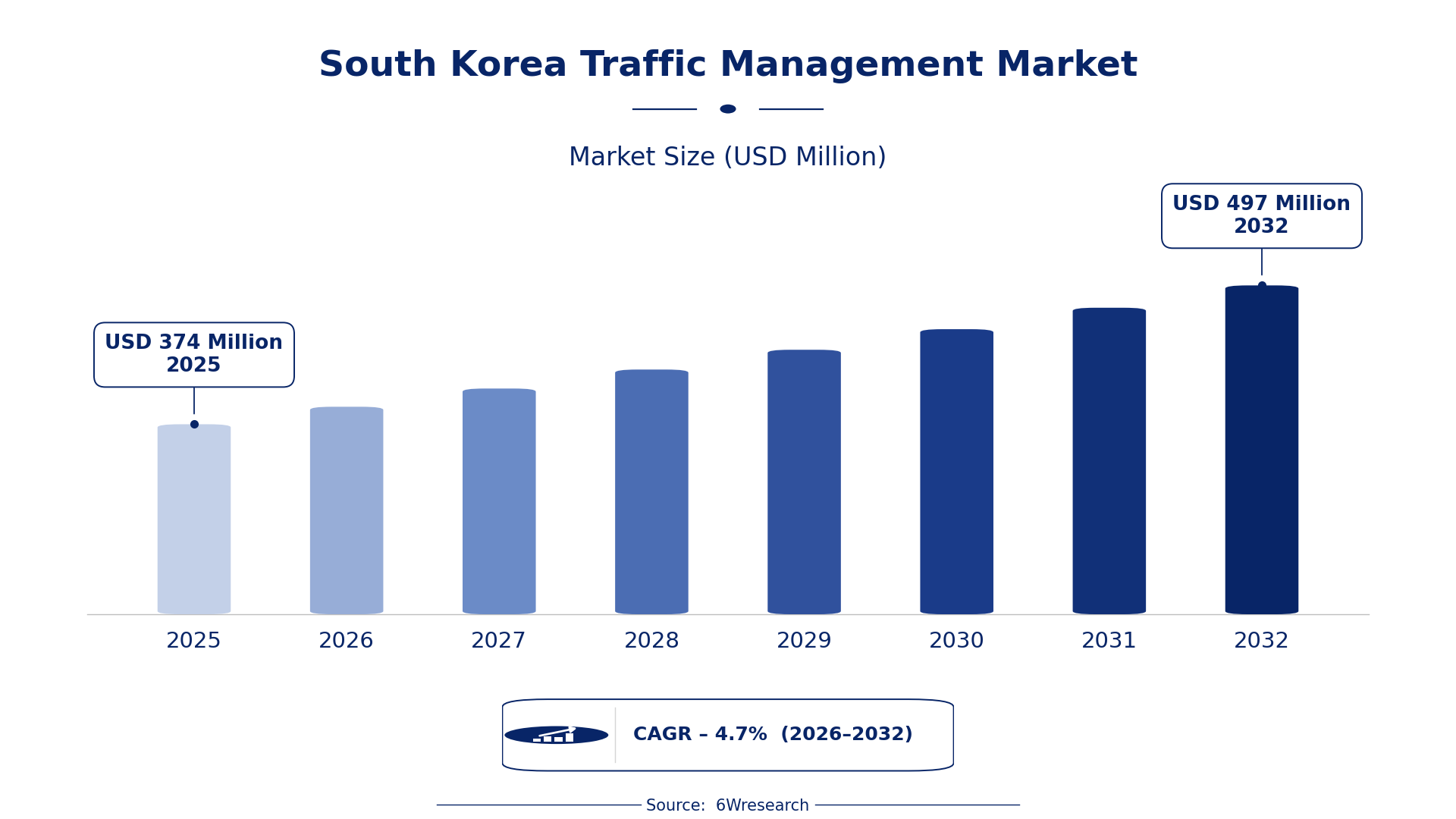
The South Korea Traffic Management Market was estimated at USD 374 Million in 2025 and is projected to reach USD 497 Million by 2032, growing at a CAGR of 4.7% from 2026 to 2032.
South Korea Traffic Management Market Synopsis
In South Korea, the demand for sophisticated traffic management solutions is rising sharply, driven by rapid urbanization and increasing vehicle ownership. As cities become more congested, local authorities are actively seeking advanced systems to optimize traffic flow and enhance road safety.
The adoption of intelligent transportation systems (ITS) is becoming commonplace, integrating traffic monitoring and signal control technologies. With a focus on sustainable urban mobility, these solutions not only address current traffic issues but also support long-term urban planning efforts.
South Korea Traffic Management Market Year-wise Growth Rate and Key Drivers
This graph illustrates the annual growth rates of the South Korea Traffic Management Market from 2021 to 2032, highlighting a steady upward trajectory and projected expansion over the forecast period.
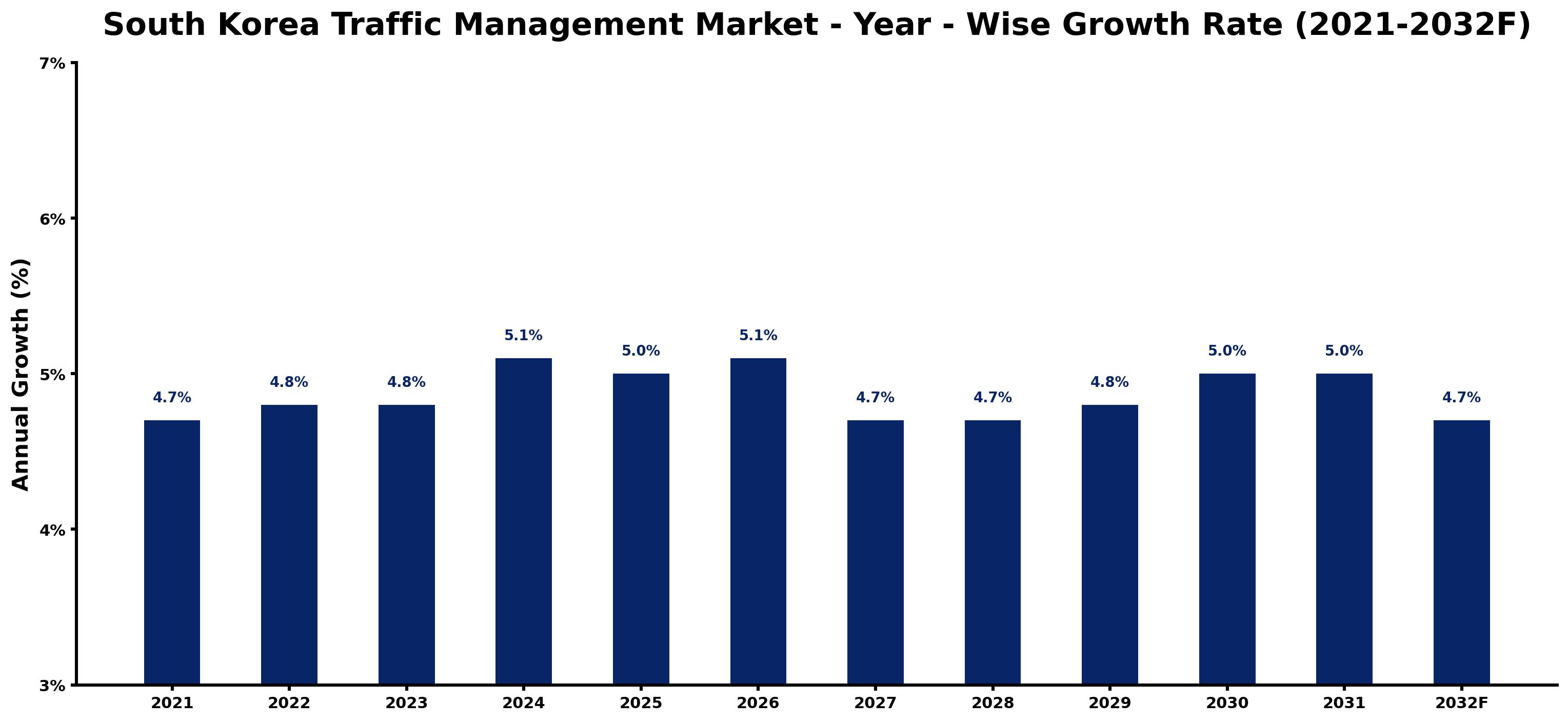
The table below presents the year‑wise growth rates along with the key drivers influencing the market
| Year | Growth Rate | Major Drivers |
| 2021 | 4.7% | Implementation of Smart City policies in major cities. |
| 2022 | 4.8% | Launch of National Intelligent Transportation System initiatives. |
| 2023 | 4.8% | Increase in electric vehicle adoption spurring traffic solutions. |
| 2024 | 5.1% | Investment in AI-driven traffic signal management technologies. |
| 2025 | 5.0% | Government support for eco-friendly urban transportation projects. |
| 2026 | 5.1% | Enhancements in public transport integration across metropolitan areas. |
| 2027 | 4.7% | Rising urban population demanding efficient traffic management. |
| 2028 | 4.7% | Growing emphasis on reducing traffic congestion in Seoul. |
| 2029 | 4.8% | Development of real-time traffic analytics applications gaining traction. |
| 2030 | 5.0% | Collaboration with tech firms to advance smart traffic systems. |
| 2031 | 5.0% | New policies focused on improving road safety measures. |
| 2032 | 4.7% | Emergence of digital twin technology in urban planning. |
Note: Market size estimations and growth projections presented in this report are based on 6Wresearch's proprietary forecasting methodology, utilizing the latest available industry data, government publications, and primary research inputs.
South Korea Traffic Management Market Key Takeaways
Below are some of the specific key takeaways from the market, including:
- Rapid urbanization in South Korea is driving the demand for innovative traffic management solutions.
- Intelligent transportation systems are key to improving safety and efficiency on the roads.
- Government initiatives are promoting infrastructure development and technology integration.
- Challenges in data security and interoperability must be addressed for future growth.
- Investment opportunities exist in smart city projects and public transportation upgrades.
Evaluation of Restraints in South Korea Traffic Management Market
The South Korea Traffic Management Market faces multiple challenges that hinder its potential. One of the most pressing issues is the increasing congestion resulting from rapid urban expansion. As roadways become more crowded, the demand for efficient traffic management systems intensifies, placing pressure on existing infrastructure.
on top of that, the integration of advanced technologies such as AI and IoT presents significant hurdles, particularly concerning data security and system interoperability. These challenges require innovative solutions and strategic planning to ensure the effective implementation of traffic management systems.
South Korea Traffic Management Market Trends
Current trends indicate a shift towards the use of data analytics in traffic management. Municipalities are increasingly leveraging real-time data to enhance decision-making and improve traffic flow. Additionally, the rise of eco-friendly transportation options is driving the demand for sustainable traffic solutions.
The market is also witnessing a growing interest in integrated systems that provide comprehensive traffic management capabilities. These systems aim to reduce delays and enhance safety by synchronizing traffic signals and providing real-time updates to drivers.
South Korea Traffic Management Market Opportunities
There are considerable opportunities for investment within the South Korea Traffic Management Market, particularly in smart city initiatives. These projects focus on deploying advanced traffic management technologies that enhance urban mobility. on top of that, public transportation upgrades offer avenues for developing innovative traffic solutions.
As cities continue to grow, the need for effective congestion management strategies will only intensify. This creates a ripe environment for companies that specialize in cutting-edge traffic solutions to establish a foothold in the market.
Government Initiatives in the South Korea Traffic Management Market
The South Korean government is actively shaping the traffic management environment through various policy initiatives aimed at improving transportation efficiency and safety. By investing in intelligent transportation technologies and infrastructure development, the government seeks to address the pressing challenges of urban congestion.
- A recently completed initiative involved the deployment of advanced traffic signal optimization technologies in major urban centers.
- A current project is focusing on real-time traffic monitoring systems to enhance data accuracy and improve response times during peak hours.
- Upcoming plans include a nationwide strategy to integrate smart city technologies with existing traffic management frameworks.
- There are also ongoing efforts to develop dynamic route guidance systems that provide real-time traffic updates to commuters.
- In 2026, a regulatory framework will be introduced to ensure the interoperability of different traffic management systems across cities.
Future Insights of the South Korea Traffic Management Market
Looking ahead to 2026-2032, the South Korea Traffic Management Market is set to experience transformative changes. The integration of AI and IoT will play a critical role in developing smarter traffic systems capable of real-time adjustments based on traffic patterns and conditions.
As the government continues to invest in infrastructure and smart city initiatives, the market is likely to see a surge in demand for innovative solutions that not only improve traffic flow but also promote environmental sustainability.
South Korea Traffic Management Market Latest Developments
In the last 12-14 months, the South Korea Traffic Management Market has seen significant advancements, particularly in the integration of smart technologies into existing systems. Local municipalities are increasingly adopting advanced traffic management solutions to combat congestion and improve road safety.
- An initiative launched in early 2025 focused on upgrading traffic signal systems with adaptive technologies that respond to real-time traffic conditions.
- A major technology vendor is currently implementing a comprehensive traffic monitoring system across multiple cities, expected to be completed by mid-2026.
- Plans are in place for a public-private partnership aimed at developing a nationwide dynamic route guidance system to be initiated in late 2026.
- A pilot project introduced in Q1 2025 is testing the effectiveness of AI-driven traffic prediction models in urban areas.
- By the end of 2025, several municipalities will begin deploying electric vehicle-friendly traffic management systems as part of sustainability efforts.
South Korea Traffic Management Market - Key Attractiveness of the Report
- 10 Years of Market Numbers
- Historical Data Starting from 2022 to 2025
- Base Year: 2025
- Forecast Data until 2032
- Key Performance Indicators Impacting the Market
- Major Upcoming Developments and Projects
Key Highlights of the Report:
- South Korea Traffic Management Market Outlook
- Market Size of South Korea Traffic Management Market, 2025
- Forecast of South Korea Traffic Management Market, 2032
- Historical Data and Forecast of South Korea Traffic Management Revenues & Volume for the Period 2022-2032F
- South Korea Traffic Management Market Trend Evolution
- South Korea Traffic Management Market Drivers and Challenges
- South Korea Traffic Management Price Trends
- South Korea Traffic Management Porter's Five Forces
- South Korea Traffic Management Industry Life Cycle
- Historical Data and Forecast of South Korea Traffic Management Market Revenues & Volume By Component for the Period 2022-2032F
- Historical Data and Forecast of South Korea Traffic Management Market Revenues & Volume By Solution for the Period 2022-2032F
- Historical Data and Forecast of South Korea Traffic Management Market Revenues & Volume By Services for the Period 2022-2032F
- Historical Data and Forecast of South Korea Traffic Management Market Revenues & Volume By Solutions for the Period 2022-2032F
- Historical Data and Forecast of South Korea Traffic Management Market Revenues & Volume By Smart Signaling for the Period 2022-2032F
- Historical Data and Forecast of South Korea Traffic Management Market Revenues & Volume By Route Guidance & Route Optimization for the Period 2022-2032F
- Historical Data and Forecast of South Korea Traffic Management Market Revenues & Volume By Traffic Analytics for the Period 2022-2032F
- Historical Data and Forecast of South Korea Traffic Management Market Revenues & Volume By Smart Surveillance for the Period 2022-2032F
- Historical Data and Forecast of South Korea Traffic Management Market Revenues & Volume By Hardware for the Period 2022-2032F
- Historical Data and Forecast of South Korea Traffic Management Market Revenues & Volume By Display Boards for the Period 2022-2032F
- Historical Data and Forecast of South Korea Traffic Management Market Revenues & Volume By Sensors for the Period 2022-2032F
- Historical Data and Forecast of South Korea Traffic Management Market Revenues & Volume By Surveillance Cameras for the Period 2022-2032F
- Historical Data and Forecast of South Korea Traffic Management Market Revenues & Volume By Other Hardware for the Period 2022-2032F
- Historical Data and Forecast of South Korea Traffic Management Market Revenues & Volume By Services for the Period 2022-2032F
- Historical Data and Forecast of South Korea Traffic Management Market Revenues & Volume By Consulting for the Period 2022-2032F
- Historical Data and Forecast of South Korea Traffic Management Market Revenues & Volume By Implementation & Integration for the Period 2022-2032F
- Historical Data and Forecast of South Korea Traffic Management Market Revenues & Volume By Support & Maintenance for the Period 2022-2032F
- Historical Data and Forecast of South Korea Traffic Management Market Revenues & Volume By Systems for the Period 2022-2032F
- Historical Data and Forecast of South Korea Traffic Management Market Revenues & Volume By Urban Traffic Management & Control for the Period 2022-2032F
- Historical Data and Forecast of South Korea Traffic Management Market Revenues & Volume By Adaptive Traffic Control System for the Period 2022-2032F
- Historical Data and Forecast of South Korea Traffic Management Market Revenues & Volume By Journey Time Measurement System for the Period 2022-2032F
- Historical Data and Forecast of South Korea Traffic Management Market Revenues & Volume By Predictive Traffic Modeling System for the Period 2022-2032F
- Historical Data and Forecast of South Korea Traffic Management Market Revenues & Volume By Incident Detection & Location System for the Period 2022-2032F
- Historical Data and Forecast of South Korea Traffic Management Market Revenues & Volume By Dynamic Traffic Management System for the Period 2022-2032F
- South Korea Traffic Management Import Export Trade Statistics
- Market Opportunity Assessment By Component
- Market Opportunity Assessment By Solutions
- Market Opportunity Assessment By Hardware
- Market Opportunity Assessment By Services
- Market Opportunity Assessment By Systems
- South Korea Traffic Management Top Companies Market Share
- South Korea Traffic Management Competitive Benchmarking By Technical and Operational Parameters
- South Korea Traffic Management Company Profiles
- South Korea Traffic Management Key Strategic Recommendations






































